


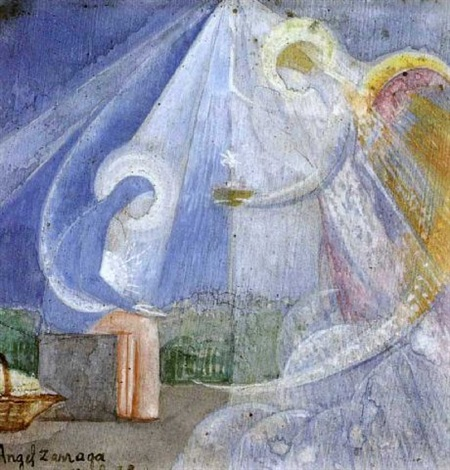
Six months after Elizabeth had become pregnant, God sent the angel Gabriel to Nazareth, a city in Galilee. The angel went to a virgin promised in marriage to a descendant of David named Joseph. The virgin’s name was Mary.
When the angel entered her home, he greeted her and said, “You are favored by the Lord! The Lord is with you.”
She was startled by what the angel said and tried to figure out what this greeting meant.
The angel told her,
“Don’t be afraid, Mary. You have found favor with God.
You will become pregnant, give birth to a son,
and name him Jesus.
He will be a great man
and will be called the Son of the Most High.
The Lord God will give him
the throne of his ancestor David.
Your son will be king of Jacob’s people forever,
and his kingdom will never end.”
Mary asked the angel, “How can this be? I’m a virgin.”
The angel answered her, “The Holy Spirit will come to you, and the power of the Most High will overshadow you. Therefore, the holy child developing inside you will be called the Son of God.
“Elizabeth, your relative, is six months pregnant with a son in her old age. People said she couldn’t have a child. But nothing is impossible for God.”
Mary answered, “I am the Lord’s servant. Let everything you’ve said happen to me.”
Then the angel left her. (God’s Word Translation)
Most of life is lived in the mundane. For the most part, we go about our business and deal with the daily grind. That’s because we are common ordinary people.
So, we can especially relate to Mary. She is rather plain. Mary is of junior high age. If she were living in our day and age, Mary would likely be wearing clothes from the local Goodwill. She cannot read, because girls of her day rarely did.
Mary’s parents make all the decisions that affect her life, including the one that she should be married to an older man named Joseph. We don’t know if she even liked him. She lives in a small town that most people can’t even point to on a map.
One night, this young girl is visited by the brightly beaming divine messenger Gabriel, whose name means, “God has shown himself mighty.” Mary stands there in her flannel nightgown; her life very quickly moving from the ordinary to extraordinary. The juxtaposition could not be more pronounced:
- a mighty angel and a plain teen-ager
- a messenger of the Most High God and a girl barely past puberty
- holy angelic light in a simple candlelit bedroom
- awesome power and complete vulnerability
Mary, compared to Gabriel, is defenseless, fragile, and overwhelmed. She’s in over her head. And that’s why we can relate to her. We can get our human arms around Mary. She’s like us. She has faced life with little power to make it turn out the way she planned. Forces beyond her control have rearranged her life and altered it forever. Mary is the Matron Saint of the Ordinary. We can totally understand why she responds the way she does.
Young Mary’s initial reaction was to be greatly troubled. She was disturbed, and was shaking in her ratty old slippers. The angel confidently told Mary that she had found favor with God. In other words Mary was quite literally “graced” by God.
The situation was not that Mary had some extreme spirituality; but rather that God simply chose her to be the mother of Jesus.
And Mary needed to come to grips with what was happening to her. This was not what she was looking for. Becoming pregnant with the Savior of the world was not an answer to prayer for Mary. This was not on her agenda.
Mary immediately sensed the crazy disconnect between what was being told to her and who she was. After all, she was a plain ordinary girl from the hick town of Nazareth, and she was being told that she would raise a king. Maybe somebody in heaven screwed up. It could very well be that Gabriel got the wrong girl. Perhaps the angel’s Google map popped up the wrong town to visit.
Relating to Mary, we can totally understand that she would question how in the world all this was going to happen. Not only is Mary ordinary, and far from royalty, but she is also very much a virgin. None of this made any sense whatsoever.
But the angel lets Mary know that God specializes in the impossible. I understand why many English translators chose to phrase the original rendering as “for nothing is impossible with God.” But I rather like a more literal translation which is “for there is nothing outside of God’s power.”
There is nowhere we can go, no place on earth, no situation whatsoever that is beyond God’s ability, reach, and power to effect the divine will.
We do not always get straightforward answers to our questions about God. Yet, Mary asked a question and got a straight answer. She really can be pregnant with Jesus because the Holy Spirit will come upon her and overshadow her with power.
If the story were to end here it would be a great story. But to me the most astonishing part of this narrative is Mary’s response to what was happening to her.
Mary believed the message and took Gabriel’s words at face value. And so, having believed, she then submitted herself completely to God’s will for her life.
I think we might totally understand if Mary simply said in her ordinary way that she was not prepared for this. We would completely “get it” if Mary pushed back on what the angel said to her.
We could relate if Mary just dismissed it all, like Scrooge in the Christmas Carol, with the angel and his message being all humbug as if it were just “an undigested bit of beef, a blot of mustard, a crumb of cheese, a fragment of an underdone potato. There’s more of gravy than of grave about you, whatever you are!”
And yet, Mary not only believed, but she also humbly submitted herself to what was happening. And, to me, this is what we need to relate to most about Mary – not her being just a plain ordinary person in a non-descript village, but stepping up to the calling she received.
We, too, have received a calling in our lives. We, too, have been given the power of the Holy Spirit. And we, too, are ordinary people who have been given a very extraordinary task.
It seems to me that our response today can and ought to be the same as Mary: “I am the Lord’s servant; may it be to me as you have said.”
The Church is pregnant with possibilities because of the Holy Spirit. We know the end of Mary’s story. She gave birth to Jesus. She raised him in her plain ordinary way. She watched him grow up. She saw him embark on his ministry to proclaim that the kingdom of God has come near.
Mary did not always understand what Jesus said or what he was doing. And she experienced every mother’s nightmare: seeing her beloved son killed in a terribly gruesome manner right in front of her eyes.
Yet, just as the Holy Spirit was with the birth of Jesus, so the Spirit was with Jesus at his resurrection from the dead. Jesus, like his earthly mother, lived an ordinary life in a very extraordinary way. And today Jesus invites us to do the same.
Because Jesus accomplished his mission of saving people from their sins and establishing a kingdom that will never end, he has given us the same Holy Spirit to follow him forever and call other people to follow him, too.
The Christian life may often be difficult; but it is really not complicated. It’s rather simple, just like Mary.
Mary responded to God’s revelation with faith, choosing to fully participate in what God was doing. “I am the Lord’s servant” is to be our confession, as well. “May it be to me as you have said” is to be our cry, along with Mary.
The message Christians proclaim is that Jesus saves – he delivers from sin and Satan and will restore all things.
May you know the presence and the power of God today and always, through knowing Christ Jesus the Lord of all. Amen.





 Rev. Tim Ehrhardt