The Suffering of Job (Job 6:14-30)

The Sufferings of Job, by Silvestro Chiesa (1623-1657)

“Those who withhold kindness from a friend
    forsake the fear of the Almighty.
My companions are treacherous like a torrent bed,
    like swollen streams that pass away,
that run dark with ice,
    turbid with melting snow.
In time of heat they disappear;
    when it is hot, they vanish from their place.
The caravans turn aside from their course;
    they go up into the waste and perish.
The caravans of Tema look;
    the travelers of Sheba hope.
They are disappointed because they were confident;
    they come there and are confounded.
Such you have now become to me;
    you see my calamity and are afraid.
Have I said, ‘Make me a gift’?
    Or, ‘From your wealth offer a bribe for me’?
Or, ‘Save me from an opponent’s hand’?
    Or, ‘Ransom me from the hand of oppressors’?

“Teach me, and I will be silent;
    make me understand how I have gone wrong.
How forceful are honest words!
    But your reproof, what does it reprove?
Do you think that you can reprove words,
    as if the speech of the desperate were wind?
You would even cast lots over the orphan
    and bargain over your friend.

“But now, be pleased to look at me,
    for I will not lie to your face.
Turn, I pray; let no wrong be done.
    Turn now; my vindication is at stake.
Is there any wrong on my tongue?
    Cannot my taste discern calamity? (New Revised Standard Version)

There was a time when faith, hope, and love meant something; a time in which neighbor cared for neighbor, basic human kindness was extended to the stranger, and one’s word was more of a bond than a legal document. At least, that’s what the ancient character of Job felt like. And to be honest, I feel like that, too.

Wherever there is suffering, death, and accusations, there you will find behind it all the character we know as Satan. Evil is very much real. And it exists as much today as it did all those millennia ago when Job experienced Satan’s sinister touch of horrible suffering.

Today, we too often interact with each other much like Job’s supposed friends talked to him in a strictly legalistic way. They believed the world operated in a way where the sign of being under God’s blessing was to be wealthy and healthy. And those who were cursed could expect poverty and sickness.

But the world we live in is not so simplistic as that. Good and godly people suffer; whereas the bad use their riches and power to gain more riches and power for themselves. Satan is alive and well. He lives just down the street, even next door.

Until we can get a hold of that reality, we will be continually flummoxed about the real nature of the Book of Job in the Bible’s Old Testament. And we will fail to discern that not only was Job a profoundly righteous person, but that in all righteousness he contended with God. What’s more, he was eventually vindicated by God.

Some of the greatest suffering a human can endure is not what can be done to the body, but what affects the soul. To experience the silence of God, and the ignorant chattering of friends, is perhaps the hardest of all sufferings to daily contend with.

Job’s companions were more than unhelpful – they were just as harmful as the physical machinations of Satan. And if you can accept it, the companions themselves were mere tools of the evil one. It’s a scary thought, but one we must face.

Although Job was cursed with terrible pain of both body and soul, he never gave a curse back to his companions; and he never chose to curse God and die. You see, Job understood, more than most of us today, that it is diabolical and demonic to return curse for curse.

Nowhere in Holy Scripture will you find that God desires someone who has been struck on the cheek to strike the other back with so much force that they won’t ever do it again. Payback and retaliation may be the way of the world, but it is not the way of God’s everlasting kingdom. And Job knew it.

Job’s friends did not see the reality about his calamity. That’s probably because they just couldn’t admit the truth of it. Their self and spiritual awareness was so small that they stubbornly held to false notions of God, God’s world, and God’s people.

The thing any of us needs from friends and neighbors in a time of crisis is some commitment to helping, not harming. Unfortunately, Job’s friends were of the fair weather type; when the weather’s good, they’re all in; but when the weather’s bad, they emotionally and spiritually distance themselves as far from their friend as they can get.

As a person of integrity, Job never asked his companions to rescue him. He only expected them to stand by him, and not haggle over his worth as a friend. They proved to be false friends who were more harm than help.

The suffering person is in a time of profound disorientation. It’s difficult for them to know which way is up. They don’t need a friend who has all the answers; in fact, someone with all the answers is only annoying. Instead, they need a friend who will come alongside and never forsake them.

In the end, God’s anger didn’t extend to Job but to his so-called friends. Their pride and ignorance was their undoing. What’s more, Job continued to show his integrity by praying for his friends, despite all their emotional harm to him.

You would never find Satan responding in the way of Job.

O God, help me to keep my heart clean and to live so honestly and fearlessly that no outward failure can dishearten me or take away the joy of conscious integrity. Open wide the eyes of my soul that I may see good in all things. Grant me this day some new vision of divine truth; and inspire me with the spirit of joy and gladness. Make me the cup of strength to suffering souls; in the name of the strong Deliverer, our only Lord and Savior, Jesus Christ. Amen.

Hold Onto Faith (Job 26:1-14)

Job, by Gonzalo Carrasco (1860-1936)

Then Job replied:

“How you have helped the powerless!
    How you have saved the arm that is feeble!
What advice you have offered to one without wisdom!
    And what great insight you have displayed!
Who has helped you utter these words?
    And whose spirit spoke from your mouth?

“The dead are in deep anguish,
    those beneath the waters and all that live in them.
The realm of the dead is naked before God;
    Destruction lies uncovered.
He spreads out the northern skies over empty space;
    he suspends the earth over nothing.
He wraps up the waters in his clouds,
    yet the clouds do not burst under their weight.
He covers the face of the full moon,
    spreading his clouds over it.
He marks out the horizon on the face of the waters
    for a boundary between light and darkness.
The pillars of the heavens quake,
    aghast at his rebuke.
By his power he churned up the sea;
    by his wisdom he cut Rahab to pieces.
By his breath the skies became fair;
    his hand pierced the gliding serpent.
And these are but the outer fringe of his works;
    how faint the whisper we hear of him!
    Who then can understand the thunder of his power?” (New International Version)

Sarcasm is a form of criticism. Criticism is a form of anger. Job was angry at his “friends.” Namely, because they had proved themselves to be not very good companions.

Job needed comfort and consolation, not hellfire sermons about his being sinful. Because, in fact, he had not sinned. His intense pain and suffering were not a punishment from God, as the prologue to the story of Job makes clear. (Job 1:1-22)

But neither Job nor his friends knew what was going on behind the scenes in the cosmic court of heaven.

Job only knew he was getting a lot of undeserved tragedy. And Job’s friends only knew that he was suffering terribly.

Job didn’t know how to interpret his situation. Job’s friends misinterpreted his situation as condemnation from the Lord.

Thus, Job became exasperated and angry. Job’s friends became the ignoramuses of ancient history.

Job was certainly no ignoramus. He knew what it meant to be right with God – which was why he was so doggone confused and confounded as to why he felt abandoned by God. Job knew his suffering wasn’t a result of unfaithfulness.

The biblical character Job came face to face with the reality that good people suffer, too.

The friends of Job kept reiterating how unworthy and sinful people are; and that Job must be especially sinful to be experiencing such trouble. And, of course, Job found this line of reasoning asinine.

The majesty of God, as Job understood it, is much greater and higher than his supposed friends could ever imagine. The dead know this better than anyone. Job himself was nearly dead, and so, he seems to see some things more clearly from his perspective of abject suffering.

Job’s observations of creation are profound reflections of God’s greatness and sovereignty in the world. His faith rested firmly with God alone, as Creator and Sustainer of the universe. So, he looked beyond the water and the clouds to heaven above.

Even in the realms we humans cannot see, God has authority and power over angelic beings. We cannot fathom the breadth and depth and extent of God’s reach and knowledge of all things. Indeed, humanity only observes a mere fraction of God’s rule and reign. And we barely know anything in comparison to God’s wisdom and knowledge.

In other words, our incredible God is so mighty and wondrous that it is incomprehensible to us.

Oh, the depth of the riches of the wisdom and knowledge of God!
    How unsearchable his judgments,
    and his paths beyond tracing out! (Romans 11:33, NIV)

God is big, to the point that only the fringes of God’s robe can fit inside the temple:

I saw the Lord, high and exalted, seated on a throne; and the train of his robe filled the temple. (Isaiah 6:1, NIV)

Although Job was flummoxed as to why God was silent and allowed suffering to happen, Job nevertheless had a majestic view of God which remained intact.

And, what’s more, Job seems to have gained an even more expansive view of God through his awful experience of suffering in both body and soul. In other words, Job got to know God better, and not for worse, because of his terrible situation.

Satan certainly meant to upend Job and cause him to renounce his faith; but God meant it all, ironically, for good.

Even though Job’s words about God appear similar to the words of his friends, they come from a very different place.

It’s one thing to talk of God’s majesty, sovereignty, and power when everything is going okay for you in your life. But it is an altogether different thing whenever your life has unraveled and distress is what you eat for breakfast.

To affirm God’s inherent power and goodness, smack in the middle of grinding hardship and ill health – and truly mean it – is the genuine article of faith.

Authentic faith is resilient and gains strength when tested and tried. Bogus faith crumbles like burnt toast when it is put through the fire.

True faith is always connected to hope and love. False faith evaporates and becomes nihilistic and hateful in the face of hellish circumstances.

Real faith perseveres through suffering, knowing that God is good, no matter what. Skin deep faith is herky-jerky, vacillating between confidence and doubt.

The only way for faith to be shown as real or fake is in the crucible of suffering. How we handle the adverse situations of life demonstrates where our faith is truly placed.

Satan’s statement to God was that Job’s faith would be shown to be a mere façade because God had blessed him with health, wealth, and family.

Satan was wrong. God was right. However, we may wonder about what Job thought of all this, once the suffering subsided.

I don’t know about Job. I can only speak for myself. I won’t list the long litany of trials and tribulations I have personally encountered in my life, and those I am facing presently. Yet, I will say that each of my experiences have taught me something important about God; and those hard experiences have changed and strengthened my faith in ways I could not have imagined.

Although I would never want to go through all of the past adversity again, I would not change a thing in my life. Because each of my experiences were formative in making me the person I am today – full of robust faith in God and confident in the Lord, no matter the circumstances.

Strengthen us, O Lord, by your grace, so that through your mighty power we may overcome all spiritual enemies, and with pure hearts serve you; through Jesus Christ our Lord, who lives and reigns with you and the Holy Spirit, one God, for ever and ever. Amen.

Why? (Job 18:1-21)

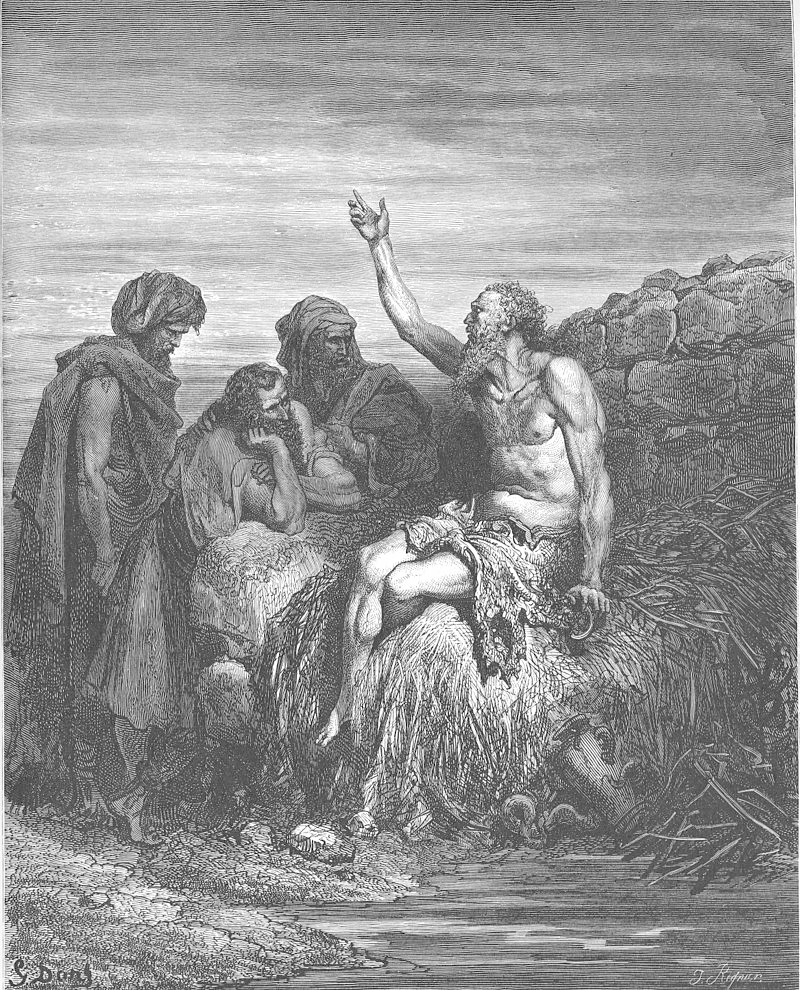
Job speaks with his friends, by Gustave Doré, 1866

Then Bildad the Shuhite replied:

“When will you end these speeches?
    Be sensible, and then we can talk.
Why are we regarded as cattle
    and considered stupid in your sight?
You who tear yourself to pieces in your anger,
    is the earth to be abandoned for your sake?
    Or must the rocks be moved from their place?

“The lamp of a wicked man is snuffed out;
    the flame of his fire stops burning.
The light in his tent becomes dark;
    the lamp beside him goes out.
The vigor of his step is weakened;
    his own schemes throw him down.
His feet thrust him into a net;
    he wanders into its mesh.
A trap seizes him by the heel;
    a snare holds him fast.
A noose is hidden for him on the ground;
    a trap lies in his path.
Terrors startle him on every side
    and dog his every step.
Calamity is hungry for him;
    disaster is ready for him when he falls.
It eats away parts of his skin;
    death’s firstborn devours his limbs.
He is torn from the security of his tent
    and marched off to the king of terrors.
Fire resides in his tent;
    burning sulfur is scattered over his dwelling.
His roots dry up below
    and his branches wither above.
The memory of him perishes from the earth;
    he has no name in the land.
He is driven from light into the realm of darkness
    and is banished from the world.
He has no offspring or descendants among his people,
    no survivor where once he lived.
People of the west are appalled at his fate;
    those of the east are seized with horror.
Surely such is the dwelling of an evil man;
    such is the place of one who does not know God.” (New International Version)

It only makes sense that Bildad was expecting a sensible discussion with Job.

But it was not going to happen.

Why?

Because grief doesn’t make sense; it’s nonsensical, whimsical, and fractal.

If you’ve ever been in a discussion with someone in which the person speaks illogically, it’s likely that you tried to talk sensibly and logically, pointing out the thought process.

And if you have ever done that, it’s also likely that the person did not change one iota of what they said.

Why?

Because people are not primarily thinking creatures who happen to have emotions. Instead, people are emotional creatures who happen to think.

Why do people ask, “Why?”

Because they’re angry. It’s not a cerebral question; it’s an emotional question.

Bildad, a “friend” of Job, was exasperated with his carrying on about being innocent, contending with God, and expressing anger – which is rather funny, because Bildad himself was angry.

Why?

Because supposedly logical and controlled people have illogical and emotional issues, too.

Welcome to the human race, all of you who pride yourselves on your flawless logic and neatly formed theology.

There is a chunk of people in this world who think that everything either works, or ought to work, according to Cartesian coordinates.

A Cartesian coordinate system describes the position of points in space using perpendicular axis lines that meet at a point called the origin. Any given point’s position can be described based on its distance from the origin along each axis. In other words, Cartesian coordinates allow one to specify the location of a point.

So, why am I talking about Cartesian coordinates?

Because that is what Bildad the Shuhite was trying to do with Job, to fix him on a plane that he could understand.

Because in Bildad’s theological world, the wicked are punished by God with bad circumstances and suffering. In the Cartesian world, as the wickedness increases, so does the pain and suffering.

Hence, one is being punished by God… But does the world really operate according to Bildad’s conception of it?

Hell no! (apparently wicked people say that sort of thing when not in the Cartesian world; they should probably get right with God; and, by the way, sarcastic people are wicked, too)

Bildad went so far as to suggest that perhaps Job doesn’t know God at all.

After all, that’s where one goes in a conversation with someone who doesn’t conform to clear and tidy Cartesian-style theology.

They can preach hellfire and damnation to others, yet when another even uses the word “hell” in a phrase, that is where they’re going to go.

It seems that Bildad isn’t really making sense.

Why?

Because he’s stuck. He cannot imagine life outside of his theological bubble.

The difference between Bildad and Job is that Job will admit that he is stuck, confused, messed-up, angry, and has no decent answer to what is going on in his life.

Whereas Bildad would never admit such a thing, even though he is so far stuck in the mud that it would take a divine miracle to get him out.

In fact, it appears we all need a divine miracle.

But God is silent.

Why?

I don’t know. But I do know that it won’t be for long.

Everyone might want to brace themselves for what’s coming.

Why?

Because we will receive precisely what we’re looking for: A word from God. But it’s probably not going to be what we expect.

After all, we aren’t living in a world of Cartesian coordinates.

O Lord God almighty, Creator of heaven and earth: I admit that these people you created drive me nuts! And I’m one of them! I can barely live with myself, let alone others.

In my wondering and confusion and pain, it’s hard to focus on anything. I don’t know why everything is upside-down and topsy-turvy. Yet, somehow I know, and am convinced, that you are present with me, and that you love me.

How in the world could I accept good from you, and not bad? If you love me, and are present with me, then I believe that whatever happens from this point forward, I shall not be forsaken by you.

Contend with those who contend against me. Help me with today, for tomorrow has enough worries of its own. Amen.

Wednesday of Holy Week (Psalm 70)

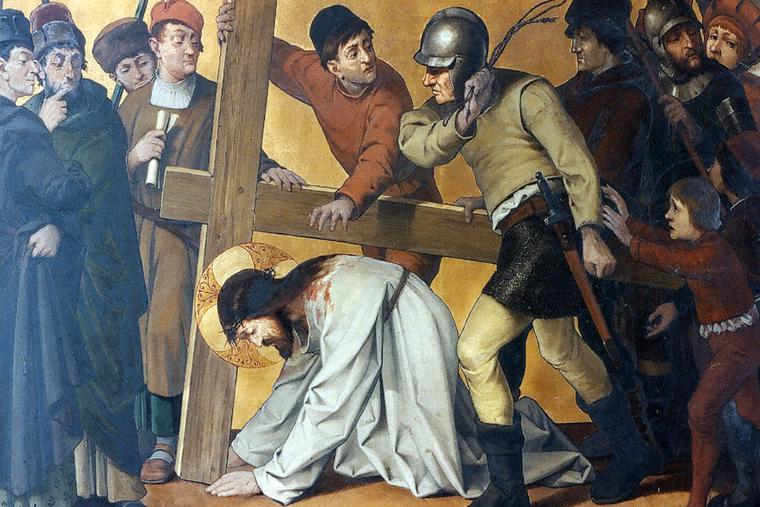
Ninth Station of the Cross, Jesus falls the third time, by Théophile Marie François Lybaert, c.1886

Be pleased, O God, to deliver me.
    O Lord, make haste to help me!
Let those be put to shame and confusion
    who seek my life.
Let those be turned back and brought to dishonor
    who desire to hurt me.
Let those who say, “Aha, Aha!”
    turn back because of their shame.

Let all who seek you
    rejoice and be glad in you.
Let those who love your salvation
    say evermore, “God is great!”
But I am poor and needy;
    hasten to me, O God!
You are my help and my deliverer;
    O Lord, do not delay! (New Revised Standard Version)

We all need help. Even Jesus.

As we journey with Jesus, and walk with him along the Via Dolorosa, we learn to set aside our illusions and delusions of radical independence, and to adopt his sense of dependence upon the heavenly Father. We come around to saying that we need divine help.

Continuing with a deliberate Christological view of the psalms, we are reminded that there was a time that Jesus felt desperation, just like we do. We go with him to the Garden of Gethsemane. And even though, in our own stressed out souls, we end up falling asleep and failing to pray as we ought, nevertheless we remember that the Lord Jesus sweat great drops of blood and agonized over what he was about to face.

There are times when the help we need isn’t for next week or tomorrow, but immediately, now!

I don’t know if you have ever been in such a stressful and dangerous situation in which all you could say is “Help, help me!” The abject feeling is helplessness is palpable and just plain awful. The sense there is nothing you can do to improve your circumstance other than some sort of merciful divine intervention is more than unnerving. It’s downright hard to breathe, let alone cry-out to be rescued.

In today’s psalm, it seems there were people getting a twisted sense of joy over the misfortune of others. It’s as if they were delighting in the confusion and vulnerability of those unable to stop what is happening.

In the throes of such stress and danger, the help we need is to have the evil turned back on the wicked. The psalmist wants such persons off his back – to have God hunt them like they are hunting the poor and needy who have no ability to resist.

It makes sense this psalm is short, just a few verses. Long prayers aren’t necessarily better than short ones, especially when it’s a frantic cry for God’s help. There is nothing in Holy Scripture that dictates how long or short prayer ought to be.

“Help!” just might be one of the best prayers we can pray. One little word. That’s all it takes.

It makes sense to me that this is an honest prayer. When in the throes of some horrible situation, all pretension goes out the window. Honest heartfelt prayers are the best kind of prayer.

If we are hurting badly enough, boldness comes quickly to the tip of our tongues. I once had a kidney stone and walked, doubled over in pain, into the Emergency Department of a hospital. I yelled at the first staff person I encountered, saying, “I need help, NOW!

To confess our great need to a God who listens might just be the best kind of theology we could ever express.

In such a terrible place of agony – of either body, soul, or both – there’s no thought to keeping up appearances, but only an unfiltered expression of need. Our prayers can, and need to be, earnest and urgent.

Prayer can be short, honest, and urgent because emergent situations require it. So, what do you do when you feel desperate? How do you handle your emotions? Where do you go for help?

In this Holy Week we are reminded that Jesus looked to the Father for help. In the worst of circumstances – facing ridicule, torture, and a horrible death – the Lord Jesus let the psalms shape his own prayers of desperation while under severe stress and duress:

“The one who ate my bread has lifted his heel against me.” (John 13:18; Psalm 41:9)

“They hated me without a cause.” (John 15:24; Psalm 69:4)

“I am deeply grieved, even to death; remain here, and stay awake with me.” (Matthew 26:38; Psalm 42:5-6)

“My God, my God, why have you forsaken me?”

Jesus (Matthew 27:46; Psalm 22:1)

Then Jesus, crying with a loud voice, said, “Father, into your hands I commend my spirit.” Having said this, he breathed his last. (Luke 23:46; Psalm 31:16)

There is a God who understands our plight. Jesus, the pioneer of our salvation, has gone before us in the way of suffering. He knows what it’s like to experience the agony and anguish of evil’s weight. He is our great high priest, the one who can intercede effectively and compassionately for us in our great times of need:

Now that we know what we have—Jesus, this great High Priest with ready access to God—let’s not let it slip through our fingers. We don’t have a priest who is out of touch with our reality. He’s been through weakness and testing, experienced it all—all but the sin. So, let’s walk right up to him and get what he is so ready to give. Take the mercy, accept the help. (Hebrews 4:14-16, MSG)

May you find in Jesus the help you so desperately need. Amen.