Day of Pentecost (John 14:8-17, 25-27)

Philip said to him, “Lord, show us the Father, and we will be satisfied.” Jesus said to him, “Have I been with you all this time, Philip, and you still do not know me? Whoever has seen me has seen the Father. How can you say, ‘Show us the Father’? Do you not believe that I am in the Father and the Father is in me? The words that I say to you I do not speak on my own, but the Father who dwells in me does his works. 

“Believe me that I am in the Father and the Father is in me, but if you do not, then believe because of the works themselves. Very truly, I tell you, the one who believes in me will also do the works that I do and, in fact, will do greater works than these, because I am going to the Father. I will do whatever you ask in my name, so that the Father may be glorified in the Son. If in my name you ask me for anything, I will do it.

“If you love me, you will keep my commandments. And I will ask the Father, and he will give you another Advocate, to be with you forever. This is the Spirit of truth, whom the world cannot receive because it neither sees him nor knows him. You know him because he abides with you, and he will be in you….

“I have said these things to you while I am still with you. But the Advocate, the Holy Spirit, whom the Father will send in my name, will teach you everything and remind you of all that I have said to you. Peace I leave with you; my peace I give to you. I do not give to you as the world gives. Do not let your hearts be troubled, and do not let them be afraid.” (New Revised Standard Version)

The Christian observance of Pentecost is much more than a date on the calendar or a cognitive belief about the Holy Spirit. Pentecost is a powerful reality for believers to be aware of and to live into.

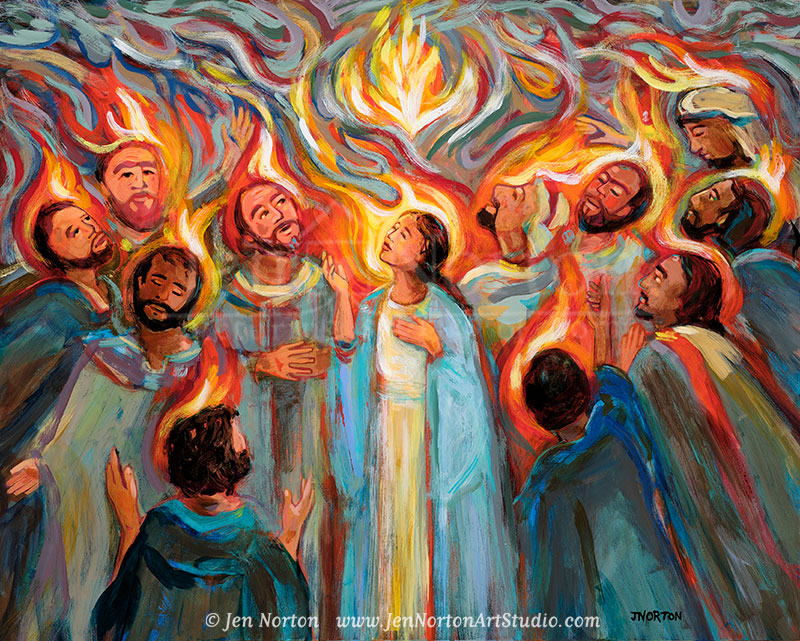
The symbols used to communicate this reality are the elements of wind and fire. They each have incredible potential for both help and harm, life and death. Tornadoes and wildfires bring awful destruction, whereas flame and wind power are necessary elements for life.

There is power in the Spirit. The Spirit of God dismantles and rearranges our lives to make something different or new altogether.

When the Spirit gets involved, nothing is the same again.

The Spirit upsets the status quo, brings energy and ability, heals broken lives, and establishes a truly egalitarian society. The New Testament knows the Christian as one given wholly to the Spirit in order to accomplish the will of God on this earth.

Therefore, this time of the year is hugely significant. Christians attune themselves to Holy Time because it is the age of the Spirit, the blessed opportunity of Pentecostal life and power. 

Jesus promised us an Advocate, the Spirit, and the era of the Spirit is here. We enjoy the very same Holy Spirit as our spiritual ancestors in the faith. This gives us great confidence and security knowing that the Spirit’s enablement, guidance, and power is available to us.

Pentecost flings every single believer into a congregational whole, the church, and lets us know that we are not to be rugged individualists acting alone, but are part of the Body of Christ.   

The Spirit uses us to forge spiritual bonds of kinship, fellowship, and solidarity.  Pentecost throws disparate people together in a unified whole, made up of every kind of language, nationality, ethnicity, gender, and race. We all use the gifts of the Spirit given to us for the benefit of building up one another.

Pentecost and the presence of the Spirit opens up the greatest of possibility in seeing our true selves emerge, and experiencing what is false melt away.

For most of us, we eventually discover that our egos are much thicker and predominant than we realized. And that ego gets in the way of bringing our authentic selves to the world. The Spirit comes along with fire to purify us, and then blows a mighty wind to drive the false self away.

Such true spiritual power helps us discern that issues of power in this world are difficult to deal with because things are not as they appear to be. Operating in the ego, far too many of us puff up ourselves to try and merely appear strong. People who present themselves as large and in charge end up hiding their vulnerabilities and insecurities in favor of keeping up appearances.

Jesus openly talked of real spiritual power, and promised to give the Spirit for our benefit. And Christ laid bear himself, stretching his arms out on a cross in a display of humiliation and degradation – all for us and our deliverance from false power and pesky egos.

If we go looking for earthly power and rely upon worldly power structures, we will likely be as confused as Philip and the other disciples of Jesus. But if we adopt the inner spiritual power provided for us, we find real effective strength which brings us the peace of Christ in any and all circumstances.

Life in the Spirit – spiritual life – happens within the depths of the soul. And it happens when we give up all pretense to alternative power sources, and participate with the Holy Spirit in allowing God to melt all that is false with spiritual fire and blow it all away with spiritual wind.

Pentecost was and is a watershed event. It’s effects are lasting, right up to the present time. Rather than settling for power-substitutes, we can imbibe ourselves of real spiritual power.

Living God, you have created all that is. Send forth your Spirit to renew and restore us, so that we may proclaim your good news in ways and words that everyone will understand and believe. Amen.


Visible Signs of Invisible Realities (Hebrews 9:15-24)

For this reason Christ is the mediator of a new covenant, that those who are called may receive the promised eternal inheritance—now that he has died as a ransom to set them free from the sins committed under the first covenant.

In the case of a will, it is necessary to prove the death of the one who made it, because a will is in force only when somebody has died; it never takes effect while the one who made it is living. This is why even the first covenant was not put into effect without blood. When Moses had proclaimed every command of the law to all the people, he took the blood of calves, together with water, scarlet wool and branches of hyssop, and sprinkled the scroll and all the people. He said, “This is the blood of the covenant, which God has commanded you to keep.” In the same way, he sprinkled with the blood both the tabernacle and everything used in its ceremonies. In fact, the law requires that nearly everything be cleansed with blood, and without the shedding of blood there is no forgiveness.

It was necessary, then, for the copies of the heavenly things to be purified with these sacrifices, but the heavenly things themselves with better sacrifices than these. For Christ did not enter a sanctuary made with human hands that was only a copy of the true one; he entered heaven itself, now to appear for us in God’s presence. (Hebrews 9:15-24)

The Hebrew Christians were tired. They had faced adverse circumstances, unjust imprisonments, persecution, prejudice, confiscation of their property, and public ridicule.

Most of all, they encountered rejection from their Jewish families of origin. There was precious little support for them, outside of their group.

The suffering went on long enough that the Christians began to experience a weakening of faith. In their distress, they started considering whether to return to Judaism, and renege on their commitment to Christ.

The author of Hebrews saw the struggle and spoke up, encouraging and exhorting the believers to keep going, to exercise faith and perseverance in the face of their ongoing troubles.

The author’s overall message to the discouraged believers was that Jesus Christ is superior over everything and everyone. Christ is better than the angels, Moses, and Aaron. Jesus is the ultimate high priest who offered himself as a sacrifice, once for all.

By means of the cross, Jesus became the mediator of a new and better covenant. There is, therefore, no more need of another high priest. Christ now occupies that office permanently.

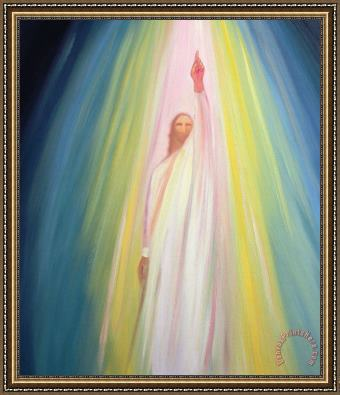
Jesus Christ Points us to God, by Elizabeth Wang

Christ’s death was efficacious for all. The sacrificial system with all of the officiating Levitical priests was the old order of things, meant to point us to Christ.

Offering sacrifices day after day, and engaging in prescribed liturgical rituals in order to access God, are no longer necessary. Perpetual anxiety exists wherever people keep wondering if they have done enough to satisfy their guilt and/or responsibility.

The answer of Christianity is yes, the work is finished; Jesus completed it, once and for all.

There is no longer anything that can distress us. Sin, death, and hell have been conquered through the death of Christ. His singular sacrifice has achieved victory over the sinful powers, and reconciliation and peace with God.

Blessed is the one
    whose sin the Lord does not count against them
    and in whose spirit is no deceit. (Psalm 32:2, NIV)

The covenant code’s sacrificial system was never designed to be a permanent way of doing things. All of the implements used in that system were symbols pointing to the real deal. They were a temporary means of leading people to Christ, who is the once for all sacrifice to end all sacrifices, the one who truly takes away our guilt and shame forever.

The picture is of Christ, as our high priest, who sprinkled us with his own blood and made us clean – not only today or for some temporary period of time – but for all time. We are not only made clean; we are made clean forever by the blood of Christ.

Cleanse me with hyssop, and I will be clean;
    wash me, and I will be whiter than snow. (Psalm 51:7, NIV)

The historical person of Jesus – his life, ministry, crucifixion, death, resurrection, ascension and glorification – was a visible image showing us the great importance of invisible realities.

The Ark of the Covenant was a visible sign of God’s invisible presence, and the need for a restoration of the divine/human connection.

The temple, the worship implements, and the whole sacrificial system was a visible sign of God’s invisible holiness, and the need for purity of heart amongst the people.

Jesus was a real person with a real body and real human needs, a visible reality which showed us the invisible God, and what God truly deems as right and good.

It is Jesus Christ, the Son of God and Son of Humanity, in whom we have redemption the forgiveness of sins. He is the image of the invisible God. (Colossians 1:14-15)

Christ is our Mediator, bridging the gap between heaven and earth.

Christ is our Savior, delivering us from our guilt and shame, our worry and anxiety, and our old enemy, death itself.

Christ is our Advocate, stepping in and acting on our behalf, and sending the Holy Spirit to be his continuing presence on this earth.

Christ is our champion, the pioneer of our salvation, securing redemption for us through his singular death.

Christ is our Intercessor, who even now lives to intercede for us, as we strive and struggle to live in humility, justice, and righteousness, as peacemakers in this world.

What this all means, from the vantage of Christianity, is that we need Jesus.

Without Christ, there is no hope. With Christ, all things are possible.

Jesus is the answer to every question, because Jesus is the center of all things. He is the fertile soil from which all of life sprouts; the first-fruit which provides life; and the continuing sustenance which saves us from a disconnected, fragmented, discouraging existence.

Along with the ancient Hebrew Christians, let us be encouraged with Christ, who is truly our everything.

Accept, O Lord, our thanks and praise for all that you have done for us. We thank you for the disappointments and failures that lead us to acknowledge our dependence on you alone.

Above all, we thank you for your Son Jesus Christ; for the truth of his Word, and the example of his life; for his steadfast obedience, by which he overcame temptation; for his dying, through which he overcame death; and for his rising to life again, in which we are raised to the life of your kingdom.

Grant us the gift of your Spirit; that we may know you and make you known; and through your Spirit, at all times and in all places, may give thanks to you in all things. Amen.

The Spirit’s Ministry (John 14:25-26)

Jesus said:

“I have spoken these things to you while I am with you. The Companion, the Holy Spirit, whom the Father will send in my name, will teach you everything and will remind you of everything I told you.” (Common English Bible)

“These things I have spoken to you while I am still with you. But the Helper, the Holy Spirit, whom the Father will send in my name, he will teach you all things and bring to your remembrance all that I have said to you.” (English Standard Version)

“I’m telling you these things while I’m still living with you. The Friend, the Holy Spirit whom the Father will send at my request, will make everything plain to you. He will remind you of all the things I have told you.” (The Message)

“All this I have spoken while still with you. But the Advocate, the Holy Spirit, whom the Father will send in my name, will teach you all things and will remind you of everything I have said to you.” (New International Version)

“These things have I spoken unto you, while yet abiding with you. But the Comforter, even the Holy Spirit, whom the Father will send in my name, he shall teach you all things, and bring to your remembrance all that I said unto you.” (American Standard Version)

“These things I have spoken to you, while I am still with you. But the Counselor, the Holy Spirit, whom the Father will send in my name, he will teach you all things, and bring to your remembrance all that I have said to you.” (Revised Standard Version)

“The Holy Spirit is the bond by which Christ unites us to himself.”

John Calvin

We are now in the season of “Ordinary Time” or “Proper Time” in the Church Year. It is “ordinary” in the sense that the Holy Spirit has been given to do the “proper” ongoing work of growing believers in Christ and helping them live into his directives.

The Spirit is our Teacher, cultivating and stirring-up within us all that we need for the Christian life.

As you can see from a few of the various English translations of today’s Gospel verses, there is no uniform rendering of the original Greek word, “Paraclete.” That’s because this word for the Spirit is so rich and full that it’s difficult to encompass what it means with a single English word.

A straightforward literal translation of “Paraclete” needs a phrase rather than a word: “Called alongside for encouragement,” fairly-well translates it. All the various words used in the different versions of the New Testament are accurate – yet they merely bring out one dimension to the understanding of the Holy Spirit’s ministry.

Our needs as followers of Jesus are many – thus requiring a multi-faceted mentoring ministry by the Spirit.

The Spirit was sent to be with Christians continually as their Teacher, reminding them of all Jesus has said and done as the ultimate witness to Christ’s life and ministry.

The role of the Holy Spirit is to provide comfort and aid for Christians, especially in difficult situations; the Spirit helps in a time of need.

The force of “Paraclete” is even more than this because there’s also the dimension of the Spirit being our close companion. Indeed, it is a special friend who stands up for us, advocates on our behalf, gives us remedial teaching, and brings comfort.

The Holy Spirit is motivated (just like the Father and the Son) with love for us, to give whatever we need to live a successful, abundant, and full Christian life.

In whatever situation we face, the Holy Spirit is something of a divine concierge in the middle of adversity who is attentive to every need.

The true difficulty in describing the Spirit’s ministry with us is that the Spirit is God – and no amount of description will adequately get our minds around the Spirit. God is much too big for that. All metaphors, images, and words fall short of genuinely expressing the Spirit’s immense work.

Perhaps a story will better illustrate the Spirit’s nature and work. When my girls were small and I was a financially struggling seminarian, we were one evening down to our last bit of food. Although they thought it was a privilege to eat Wheaties for supper, my wife and I knew the cupboard was now bare. So, we prayed.

As we got up from our knees and started off for bed, there was a knock at our patio back door. We looked at each other wondering who in the world it could be at such a late hour. When I drew the shades, one of our neighbors, a little Puerto Rican woman, was outside holding what appeared to be more than her own body weight in overflowing grocery bags.

I ushered her in and before I could say a word, she said, “I went to bed and had just fallen into a deep sleep. But the Holy Spirit woke me up and told me to take as many groceries as I could carry to you. So, here I am.” In that moment, I knew in my head and felt in my heart a ministry of the Spirit which transcends language.

The next morning our girls learned something about God that they would never get from listening to their Dad’s teaching and preaching. This is a story which gets retold often because it reminds us of how God meets us in our need and how much God cares.

Through such encounters with the Spirit (and I have mercifully been granted many of them!) I begin to understand and appreciate the wisdom of the saints throughout the ages:

“When the grace of the Holy Spirit enters a soul and is established there, it gushes forth more powerfully than any other spring; it neither ceases, dries up, nor is exhausted. And the Savior, to signify this inexhaustible gift of grace, calls it a spring and a torrent; He also calls it gushing water, to indicate its force and impetus.”

St. John Chrysostom

“Trying to do the Lord’s work in your own strength is the most confusing, exhausting, and tedious of all work. But when you are filled with the Holy Spirit, then the ministry of Jesus just flows out of you.”

Corrie Ten Boom

May you know the ministry of the Spirit, inside and out, in all ways and in all circumstances.

A Prayer of St. Augustine:

Breathe in me, O Holy Spirit,
That my thoughts may all be holy.
Act in me, O Holy Spirit,
That my work, too, may be holy.
Draw my heart, O Holy Spirit,
That I love only what is holy.
Strengthen me, O Holy Spirit,
To defend all that is holy.
Guard me, then, O Holy Spirit,
That I always may be holy. Amen.

John 14:23-29 – Spiritual Peace

Jesus replied, “Anyone who loves me will obey my teaching. My Father will love them, and we will come to them and make our home with them. Anyone who does not love me will not obey my teaching. These words you hear are not my own; they belong to the Father who sent me.

“All this I have spoken while still with you. But the Advocate, the Holy Spirit, whom the Father will send in my name, will teach you all things and will remind you of everything I have said to you. Peace I leave with you; my peace I give you. I do not give to you as the world gives. Do not let your hearts be troubled and do not be afraid.

“You heard me say, ‘I am going away, and I am coming back to you.’ If you loved me, you would be glad that I am going to the Father, for the Father is greater than I. I have told you now before it happens, so that when it does happen you will believe. (New International Version)

The Holy Spirit is our Advocate, Companion, Helper, Comforter, Counselor, and Teacher. All of that is wrapped up in the word “Paraclete” (a transliteration of the Greek word, Παράκλητος).

A straightforward literal translation of “Paraclete” needs a phrase rather than a word: “Called alongside for encouragement,” fairly-well translates the word. Our needs as followers of Jesus are many – thus requiring a multi-faceted mentoring ministry by the Spirit.

The Spirit was sent to be with Christians continually, reminding them of all Jesus has said and done as the ultimate witness to Christ’s life and ministry. So, the role of the Holy Spirit is providing aid for Christians, especially in difficult situations; the Spirit helps in a time of need.

The Spirit is also our close Companion. Indeed, it is a special friend who stands up for us, advocates on our behalf, gives us remedial teaching, and brings comfort. In other words, the Holy Spirit is motivated with love for us, just like the Father and the Son.

Whatever we need, the Holy Spirit is something of a divine concierge in the middle of adversity, attentive to our every need. Perhaps a story will better illustrate the Spirit’s nature and work.

When my girls were small and I was a financially struggling seminarian, we were one evening down to our last bit of food. Although they thought it was a privilege to eat Wheaties for supper, my wife and I knew the cupboard was now bare.

So, we prayed. As we got up from our knees and started off for bed, there was a knock at our patio back door. We looked at each other wondering who in the world it could be at such a late hour. When I drew the shades, one of our neighbors, a little Puerto Rican woman, was outside holding what appeared to be more than her own body weight in overflowing grocery bags.

As I ushered her in and before I could say a word, she said this: “I went to bed and had just fallen into a deep sleep. But the Holy Spirit woke me up and told me to take as many groceries as I could carry to you. So, here I am.”

In that moment, I knew in my head and felt in my heart a ministry of the Spirit which transcends language. And the next morning, our girls learned something about God that they would never get from listening to their Dad’s teaching and preaching. I must also add that this is a story which gets retold often because it reminds us of how God meets us in our need and how much God cares.

Through such encounters with the Spirit (and I have mercifully been granted many of them!) I begin to understand and appreciate the wisdom of the saints throughout the ages:

“When the grace of the Holy Spirit enters a soul and is established there, it gushes forth more powerfully than any other spring; it neither ceases, dries up, nor is exhausted. And the Savior, to signify this inexhaustible gift of grace, calls it a spring and a torrent; He also calls it gushing water, to indicate its force and impetus.”

St. John Chrysostom

“Trying to do the Lord’s work in your own strength is the most confusing, exhausting, and tedious of all work. But when you are filled with the Holy Spirit, then the ministry of Jesus just flows out of you.”

Corrie Ten Boom

One of greatest gifts which is given to us because of Christ and the Spirit is peace. Personal peace. Family peace. National peace. World peace. There is such a tremendous need for peace!

And yet, so many of us lack peace to the degree that we must medicate ourselves to sleep, at all. For some folks, avoiding family seems normal, just to keep the peace. National peace almost sounds oxymoronic. World peace is merely wishful thinking for far too many people. Perhaps we are in such a befuddled conundrum because of this reason:

We already possess what we so desperately want.

The search for peace is really the search within. The simplest of observations about Christ’s words is that Jesus has left us his peace. He gave it to us. We have it. Perhaps we have misplaced it? Maybe its lost in that huge stack on the desk?  Most likely, we plain old forgot about it. We need to remember that God’s peace is here with us. Right now. This very minute. We have exactly what we want.

The peace Jesus is talking about is far more than the absence of war, conflict, or infighting. The peace of Christ is the settled and restful calm and confidence of being with God, of an intimate union with the divine.

Jesus has given himself. He himself is our peace. Peace isn’t some happenstance thing, nor did it just magically appear. Peace was bought at a price – the blood of Jesus.

For God was pleased to have all his fullness dwell in him [the Son] and through him to reconcile to himself all things, whether things on earth or things in heaven, by making peace through his blood, shed on the cross. (Colossians 1:19-20, NIV)

The gift of peace needs to be unpacked.

Make every effort to keep the unity of the Spirit through the bond of peace. (Ephesians 4:3, NIV)

Practices of peace and peacemaking must be acknowledged and engrafted into our lives if we are going to experience it on the daily practical level

The kingdom of God is not a matter of eating and drinking, but of righteousness, peace and joy in the Holy Spirit, because anyone who serves Christ in this way is pleasing to God and receives human approval. Let us therefore make every effort to do what leads to peace and to mutual edification.

Romans 14:17-19, NIV

Since Jesus gives in a different way than any other gift, it may have thrown us off. Like the delivery guy who leaves a package in an odd place, we could be searching for the ongoing gift of peace somewhere on our property. It’s there – it just seems so darned elusive.

The authentic peace that is harmony and unity, can neither be found in perfect circumstances nor in idyllic families and faith communities. Divine peace is the security of relationship with God, smack in the middle of life’s crud.

The reason Jesus can exhort his disciples to be untroubled and unafraid is because the life of God is within them. As that life grows within us; as our hearts are healed with that presence; as we receive peace from the gracious hand of God; then, we discover, often by happenstance, that perfect love has driven the fear away.

Fear focuses on the hard situation in front of me, whereas love directs attention on Jesus. As the Father has loved the Son, so the Son loves us – and we have peace – without trying to miraculously conjure it with positive thoughts.

It is the glorious, gracious, and mystical union between Jesus and the believer which is peace. All obstacles have been surmounted and tossed into the trash for the garbage guy to haul away. And no, you did not accidentally throw your peace in the dumpster. There really is no need for any dumpster diving with Jesus around. He has already done that work for you and me through the cross.

Yet, peace still seems a pipe dream for some, even with the understanding of the gift. Like a new product packed so tightly in the plastic, we struggle to open it. Maybe the following thoughts may help to unpack peace for us:

  • Stop and breathe. It is no coincidence that the Holy Spirit of God is likened as wind. Pausing to take deep breaths in through our nose, and full exhales through our mouth can become prayers. The ancient Christian practice of breath-prayers can help us here. Some examples: Inhale saying, “More of you,” and exhale saying, “Less of me.” Inhale, “Holy one,” exhale, “heal me.” Inhale, “Abba Father,” exhale, “let me feel your love.”
  • Listen to peaceful music and words of peace. If we are continually in a state of agitation, it could be that we are inhaling a steady stream of radio, TV, or social media that is anything but peace forming – leaving us perpetually upset. So, pay close attention to who and what you listen to.
  • Identify some trigger words or phrases. Have a go-to word or phrase that brings you back to the peace within. For me, its quoting Psalm 23, Romans 6, John 14, or other Scripture passage from memory. So, the trigger phrase is, “The Lord is my shepherd, I have everything I need, or “Trust in God, trust also in me.”
  • Smell it. I keep candles around with pleasant odors and light them when feeling stressed. I also have found that, for me, burning sage helps to feel unburdened and, thus, peaceful.
  • Forgive. I have observed that many of the behavioral health patients I work with have little to no peace in their lives due to either resentment toward others or the inability to forgive themselves. Forgiveness brings peace, even if the other party does not want it.

May the Holy Spirit’s work abound in your life. And may the peace of Christ be with you always.