

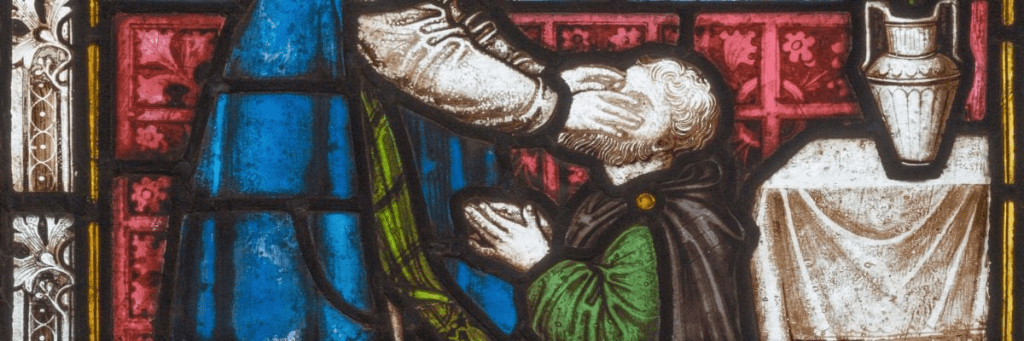
Meanwhile, Saul was still spewing out murderous threats against the Lord’s disciples. He went to the high priest, seeking letters to the synagogues in Damascus. If he found persons who belonged to the Way, whether men or women, these letters would authorize him to take them as prisoners to Jerusalem. During the journey, as he approached Damascus, suddenly a light from heaven encircled him. He fell to the ground and heard a voice asking him, “Saul, Saul, why are you harassing me?”
Saul asked, “Who are you, Lord?”
“I am Jesus, whom you are harassing,” came the reply. “Now get up and enter the city. You will be told what you must do.”
Those traveling with him stood there speechless; they heard the voice but saw no one. After they picked Saul up from the ground, he opened his eyes but he couldn’t see. So they led him by the hand into Damascus. For three days he was blind and neither ate nor drank anything.
In Damascus there was a certain disciple named Ananias. The Lord spoke to him in a vision, “Ananias!”
He answered, “Yes, Lord.”
The Lord instructed him, “Go to Judas’ house on Straight Street and ask for a man from Tarsus named Saul. He is praying. In a vision he has seen a man named Ananias enter and put his hands on him to restore his sight.”
Ananias countered, “Lord, I have heard many reports about this man. People say he has done horrible things to your holy people in Jerusalem. He’s here with authority from the chief priests to arrest everyone who calls on your name.”
The Lord replied, “Go! This man is the agent I have chosen to carry my name before Gentiles, kings, and Israelites. I will show him how much he must suffer for the sake of my name.”
Ananias went to the house. He placed his hands on Saul and said, “Brother Saul, the Lord sent me—Jesus, who appeared to you on the way as you were coming here. He sent me so that you could see again and be filled with the Holy Spirit.” Instantly, flakes fell from Saul’s eyes and he could see again. He got up and was baptized. After eating, he regained his strength.
He stayed with the disciples in Damascus for several days. Right away, he began to preach about Jesus in the synagogues. “He is God’s Son,” he declared. (Common English Bible)
A telltale sign of spiritual blindness, a lack of awareness, and an unwillingness to change is to put all the focus on another person or group as the real problem of a society.
That’s exactly what Saul did. And that’s precisely why he needed a conversion.
Family Systems Theory
Murray Bowen was an influential psychiatrist of the twentieth century. His family systems theory, also known as Bowen theory, views a family (or any group of persons) as an emotional unit. Within this unit, a change in any of the individual persons results in the others compensating for the emotional functioning that’s been altered.
Like touching one part of a spider web, the entire thing shakes. Bowen’s focus was that, rather than trying to change the other person, one can change themselves without becoming part of the problem. The theory states that if any family or group member can change their emotional functioning within the system, the whole family will improve its corporate functioning in response to that change.
In short, we must learn to function in a healthy way within the group system. Personal transformation becomes the best approach to handling family crises and problems.
Saul the Pharisee to Paul the Apostle
Bowen’s statement of the human condition could be said of Saul and his conversion:
“The human is a narcissistic creature who lives in the present and who is more interested in his own square inch of real estate, and more devoted to fighting for his rights than in the multigenerational meaning of life itself. As the human throng becomes more violent and unruly, there will be those who survive it all…. I think the differentiation of self (remaining connected to others, yet separate from their problems) may well be one concept that lives into the future.”
Murray Bowen
Saul the Pharisee was an anxious soul. He was determined to keep the Christian sect from infecting his Jewish way of life. As the followers of Jesus grew, so did the anxiety of Saul and the Pharisees. Saul turned his attention to unhealthy ways of handling the situation – to the point that Christ himself showed up and let Saul know that his harassment needed to stop.
Our Need for Change
Whatever you think of Bowen’s theory, it’s easy to see that anxiety plays a major role in many individuals, families, and even churches. Whenever worry, fear, and anxiety take over a person or group of people, things become emotionally charged.
The church is an emotional unit. Typically, the response to anything we don’t like is to try and change the other person who is rocking the boat or upsetting the status quo. The converted and changed Apostle Paul learned his lesson about the intricate web of anxious emotions:
Don’t be anxious about anything; rather, bring up all of your requests to God in your prayers and petitions, along with giving thanks. Then the peace of God that exceeds all understanding will keep your hearts and minds safe in Christ Jesus. (Philippians 4:6-7, CEB)
Learning to manage our own anxiety, and cope with the incessant worry within ourselves, is imperative to dealing with relational problems in the group. The peace of God, not the peace of others, is what makes the difference.
People are all for change, that is, we want others to change so that we don’t have to. The Christian, however, is to conform to Jesus, and not the other way around. Because the Lord is near to us, we have a consistent and continual presence to anchor ourselves, no matter whether the circumstances are to my liking, or not.
Prayer becomes the means of casting anxiety away so that peace can take its place. Sounds easy – it’s anything but.
It’s only human to want everyone else to change when there are problems, adversity, or challenge. Yet the change most needed is quite personal, perhaps even an outright conversion.
Our focus must be on finding ways to remain connected to God and others without resorting to passive-aggressive tactics, cutting-off relationships altogether, or bullying others into changing with our violent or manipulative words.
Faced with unwanted change and/or difficult circumstances, rather than looking for others to alter their lives, try asking yourself one of these questions:
- What is one small step I can take to improve my situation?
- If I were guaranteed not to make the situation worse, what would I do differently?
- Is there a person in my life whose voice and input I haven’t heard in a long time?
- What is one positive trait I possess that can serve me well in this situation?
Are there other questions you could ask that would be helpful? A journey that seems a thousand miles must begin with one step. What will that step be?


 Rev. Tim Ehrhardt