A Vision of the End (Revelation 14:1-11)

The Great Day of His Wrath, by John Martin, 1852

Then I looked, and there before me was the Lamb, standing on Mount Zion, and with him 144,000 who had his name and his Father’s name written on their foreheads. And I heard a sound from heaven like the roar of rushing waters and like a loud peal of thunder. The sound I heard was like that of harpists playing their harps. And they sang a new song before the throne and before the four living creatures and the elders. No one could learn the song except the 144,000 who had been redeemed from the earth. These are those who did not defile themselves with women, for they remained virgins. They follow the Lamb wherever he goes. They were purchased from among mankind and offered as first-fruits to God and the Lamb. No lie was found in their mouths; they are blameless.

Then I saw another angel flying in midair, and he had the eternal gospel to proclaim to those who live on the earth—to every nation, tribe, language and people. He said in a loud voice, “Fear God and give him glory, because the hour of his judgment has come. Worship him who made the heavens, the earth, the sea and the springs of water.”

A second angel followed and said, “‘Fallen! Fallen is Babylon the Great,’ which made all the nations drink the maddening wine of her adulteries.”

A third angel followed them and said in a loud voice: “If anyone worships the beast and its image and receives its mark on their forehead or on their hand, they, too, will drink the wine of God’s fury, which has been poured full strength into the cup of his wrath. They will be tormented with burning sulfur in the presence of the holy angels and of the Lamb. And the smoke of their torment will rise for ever and ever. There will be no rest day or night for those who worship the beast and its image, or for anyone who receives the mark of its name.” (New International Version)

Throughout the book of Revelation (The Apocalypse of John) the Apostle John communicates visions of the end, of God’s wrath and human suffering. Yet John also pauses throughout his vision to offer encouragement for the faithful followers of Jesus in the present time who are undergoing suffering, even persecution.

The assurance believers have is that God sees their struggle, their devotion; the Lord will protect them – not from suffering and death – but from the effects of divine judgment and punishment on the earth. The Lord will not abandon the believers. Instead, they will share in God’s new realm.

The Lamb and the Redeemed

The ultimate destiny of Christ’s faithful followers is not in judgment but in triumph – even though many of them had to face extreme circumstances and died the martyr’s death. Christ, the Lamb of God, stands in the center of God’s kingdom with the 144,000, who sing a new song to God.

It could be that these 144,000 persons are representative and symbolic of all redeemed humanity. Or, they may likely be Christian martyrs, the ones who were the victims of evil (Revelation 13). Whoever they actually are, their description is figurative in order to convey that these faithful persons are morally and spiritually pure; they did not defile themselves with the wickedness of the world’s systemic and structural evil.

These redeemed persons are the first fruits, believers who have sacrificed their lives for God and maintained their witness to King Jesus, and not to Ceasar as Lord. In the Old Testament, every firstborn (both human and animal) belonged to the Lord. The first fruits (the initial yield of crops) were set aside specifically as a sacrificial offering to God.

In the New Testament, the concept and practice of first fruits is used as a metaphor for something given to God in advance. So, in the book of Revelation, this refers to the harvest at the end of the age; the first fruits are the 144,000, the ones who are the anticipation of Christian resurrection. In other words, there are many more converts to come – people redeemed by the Lamb and set aside for resurrection and new creation. A great harvest of souls comes; because of Christ’s resurrection, his followers shall also experience resurrection.

The Message of the Three Angels

The Apostle John spoke of three angels, each of whom proclaim a coming judgment of God. The first angel has a call to repentance and a warning of imminent judgment. The second angel announces the fall of Babylon (Rome). And the third angel pronounces judgment upon those who gave themselves to the powers of this fallen world, who participated in organizational wickedness through oppression, abuse, neglect, disrespect, and dishonor of others.

It is with the third angel that the “mark of the beast” upon a person’s forehead is the mark of judgment on them. Although the language and picture of this, and what happens to them, was (and still is for some) used to scare the hell out of people so that they would embrace heaven, we must very much distance ourselves from such disgraceful rhetoric.

Again, the vision is full of symbolism and is not to be taken literally; it is John’s attempt to convey an otherworldly experience he had, in terms which his readers could grasp. The big idea is that those who have become devoted members to the machinations of evil in its various forms on this earth will experience the judgment of God.

As they sought glory in this world by any means possible – including using people to keep and hold power – so, they will face an inglorious end when God holds them accountable for their wrongdoing and for letting their own hearts become shriveled and dry.

This is neither the time to participate in evil, nor to procrastinate in making things right – while you still have time to do so.

For those holding on to bitterness, it is time to forgive.

For the ones giving in to their anger through hating others, it is now time to humble yourself, repent, and turn to right and healthy ways of dealing with that anger.

For the persons allowing themselves to be used by others for perpetuating evil in their workplace, neighborhood, or church, it is high time to find your voice, renounce the damaging practices, and speak truth to power.

We all must suffer. What it is we suffer for, is up to us.

Almighty and everlasting God, the rightful Judge of all things and all people, help us, your people, to be rightly prepared for Christ’s coming, through a right confession and right practices in this life. Enable us to walk in a manner worthy of our calling so that we might cast the bright beams which radiate from the approaching day of glory into those dark days and nights of suffering.

Sovereign God, draw us, we pray, near to Christ and in union with him. May we taste and see the goodness of the Lord; be strengthened in faith for the trials and tribulations which lie before us; bask in the love of Jesus; and hold fast to divine promises, and our confession, especially since the end of all things is at hand. Amen.

Be Renewed (Joshua 24:25-33)

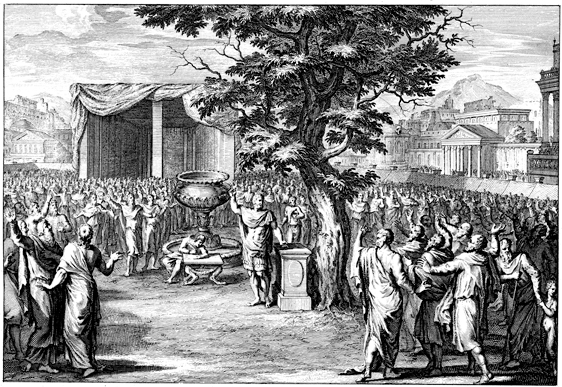
Joshua renews the covenant with the people of Israel, by David Martin (1639-1721)

On that day Joshua made a covenant for the people, and there at Shechem he reaffirmed for them decrees and laws. And Joshua recorded these things in the Book of the Law of God. Then he took a large stone and set it up there under the oak near the holy place of the Lord.

“See!” he said to all the people. “This stone will be a witness against us. It has heard all the words the Lord has said to us. It will be a witness against you if you are untrue to your God.”

Then Joshua dismissed the people, each to their own inheritance.

After these things, Joshua son of Nun, the servant of the Lord, died at the age of a hundred and ten. And they buried him in the land of his inheritance, at Timnath Serah in the hill country of Ephraim, north of Mount Gaash.

Israel served the Lord throughout the lifetime of Joshua and of the elders who outlived him and who had experienced everything the Lord had done for Israel.

And Joseph’s bones, which the Israelites had brought up from Egypt, were buried at Shechem in the tract of land that Jacob bought for a hundred pieces of silver from the sons of Hamor, the father of Shechem. This became the inheritance of Joseph’s descendants.

And Eleazar son of Aaron died and was buried at Gibeah, which had been allotted to his son Phinehas in the hill country of Ephraim. (New International Version)

All things, if they exist for any length of time, require renewal. This is especially true of relationships, and in particular, our relationship with God.

The book of Joshua is closely connected to the book of Exodus. God’s special relationship with Israel was confirmed with a covenant. God’s gave the Law to Moses as the leader of the people. And God brought a mighty deliverance to the Israelites from Egyptian bondage. These are all themes that linger with importance into the leadership and life of Joshua and the Israelites as they entered and inhabited the Promised Land.

Joshua was a faithful attendant to Moses, a model soldier, and an effective spy. After the death of Moses, Joshua was the appointed successor to bring Israel into Canaan and capture it. He was just as faithful to God and the people as Moses had been. In taking the land, Joshua made sure to do the following with the people:

  • Reminded all the Israelite tribes of their covenantal relationship and obligations to God
  • Allocated the land to each of the tribes, as specified by God’s command
  • Circumcised all the males that had been born during the forty years in the desert
  • Established cities of refuge, and cities for the Levites (because they had no land inheritance)
  • Admonished the people to be steadfast in observing the laws given to Moses by God 
  • Made it clear what the consequences are for any break or breach in the covenant agreement

Joshua did all of this by facilitating a covenant renewal ceremony. There were still some Canaanites in the land, and so, the Israelites were at risk of worshipping foreign deities and engaging in intermarriage. The people needed to have a collective memory of God’s deliverance, covenant, and law.

The covenant renewal emphasized obedience to the law and fealty to God because the Israelites are a holy nation, set apart for the Lord’s purposes. They were to serve the Lord with faithfulness and sincerity. There were to be no foreign gods whatsoever. Obedience would bring blessings, whereas disobedience would lead to the land being cursed.

As the mediator between God and Israel, Joshua commanded Israel to make a firm choice about what they were going to do. He was holding them accountable and ensuring they actively participate in the covenantal agreement.

The people declared that they would not forsake the Lord to serve other gods. And Joshua pledged to hold them accountable to their words and commitments.

Just as Israel was to be renewed in loyalty to their God, so we, too, in each generation of believers, must experience a renewal of our relationship to the Lord. We do so through reaffirmation, recording our response, and setting up a remembrance of the renewal.

Reaffirm

To reaffirm is to make a renewed commitment to something, usually verbally. In affirming God as the Lord, we are saying, “I believe!” So reaffirming repeats the belief, and makes it clear that you still feel that way. We make promises and make plans to keep them. We vow to be faithful and restate our love for God and God’s Word.

Joshua repeated, restated, and reaffirmed God’s Law for the people, so that they would know exactly what their responsibilities are, and pledge to keep them always.

Record

To record something is to establish a written record of what was said. Joshua made sure that everything was written down so that nobody in the future could say something contrary, or forget what was said.

One of the most powerful ways we can engage in personal renewal is by actually recording our promises and commitments to the Lord in a journal. The act of writing, in-and-of itself, is a transforming practice. And when we couple the practice with important and impactful words of intention and desire, then we are doubling our chances of actually following through and doing what we say we will do.

Remember

Memory is more than the mind. Remembering is activated with tangible things that we can see, touch, or smell. With the Israelites, Joshua set up a huge stone as a remembrance of what was said and promised. And he engaged the imagination by stating that the stone heard it all – and would hold them all accountable.

Physical objects, such as the cup and the bread in Christian communion, press the remembrance much better and deeper into both our minds and our hearts. Anything in life that is vital to remember ought to have a tangible item which symbolizes the importance of the memory.

Experiencing renewal in life doesn’t simply happen, but is an intentional process of reaffirming, recording, and remembering. Concerning God’s Word, Holy Scripture is something worth putting the effort into in order to realize new life and a renewed relationship with the Lord.

O God, King eternal, your light divides the day from the night and turns the shadow of death into the morning: Drive from us all wrong desires; incline our hearts to keep your law; and guide our feet into the way of peace; so that, having done your will with cheerfulness during the day, we may, when night comes, rejoice to give you thanks, through Jesus Christ our Lord. Amen.

Against Apathy (Obadiah 15-21)

The day of the Lord is near
        against all the nations.
    As you have done, so it will be done to you;
        your actions will make you suffer!
Just as you have drunk on my holy mountain,
        so will all the nations around you drink;
    they will drink and swallow quickly,
        and they will be like they’ve never been before.

But on Mount Zion there will be those who escape,
        and it will be holy;
        and the house of Jacob will drive out those who drove them out.
The house of Jacob will be a fire,
        the house of Joseph a flame,
        and the house of Esau straw;
    they will burn them up completely,
        and there will be no one left of the house of Esau,
for the Lord has spoken.
Those of the arid southern plain will possess Mount Esau,
        and those of the western foothills, the land of the Philistines;
    they will possess the land of Ephraim and the land of Samaria,
        and Benjamin will possess Gilead.
Those who remain of the Israelites
            will possess the land of the Canaanites as far as Zarephath;
    and those left from Jerusalem and who are now living in Sepharad
        will possess the cities of the arid southern plain.
The deliverers will go up to Mount Zion
        to rule Mount Esau,
        and the kingdom will be the Lord’s. (Common English Bible)

The prophet Obadiah is a small book in the sea of the Old Testament prophets (a single chapter of twenty-one verses). It’s a prophecy dedicated to the singular focus of delivering a message of divine judgment against the nation of Edom.

Why judgment? Because when people remove themselves from or place themselves in opposition to God (and God’s people) they can expect divine retribution, rather than restoration.

“The day of the Lord” is a phrase used throughout Holy Scripture as a reference to God’s upcoming judgment of the world. Along the way, until that final day, there are many nations which come and go.

Actions

Edom was in an ideal position to help Judah when King Nebuchadnezzar and the Babylonians captured Jerusalem in 586 B.C.E. But they didn’t. They could have given military assistance; but the ancient animosity between Jacob (Israel) and Esau (Edom) prevented this.

They still could have sheltered the Jews fleeing Jerusalem and Judah in order to escape the Babylonian onslaught. Edom’s rocky strongholds would have been extremely difficult for Babylon to maneuver in pursuit of Judah. Yet, the Edomites refused to trouble themselves in offering Judah even the slightest assistance in the day of its great need.

In fact, the situation was worse than refusing to assist. Edom committed violence against Judah at the time of Jerusalem’s fall. The Edomites progressed from being aloof and disinterested observers of Judah’s fate, to gloating over Judah’s trouble, to participating as invaders of Jerusalem. Finally, Edom played the antagonistic enemy who plucked off desperate Jewish fugitives as they tried to escape certain death.

The Edomites were like a bunch buzzards, hovering overhead, waiting for Babylon to smash Judah so that they could swoop down and devour the leftovers.

Accountable

Historically, we don’t really know much Edom was actually involved in Jerusalem’s destruction. Yet, it’s notable that some later Jewish traditions indicate that Edom helped the Babylonians burn the temple in Jerusalem to the ground. Whatever really happened, the Edomites took advantage of Judah and profited from their destruction. What’s more, God held them accountable for their actions and/or inaction.

And that is the very nature of sin. A sinner is one who either acts in breaking God’s penultimate command of love by harming another, or fails to act lovingly with apathetic inaction, when it is in their power to act. Therefore, living rightly and justly is not only refraining from acts of evil; it’s also doing good whenever we see that love and good works are needed.

It is a sin when someone knows the right thing to do and doesn’t do it.

James 4:17, CEB

Edom knew that Judah needed help, but refused to give it. So, the Edomites were guilty before God for failing to offer hospitality, relief, and basic human kindness. As for us, we have a great deal to answer for as idle spectators, whenever we are capable of being active helpers.

Apathy

Today, it appears that society has lost its self-awareness. As a result, there is widespread apathy toward others. We have made a devil’s bargain of trading an interior life of developing spiritual discipline and actionable love for an exterior life of position, power, and prestige.

In our contemporary culture, there is no longer any intentional and systematic spiritual formation happening. Instead, we are regularly fed the unholy porridge that we can do and think whatever we like, as long we aren’t hurting anybody.

Therefore, we don’t see the connection between our current political and religious acrimony and our spiritual apathy. We have relegated practices such as centering and contemplative prayer as mere optional extras for the eccentric few. “Why struggle with all this scriptural, religious, and spiritual stuff?” we say. “Meh, it’s not worth the effort.” From such a stance, we are only a stone’s throw away from not caring about our neighbor.

This all makes me wonder if the ancient Edomites, over time, created a culture of spiritual carelessness that neglected the disciplined life of the soul. I’m curious if they ever said things like, “I don’t have time for all that God stuff.”

It is this sort of apathy which underlies so much of Western society. Even the word “apathy” barely gets used anymore – along with a lot of other words like “avarice.” They have become relics of another era. But they’re still among us. And they come out in a phrase such as, “Yeah, whatever. It is what it is.”

We are largely an unhappy people these days. And we cannot seem to put our finger on why that is. Maybe we need to rediscover the prophets – and the ones who never seem to get a hearing – like the prophet Obadiah. Or are we too indifferent to give him an honest reading?

All too often, Lord, we turn away from the world’s many problems, which seem too big, too complex, or too far away. Forgive us our indifference.

It is easier, Lord, to see only what is around us: our lives, our homes, our challenges. Forgive us our isolation.

Help us to see with your eyes: eyes which notice one another and help us understand.

Help us to dream your dream: of communities that reach out and dialogue and where diverse people creatively cooperate.

Help us to be people of solidarity and action, so moved by prayer, encounter, and understanding that peace can become a reality. Amen.

Jeremiah 7:1-15 – Holding People Accountable

The prophet Jeremiah, Basilica of St Vitalis, Ravenna, Italy—Photo by mountainpix

The word that came to Jeremiah from the Lord: Stand in the gate of the Lord’s house, and proclaim there this word, and say, Hear the word of the Lord, all you people of Judah, you who enter these gates to worship the Lord. Thus says the Lord of hosts, the God of Israel: Amend your ways and your doings and let me dwell with you in this place. Do not trust in these deceptive words: “This is the temple of the Lord, the temple of the Lord, the temple of the Lord.”

For if you truly amend your ways and your doings, if you truly act justly one with another, if you do not oppress the alien, the orphan, and the widow or shed innocent blood in this place, and if you do not go after other gods to your own hurt, then I will dwell with you in this place, in the land that I gave to your ancestors forever and ever.

Here you are, trusting in deceptive words to no avail. Will you steal, murder, commit adultery, swear falsely, make offerings to Baal, and go after other gods that you have not known and then come and stand before me in this house, which is called by my name, and say, “We are safe!”—only to go on doing all these abominations? Has this house, which is called by my name, become a den of robbers in your sight? I, too, am watching, says the Lord. Go now to my place that was in Shiloh, where I made my name dwell at first, and see what I did to it for the wickedness of my people Israel. 

And now, because you have done all these things, says the Lord, and when I spoke to you persistently, you did not listen, and when I called you, you did not answer, therefore I will do to the house that is called by my name, in which you trust, and to the place that I gave to you and to your ancestors just what I did to Shiloh. And I will cast you out of my sight, just as I cast out all your kinsfolk, all the offspring of Ephraim. (New Revised Standard Version)

One of the dangers of the religious life is slipping into the view that possessing a certain thing protects us from all harm – sort of like a talisman or rabbit’s foot.

Today’s Old Testament lesson is a classic example of succumbing to just such a danger. The ancient Jews in Jerusalem, in the days of the prophet Jeremiah, sincerely believed that because they had God’s temple in their city that this would protect them from any kind of attack from the outside. 

What is more, since they viewed the temple as an incredibly powerful good-luck-charm, the people thought that they could do whatever they wanted; they were covered and protected. So, they had no sense of accountability to the holy God whose temple overlooked Jerusalem and saw all of their unjust ways.

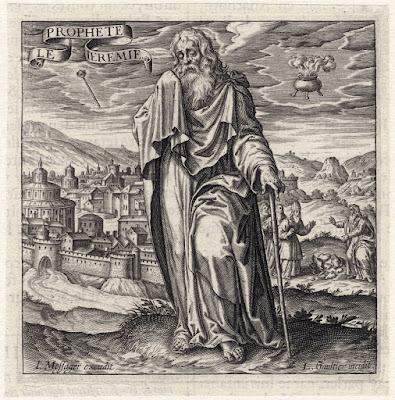
An engraving of the prophet Jeremiah by Léonard Gaultier (1561-1641)

Separated by a few millennia, we might see the folly with this magical type of thinking. Yet, it is just as easy for us to slip into the same mentality. 

Whenever we Americans think that our nation is so great that no one will ever take us over; or when we sincerely believe that because we are a missionary-sending nation that God will protect us; or when we buy into the notion that we can live however we want, but God would never judge us!; after all, we aren’t as bad as other nations!; well, then, we have come under the same condemnation as the Jews of old, we need to hear God’s Word for us today.

Jeremiah’s message was uncompromising. He clearly let the people know that while they have been living their hedonistic lives, God has been trying to talk them. But the people refused to listen. The prophet insisted that having the temple in the city is not some inoculation from keeping enemies at bay.

The prophet Jeremiah asserted that the people must change their ways, start living right, and be fair and honest with each other. They need to stop taking advantage of foreigners, orphans, and widows. They cannot kill innocent people and worship other gods, then turn around and invoke the temple as God’s presence and sanction on their security.

Justice is the responsibility of everyone; there are no favorites with God. The Lord does not favor particular people, ethnicities, or nations above others. Because one is an American, or not, makes no difference. Race and gender don’t come into view.

The sovereign God will hold all people culpable for their violent speech and behavior, no matter who they are or where they are from. Oppression, injustice, and spiritual gerrymandering will be dealt with by Judge Jesus, for both Jew and Gentile, man and woman, Westerner and Easterner, young and old.

For whom God has given much, much will be required. The Lord holds all people accountable for their actions.

Holy God, you still speak today through your Holy Word. Help me to listen well and pay attention to what you are saying so that I might honor you through humility and obedience for the sake of Jesus. Amen.