Accept Accountability (Genesis 35:22-29)

So then, each one of us will be held accountable. (Romans 14:12)

While Israel lived in that land, Reuben went and lay with Bilhah his father’s concubine, and Israel heard of it.

Now the sons of Jacob were twelve. The sons of Leah: Reuben (Jacob’s firstborn), Simeon, Levi, Judah, Issachar, and Zebulun. The sons of Rachel: Joseph and Benjamin. The sons of Bilhah, Rachel’s maid: Dan and Naphtali. The sons of Zilpah, Leah’s maid: Gad and Asher. These were the sons of Jacob who were born to him in Paddan-aram.

Jacob came to his father Isaac at Mamre, or Kiriath-arba, that is, Hebron, where Abraham and Isaac had resided as aliens. Now the days of Isaac were one hundred eighty years. And Isaac breathed his last; he died and was gathered to his people, old and full of days, and his sons Esau and Jacob buried him. (New International Version Updated Edition)

For me, one of the great tragedies of the human experience is that we share so little of ourselves to and for one another. And that especially goes for those times when we fail, make a poor decision, or feel guilty for not being a better person.

It seems that in those times we gravitate toward covering up whatever misdeeds we have done. Why do we do that? There’s a myriad of answers to that question. There are many folks who simply do want to be held accountable for their wrongdoing – not to mention the shame and embarrassment the action may bring to them. They would like to keep some sort of manufactured pristine image to project for the world, instead of what’s really going on.

I like that the Bible is mostly straightforward about issues concerning accountability (both at the personal, and especially at the corporate level). It’s hard to live in a safe and enjoyable society whenever there is a lack of accountability within the community.

In today’s Old Testament lesson, we get this seemingly isolated verse thrown into the mix of a Scripture story. But it’s an important insertion. It has consequences to its actions, with the sort of ramifications that reverberate throughout time.

Reuben was the firstborn son of Jacob – which carried with it a whole set of responsibilities, as well as privileges. Yet, Reuben did something that left him accountable before both his earthly and heavenly fathers. He “lay with” his father’s concubine (that is, a lesser wife) who was not his own mother.

We aren’t told why Reuben did it. But I think we are meant to read between the lines enough to know why.

What eventually happens is that Reuben loses his family status. At the end of Jacob’s life – as he was doling out blessings to each son – he had this to say about Reuben:

Assemble and hear, O sons of Jacob;
    listen to Israel your father.

Reuben, you are my firstborn,
    my might and the first fruits of my vigor,
    excelling in rank and excelling in power.
Unstable as water, you shall no longer excel
    because you went up onto your father’s bed;
    then you defiled it—you went up onto my couch! (Genesis 49:2-4, NRSVUE)

Unfortunately, this fails to sound like the sort of blessing one would want to hear at the end of his father’s life. But that’s what accountability does; it makes sure that the offense is put squarely on the perpetrator, and not the victim.

For me, one of the maddening things about today’s political climate is that personal wrongdoers, along with the institutional evils surrounding them, have no thought or appetite for being accountable to the very people to whom they are supposed to be serving. It’s as if public service and the value of the nation’s common good isn’t even in the current presidential cabinet vocabulary.

However, accountability will have its day. And it’s not only in government. Business corporations, healthcare organizations, financial systems, educational institutions, and much more are rife with all sorts of clever ways to get around being accountable to others for their unjust activity.

I have personally experienced it myself, multiple times. And right now, today, there are millions of people whom no one knows is going through hell at their job because of this very issue of the powerful using their position at the expense of the powerless.

“Accountability breeds responsibility.” Stephen Covey

Please hear me when I say this, even though it can be a very scary and intimidating thing: Not naming the person or persons or institutions which perpetrate injustice protects those perpetrators from the accountability they need. Investigations into unethical and/or illegal activity cannot happen unless it is identified and named.

Not everyone is a deliberate knucklehead who goes around hurting people. Sometimes they just need a whistleblower to call them on their injustice. And once that happens, behavior and attitudes change. That’s how it’s supposed to work. Yet, we all know that it doesn’t always work like that – which is why it is important to have plenty of support through your own unwanted and fiery experience.

Taking a lesson in accountability from Jacob toward Reuben, he didn’t attack his son, but stuck to the issue which brought his downfall from firstborn status. In other words, it’s always best to attack problems, not people. If not, we ourselves end up becoming the very sort of perpetrators we try to expose.

And, by the way, if you are observing or seeing a pattern of illicit behavior, keep a journal of it; write it down; document what actually happened and what kind of impact it had on you. In today’s society, failing to have appropriate documentation usually means the perpetration is going to go unaccounted for.

One of the reasons there is not a full-fledged soap opera account of Reuben’s act with Bilhah is the nature of Holy Scripture itself. The Bible leaves lots of details out with open stories in order for us as readers to understand with our imaginations what’s going on; and to envision the potential outcomes of particular actions.

What “really happened” is much less important than the lessons we are meant to learn from any biblical story. We may consider large gaps in stories as an annoyance, yet I believe those gaps are quite intentional.

Holy Scripture is meant to not only be an individual reading experience, but is a valuable opportunity for robust moral and theological discussion about contemporary realities as they relate to ancient wisdom traditions.

As readers and interpreters, we must fully engage the story, paying attention to what’s there, and what’s not there. Then, figure out together how we might (or ought) to fill in those gaps of what’s missing.

And for me, I see all sorts of ways in which all of us must be surrounded by and surrendered to accountability. Being accountable to others means that we accept responsibility when it is ours to accept, thus strengthening the bonds of community.

What’s more, accountability fosters courage and humility, as well as stopping the blame game in its tracks.

When it comes to the Church, we have a collective responsibility because of our baptismal covenant to strive for justice, peace, and the common good of all heavenly citizens. That means we will continually work toward observing the dignity and worth of every human we encounter – even the ones we don’t much like.

Blessed God and Father of our Lord Jesus Christ, help me to be honest with myself and release the excuses that hold me back.

Give me the strength to take responsibility for my actions and the courage to choose growth over comfort.

Renew my mindset so I see challenges as opportunities, not reasons to delay.

Align my thoughts and actions with purpose, discipline, and truth.

Teach me to be consistent in the small things,

and to follow through on what I start, even when it feels difficult.

Help me to trust my ability to grow,

and to move forward with confidence instead of doubt.

Guide me to move forward with clarity, ownership, and intention,

becoming the person I am meant to be, in the power of your Holy Spirit.

Amen.

Already Justified and Accepted (Romans 5:1-8)

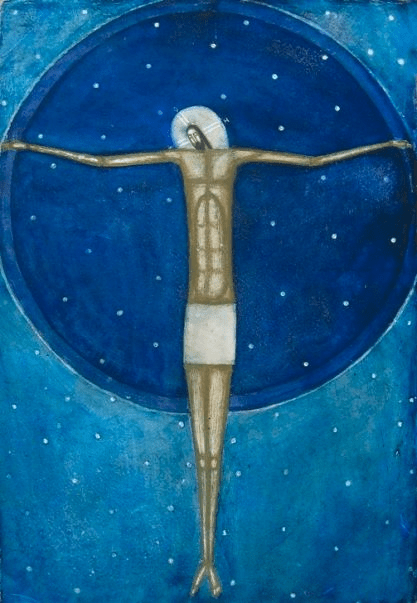
Crucifixion, by Natalya Rusetska

Therefore, since we are justified by faith, we have peace with God through our Lord Jesus Christ, through whom we have obtained access to this grace in which we stand, and we boast in our hope of sharing the glory of God. And not only that, but we also boast in our afflictions, knowing that affliction produces endurance, and endurance produces character, and character produces hope, and hope does not put us to shame, because God’s love has been poured into our hearts through the Holy Spirit that has been given to us.

For while we were still weak, at the right time Christ died for the ungodly. Indeed, rarely will anyone die for a righteous person—though perhaps for a good person someone might actually dare to die. But God proves his love for us in that while we still were sinners Christ died for us. (New Revised Standard Version Updated Edition)

Perhaps we have so many people filled with shame and regret today over their past poor decisions and the trajectory their lives, because there is such a profound lack of hope in the world.

Becoming confident in both the unseen realities and the stated promises of God can melt away both personal and corporate shame.

Long ago, the Apostle Paul reminded the Roman Church of their true standing before the God of all. Paul knew that if the people were secure in their identity, then resilience would arise; and if resilience rises, then a robust Christian character and identity will take root. Hope then becomes a central part of life.

Notice that the Apostle made it clear what is true of believers: They are justified, possessing the justification of God. In other words, the Christians have no reason to try and justify themselves to others (or to God) because they already have been justified by God.

There is great freedom in feeling no compunction whatsoever to prove oneself. Followers of Jesus Christ need not prove themselves, spending all sorts of social capital attempting to please others, out of some perceived need to demonstrate who they are.

If you want others to know who you are and what kind of God you serve, then know thyself, instead of constantly putting your finger to the wind in order to gauge which way the prevailing winds of society are blowing so that you can follow it.

In truth, all you need is the wind of the Spirit to carry you on into doing God’s will from a merciful, pure, and peaceful heart.

Since we are already justified, we have peace with God through our Lord Jesus Christ. Things are good between us and God. Not only do we have no need to prove ourselves to the world, but we especially have also absolutely no reason to try and prove ourselves to God.

The Lord already knows the score of everyone’s life. It is a silly venture to put on airs before the Sovereign of the universe, as if God must be convinced to love us and have our backs.

The grace of God is abundant and ever-present; grace is continually available. And there are no exceptions to this. One is never too far from God or too estranged from the good in order to receive the mercy of God.

God’s love has been already poured into our hearts. God is with us; divine love is intimately close to us. Rather than wondering or vacillating between whether God loves me or God loves me not, the objective spiritual reality of the moment is that you and I are surrounded by the God who rejoices over us.

The Lord your God is with you.
He is a hero who saves you.
He happily rejoices over you,
renews you with his love,
and celebrates over you with shouts of joy. (Zechariah 3:17, GW)

What’s more, God does not wait for anyone to get their lives straightened out before paying gracious attention to them. No, while we were still stuck in the darkness of our bad and misguided ways, Christ died for us. Jesus Christ died for the ungodly while they were still going on in their own selfish and oppressive way.

That, my friend, is the extent to which God’s love reaches. There is no pit too deep, no meanness too great, nor any unrighteous life too bad that God cannot reach the long divine arm of mercy and love into the muck, and snatch us out of a depressing existence.

And the world is not too filthy rotten that God is unable to cut through the filth. As far as the Lord is concerned, the earth is presently just a compost pile that will eventually become transformed from garbage to fertilizer for new life, in which love can grow, thrive, and flourish across this world.

Unhindered access to God has been granted to us.

Let us then approach God’s throne of grace with confidence, so that we may receive mercy and find grace to help us in our time of need. (Hebrews 4:16, NIV)

We now have the hope and the freedom to be active spiritual farmers who carefully and pastorally care for all creation by spreading the seeds of God’s love to the world.

Everything we have and all that we are, comes from the grace, mercy, and love of God. Therefore, we have no reason to boast in and of ourselves, but to boast extravagantly in what Christ has done for us. He has bought and brought  deliverance from all which hindered us from living a loving and hopeful life.

So then, the path to true self-acceptance comes from knowing that we are already accepted by God.

The very core of our identity is in the Creator, Savior, and Sustainer. Since we possess God’s love and acceptance, there is never a need for subjective feelings of trying to gin-up a sense of self-acceptance. You and I already have it. You are profoundly loved.

This, then, is the basis for peace and rest. Please understand that it is quite possible that later today or tomorrow or next week you will again feel unworthy of God’s love, unaccepted by God and others, and nervous to the point of peace becoming a bygone wish.

None of this, however, erases what is already real and true of you, or changes your identity in any way. You are still in the hollow of God’s hand; still the apple of God’s eye; and still in a place where there is no need to justify yourself. What there is, however, is abundant grace.

No matter how we are doing, feeling, or believing, there is always open access to God because of Jesus Christ.

The ground of our confidence allows us to view tribulations as opportunities for spiritual growth; and patient waiting as the privilege to hope in what is yet to come. I will yet see the glory of God face to face.

God in Christ has done for us what we could not do for ourselves. The Lord has granted us faith, and gifted us with a fresh new allegiance. Through recognition of our helpless state, and our distance from God (including a nasty tendency to ignore God) we discover that the love of God is with us. So, we may rely completely on the divine initiative of the love which never wavers.

In this state, guilt, shame, and regret is left in the dust – replaced by faith in the Son of God who loved me and gave himself for me.

Loving God, open our ears to hear your Word, and draw us closer to You, so that the whole world may be one with you as you are one with us in Jesus Christ our Lord. Amen.

Look Up (Isaiah 42:10-18)

Sing to the Lord a new song,
    his praise from the end of the earth!
Let the sea roar and all that fills it,
    the coastlands and their inhabitants.
Let the desert and its towns lift up their voice,
    the villages that Kedar inhabits;
let the inhabitants of Sela shout for joy;
    let them shout from the tops of the mountains.
Let them give glory to the Lord
    and declare his praise in the coastlands.
The Lord goes forth like a soldier;
    like a warrior he stirs up his fury;
he cries out; he shouts aloud;
    he shows himself mighty against his foes.

For a long time I have held my peace;
    I have kept still and restrained myself;
now I will cry out like a woman in labor;
    I will gasp and pant.
I will lay waste mountains and hills
    and dry up all their herbage;
I will turn the rivers into islands
    and dry up the pools.
I will lead the blind
    by a road they do not know;
by paths they have not known
    I will guide them.
I will turn the darkness before them into light,
    the rough places into level ground.
These are the things I will do,
    and I will not forsake them.
They shall be turned back and utterly put to shame—
    those who trust in carved images,
who say to cast images,
    “You are our gods.”

Listen, you who are deaf,
    and you who are blind, look up and see! (New Revised Standard Version)

All creation, along with all creatures, are to praise the Lord. The coastlands and borderlands serve as witnesses to God’s justice and to human injustice.

The trees aren’t just standing there with their majestic trunks and branches. They are present to any and all of the wickedness that people may do.They experience all good that God does, and the evil which humanity does.

The rocks, the hills, the plants, all that is alive around us are sacred witnesses to what is happening on this earth – both the good and the bad.

All of creation declares God’s praise, and testifies to God of what is going on in the world.

As a result, the Lord is roused to action; God comes to attention like a soldier and is ready to move out.

The Lord will lead the (spiritually) blind in new directions. God’s active participation will put to shame all the people who trust in alternative gods or other things.

The prophet Isaiah says that the people were called to look up and see.

Everyone, look up. Look. Up.

Because the Lord knows that if folks will look up, and see God, that it changes everything for them.

We are invited to look up and sing praises to the Lord. The singers include every creature on earth, the oceans, the seas, the waters, the desert, the coast, the land, and the people.

Look up and see that God is about to act. And the action will be good for some, and not so good for others.

Whenever God moves, you know it. There will be some noise to it, like a woman in labor.

Nothing is beyond the reach of God. The Lord will do divine work of building up, tearing down, and building up again – all according to the divine will.

God will act on behalf of the faithful, the humble, the needy, and all those who look to the Lord. So, we must look up.

We cannot see what is happening, or who is there, if our heads are down. Everything has the potential to be different and changed if we will but lift our heads and look up.

There are a lot of reasons why we may be looking down. We might believe God doesn’t see or isn’t watching. But the Lord is neither deaf nor blind – we are. For us to notice, we must look up.

We may lack self-awareness, not realizing who we truly are, or what the state of things with us really is. Perhaps there is discouragement, despondency, or depression. Maybe hope has disappeared.

It could be that there is guilt, or shame, or uncertainty, and so fear is keeping the head down and eyes looking at the ground.

So, look up.

Abram looked up, saw an incredible future, and heard an amazing promise:

He [the Lord] took him outside and said, “Look up at the sky and count the stars—if indeed you can count them.” Then he said to him, “So shall your offspring be.” Abram believed the Lord, and he credited it to him as righteousness. (Genesis 15:5-6, NIV)

Mary Magdalene looked up at Jesus, and her deep sorrow turned to great astonishment and joy:

Mary was standing outside the tomb crying, and as she wept, she stooped and looked in.She saw two white-robed angels, one sitting at the head and the other at the foot of the place where the body of Jesus had been lying. “Dear woman, why are you crying?” the angels asked her.

“Because they have taken away my Lord,” she replied, “and I don’t know where they have put him.”

She turned to leave and saw someone standing there. It was Jesus, but she didn’t recognize him. “Dear woman, why are you crying?” Jesus asked her. “Who are you looking for?”

She thought he was the gardener. “Sir,” she said, “if you have taken him away, tell me where you have put him, and I will go and get him.”

“Mary!” Jesus said.

She turned to him and cried out, “Rabboni!” (which is Hebrew for “Teacher”). (John 20:11-16, NLT)

Stephen looked up, and his persecution turned to glory:

When the members of the Sanhedrin heard this, they were furious and gnashed their teeth at him. But Stephen, full of the Holy Spirit, looked up to heaven and saw the glory of God, and Jesus standing at the right hand of God. “Look,” he said, “I see heaven open and the Son of Man standing at the right hand of God.” (Acts 7:54-56, NIV)

We are to look up so that we can see how things truly are, and whom we really serve. Only then can we accept what is, and what God is doing.

Spiritual awareness enables us to see clearly and discern well. It comes when we look up, see the glory of God, and accept the invitation to respond.

Lord God almighty, Creator of heaven and earth:

How awesome are your works!
    Because of your great strength,
        your enemies cringe before you.
All the earth worships you,
    sings praises to you,
        sings praises to your name!

If I had cherished evil in my heart,
    my Lord would not have listened.
But God definitely listened.
    He heard the sound of my prayer.
Bless God! He didn’t reject my prayer;
    he didn’t withhold his faithful love from me. Amen. (Psalm 66:3-4, 18-20, CEB)

I Want To Know Christ (Philippians 3:7-11)

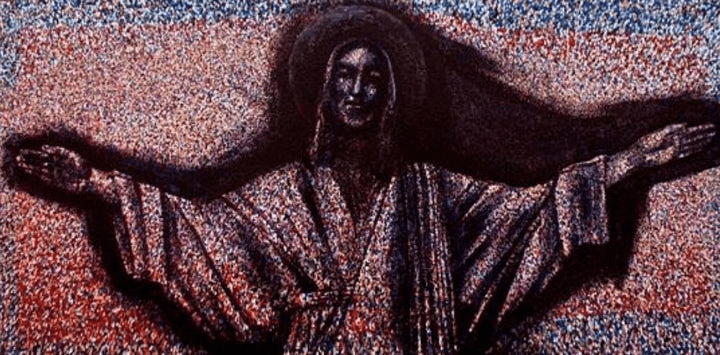
Jesus Christ and the Apostles, by Nikolas Martínez Ortiz de Zarate (1907-1990)

But whatever were gains to me I now consider loss for the sake of Christ. What is more, I consider everything a loss because of the surpassing worth of knowing Christ Jesus my Lord, for whose sake I have lost all things. I consider them garbage, that I may gain Christ and be found in him, not having a righteousness of my own that comes from the law, but that which is through faith in Christ—the righteousness that comes from God on the basis of faith. 

I want to know Christ—yes, to know the power of his resurrection and participation in his sufferings, becoming like him in his death, and so, somehow, attaining to the resurrection from the dead. (New International Version)

Whenever someone asks me what my favorite portion of Holy Scripture is, I reflexively turn to these verses in our New Testament lesson for today.

I resonate with these words from the Apostle Paul to the Church at Philippi, because they match what I truly believe, and how I really feel about Jesus.

We go through a lot of loss in this earthly life. We experience hardship and adversity. We grieve and lament.

Some of the losses in this life, we are okay with, or at least, we come around to being okay with them after a bit of time. Yet, there are other losses that are heartrending.

On the flipside, there are many gains we experience in this life. Some of them we worked very hard for, and others came to us as gifts.

Oftentimes, our gains and our losses are inextricably bound with each other. Something we consider precious is lost. We may even choose to set aside or give up something we have – we allow it become lost – so that we can gain something even better.

At other times, the process of gaining, losing, then gaining something good was not purposed by us, but by God.

And, to me, that’s probably the best sort of good there is.

Another way of putting the matter is: We must let go and accept how something or someone is, before we can experience what a truly good life really is.

Jesus, by Ghanshyam Gupta

Allow me, or please indulge me, as I frame the Apostle’s words in my own sort of language:

Anything in this life that I have achieved; anything I have come to possess; any sort of position or title I hold or have held; any kind of identification I have, or prestige  I have gained, is of no value. In reality, it’s all rather worthless.

If you will let me take it even further, compared to having an authentic, real, and experiential relationship with Jesus as my Savior, my Lord, and my Friend, everything else is like a bunch of garbage. That’s how much I value Jesus. There’s no other thing, no other relationship, that comes remotely close to knowing Christ.

It isn’t so much that I found Jesus, but that he found me. So, I have a faith that’s got nothing to do with keeping up appearances or rule-keeping, or keeping ahold of anything. I have the life that is truly life.

But, oh my, there is so much more to experience and to know with Jesus! I want to experientially know the power of Christ’s mighty resurrection. I  want to be like him, and participate with him, as if Jesus were living his life through me.

And, I must tell you, I know that this sort of life means suffering. But I also know that this suffering puts me in solidarity with my Lord – which is exactly where I want to be.

I only want to live up to who I’m supposed to be in Christ, to be my true self, and not some faux Christian living according to mere rules and regulations. The only thing that counts to me is faith expressing itself through love.

I understand that I took a lot of liberties with the text, and elaborated on it in order to make it my own. But, truth be told, we all need to find ways to make scripture as our own.

We all must let go of some old ways and unlearn a lot of things, in order to discover new life and be united with Christ. Everyone needs to learn from the past, so that we can live a new life here in the present.

If you don’t like my words, that’s fine. You aren’t under any obligation to read them. Yet, I do believe we have an obligation to Holy Scripture, and specifically, to ingest it as if it were the best meal you’ve ever eaten.

Indeed, we end up experiencing a lot of losses in this life. Yet, with Jesus, we will never lose him, because he will never forsake us. Christ is our eternal gain. He’s alive, always living, so that we need never be concerned about him not existing anymore.

That’s my faith. That’s what I trust in, or rather whom I put my faith in, and my trust upon. It’s all about Jesus. Anything less will not stand the test of time, nor of satisfaction in life.

What will you do with Jesus?

Christ isn’t going to strongarm you into the kingdom of God. But he will doggedly go after you, and be a pester pup in your ears and an ever-present sense in your heart.

You might as well go ahead and consider him, or perhaps reconsider him, like you’ve never done before.

After all, you’ve really got nothing to lose.

We believe in one Lord, Jesus Christ,

the only Son of God,
eternally begotten of the Father,
God from God, Light from Light,
true God from true God,
begotten, not made,
of one being with the Father;
through him all things were made.
For us and for our salvation
he came down from heaven:
was incarnate of the Holy Spirit and the Virgin Mary,
and became truly human.
For our sake he was crucified under Pontius Pilate;
he suffered death and was buried.
On the third day he rose again
in accordance with the Scriptures;
he ascended into heaven
and is seated at the right hand of the Father.
He will come again in glory to judge the living and the dead,
and his kingdom will have no end. – The Nicene Creed, on Jesus Christ