Look Up (Isaiah 42:10-18)

Sing to the Lord a new song,
    his praise from the end of the earth!
Let the sea roar and all that fills it,
    the coastlands and their inhabitants.
Let the desert and its towns lift up their voice,
    the villages that Kedar inhabits;
let the inhabitants of Sela shout for joy;
    let them shout from the tops of the mountains.
Let them give glory to the Lord
    and declare his praise in the coastlands.
The Lord goes forth like a soldier;
    like a warrior he stirs up his fury;
he cries out; he shouts aloud;
    he shows himself mighty against his foes.

For a long time I have held my peace;
    I have kept still and restrained myself;
now I will cry out like a woman in labor;
    I will gasp and pant.
I will lay waste mountains and hills
    and dry up all their herbage;
I will turn the rivers into islands
    and dry up the pools.
I will lead the blind
    by a road they do not know;
by paths they have not known
    I will guide them.
I will turn the darkness before them into light,
    the rough places into level ground.
These are the things I will do,
    and I will not forsake them.
They shall be turned back and utterly put to shame—
    those who trust in carved images,
who say to cast images,
    “You are our gods.”

Listen, you who are deaf,
    and you who are blind, look up and see! (New Revised Standard Version)

All creation, along with all creatures, are to praise the Lord. The coastlands and borderlands serve as witnesses to God’s justice and to human injustice.

The trees aren’t just standing there with their majestic trunks and branches. They are present to any and all of the wickedness that people may do.They experience all good that God does, and the evil which humanity does.

The rocks, the hills, the plants, all that is alive around us are sacred witnesses to what is happening on this earth – both the good and the bad.

All of creation declares God’s praise, and testifies to God of what is going on in the world.

As a result, the Lord is roused to action; God comes to attention like a soldier and is ready to move out.

The Lord will lead the (spiritually) blind in new directions. God’s active participation will put to shame all the people who trust in alternative gods or other things.

The prophet Isaiah says that the people were called to look up and see.

Everyone, look up. Look. Up.

Because the Lord knows that if folks will look up, and see God, that it changes everything for them.

We are invited to look up and sing praises to the Lord. The singers include every creature on earth, the oceans, the seas, the waters, the desert, the coast, the land, and the people.

Look up and see that God is about to act. And the action will be good for some, and not so good for others.

Whenever God moves, you know it. There will be some noise to it, like a woman in labor.

Nothing is beyond the reach of God. The Lord will do divine work of building up, tearing down, and building up again – all according to the divine will.

God will act on behalf of the faithful, the humble, the needy, and all those who look to the Lord. So, we must look up.

We cannot see what is happening, or who is there, if our heads are down. Everything has the potential to be different and changed if we will but lift our heads and look up.

There are a lot of reasons why we may be looking down. We might believe God doesn’t see or isn’t watching. But the Lord is neither deaf nor blind – we are. For us to notice, we must look up.

We may lack self-awareness, not realizing who we truly are, or what the state of things with us really is. Perhaps there is discouragement, despondency, or depression. Maybe hope has disappeared.

It could be that there is guilt, or shame, or uncertainty, and so fear is keeping the head down and eyes looking at the ground.

So, look up.

Abram looked up, saw an incredible future, and heard an amazing promise:

He [the Lord] took him outside and said, “Look up at the sky and count the stars—if indeed you can count them.” Then he said to him, “So shall your offspring be.” Abram believed the Lord, and he credited it to him as righteousness. (Genesis 15:5-6, NIV)

Mary Magdalene looked up at Jesus, and her deep sorrow turned to great astonishment and joy:

Mary was standing outside the tomb crying, and as she wept, she stooped and looked in.She saw two white-robed angels, one sitting at the head and the other at the foot of the place where the body of Jesus had been lying. “Dear woman, why are you crying?” the angels asked her.

“Because they have taken away my Lord,” she replied, “and I don’t know where they have put him.”

She turned to leave and saw someone standing there. It was Jesus, but she didn’t recognize him. “Dear woman, why are you crying?” Jesus asked her. “Who are you looking for?”

She thought he was the gardener. “Sir,” she said, “if you have taken him away, tell me where you have put him, and I will go and get him.”

“Mary!” Jesus said.

She turned to him and cried out, “Rabboni!” (which is Hebrew for “Teacher”). (John 20:11-16, NLT)

Stephen looked up, and his persecution turned to glory:

When the members of the Sanhedrin heard this, they were furious and gnashed their teeth at him. But Stephen, full of the Holy Spirit, looked up to heaven and saw the glory of God, and Jesus standing at the right hand of God. “Look,” he said, “I see heaven open and the Son of Man standing at the right hand of God.” (Acts 7:54-56, NIV)

We are to look up so that we can see how things truly are, and whom we really serve. Only then can we accept what is, and what God is doing.

Spiritual awareness enables us to see clearly and discern well. It comes when we look up, see the glory of God, and accept the invitation to respond.

Lord God almighty, Creator of heaven and earth:

How awesome are your works!
    Because of your great strength,
        your enemies cringe before you.
All the earth worships you,
    sings praises to you,
        sings praises to your name!

If I had cherished evil in my heart,
    my Lord would not have listened.
But God definitely listened.
    He heard the sound of my prayer.
Bless God! He didn’t reject my prayer;
    he didn’t withhold his faithful love from me. Amen. (Psalm 66:3-4, 18-20, CEB)

I Want To Know Christ (Philippians 3:7-11)

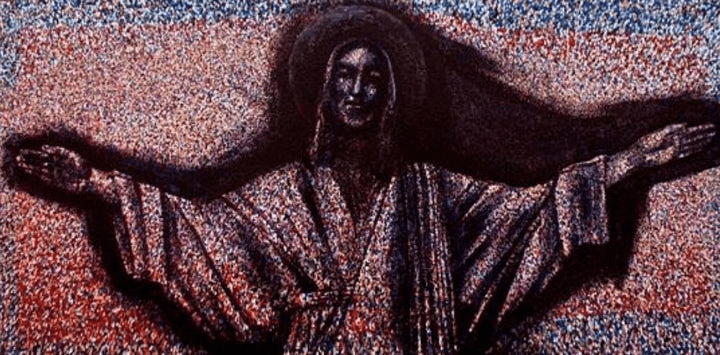
Jesus Christ and the Apostles, by Nikolas Martínez Ortiz de Zarate (1907-1990)

But whatever were gains to me I now consider loss for the sake of Christ. What is more, I consider everything a loss because of the surpassing worth of knowing Christ Jesus my Lord, for whose sake I have lost all things. I consider them garbage, that I may gain Christ and be found in him, not having a righteousness of my own that comes from the law, but that which is through faith in Christ—the righteousness that comes from God on the basis of faith. 

I want to know Christ—yes, to know the power of his resurrection and participation in his sufferings, becoming like him in his death, and so, somehow, attaining to the resurrection from the dead. (New International Version)

Whenever someone asks me what my favorite portion of Holy Scripture is, I reflexively turn to these verses in our New Testament lesson for today.

I resonate with these words from the Apostle Paul to the Church at Philippi, because they match what I truly believe, and how I really feel about Jesus.

We go through a lot of loss in this earthly life. We experience hardship and adversity. We grieve and lament.

Some of the losses in this life, we are okay with, or at least, we come around to being okay with them after a bit of time. Yet, there are other losses that are heartrending.

On the flipside, there are many gains we experience in this life. Some of them we worked very hard for, and others came to us as gifts.

Oftentimes, our gains and our losses are inextricably bound with each other. Something we consider precious is lost. We may even choose to set aside or give up something we have – we allow it become lost – so that we can gain something even better.

At other times, the process of gaining, losing, then gaining something good was not purposed by us, but by God.

And, to me, that’s probably the best sort of good there is.

Another way of putting the matter is: We must let go and accept how something or someone is, before we can experience what a truly good life really is.

Jesus, by Ghanshyam Gupta

Allow me, or please indulge me, as I frame the Apostle’s words in my own sort of language:

Anything in this life that I have achieved; anything I have come to possess; any sort of position or title I hold or have held; any kind of identification I have, or prestige  I have gained, is of no value. In reality, it’s all rather worthless.

If you will let me take it even further, compared to having an authentic, real, and experiential relationship with Jesus as my Savior, my Lord, and my Friend, everything else is like a bunch of garbage. That’s how much I value Jesus. There’s no other thing, no other relationship, that comes remotely close to knowing Christ.

It isn’t so much that I found Jesus, but that he found me. So, I have a faith that’s got nothing to do with keeping up appearances or rule-keeping, or keeping ahold of anything. I have the life that is truly life.

But, oh my, there is so much more to experience and to know with Jesus! I want to experientially know the power of Christ’s mighty resurrection. I  want to be like him, and participate with him, as if Jesus were living his life through me.

And, I must tell you, I know that this sort of life means suffering. But I also know that this suffering puts me in solidarity with my Lord – which is exactly where I want to be.

I only want to live up to who I’m supposed to be in Christ, to be my true self, and not some faux Christian living according to mere rules and regulations. The only thing that counts to me is faith expressing itself through love.

I understand that I took a lot of liberties with the text, and elaborated on it in order to make it my own. But, truth be told, we all need to find ways to make scripture as our own.

We all must let go of some old ways and unlearn a lot of things, in order to discover new life and be united with Christ. Everyone needs to learn from the past, so that we can live a new life here in the present.

If you don’t like my words, that’s fine. You aren’t under any obligation to read them. Yet, I do believe we have an obligation to Holy Scripture, and specifically, to ingest it as if it were the best meal you’ve ever eaten.

Indeed, we end up experiencing a lot of losses in this life. Yet, with Jesus, we will never lose him, because he will never forsake us. Christ is our eternal gain. He’s alive, always living, so that we need never be concerned about him not existing anymore.

That’s my faith. That’s what I trust in, or rather whom I put my faith in, and my trust upon. It’s all about Jesus. Anything less will not stand the test of time, nor of satisfaction in life.

What will you do with Jesus?

Christ isn’t going to strongarm you into the kingdom of God. But he will doggedly go after you, and be a pester pup in your ears and an ever-present sense in your heart.

You might as well go ahead and consider him, or perhaps reconsider him, like you’ve never done before.

After all, you’ve really got nothing to lose.

We believe in one Lord, Jesus Christ,

the only Son of God,
eternally begotten of the Father,
God from God, Light from Light,
true God from true God,
begotten, not made,
of one being with the Father;
through him all things were made.
For us and for our salvation
he came down from heaven:
was incarnate of the Holy Spirit and the Virgin Mary,
and became truly human.
For our sake he was crucified under Pontius Pilate;
he suffered death and was buried.
On the third day he rose again
in accordance with the Scriptures;
he ascended into heaven
and is seated at the right hand of the Father.
He will come again in glory to judge the living and the dead,
and his kingdom will have no end. – The Nicene Creed, on Jesus Christ

Be Prepared, For the Lord Is Coming (Luke 1:5-17)

The Angel Appearing to Zechariah, by William Blake, 1800

In the days of King Herod of Judea, there was a priest named Zechariah, who belonged to the priestly order of Abijah. His wife was descended from the daughters of Aaron, and her name was Elizabeth. Both of them were righteous before God, living blamelessly according to all the commandments and regulations of the Lord. But they had no children because Elizabeth was barren, and both were getting on in years.

Once when he was serving as priest before God during his section’s turn of duty, he was chosen by lot, according to the custom of the priesthood, to enter the sanctuary of the Lord to offer incense. Now at the time of the incense offering, the whole assembly of the people was praying outside. 

Then there appeared to him an angel of the Lord, standing at the right side of the altar of incense. When Zechariah saw him, he was terrified, and fear overwhelmed him. 

But the angel said to him, “Do not be afraid, Zechariah, for your prayer has been heard. Your wife Elizabeth will bear you a son, and you will name him John. You will have joy and gladness, and many will rejoice at his birth, for he will be great in the sight of the Lord. He must never drink wine or strong drink; even before his birth he will be filled with the Holy Spirit. He will turn many of the people of Israel to the Lord their God. With the spirit and power of Elijah he will go before him, to turn the hearts of parents to their children and the disobedient to the wisdom of the righteous, to make ready a people prepared for the Lord.” (New Revised Standard Version)

We have the story of John the Baptist in the New Testament Gospels. In today’s Gospel lesson, we have the events surrounding his conception.

John’s birth story and life’s narrative are deeply rooted in Old Testament promises of deliverance and divine connection.

John’s ministry was one of preparing people for the Lord. John was, in many ways, the prophet Elijah who was to come, as Jesus said about him:

As they were coming down the mountain [of Transfiguration], Jesus ordered them, “Tell no one about the vision until after the Son of Man has been raised from the dead.” And the disciples asked him, “Why, then, do the scribes say that Elijah must come first?” He replied, “Elijah is indeed coming and will restore all things, but I tell you that Elijah has already come, and they did not recognize him, but they did to him whatever they pleased. So also the Son of Man is about to suffer at their hands.” Then the disciples understood that he was speaking to them about John the Baptist. (Matthew 17:9-13, NRSV)

Just as John’s story only has meaning because of Israel’s history, so the story of Jesus is deeply connected to the Old Testament, as well. Jesus is very much related to Israel’s God.

Furthermore, the coming salvation that the Gospel writer Luke wrote about is not only for the glory of Israel; it will also be a revelation of light available to Gentiles.

So it ought to be no surprise to the reader that the angelic birth announcement of John is reminiscent of similar messages in the Old Testament about the coming of a special child. (Genesis 16:7-13; 17:1-22; Judges 13:3-20)

John’s parents, Zechariah and Elizabeth, appear in the narrative as solid citizens of Israel, reminiscent of ancient heroes like Abraham and Sarah. And much like their faithful ancestors, Zechariah and Elizabeth are told they will have a child in their old age.

Elizabeth having been barren all her life is no problem or issue for God. The Lord had done it before; and would do it again.

And the child to come, John, will resemble Old Testament heroes, especially the prophet Elijah. (Malachi 4:5-6)

The visitation to the old couple was a message designed to be lifted up for the entire world: The Lord is coming! Be prepared!

All of us find ourselves getting on in years. Certainly, I do, as a father and grandfather. Yet, at any age, even younger persons feel this. We grow as people. We move on from being a baby to a toddler to an adolescent, a teenager, a young adult, middle-aged, older, geriatric.

We continually age. Hopefully, with the aging process comes a bit of wisdom.

I’d like to think that old Zechariah and Elizabeth had learned enough wisdom over their life’s journey to embrace both the meaning and mystery of that life.

I believe they had a sense of what is, and had an acceptance of it. Yet, at the same time, they had a sense of hope and of what could be. And that’s because they knew something of God’s promises.

Not everything will remain as it presently is. All will change. Acceptance entails knowing this, that all things will be different. And this helps open us to all the possibilities of prayers rooted in ancient promises.

The angel told Zechariah that his prayer had been heard. We aren’t told exactly what Zechariah had prayed. But it seems it was a rather “pregnant” prayer, full of asking for a child of his own, as well as a Messiah to come, and an Elijah to come.

In that sense, Zechariah’s very full prayer was answered magnanimously.

Now, in the spirit of old Zechariah and Elizabeth, we have our own opportunity to offer an advent prayer. We have the privilege of hearing the message.

The Lord is coming. Be prepared.

“Surely I am coming soon.”

Amen. Come, Lord Jesus!

The grace of the Lord Jesus be with all the saints. Amen. (Revelation 22:20-21, NRSV)

Gracious God, guard our hearts and minds by the power of Christ Jesus. Speak to our anxieties with the peace that passes understanding and let our gentleness and joy be a sign of Christ’s gracious presence.

Through Christ, with Christ, in Christ, in the unity of the Holy Spirit, all glory and honor are yours, almighty God, now and forever. Amen.

The Almighty Has Dealt Bitterly with Me (Ruth 1:18-22)

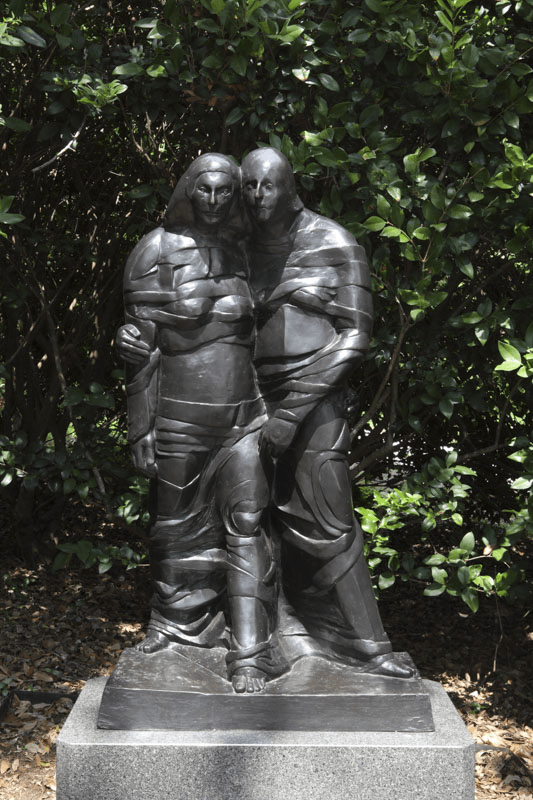
Statue of Ruth and Naomi, by Leonard Baskin (1922-2000)

When Naomi saw that she was determined to go with her, she said no more to her.

So the two of them went on until they came to Bethlehem. When they came to Bethlehem, the whole town was stirred because of them, and the women said, “Is this Naomi?” She said to them,

“Call me no longer Naomi;
    call me Mara,
    for the Almighty has dealt bitterly with me.
I went away full,
    but the Lord has brought me back empty;
why call me Naomi
    when the Lord has dealt harshly with me
    and the Almighty has brought calamity upon me?”

So Naomi returned together with Ruth the Moabite, her daughter-in-law, who came back with her from the country of Moab. They came to Bethlehem at the beginning of the barley harvest. (New Revised Standard Version)

A famine in Judah had brought Naomi and her husband Elimelech to the country of Moab. While there, they had two sons who eventually married two Moabite women: Orpah and Ruth. Over time, each of the husbands died, leaving Naomi and her two daughters-in-law as widows.

Naomi heard that things were finally better in her native Judah. So, she decided to go there, alone. Naomi encouraged her daughters-in-law to remain with their own people and remarry. Orpah did so. Ruth, however, wasn’t having it.

Ruth was determined to stay with her mother-in-law – which meant that she would enter Judah as a foreigner. Despite Naomi’s insistence that Ruth do what is best for herself, Ruth stuck with Naomi.

Once they arrived, the people of Naomi’s hometown were surprised to see the two of them. Naomi was not shy about communicating her bitterness in losing a husband and two sons. She commented that God had turned against her and made her life hard and bitter.

In saying that the Lord had emptied her and brought calamity, Naomi was not speaking against God. Rather, Naomi was expressing some significant theology that has become lost to many modern day Christians around the globe.

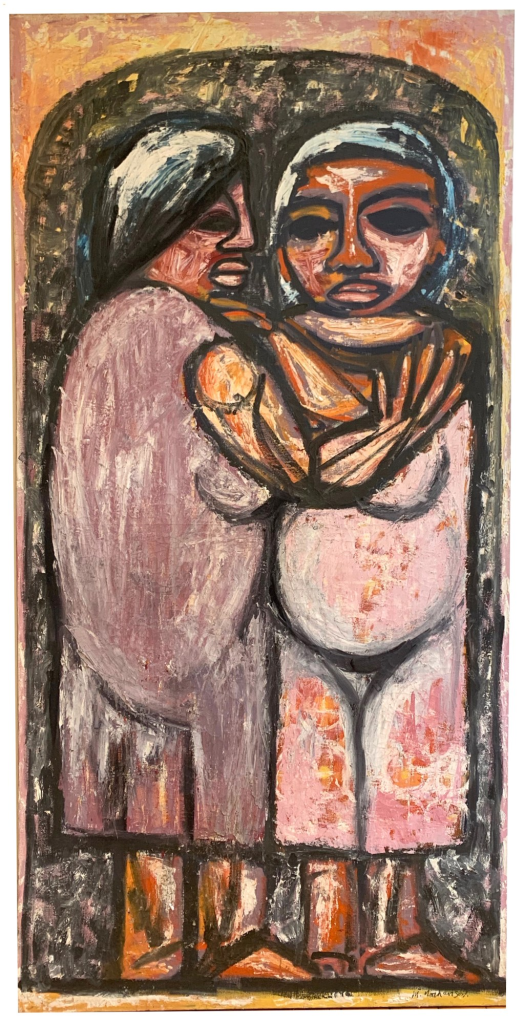
Ruth and Naomi, by Morris Nathanson (1927-2022)

I believe that Ruth was not expressing something malevolent about God, but rather made a statement of faithful recognition, not unlike what Job had to say when he lost his family and his health:

“Naked I came from my mother’s womb, and naked shall I return there; the Lord gave, and the Lord has taken away; blessed be the name of the Lord.” (Job 1:21, NRSV)

No one can escape the dark side of life. Yet, we can deal with that darkness intelligently. It is most necessary to be aware that light creates a shadow that was not there before. The bigger and brighter the light, the bigger and darker the shadow.

There is a centuries old idiom which says, “You can’t have your cake, and eat it, too!” This is a proverbial way of saying that we cannot expect everything to always be good in this life; we must also accept that we cannot always have our way, and that we will go without, experiencing loss.

Whether we want to acknowledge it, or not, an integral part of life is receiving some bad things from God. The Lord does not just go around dispensing everyone’s wishes and making everything a utopia of unicorns and butterflies.

God is most certainly benevolent; yet God also brings darkness to people. We cannot have the Light of the world without experiencing the world’s darkness. Another way of stating this is that a very big God creates quite a large shadow.

In Christianity, the predominant symbol is the cross. The Cross of Christ is both light and dark. Christians may reflexively associate the cross with salvation from sin, while forgetting that the cross is an instrument of torture and death, a tool of execution, like an electric chair.

We must honor the axis crossing at the center of the cross. It is the place of equilibrium, the place of wholeness, where we have the opportunity of integrating all of that unwanted grief and loss into our lives. Failing to do this, let alone neglecting to acknowledge the shadowy places of our hearts, brings harm and hurt to ourselves and to the world.

Naomi acknowledged the shadow. She accepted the darkness, which enabled her to return to her homeland of Judah, the very place where the God of light and dark is worshiped.

I’m not talking about the sort of darkness that is malevolent and mean-spirited, the darkness which comes from Satan. I’m talking about the darkness which weans us away from all things and the ways that hinder us from knowing God.

This is what St. John of the Cross was referring to in naming the dark night of the soul. In our quest to experience union with God, we journey through the darkness, and learn that purification isn’t simply putting something impure away. Purity of heart comes through joining with the God who is pure love itself.

“In the dark night of the soul, bright flows the river of God.”

St. John of the Cross

God loves us so much as to be nailed to a cross and suffer darkness. The Christian is to take up their cross and follow Jesus. That is, we embrace the darkness with an honest engagement of God and God’s world, and through a vulnerable assessment of our own shadow.

For if we fail to acknowledge our shadow, we shall fail to be in union with God.

Not only do many people disown the parts of themselves they don’t like, but they do the same with God – thus making God into their own image of how God should be, instead of taking God as God is.

If you have ears to hear, take this to heart: To accept and honor your own shadow is a profound and necessary spiritual discipline. By “shadow” I mean all of the characteristics of myself that I withhold from others, so that they will only see what I want them to see.

We often put a false self out into the world, for others to see. It is a sort of psychological clothing we wear, much as we have actual clothing. Whether the clothes are real or metaphorical, we dress ourselves in the particular way we want to be seen.

Naomi was a true Israelite, showing her honest true self. There was no separation or division between the inner self and the self she presented to others.

I tend to think that Naomi knew something about God that many don’t know today – and was therefore able to be faithful to both her people and her God.

It is no wonder, then, that Ruth wanted to remain with her mother-in-law Naomi, who was a real person acknowledging the real God.

Almighty God and Father, maker of heaven and earth, of all that is seen and unseen: You are the God of light who illumines our way. And You are the God of darkness who is shadowed in mystery. In knowing You, may I know myself; and in knowing myself, may I more fully know You. Amen.