Impatient (Genesis 16:1-6)

Sarai and Hagar, by Cody F. Miller

Now Sarai, Abram’s wife, had borne him no children. But she had an Egyptian slave named Hagar; so she said to Abram, “The Lord has kept me from having children. Go, sleep with my slave; perhaps I can build a family through her.”

Abram agreed to what Sarai said. So after Abram had been living in Canaan ten years, Sarai his wife took her Egyptian slave Hagar and gave her to her husband to be his wife. He slept with Hagar, and she conceived.

When she knew she was pregnant, she began to despise her mistress. Then Sarai said to Abram, “You are responsible for the wrong I am suffering. I put my slave in your arms, and now that she knows she is pregnant, she despises me. May the Lord judge between you and me.”

“Your slave is in your hands,” Abram said. “Do with her whatever you think best.” Then Sarai mistreated Hagar; so she fled from her. (New International Version)

In a convoluted series of decisions, mostly outside of her control, Hagar became pregnant with Abraham’s son. Although it may seem strange to us today, the practice of building a family line through a surrogate – in this case the slave of the household’s mistress Sarai – was not an unusual way of handling infertility in the ancient world.

Yet, things went awry with that approach. God had promised that a son of Abram’s own flesh and blood would inherit the divine covenant. But it wasn’t happening quickly enough for his wife Sarai. And this impatience led to the worldly approach of trying to gain an heir.

Impatience

Throughout Holy Scripture, patience is a virtue, as well as a spiritual practice to be cultivated. Impatience is the ants-in-your-pants response of wanting something now, without all the fuss and effort of planting and cultivating. The inability to wait is the desire for an instant harvest of righteousness.

The spiritual life of patience, however, like every other virtue, requires progressive growth over a long period of time. That is the only way of attaining any sort of spiritual maturity in this life. To go with shortcuts, or ingenious plans for quickness and efficiency, will not end well.

And it only short circuits the spiritual growth and formation of the believer. Like a farm-factory-raised animal who has been given growth hormones to speed things along, the fallout is the mistreatment of creatures – both animal and human – in shortened lifespans and poor quality of life.

Perhaps the original ancestor of Sarai, Eve, also had a bit of impatience in wanting to gain wisdom, now, from the tree of the knowledge of good and evil. And maybe the original ancestor of Abram, Adam, was okay with letting Eve follow through with an impatient plan.

It could be that both Adam and Abram just wanted to keep their spouses happy; and so, they let them do whatever the heck they wanted in order to keep the peace. It certainly wouldn’t be the only time this ever happened in history.

A commitment to submitting to the process of developing patience is a must – otherwise, the believer will give up and retreat into half-baked ideas for getting what they want, without all the hard work. We also need to realize that patience itself is a great reward, and worth all the energy it takes to possess it.

Be patient, then, brothers and sisters, until the Lord’s coming. See how the farmer waits for the land to yield its valuable crop, patiently waiting for the autumn and spring rains. You too, be patient and stand firm, because the Lord’s coming is near.

James 5:7-8, NIV

What’s more, the effects of impatience are murmuring and complaining to God and others, leading to depression and anxiety. That’s what happened to the ancient Israelites in the desert when it was taking too long to get to the Promised Land:

They traveled from Mount Hor along the route to the Red Sea, to go around Edom. But the people grew impatient on the way; they spoke against God and against Moses, and said, “Why have you brought us up out of Egypt to die in the wilderness? There is no bread! There is no water! And we detest this miserable food!” (Numbers 21:4-5, NIV)

Worldliness

If we give the attainment of patience it’s due attention, then a lot of ungodly worldliness can be avoided. In Holy Scripture, “the world” is many times used not as a reference to the people of the earth, but as an inordinate interest in, concern with, or devotion to the systems, organizations, and institutions of this world that operate by unjust means.

Do not love the world or anything in the world. If anyone loves the world, love for the Father is not in them. For everything in the world—the lust of the flesh, the lust of the eyes, and the pride of life—comes not from the Father but from the world. The world and its desires pass away, but whoever does the will of God lives forever. (1 John 2:15-17, NIV)

Worldliness, then, is an obstacle to that which is good, right, and just; it is in opposition to and independence from God. In short, worldliness isn’t some sort of sophisticated intelligence, but is a way to get what we want apart from virtue and godliness. But God’s grace can be our teacher to a better way of life:

For the grace of God has appeared that offers salvation to all people. It teaches us to say “No” to ungodliness and worldly passions, and to live self-controlled, upright and godly lives in this present age, while we wait for the blessed hope—the appearing of the glory of our great God and Savior, Jesus Christ.

Titus 2:11-13, NIV

Conclusion

Patience is one of the hardest lessons in life to learn. Yet, a devotion to becoming skilled in the art of patience, and of forsaking the practice of impatience, can reap both existential and eternal rewards. And it will keep us from going down the path of worldly temptation; and delivered from the machinations of the evil one.

Perhaps with patience, Sarai could have avoided mistreating her servant; and maybe Abram could have stood up and held her accountable. Together, they would eventually embrace faith in it’s fullness and enjoy the blessing of a son from Sarai’s own womb. Yet, today’s Old Testament lesson would always serve as part of their history to learn from. And, thankfully, we can learn from it, as well.

Almighty God, support your people and grant us patience in all our circumstances and miseries.
Lord, when in the midst of trials and temptations, suffering and injustice, give us patience.
When wracked with pain, illness, and lack of sleep, give us patience.
When burdened with afflictions, wonderings, and loneliness, give us patience.
When overcome by fear, and all our spiritual energy is dried up, give us patience.
When distractions grab our attention, bring us back, and grant us patience, O Lord. Amen.

From Infertility to Laughter (Genesis 21:1-7)

The Lord was attentive to Sarah just as he had said, and the Lord carried out just what he had promised her. She became pregnant and gave birth to a son for Abraham when he was old, at the very time God had told him. Abraham named his son—the one Sarah bore him—Isaac. Abraham circumcised his son Isaac when he was eight days old just as God had commanded him. Abraham was 100 years old when his son Isaac was born. Sarah said, “God has given me laughter. Everyone who hears about it will laugh with me.” She said, “Who could have told Abraham that Sarah would nurse sons? But now I’ve given birth to a son when he was old!” (Common English Bible)

Abram and Sarai had settled into an uncomfortable comfortableness. They lived in Ur of the Chaldees, childless and past child bearing years. I’m sure they expected to live out the rest of their days in the land they had grown up in.

But then, God shook up things. The Lord comes along and calls the two of them to leave their familiar country and go to a new land. Along with the calling came a promise of making them the progenitors of a great nation. And the heir would come from their own biological bodies.

It did not all happen at once. And there were lots of questions. Each time Abraham brought up the issue, God simply restated the promise (Genesis 13:16, 15:2-5, 17:5-6). Abraham and Sarah were (understandably) at some points impatient and took matters into their own hands – which is how we get Ishmael, a son from Sarah’s servant Hagar (Genesis 16).

After Hagar gave birth to Ishmael, God informed Abraham that his heir will be born from Sarah – which (again understandably) evoked laughter. It was downright far-fetched to imagine a 100-year-old man and a 90-year-old woman giving birth to a baby.

It turns out that infertility, even with an old woman, can be surmounted by God. So, anyone settling into an uncomfortable comfortableness may need to switch to a comfortable uncomfortableness of knowing that nothing is impossible with God – which is, of course, what the angel said to a young Mary about becoming pregnant without having been with a man. (Luke 1:26-38)

Plenty of couples today struggle to conceive – even with the availability of infertility treatments and assistive reproductive technologies. And some families still walk away without a child, and instead come away with thousands of dollars of debt. 

I am heartened that Abraham kept bringing up Sarah’s infertility issue to God. And the Lord was never silent about it, but remained adamant that the divine promise would come from the two of them together.

Individual Christians and churches tend to shy away from conversations about infertility. Yet, it’s something for which many people need spiritual and emotional support. Fertile couples may feel awkward talking to infertile couples, but it is very much needed. God didn’t remain silent, so let’s not keep quiet either.

It’s okay to talk about the struggles of infertility. Sometimes we need to name it as an experience of suffering seen and known by God. Many couples need to experience the presence of God and know God is with them in their struggle. For, indeed, God cares about the feelings of women experiencing infertility.

For many families with children, they have the luxury of discussing infertility as a theological issue. And they may offer easy solutions of prayer, or to simply ask for a miracle (as if the barren woman hadn’t already done that a thousand times). Yet, for females longing to carry a child full term, this is a very real problem which involves the whole person – and not only cerebral arguments.

It’s important that the stories and experiences of those who live with the pain and disappointment of infertility are heard by us, and what’s more, honored and lifted up. Women experiencing infertility need our support, and not our silence.

The Lord was attentive to Sarah. We can be attentive to the Sarah’s around us. The following are some ways we can do just that:

1. Validate their feelings

Many women with infertility do not share their struggles with family or friends. This secrecy may lead to feelings of depression, anxiety or low self-worth.  Asking open-ended questions like, “How can I best support you?” or, “What can I do for you during this time?” shows that you want to understand their situation and are willing to have helpful dialogue.

2. Ask, don’t assume

Constantly trying to figure out if someone is pregnant can be upsetting for a person with infertility. Just give them grace and space to talk. If you want to know something, ask. But never try to pull information out of another person.

3. Don’t minimize their situation

Statements such as, “It will happen soon enough” minimize the pain and sorrow a couple may be experiencing. And being overly positive about a situation does not help. Acknowledging the uncertainty is more helpful than giving a false sense of hope.

4. Don’t compare

Every person’s journey with infertility is different. Comparing someone’s situation with someone else’s can create stress and make them feel as if they’re doing something wrong.

Avoid statements such as: 

  • “I know a friend who…”
  • “Have you tried…”
  • “Maybe you should just…”
  • “Relax. All that stress is causing your infertility.”
  • “Why don’t you just adopt?”

5. Be thoughtful

If you have kids of your own, don’t complain. Things like lack of sleep from caring for a newborn can be painful reminders of what your infertile friend has not been able to have. Yet, that doesn’t mean avoiding your own situation. Be honest and real, but be thoughtful and sensitive. Let another be part of your life, while at the same time, asking about theirs.

6. Be involved

People don’t like to be excluded from knowing details about your experience with kids and want to be invited to important occasions. Let them decide what they want and can do.

If we learn to cry with others in their wondering and discouragement, we will be able to laugh with them when joy abounds. Just ask Sarah.

God of Life,
You fill what is empty,
You make abundant what is scarce,
You bring to bloom what is barren.

We ask your presence and care for all those who seek to be parents. Bless them with the conception, healthy delivery and joyful rearing of children made in your image and likeness. Dwell with them and console them as they wait for the gifts given in your good time.

With Sarah and Abraham, we are bold to pray. Amen.  

A Laughable Faith (Genesis 18:1-14)

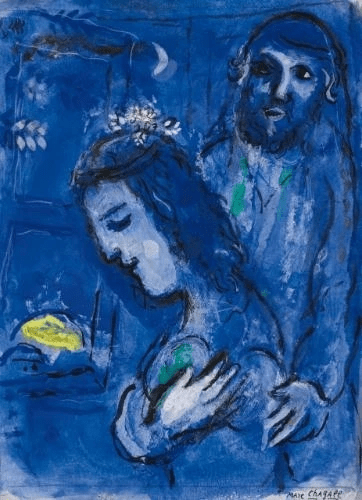
Abraham and Sarah, by Marc Chagall, 1956

One hot summer afternoon while Abraham was sitting by the entrance to his tent near the sacred trees of Mamre, the Lord appeared to him. Abraham looked up and saw three men standing nearby. He quickly ran to meet them, bowed with his face to the ground, and said, “Please come to my home where I can serve you. I’ll have some water brought, so you can wash your feet, then you can rest under a tree. Let me get you some food to give you strength before you leave. I would be honored to serve you.”

“Thank you very much,” they answered. “We accept your offer.”

Abraham went quickly to his tent and said to Sarah, “Hurry! Get a large sack of flour and make some bread.” After saying this, he rushed off to his herd of cattle and picked out one of the best calves, which his servant quickly prepared. He then served his guests some yogurt and milk together with the meat.

While they were eating, he stood near them under the tree, and they asked, “Where’s your wife Sarah?”

“She is right there in the tent,” Abraham answered.

One of the guests was the Lord, and he said, “I’ll come back about this time next year, and when I do, Sarah will already have a son.”

Sarah was behind Abraham, listening at the entrance to the tent. Abraham and Sarah were very old, and Sarah was well past the age for having children. So she laughed and said to herself, “Now that I am worn out and my husband is old, will I really know such happiness?”

The Lord asked Abraham, “Why did Sarah laugh? Does she doubt that she can have a child in her old age? I am the Lord! There is nothing too difficult for me. I’ll come back next year at the time I promised, and Sarah will already have a son.” (Contemporary English Version)

You never know what a day will bring.

Abraham and Sarah woke up one morning and went about their daily routines. But when they went to bed that night, their lives were turned upside-down. After all, God has a way of shaking up our lives, in a good way.

There’s nothing quite like an unsolicited promise. It seems the old couple, Abraham and Sarah, had come to grips with their childlessness. But the Lord was about to upset the status quo, in a good way.

“To one who has faith, no explanation is necessary. To one without faith, no explanation is possible.”

St. Thomas Aquinas

A divine promise was made. The only thing Abraham and Sarah needed to do was believe – and, well, do what a couple needs to do to conceive a child. I don’t know many couples who are sexually active at 100 years old. It certainly would take an act of faith to believe that you could become impregnated and give birth to a baby at that age.

True belief results in decisive action. Abraham and Sarah believed and God’s promise was activated in their lives, not only changing the couples’ life, but also transforming history. The experience taught them to keep their heads up and continue looking ahead for the fulfillment of all God’s good promises.

By faith Abraham obeyed when he was called to go out to a place that he was going to receive as an inheritance. He went out without knowing where he was going.

By faith he lived in the land he had been promised as a stranger. He lived in tents along with Isaac and Jacob, who were coheirs of the same promise. He was looking forward to a city that has foundations, whose architect and builder is God.

By faith even Sarah received the ability to have a child, though she herself was barren and past the age for having children, because she believed that the one who promised was faithful. So descendants were born from one man (and he was as good as dead). They were as many as the number of the stars in the sky and as countless as the grains of sand on the seashore. (Hebrews 11:8-12, CEB)

Sometimes faith seems laughable. Belief in God, or at least in God’s promise, might appear by some to be about as possible or relevant as getting a hamburger named after you at Burger King. But faith, nonetheless, is very real and very needed.

Without faith, there’s no hope, and no basis for love. Belief is the foundation from which we construct a life. Faith imagines and actualizes a new reality, even when that reality seems improbable, impossible, and far-fetched.

In the New Testament Gospels, there were people who believed Jesus could heal their paralyzed friend. They envisioned a different reality than the one their friend was experiencing.

Some people brought to him a paralyzed man on a mat. Seeing their faith, Jesus said to the paralyzed man, “Be encouraged, my child! Your sins are forgiven”…. Then Jesus turned to the paralyzed man and said, “Stand up, pick up your mat, and go home!” And the man jumped up and went home! (Matthew 9:2, 6b-7, NRSV)

The size of the faith is not the issue – it is in whom that faith is placed. The littlest of faith in Jesus can have massive results, whereas the biggest of faith in someone who cannot get you to the other side gets no results.  Small information put into action through placing complete trust in Jesus makes all the difference.

“I [Jesus] assure you that if you have faith the size of a mustard seed, you could say to this mountain, ‘Go from here to there,’ and it will go. There will be nothing that you can’t do.” (Matthew 17:20, CEV)

God is ready to open a new future to us. And, indeed, it will be a good, just, and right future beyond what we ourselves can even ask or imagine. We just need a bit of faith to see the impossible become possible.

You never know what a day will bring. Maybe today you’ll experience a faith so laughable that it will change your life forever.

O heavenly Father, in whom we live and move and have our being: We humbly pray you to guide and govern us by the Holy Spirit, so that in all the cares and occupations of our life we may not forget you, but may remember that we are ever walking in your sight, and so, trust in your grace and goodness, through Jesus Christ our Lord. Amen.

The Blessing (Genesis 17:15-22)

By American artist Julie Lonneman

God said to Abraham, “Don’t call your wife by the name Sarai anymore. Instead, her name is Sarah [Princess]. I will bless her, and I will also give you a son by her. I will bless her, and she will become a mother of nations, and kings will come from her.” Immediately, Abraham bowed with his face touching the ground. He laughed as he thought to himself, “Can a son be born to a hundred-year-old man? Can Sarah, a ninety-year-old woman, have a child?” Then Abraham said to God, “Why not let Ishmael be my heir?”

God replied, “No! Your wife Sarah will give you a son, and you will name him Isaac [He Laughs]. I will make an everlasting promise to him and his descendants. I have heard your request about Ishmael. Yes, I will bless him, make him fertile, and increase the number of his descendants. He will be the father of 12 princes, and I will make him a great nation. But I will make my promise to Isaac. Sarah will give birth to him at this time next year.” When God finished speaking with Abraham, he left him. (God’s Word Translation)

Life can only be lived with faith. We all believe in something, in someone. It’s just a matter of what or whom we place our faith in. Whomever we direct our faith, that is where we give our allegiance and obedience.

As for Abraham and his wife Sarah, they had their faith in the God who called them from Ur of the Chaldees. They demonstrated their belief by doing exactly what the Lord said to do – they went West to the land God would show them. (Genesis 12:1-5)

Abraham and Sarah listened to God and acted accordingly.

I don’t want to cross over into TMI territory (Too Much Information) yet I want us to consider what had to take place when the Lord tells the old couple they will have a baby next year. Here’s where the faith and action comes in: It is highly unlikely that a 100-year-old man and a 90-year-old woman were sexually active. But the Lord essentially told them to get going on conceiving a child. So, they did!

I can’t speak for Abraham and Sarah, but I know as a grandfather that I am really glad I don’t have to raise kids anymore. It makes me exhausted just thinking about it, at my age, so I’ve got to believe it crossed their minds, too. Maybe that’s why Abraham sort of pleaded with God to let Ishmael be the son of promise; the reality of being responsible for a newborn was maybe the last thing on old Abe’s mind.

But faith they had, as the New Testament attests:

Even when Sarah was too old to have children, she had faith that God would do what he had promised, and she had a son. Her husband Abraham was almost dead, but he became the ancestor of many people. In fact, there are as many of them as there are stars in the sky or grains of sand along the seashore. (Hebrews 11:11-12, CEV)

Genuine belief results in decisive action. At Abraham and Sarah’s age, sex may likely have seemed a safety hazard. Yet, they were submissive to God’s plan that divine promises would come through Isaac – who was indeed born the next year, just as the Lord said.

Abraham and Sarah by Marc Chagall, 1956

All this is consistent with the names “Abraham” and “Sarah.” Names were (and still are in most of the world) important identifiers of personal character – particularly toward what sort of person one would become.

God made a name change for the old couple. “Abram,” meaning “exalted father,” was changed to “Abraham,” “father of many nations.” “Sarai” was altered to “Sarah,” yet both names have the same meaning: “Princess.” (Genesis 17:3-8, 15-16)

The change of names was meant to communicate the promise of divine blessing from God for the future. All the world will be blessed through the covenant made with Abraham. Sarah’s alteration of name, though only in form and not substance, brought to the fore that Sarah, too, had a special purpose along with her husband in blessing the world.

Today, this blessing is still unfolding. Throughout all history, since the time of Abraham and Sarah over four millennia ago (c.2100 B.C.E.), the divine ripples of God’s covenant with them have moved across the earth.

Their progeny, through Isaac, the son of the promise, the Jewish people, continue to exist as arguably the most resilient group on the planet. We, especially Christians and Muslims, owe a great debt to the Jews for persevering in faith for such a long stretch of time. They have much to teach us, if we have ears to hear and hearts receptive.

Since the time of Christ, the blessing has extended well beyond the physical descendants of Abraham and Sarah:

Is this blessedness only for the circumcised [Jews] or also for the uncircumcised [Gentiles]? We have been saying that Abraham’s faith was credited to him as righteousness. Under what circumstances was it credited? Was it after he was circumcised, or before? It was not after, but before! And he received circumcision as a sign, a seal of the righteousness that he had by faith while he was still uncircumcised. 

So then, Abraham is the father of all who believe but have not been circumcised, in order that righteousness might be credited to them. And he is then also the father of the circumcised who not only are circumcised but who also follow in the footsteps of the faith that our father Abraham had before he was circumcised….

Therefore, the promise comes by faith, so that it may be by grace and may be guaranteed to all Abraham’s offspring—not only to those who are of the law but also to those who have the faith of Abraham. He is the father of us all. As it is written: “I have made you a father of many nations.” He is our father in the sight of God, in whom he believed—the God who gives life to the dead and calls into being things that were not.

Against all hope, Abraham in hope believed and so became the father of many nations, just as it had been said to him, “So shall your offspring be.” Without weakening in his faith, he faced the fact that his body was as good as dead—since he was about a hundred years old—and that Sarah’s womb was also dead. 

Yet he did not waver through unbelief regarding the promise of God but was strengthened in his faith and gave glory to God, being fully persuaded that God had power to do what he had promised. This is why “it was credited to him as righteousness.” The words “it was credited to him” were written not for him alone, but also for us, to whom God will credit righteousness—for us who believe in him who raised Jesus our Lord from the dead. He was delivered over to death for our sins and was raised to life for our justification. (Romans 4:9-12, 16-25, NIV)

May you know the depth and breadth of your faith, that it stretches far beyond this time and place. And may the blessing of God almighty – Father, Son, and Spirit – be upon you and remain with you, now and forever. Amen.