From Good to Bad (1 Kings 11:26-40)

Also, Jeroboam son of Nebat rebelled against the king. He was one of Solomon’s officials, an Ephraimite from Zeredah, and his mother was a widow named Zeruah.

Here is the account of how he rebelled against the king: Solomon had built the terraces and had filled in the gap in the wall of the city of David his father. Now Jeroboam was a man of standing, and when Solomon saw how well the young man did his work, he put him in charge of the whole labor force of the tribes of Joseph.

About that time Jeroboam was going out of Jerusalem, and Ahijah the prophet of Shiloh met him on the way, wearing a new cloak. The two of them were alone out in the country, and Ahijah took hold of the new cloak he was wearing and tore it into twelve pieces. Then he said to Jeroboam, “Take ten pieces for yourself, for this is what the Lord, the God of Israel, says:

“‘See, I am going to tear the kingdom out of Solomon’s hand and give you ten tribes. But for the sake of my servant David and the city of Jerusalem, which I have chosen out of all the tribes of Israel, he will have one tribe. I will do this because they have forsaken me and worshiped Ashtoreth the goddess of the Sidonians, Chemosh the god of the Moabites, and Molek the god of the Ammonites, and have not walked in obedience to me, nor done what is right in my eyes, nor kept my decrees and laws as David, Solomon’s father, did.

“‘But I will not take the whole kingdom out of Solomon’s hand; I have made him ruler all the days of his life for the sake of David my servant, whom I chose and who obeyed my commands and decrees. I will take the kingdom from his son’s hands and give you ten tribes. I will give one tribe to his son so that David my servant may always have a lamp before me in Jerusalem, the city where I chose to put my Name. 

“However, as for you, I will take you, and you will rule over all that your heart desires; you will be king over Israel. If you do whatever I command you and walk in obedience to me and do what is right in my eyes by obeying my decrees and commands, as David my servant did, I will be with you. I will build you a dynasty as enduring as the one I built for David and will give Israel to you. I will humble David’s descendants because of this, but not forever.’”

Solomon tried to kill Jeroboam, but Jeroboam fled to Egypt, to Shishak the king, and stayed there until Solomon’s death. (New International Version)

The prophet Ahijah speaking to the future king, Jeroboam, by Gerard Hoet, 1728

The Good and the Bad

People were originally created by a good God for the purpose of goodness. After forming the first people, Adam and Eve, God looked at humanity and said that it was “very good.” (Genesis 1:26-28, 31)

Yet, even though we all have been created good, that which is bad entered the world by means of the devil. And ever since that time, people in every era have struggled between their inherent design and their innate desires for something different. (Genesis 3:1-20)

Even King Solomon, with all of his great and God-given wisdom, eventually drifted into the bad. He succumbed to allowing other gods to come alongside the worship of the One true God. And there were consequences to those choices.

Recovering the Word “Sin”

“Sin” is a word that isn’t much used anymore. On the one hand, this is okay since the term has been much abused by many a misguided preacher. Yet, on the other hand, it’s a word which needs to be recovered, so that we will learn to avoid the bad and live into our good as image-bearers of God.

As the head of all Israel and Judah, Solomon had a grand kingdom. His father, David, was a man after God’s own heart. So, God established a covenant with David that there would always be one of his descendants on the throne. Solomon followed in his father’s footsteps and expanded the borders of Israel, bringing a level of prosperity and wealth never seen before or since.

And yet, either despite or because of Solomon’s wild success, bits of disobedience began to occur. Perhaps Solomon simply rested on his own laurels; or maybe he could not envision anything other than ongoing abundance. But for whatever reason, King Solomon started gravitating toward having more than he needed and ignored the instructions given to the people by God:

The king, moreover, must not acquire great numbers of horses for himself or make the people return to Egypt to get more of them, for the Lord has told you, “You are not to go back that way again.” He must not take many wives, or his heart will be led astray. He must not accumulate large amounts of silver and gold. (Deuteronomy 17:16-17, NIV)

And that is precisely what happened. Solomon had 700 wives (women of royal birth) and 300 concubines (women of common origin). And all those women served a variety of gods in a cornucopia of religious practices – some of which were downright inhumane and unjust. (1 Kings 11:1-13)

None of us are immune from falling into the guilt and shame of disobedient sin. For Solomon, this had the consequence of having the kingship almost completely ripped from his descendants to another man’s, Jeroboam.

Individuals, institutions, and nations have the potential for both great good, as well as heinous evil. When anyone begins to be concerned only for themselves and rests on their success, instead of the Lord, they have set up themselves for a collapse through the displeasure of God.

Stories of people who topple into sin are all close to the same – having some power, they use it to assert control over another person or group to obtain whatever they want. King Solomon violated God’s law. Not only that, but when he saw his control threatened, he sought to kill Jeroboam. Perhaps Solomon thought he was above all this, and believed he could do whatever he wanted. But he couldn’t.

Sin causes us to sell-out our principles 

Sin only begets more sin until we deal with it. Sin will always distort the truth so that we minimize the impact of our words, choices, and actions. Truth celebrates openness and honesty; sin seeks the shadows and prizes secrecy. 

The first step to dealing with sin is not to minimize it, ignore it, or pretend it isn’t a big deal. If we do not go down this path of truth, then we will be forever encrusting our lives with ways of ensuring that no one ever knows the sinful secrets. 

In fact, much of religious legalism is nothing more than a person piling on the rules in order for others to not see the sin that hides deep within. In Christianity, turning from the sin and receiving the grace of forgiveness in Jesus Christ is the true and real path to spiritual wholeness, happiness, and success in life.

Results that satisfy us do not necessarily satisfy God

Solomon accomplished what he wanted – some of it very good, and some of it very bad. The good was celebrated, and the bad was covered up. Yet, God sees all of it, celebrating with us the good, but not going with us down the path of self-indulgent sin.

We cannot simply assume that because we do something, and there was no immediate lightning strike, that it was okay. It does not matter if it happened yesterday, last month, or twenty years ago. If we did not deal with the sin, God is not satisfied because he wants to dispense grace; love and a flourishing soul cannot happen if we keep putting things out-of-sight out-of-mind. To only satisfy ourselves is being a spiritual cannibal who eats other people alive.

Outward success and abundance means little to God if the inward state leadership is a vacuous soul, bereft of authentic spiritual connection, with no determination toward God’s intentions for a particular course of action. 

Sin is not something to simply be managed; it is to be put to death through the cross of Christ, and applied to life through intentional spiritual practices meant to genuinely connect with God. 

For the Christian, to do less is to wander into a morass of consequences that damage others, not to mention harming ourselves. So, let us do the work of soul care so that the common good of all will thrive in the grace of God in Christ.

God, you have given all peoples one common origin.
It is your will that they be gathered together
as one family in yourself.
Fill the hearts of mankind with the fire of your love
and with the desire to ensure justice for all.
By sharing the good things you give us,
may we secure an equality for all
our brothers and sisters throughout the world.
May there be an end to division, strife and war.
May there be a dawning of a truly human society
built on love and peace.
We ask this in the name of Jesus, our Lord. Amen.

A Prayer of Blessing (1 Kings 8:54-65)

Solomon, by Marc Chagall (1887-1985)

As soon as Solomon finished praying and making these requests to the Lord, he got up from before the Lord’s altar, where he had been kneeling with his hands spread out to heaven. He stood up and blessed the whole Israelite assembly in a loud voice: 

“May the Lord be blessed! He has given rest to his people Israel just as he promised. He hasn’t neglected any part of the good promise he made through his servant Moses. 

May the Lord our God be with us, just as he was with our ancestors.

May he never leave us or abandon us. 

May he draw our hearts to him to walk in all his ways and observe his commands, his laws, and his judgments that he gave our ancestors. 

And may these words of mine that I have cried out before the Lord remain near to the Lord our God day and night so that he may do right by his servant and his people Israel for each day’s need, and so that all the earth’s peoples may know that the Lord is God.

There is no other God! Now may you be committed to the Lord our God with all your heart by following his laws and observing his commands, just as you are doing right now.”

Then the king and all Israel with him sacrificed to the Lord. Solomon offered well-being sacrifices to the Lord: twenty-two thousand oxen and one hundred twenty thousand sheep when the king and all Israel dedicated the Lord’s temple. 

On that day the king made holy the middle of the courtyard in front of the Lord’s temple. He had to offer the entirely burned offerings, grain offerings, and the fat of well-being sacrifices there, because the bronze altar that was in the Lord’s presence was too small to contain the entirely burned offerings, the grain offerings, and the fat of the well-being sacrifices. 

At that time Solomon, together with all Israel, held a celebration. It was a large assembly from Lebo-hamath to the border of Egypt. They celebrated for seven days and then for another seven days in the presence of the Lord our God: fourteen days in all. (Common English Bible)

Prayer is arguably one of the most significant works a spiritual person could ever do.

Why do I say that?

Because we, as people (especially Americans!) tend to be focused on solutions, fixes, and getting things done. We work hard; and if it doesn’t work out, then we pray.

Yet prayer is a needed activity from the get-go. Prayer is to be infused from the beginning to the end. Prayer is to be our very breath.

Relying solely on our strength, smarts, and stamina – on self – may yield some results; but the human touch cannot provide like the divine touch. Trusting in all else, besides God, shall eventually fail.

Now this I know:
    The Lord gives victory to his anointed.
He answers him from his heavenly sanctuary
    with the victorious power of his right hand.
Some trust in chariots and some in horses,
    but we trust in the name of the Lord our God.
They are brought to their knees and fall,
    but we rise up and stand firm. (Psalm 20:6-8, NIV)

King Solomon prayed. He prayed before building a temple to the Lord. He prayed during construction. He offered prayers after its erection and provided prayers of dedication to it.

And, in today’s Old Testament lesson, Solomon was faithful to pray and bless the people who participated in the building, as well as all the people who would worship at the temple.

Biblical prayers are solid theological models for us in our own prayers. They give us some needed form and function, directing us in how to pray and what the content of those prayers ought to be.

So, I offer this prayer of blessing for you, based in Solomon’s to the people:

Blessed be the Lord our God, who has given peace to people, just as he said he’d do. Since we have been justified through faith, we have peace with God through our Lord Jesus Christ. Not a one of all those good and wonderful promises that God spoke has failed.

May the God and Father of our Lord Jesus Christ, our very own God, continue to be with us just as he was with all of our spiritual ancestors.

May God never give up and walk out on us.

May God keep us Christo-centric, revolving our entire lives around him, devoted to him, following the life path he has cleared, being attentive to the words and ways of Jesus, walking at the pace and the rhythms he laid down for us to follow and observe.

May these words that I pray in the presence of God be always before the divine throne, day and night, so that the Lord will do what is right, just, and fair for us and for all people everywhere.

May mercy and justice reign day after day after day. Then all the people on earth will know God is the true God; there is no other God.

And may your lives be totally obedient to God, following the path of righteousness the Lord has cleared, alert and attentive to avoid the path of temptation, through Jesus Christ our Lord, in the strength of the Holy Spirit. Amen.

Companions (1 Kings 19:19-21)

Depiction of Elijah anointing Elisha as a prophet, Aylesford Priory, Maidstone, UK

Elijah left and found Elisha plowing with a team of oxen; there were eleven teams ahead of him, and he was plowing with the last one. Elijah took off his cloak and put it on Elisha. Elisha then left his oxen, ran after Elijah, and said, “Let me kiss my father and mother good-bye, and then I will go with you.”

Elijah answered, “All right, go back. I’m not stopping you!”

Then Elisha went to his team of oxen, killed them, and cooked the meat, using the yoke as fuel for the fire. He gave the meat to the people, and they ate it. Then he went and followed Elijah as his helper. (Good News Translation)

Some background…

Elijah was a prophet during a very hard time in Israel’s history. Ahab, a terribly unjust and wicked king, had led the nation away from the worship of Yahweh and toward the worship of Baal. Things were bad – both religiously and meteorologically; there was a drought of rain and a drought of God’s words.

The prophet Elijah stepped out and took on the powerful king and his diabolical wife, Jezebel. As a result, he had to go into hiding and bide his time. For about three years, Elijah was mostly on his own, moving around, trying to avoid Ahab’s wrath, just trying to stay alive during the drought.

Although Elijah’s physical needs were cared for by the Lord, the years of aloneness took their toll.

Finally, things came to a head. There was a showdown between the hundreds of Baal prophets and the lone prophet of Yahweh, Elijah. It was a dramatic encounter marked by a huge victory of the Lord through Elijah’s faith and courage.

Yet, when it was all over, and spiritual revival was transforming the land, Elijah was physically and emotionally exhausted. In fact, the darkness of depression enveloped him.

So, Elijah had a “come-to-Yahweh-meeting” which was both gracious and much needed. The prophet took the time to sleep, eat, and experience the Lord.

But, going forward, things would be different. No more going alone for Elijah. He needed a companion.

So, God instructed Elijah to specifically go to Elisha and anoint him as the next prophet of Yahweh. Which is exactly what Elijah did.

Some help…

The prophet Elijah flat-out needed help; and God knew it.

Elijah had been in his own personal slimy pit experience of exhaustion and depression. The Lord helped him get out of it. God knows better than any of us that people need one another for encouragement, companionship, giving and receiving love, and being both a mentor and a mentee.

Sheer independence isn’t even what God does, so why in the world do any of us believe we need to be that way?

Christians serve a triune God of Father, Son, and Spirit. God is One, and God is also Community. As people created in the image and likeness of God, we were formed for unity and community with others. Therefore, it is necessary for us to have healthy dynamics of relational interactions. Elijah needed his inner balance restored through working with Elisha.

Some insight….

Not only does Elijah’s story enlighten our need for relational ministry, but Elisha’s experience also provides some insightful perspective on what it means to connect with others.

I can imagine what Elisha’s life must have been like before being anointed a prophet of the Lord. Having grown up on a midwestern American farm, I know the kind of work it takes. Elisha was out there every day. On one particular day, just like many of the other days of farm labor, he’s at the end of the work train – in the back slowly moving along with his animals, trying to get a field plowed.

Then, in the mundane dirty work of plowing, the prophet Elijah comes strolling along and puts his cloak on Elisha, thereby clearly communicating to him that he is being called to become a prophet himself.

Elisha immediately responds and goes all in with following Elijah. And with a demonstrative act of setting out on a new life, Elisha takes his means of making a living, the oxen, and kills them, cooks them over a fire made from the wooden plow and yoke, and feeds a bunch of people. He then walks away, for good.

Maybe Elisha was in his own slimy pit of depression, feeling like his life was going nowhere. We don’t really know. Yet, God chose Elisha, just like he chose Elijah, to be a prophet. Perhaps the Lord knew Elisha needed this as much as Elijah did.

Some reflection….

What, or who, do you need today?

I have found that it’s a common misunderstanding with many Christians that as long as they read their Bible, pray, and rely on the Holy Spirit, that everything will go peachy dandy. And when it doesn’t, they castigate themselves for being down or depressed or in dire straits.

It just could be that you’re trying to go it alone without the help of other people. It also could be that you have a history in which the folks you believe needed to help you, didn’t; and now you’re determined to do life alone without anyone hurting you again.

It might be that the Lord wants to use someone else besides the people you think ought to help. And it also could be that you’ve put limits on how God can work. But, really, who are you or I to tell God whom he can love us through?

Let yourself be open to the ministry of others. Be a companion.

Bless us with Love, O Merciful God;
That we may Love as you Love,
That we may show patience, tolerance,
Kindness, caring and love to all!
O Compassionate One, grant compassion to us;
That we may help all fellow souls in need.
Bless us with your Love, O God,
Bless us with your Love. Amen.

1 Kings 3:5-14 – A Prayer for Discernment

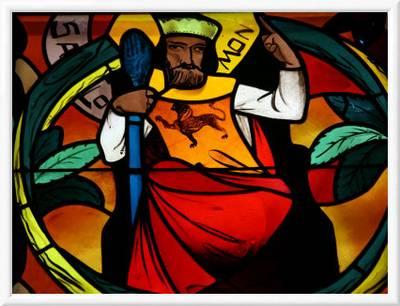
Stained glass window of King Solomon in Saint-Joseph Des Fins Church, France

The Lord appeared to Solomon at Gibeon in a dream at night. God said, “Ask whatever you wish, and I’ll give it to you.”

Solomon responded, “You showed so much kindness to your servant my father David when he walked before you in truth, righteousness, and with a heart true to you. You’ve kept this great loyalty and kindness for him and have now given him a son to sit on his throne. And now, Lord my God, you have made me, your servant, king in my father David’s place. But I’m young and inexperienced. I know next to nothing. But I’m here, your servant, in the middle of the people you have chosen, a large population that can’t be numbered or counted due to its vast size. Please give your servant a discerning mind in order to govern your people and to distinguish good from evil, because no one is able to govern this important people of yours without your help.”

It pleased the Lord that Solomon had made this request. God said to him, “Because you have asked for this instead of requesting long life, wealth, or victory over your enemies—asking for discernment so as to acquire good judgment— I will now do just what you said. Look, I hereby give you a wise and understanding mind. There has been no one like you before now, nor will there be anyone like you afterward. I now also give you what you didn’t ask for: wealth and fame. There won’t be a king like you as long as you live. And if you walk in my ways and obey my laws and commands, just as your father David did, then I will give you a very long life.” (Common English Bible)

You will recognize today’s Old Testament lesson as being the same as yesterday – just in a different book of the Bible. The books of 1 and 2 Chronicles are a restatement and edited version of 1 and 2 Kings. That’s because each was written in a different time for a particular context. Kings was compiled at the time of the Jewish exile when the Babylonians captured Jerusalem. Chronicles was put together for the exiles returning to Jerusalem.

Both accounts were meant to be lessons in how to live rightly as God’s people. For the people going into exile, the Kings narrative was to serve as a remembrance of how far the people had strayed from their roots in basic life wisdom.

“It is said that wisdom lies not in seeing things, but seeing through things.”

Manly P. Hall

Solomon was a very wise king. And today’s lesson makes it clear why. At the outset of his reign, Solomon could have asked for anything from God. A typical request might be for power in subduing enemies, popularity for appealing to the masses, or perks for maintaining political stability. 

Instead, Solomon asked for understanding and wisdom to govern God’s people so that he could discern between good and evil. It was the kind of asking which the Lord was pleased to hear and to give. All these millennia later, Solomon still has the reputation of being the wisest king that ever lived.

Solomon’s prayer resonates with me. As a church pastor, rather than focusing prayers on a bigger budget, more people reached, or adding programs, I can make the choice to pray for wisdom so that I will have my ministerial ladder on the right wall. 

As a hospital chaplain, instead of praying for greater visibility of the spiritual in healthcare, increased impact within the system, or more healing of patients, I can pray for understanding so that I will be able to make sound ethical, practical, and ministerial decisions in each context and case I encounter.

Solomon’s request was borne of a clear realization of who God is (the One who shows steadfast love) and who he himself is (like a little child with a big responsibility). God’s greatness and Solomon’s humility collided in a wonderful prayer for discernment to carry out God’s will on earth and to bless God’s people.

In this time of year, in which it is vogue to make New Year’s resolutions based upon the individual’s willpower, let’s take a different approach. Let’s pray and invite God to do the kind of deep change needed in our lives so that we can accomplish the will of God on this earth for this time. 

May we pray for discernment to serve well, ask for wisdom to be good stewards of our callings, and seek understanding from the God who delights in answering altruistic requests from humble people.

May you walk in the way of wisdom so that you will make good decisions and act in all good understanding.

Lord God, give me a mind and heart of wisdom so that I might rightly discern good and evil, right and wrong, and the best decisions to made in every situation. I choose to seek your ways and follow the narrow way of Jesus Christ through the enablement of your Holy Spirit. Amen.