Isaiah 11:1-10 – All I Want for Christmas Is a Savior

The Lion and the Lamb by Aaron Spong

A shoot will come up from the stump of Jesse;
    from his roots a Branch will bear fruit.
The Spirit of the Lord will rest on him—
    the Spirit of wisdom and of understanding,
    the Spirit of counsel and of might,
    the Spirit of the knowledge and fear of the Lord—
and he will delight in the fear of the Lord.

He will not judge by what he sees with his eyes,
    or decide by what he hears with his ears;
but with righteousness he will judge the needy,
    with justice he will give decisions for the poor of the earth.
He will strike the earth with the rod of his mouth;
    with the breath of his lips he will slay the wicked.
Righteousness will be his belt
    and faithfulness the sash around his waist.

 The wolf will live with the lamb,
    the leopard will lie down with the goat,
the calf and the lion and the yearling together;
    and a little child will lead them.
The cow will feed with the bear,
    their young will lie down together,
    and the lion will eat straw like the ox.
The infant will play near the cobra’s den,
    and the young child will put its hand into the viper’s nest.
They will neither harm nor destroy
    on all my holy mountain,
for the earth will be filled with the knowledge of the Lord
    as the waters cover the sea.

In that day, the Root of Jesse will stand as a banner for the peoples; the nations will rally to him, and his resting place will be glorious. (Isaiah 11:1-10, NIV)

Christians believe Isaiah’s prophecy to speak of Jesus in whom all these virtues exist in wonderful perfection and practice. Jesus Christ has so clearly identified with us that we are in a vital union with him.  He still exists here on earth in the person of the Holy Spirit.  Jesus was sent by the Father.  With the Father and the Son, the Spirit was sent to press the redemptive events of Jesus into the believer’s heart.  This is basic Trinitarian theology.  Yet these are not abstract ideas.  Prayer, discernment, and listening are the pathways forward to discovering the wisdom, counsel, and knowledge we need to live and serve well as Christians.

In some quarters of Christianity, the church exists as a mere stump of its former existence. For many Christians, daily experience of the Spirit has been supplanted by individual ingenuity, hard work, and getting ahead through accumulation of more and more.  Basic Christian spirituality then becomes a mere shadow of its former influence.  If we desire the Spirit of the Lord to rest upon us, we will seek Christ as our foremost importance.  

Indeed, it is when we are worn down to a stump and have no ability to grow or sustain life anymore that God enters, specializing in giving hope to the hopeless, justice for the poor, wisdom to the confused, and peace to all who desire a harmonious world.

In the awful feelings of helplessness and hopelessness, there is a faint sign of life. A fresh shoot becomes discernible. Could there be possibility amidst such impossible circumstances? Can there be life again? Do I dare hope again? Will things really change, and do so for the better?

The answer is “yes.” For where the Spirit of the Lord blows there is the force of resurrection power, spiritual energy, and fresh courage. Where others see only three-dimensional impossibilities, the believer has the capacity of faith to see multi-dimensional possibilities. The Spirit’s force generates possibility where none existed before. When the breath of God whispers to the sprout in the stump, pessimistic despair turns to optimistic hope, even joy.

Jesus Christ is the Christian’s hope. In Christ, there is security, well-being, and life. With Jesus, there is a vision of justice in which all persons receive what they need to live, thrive, and flourish in God’s world. Christ operates to our advantage and on our behalf without the personal greed and indifference of so many earthly rulers. The weak and vulnerable have a champion in Jesus. Renewal and restoration become very real possibilities.

I have lately taken a liking to a show called “The Repair Shop,” a British television series in which family heirlooms which have sentimental value for their owners are carefully restored by experts. What captivates me about the show is how one person can take an old broken-down item (and by all appearances now a piece of junk) and restore it to its once glorious newness.

There is more to my captivation of the show. I am struck by the sheer pleasure the restorers take in handling the old object, enjoying the process. Just by the looks on their faces, I can tell they consider it a privilege to be restoring such a precious object of the past.

Artisan Steve Fletcher restoring an 18th century French clock

I am sure this is precisely how God feels with us. Rather than envisioning the Lord as some reluctant deity who feels put out with having to rescue a bunch of dumb and wayward people, God is One who has delight in taking this old stump of fallen damaged humanity and restoring us to our original luster and beauty. Transformation is God’s specialty, and the Lord goes about the process of restoration with great care and delight.

The impossible possibility of God’s new creation is poetically described in the peaceful co-existence of animals and creatures who are inconceivably together without fear or violence. There is a time coming when death will be no more, and so, the necessity in this life of hunter and prey shall be forever negated. No more snakes terrorizing women and children. No more big fishes eating little ones. No more human fat cats preying upon and striking poison on the smaller and vulnerable.

The presence of the godly Ruler means the world will be governed rightly, detoxified of its sinful impurities; a place where the poor, the weak, and the little lambs will indeed be safe and secure forever. There will be peace because of the Prince of Peace. All creation will be full of God, and thus, free of all malice.

This beautiful prophecy from Isaiah envisions a deep, radical, limitless transformation in which there will be no more appetite to injure another; no more desire to devour another; no more lust for selfish control of another; and no more destructive passion for domination over others.

It is a thorough renovation of the human heart, human institutions, the animal kingdom, and even every blade of grass in creation. The Apostle Paul had this grand vision of God in mind when he wrote to the Church at Rome:

The creation waits in eager expectation for the children of God to be revealed. For the creation was subjected to frustration, not by its own choice, but by the will of the one who subjected it, in hope thatthe creation itself will be liberated from its bondage to decay and brought into the freedom and glory of the children of God. We know that the whole creation has been groaning as in the pains of childbirth right up to the present time. Not only so, but we ourselves, who have the first fruits of the Spirit, groan inwardly as we wait eagerly for our adoption to sonship, the redemption of our bodies. (Romans 8:19-23, NIV)

The implication for us as humanity was voiced by Paul to the Colossian Church:

Now you must rid yourselves of all such things as these: anger, rage, malice, slander, and filthy language from your lips. Do not lie to each other, since you have taken off your old self with its practices and have put on the new self, which is being renewed in knowledge in the image of its Creator. Here there is no Gentile or Jew, circumcised or uncircumcised, barbarian, Scythian, slave or free, but Christ is all, and is in all. (Colossians 3:8-11, NIV)

The transformation is all-pervasive, impacting everything public while also being intimately personal. It is a gift from God; it is the impossible made possible. And it is this precise thing which we acknowledge, celebrate, and long for in the season of Advent. When the angel came to Mary and communicated that Isaiah’s vision was coming to reality through her womb, Mary astonishingly retorted:

“How will this be, since I am a virgin?”

The angel, with supreme confidence, answered Mary as a matter of fact:

“The Holy Spirit will come on you, and the power of the Most High will overshadow you. So, the holy one to be born will be called the Son of God…. For no word from God will ever fail.”

Mary’s response gives voice to our own desires and longings for the new order of things:

“I am the Lord’s servant. May your word to me be fulfilled.” (Luke 1:34-38, NIV)

This is our confession, too. I am the Lord’s servant. You are the Lord’s servant. May God’s word to us about the coming of Christ be fulfilled, just as Isaiah has said. The hopes and fears of all the years are met in Jesus on a bright starry night.

Matthew 25:14-30 – The Parable of the Talents

Welcome, friends. Although we are socially distanced, let us be spiritually connected through our worldwide communion with all the saints. Click the video below and, by God’s grace, we will be linked with the blessing of Christ…

The following is an animated take on Christ’s parable of the talents…

Jesus’ Parable of the Talents. Completed 2012 from http://www.max7.org.

And consider this song as we consider our own gifts…

We All Have Gifts to Share by Susan Kay Wyatts

May each of you use whatever gift you have received to serve others, as faithful stewards of God’s grace in its various forms.

Hebrews 9:11-15 – Monday of Holy Week

Wood Cross

When the Messiah arrived, high priest of the superior things of this new covenant, he bypassed the old tent and its trappings in this created world and went straight into heaven’s “tent”—the true Holy Place—once and for all. He also bypassed the sacrifices consisting of goat and calf blood, instead using his own blood as the price to set us free once and for all. If that animal blood and the other rituals of purification were effective in cleaning up certain matters of our religion and behavior, think how much more the blood of Christ cleans up our whole lives, inside and out. Through the Spirit, Christ offered himself as an unblemished sacrifice, freeing us from all those dead-end efforts to make ourselves respectable, so that we can live all out for God. (The Message)

The Christian Holy Week is an opportunity to embrace the value and practice of journeying with Jesus.  Just as birthday and anniversary celebrations allows us a different rhythm of life for a time, or as holidays provide us with certain family traditions, so Holy Week can be a special and unique time of contemplation and reflection on the last week of Christ’s earthly life.  As we journey with Jesus, consider the days of this week:

Palm Sunday is a focus on the entry of Christ into Jerusalem to shouts of “Hosanna! Blessed is he who comes in the name of the Lord!”

Monday of Holy Week looks ahead to Christ’s sacrifice with Mary’s anticipatory grief through a heartfelt and beautiful anointing of Jesus’ feet with her hair and her tears.

Tuesday of Holy Week depicts the difficulty of the disciples in wrapping their hearts and minds around what Jesus is telling them about his impending death.

Wednesday of Holy Week is known in some Christian traditions as “Spy Wednesday” because we remember that Jesus was betrayed by Judas, a clandestine spy among the disciples.

Maundy Thursday marks three significant events in Christ’s last week:  his washing of the disciples’ feet; his institution of the Lord’s Supper; and, his new commandment to love one another.

Good Friday marks the death of Jesus Christ.  It is “good” because his death means redemption for the world.  We especially remember why the cross is so very important, that it is the once-for-all sacrifice to end all sacrifices.  There is now eternal forgiveness.

Holy Saturday remembers the death of Jesus and his body in the grave with the Romans securing and keeping guard over it.

Easter Sunday is the culmination of all the expectations of God’s people, and the fulfillment of all God’s promises to them in Christ.  We rejoice, celebrate, and renew our love and commitment to God for raising Jesus from death.  His resurrection means new life for us.  He is risen, indeed!

Observing Holy Week is rather different this year.  Whereas this week typically takes the form of attending special church services, we are presently reliant on virtual community and spiritual presence.  It seems to me that, more than ever, we are reminded of our wonderful privilege in a worldwide community of redeemed persons who together are focusing on the life and death of Jesus.  If ever there was a time to realize our incredible connection with believers across the earth in contemplation and celebration together as Christ’s own Church, now is such a time.

Together with Christ’s Church throughout the globe we have opportunity to read treasured Christian Scriptures over the course of the week and to focus on the passion narratives in the Gospels.  For the follower of Jesus Christ, these are the fundamentals of our faith, the base upon which our eternal lives are constructed.  We return to the redemptive events of Jesus again and again so that for the entirety of the year we can live in careful devotion to the Savior who has brought us salvation from sin and offers new life.

Holy Week is here.  So, we choose to remember and give thanks with both quiet gratitude and loud shouts of praise, with solemn reflection and expressive response.  There is no time like it in the year.

Grant to us, Almighty God, that in our weakness we might be revived and renewed through the Passion of your one and only Son Jesus, our Lord, who lives and reigns with you and the Holy Spirit, one God, now and forever.  Amen.

Job 13:13-19 – Contending with God

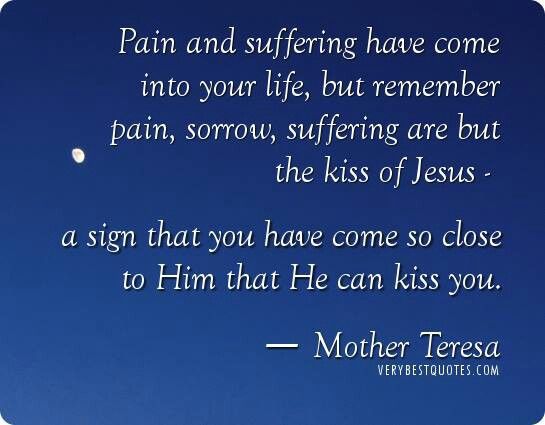
Mother Teresa suffering quote

“Keep silent and let me speak;
then let come to me what may.
Why do I put myself in jeopardy
and take my life in my hands?
Though he slay me, yet will I hope in him;
I will surely defend my ways to his face.
 Indeed, this will turn out for my deliverance,
for no godless person would dare come before him!
Listen carefully to what I say;
let my words ring in your ears.
Now that I have prepared my case,
I know I will be vindicated.
Can anyone bring charges against me?
If so, I will be silent and die. (NIV)

The story of the biblical character, Job, is both famous and infamous.  It’s famous among most bible readers because we are privy to why Job endured such terrible suffering and how the story ends.  Conversely, the story is infamous because Job’s “friends” and most everyone else in his day believed that the extremely hard circumstances were proof positive of sin.  Job had the misfortune of being misunderstood and misinterpreted with an evil, infamous, reputation.

Job was understandably desperate.  He hadn’t a clue why he lost his every earthly possession and relationship, not to mention his health.  Job was hurt, angry, and lonely.  In today’s Old Testament text, we observe Job getting ready to have-it-out with God.  It is interesting to me that in such grinding physical, emotional, and spiritual pain as Job experienced, he held to both his own integrity and of confidence in God.

If this story strikes a familiar chord, it may be because this was also Christ’s experience.  Jesus did nothing unethical or immoral to deserve being whipped, beaten, and tortured.  Our Lord, like Job, felt the awful sting of silence stating, “My God, my God, why have you forsaken me?” (Matthew 27:46).  As we fast approach Holy Week, the Lectionary reminds us that there must be suffering before glory, crucifixion before resurrection, agony before victory.

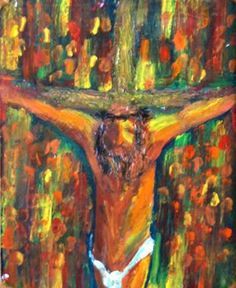
Christ on the Cross
Painting by Hans Mertens

I wonder what humanity would be like if we stopped fighting so hard against suffering and instead leaned into it as a teacher and a means of awareness.  For the Christian, I am curious what the Church everywhere would be like if she embraced suffering as the path of solidarity with Jesus. I wonder what human interactions on the personal, corporate, and global level would look like if people throughout the earth would stare this current pandemic through their spiritual eyes and imagine as Old Testament scholar Walter Brueggemann does:

“We may imagine God doing a new thing among us. Perhaps we are arriving at a new neighborly normal:

  • Imagine, we are treating prisoners differently, even releasing some who constitute no threat
  • Imagine, we are mobilizing generous financing for needy neighbors who must have resources in order to survive.
  • Imagine, we are finding generous provisions for students and their debts.

The new thing God is making possible is a world of generous, neighborly compassion.”

When we are stripped of wealth, cut-off from others, and do not know how to make sense of the suffering around us and in our own lives – it is in such a time that we are invited to consider a few observations from the story of Job:

  1. Much, if not most, of life is a mystery – including God. We are neither all-knowing nor all powerful.  Our nation’s perceived power and intellectual savvy expose deep fissures of pride and hubris.  Events like pandemics reveal that there is so much we don’t know and must learn.  We will likely never get all the answers we want when tragedy hits and lives are turned upside-down.
  2. Confronting and contending with God is okay, perhaps even encouraged. Unlike the human creature, the Creator God is big enough to take and absorb whatever anger, rage, disappointment, discouragement, depression, fist-shaking, and expletives we throw at him.
  3. Suffering does not mean that God has forgotten us. We may not understand why or even what we go through.  We will, however, never go through it alone.  God is often silent; yet, never aloof.  God maintains both his transcendence high above us and his immanence close to us at the same time, all the time.  In the Christian tradition, this is why the Holy Spirit was given – to be the continuing presence of Jesus on this earth.

My prayer for you today is that your suffering will not be wasted – that God will bend each adverse situation toward your good and the good of others.

Soli Deo Gloria

Click How Deep the Father’s Love for Us sung and mixed by David Wesley as we anticipate the suffering of Christ on our behalf in this next Holy Week.