
Living Water and Real Food (John 4:5-42)

Jesus and the Samaritan Woman, by He Qi

So he came to a town in Samaria called Sychar, near the plot of ground Jacob had given to his son Joseph. Jacob’s well was there, and Jesus, tired as he was from the journey, sat down by the well. It was about noon.

When a Samaritan woman came to draw water, Jesus said to her, “Will you give me a drink?” (His disciples had gone into the town to buy food.)

The Samaritan woman said to him, “You are a Jew and I am a Samaritan woman. How can you ask me for a drink?” (For Jews do not associate with Samaritans.)

Jesus answered her, “If you knew the gift of God and who it is that asks you for a drink, you would have asked him and he would have given you living water.”

“Sir,” the woman said, “you have nothing to draw with and the well is deep. Where can you get this living water? Are you greater than our father Jacob, who gave us the well and drank from it himself, as did also his sons and his livestock?”

Jesus answered, “Everyone who drinks this water will be thirsty again, but whoever drinks the water I give them will never thirst. Indeed, the water I give them will become in them a spring of water welling up to eternal life.”

The woman said to him, “Sir, give me this water so that I won’t get thirsty and have to keep coming here to draw water.”

He told her, “Go, call your husband and come back.”

“I have no husband,” she replied.

Jesus said to her, “You are right when you say you have no husband. The fact is, you have had five husbands, and the man you now have is not your husband. What you have just said is quite true.”

“Sir,” the woman said, “I can see that you are a prophet. Our ancestors worshiped on this mountain, but you Jews claim that the place where we must worship is in Jerusalem.”

“Woman,” Jesus replied, “believe me, a time is coming when you will worship the Father neither on this mountain nor in Jerusalem. You Samaritans worship what you do not know; we worship what we do know, for salvation is from the Jews. Yet a time is coming and has now come when the true worshipers will worship the Father in the Spirit and in truth, for they are the kind of worshipers the Father seeks. God is spirit, and his worshipers must worship in the Spirit and in truth.”

The woman said, “I know that Messiah” (called Christ) “is coming. When he comes, he will explain everything to us.”

Then Jesus declared, “I, the one speaking to you—I am he.”

Just then his disciples returned and were surprised to find him talking with a woman. But no one asked, “What do you want?” or “Why are you talking with her?”

Then, leaving her water jar, the woman went back to the town and said to the people, “Come, see a man who told me everything I ever did. Could this be the Messiah?” They came out of the town and made their way toward him.

Meanwhile his disciples urged him, “Rabbi, eat something.”

 But he said to them, “I have food to eat that you know nothing about.”

Then his disciples said to each other, “Could someone have brought him food?”

“My food,” said Jesus, “is to do the will of him who sent me and to finish his work. Don’t you have a saying, ‘It’s still four months until harvest’? I tell you, open your eyes and look at the fields! They are ripe for harvest. Even now the one who reaps draws a wage and harvests a crop for eternal life, so that the sower and the reaper may be glad together. Thus the saying ‘One sows and another reaps’ is true. I sent you to reap what you have not worked for. Others have done the hard work, and you have reaped the benefits of their labor.”

Many of the Samaritans from that town believed in him because of the woman’s testimony, “He told me everything I ever did.” So when the Samaritans came to him, they urged him to stay with them, and he stayed two days. And because of his words many more became believers.

They said to the woman, “We no longer believe just because of what you said; now we have heard for ourselves, and we know that this man really is the Savior of the world.” (New International Version)

Samaritan Woman and Jesus at the Well, by He Qi

Samaria, back in Christ’s day, was viewed by many as an infamous place, full of untrustworthy people who were a mongrel mix of Jewish and ancient Assyrian blood. And their religion was most suspect of all – an unholy blend of Jewish and Gentile practices. So, no respectable Jewish person ever got near Samaria or even talked with a Samaritan.

Jesus, however, saw things differently. He did not avoid the territory but confidently walked through Samaria. Christ had no problem stopping to rest on his journey in a foreign area. That’s because Jesus didn’t class people into groups, nor did he attach adjectives to people, such as “those” Samaritans. He had no obstacles between himself and others.

Which is why an organic conversation happened between Jesus and a Samaritan woman. Christ simply saw a human being who happened to be a woman and a Samaritan. He acknowledged both her gender and her ethnicity without those being a problem. Not even Christ’s knowledge of her string of husbands was an issue in conversing with her.

Every time I read this narrative of Jesus interacting with the Samaritan woman, I imagine what all the non-verbal communication was like. I’m sure the conversation was as much about Christ’s affect, gestures, and tone of voice, as it was his well-placed words. I fully believe both his verbal and non-verbal communication was perfectly congruent with each other, giving the woman a compelling sense that her ultimate needs could be met with the living well of a person in front of her.

Water gives life. And Jesus, as living water, gives new life. A bunch of failed relationships testified to the woman’s dissatisfaction. Even though we hear no more about her after this story in the Bible, we as readers get the overwhelming sense that the woman finally found satisfaction. The love which kept slipping through her fingers now had staying power.

Jesus stood and said in a loud voice, “Let anyone who is thirsty come to me and drink. Whoever believes in me, as Scripture has said, rivers of living water will flow from within them.” (John 7:37-38, NIV)

We need the living water of Jesus as a river flowing straight from him to us — replenishing, renewing, sustaining, and breaking through every barrier in its path like a mighty flood overcoming and pushing everything out of the way that blocks its path so that our love can overflow onto all sorts of people, like a Samaritan woman.

The disciples come along, seemingly confused about this scene of Jesus and a Samaritan woman. So they blurt out something like the stereotypical mother concerned for her son saying, “Sit down and eat some of Mama’s pasta. You need some food!” As if preparing and serving a meal will make everything better.

Food has both the power to bring us together, as well as separate us. A meal can create the conditions for fellowship, acceptance, and enjoyment. On the other hand, sitting down to eat can also be a way to avoid painful emotions, and so, becomes an obstacle, keeping love at bay.

The disciples were uncomfortable and maybe a bit stressed. Looking to fill up with food instead of with God, their sense of unfulfillment was coming out sideways by opening the pantry and looking for comfort food. Jesus saw through the situation and put the focus on the disciples’ spiritual hunger.

Paying attention to our vocation and discovering humble work in the service of God, rather than a vacation to the fridge to cover unwanted feelings, is the essence of Christ’s interaction with his disciples.

People are much more ready for the gospel than we think. There are times we can become insular, lost within our own heads, that we are then unable to see the world as ripe for a harvest of people who are eager to be gathered into a community of redemption and love.

Jesus had a significant interaction with the Samaritan woman – despite the social prohibitions of the time. Shenanigans like this, by Christ, got a lot of people’s  undies in a bundle. The disciples, having a front seat to most of Christ’s ways, did a few too many palms to the forehead, believing their Rabbi’s behavior was going to make him unpopular. They feared no one would follow him.

Looks like the disciples didn’t quite get that one right.

The Samaritan woman received Jesus as Living Water, having her ultimate needs met by the Lord of all. The disciples hadn’t quite caught up to this, so fell back on their old ways of physical food and drink to assuage the awkward uncomfortable feelings happening inside them.

The woman became a wellspring of good news to her community. Whereas the disciples eventually became a fountain of the gospel after Christ’s death and resurrection, they are here only an annoying drip from the kitchen faucet. A non-descript ethnically suspect woman of dubious character coming to faith was meant by Jesus to open the disciples’ eyes to a new reality:

The good news of Christ is meant for the world, not just Jewish men.

The disciples were given the opportunity to participate a mission of bringing the love of God where love wasn’t present, of helping all kinds of people awaken to the deep spirituality within them, of lifting their downcast faces of guilt and shame to see the Living God bless the world with the body and blood of Jesus.

All of our work, no matter how big or small, is made possible by God, the great Chef of the universe. God has done all the preparations of chopping the onions, mincing the garlic, slicing the carrots, and peeling the potatoes so that we, his followers, can make a savory stew of diverse people sharing a common pot of God’s love and hospitality. It is, therefore, our privilege to be the wait staff who serves the meal to a whole host of persons.

O God, you made us in your own image, and you have redeemed us through your Son Jesus Christ: Look with compassion on the whole human family; take away the arrogance and hatred which infect our hearts; break down the walls that separate us; unite us in bonds of love; and work through our struggle and confusion to accomplish your purposes on earth; that, in your good time, all nations and races may serve you in harmony around your heavenly throne; through Jesus Christ our Lord. Amen.

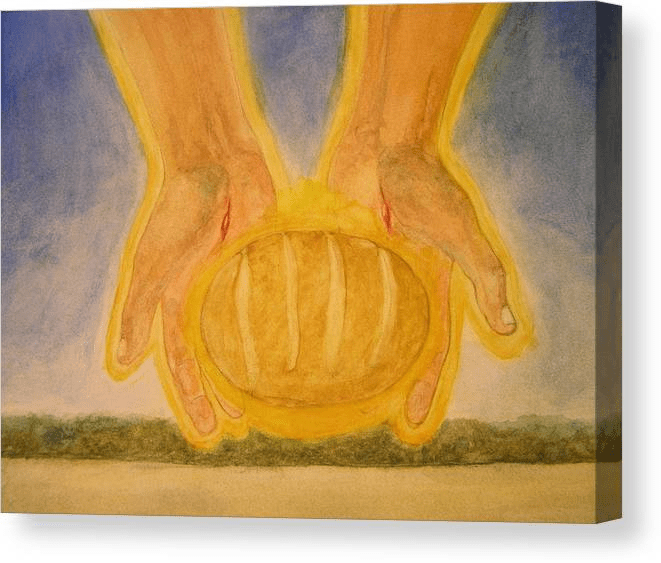
Bread from Heaven (Exodus 16:27-35)

Bread From Heaven, by Nigel Wynter

On the seventh day some people went out to gather food, but they didn’t find any. The Lord said to Moses, “How long will you refuse to do what I have commanded and instructed you to do? Remember: The Lord has given you this day of rest as a holy day. That’s why he gives you enough food on the sixth day for two days. On the seventh day stay in your place—no one is to go out. Everyone, stay where you are.” So the people never worked on the seventh day of the week.

The Israelites called the food manna. It was like coriander seeds. It was white and tasted like wafers made with honey.

Moses said, “This is what the Lord has commanded: Take two quarts of manna to be kept for your descendants. This way they will see the food that I gave you to eat in the desert when I brought you out of Egypt.”

Moses said to Aaron, “Take a jar, put two quarts of manna in it, and put it in the Lord’s presence to be kept for your descendants.” Aaron put the jar of manna in front of the words of God’s promise to be kept there, as the Lord commanded Moses.

The Israelites ate manna for 40 years until they came to a place to settle. They ate manna until they came to the border of Canaan. (God’s Word Translation)

“What is it?” is the quite literal meaning of the word manna. And the answer is: It is bread from heaven.

The manna was food for the Israelite people in their 40 years of sojourning through the desert. There is also an implicit question surrounding this bread: What to do with it? Well, of course, you eat it. But, before eating it, there are issues and instructions about the manna’s arrival and collection.

The special food, only graciously given to this particular group of cantankerous people, appeared in the mornings for six days a week, not seven, and only had a shelf life of one day, with the exception of the singular Sabbath day each week.

There is a time to go out and gather, and there is a time to stay put and eat; a time to work, and a time to rest. The lack of wisdom in timing could cost you not only a meal, but also your overall sense of paying attention to God’s commands.

It is the fool who spurns the relationship between events, that is, the space between when the Lord speaks and when humanity responds. Our human responsibility is dependent upon Divine sovereignty. Ignoring the voice of God, or simply failing to listen out of present anxieties or fears, will nearly always result in a skewed response-ability.

Yes, indeed, we all have very legitimate needs for cuisine, clothing, companionship, care, and compassion. If these vital needs go unmet, we are undone and shall die. Yet, there is also the question of how we will go about getting those very important and basic needs met – and many people, having not listened well to the instructions about life, will go about attempting to meet those needs in illegitimate ways.

Trying to satisfy legitimate needs through illegitimate means ends up eroding the soul, compromising character, and searing the conscience. It’s inevitable that such a person will grumble and complain, projecting on God the evil that is, in reality, residing within the human heart.

Whenever folks go out and try to gather what isn’t there, they have lost their way and their very real needs will not really be met, at all.

This is why humans need remembrances – to have reminders of what time it is and what’s important to do and not do, to seek the appropriate paths of living well, and to avoid the pitfalls of dead end trails.

One purpose of Sabbath is to remember – to recall the great story of deliverance and never forget where we came from, so that we will continually have before us where we are going.

I Am the Bread of Life, by Joseph Matar

The Christian remembers the saving and redemptive events of Jesus by coming to the Table. We gather together to ingest bread from heaven, to partake of the Bread of Life. For those who choose to carefully listen and pay attention, the words of Christ will not only speak life into our weary selves, but shall also shape how we go about getting our needs met and satisfied:

The people began to murmur in disagreement because he had said, “I am the bread that came down from heaven….”

But Jesus replied, “Stop complaining about what I said. For no one can come to me unless the Father who sent me draws them to me, and at the last day I will raise them up. As it is written in the Scriptures, ‘They will all be taught by God.’ Everyone who listens to the Father and learns from him comes to me….

“I tell you the truth, anyone who believes has eternal life. Yes, I am the bread of life! Your ancestors ate manna in the wilderness, but they all died. Anyone who eats the bread from heaven, however, will never die. I am the living bread that came down from heaven. Anyone who eats this bread will live forever; and this bread, which I will offer so the world may live, is my flesh.”

Then the people began arguing with each other about what he meant. “How can this man give us his flesh to eat?” they asked.

So Jesus said again, “I tell you the truth, unless you eat the flesh of the Son of Man and drink his blood, you cannot have eternal life within you. But anyone who eats my flesh and drinks my blood has eternal life, and I will raise that person at the last day. For my flesh is true food, and my blood is true drink. Anyone who eats my flesh and drinks my blood remains in me, and I in him. I live because of the living Father who sent me; in the same way, anyone who feeds on me will live because of me. I am the true bread that came down from heaven. Anyone who eats this bread will not die as your ancestors did (even though they ate the manna) but will live forever.” (John 6:41-58, NLT)

Consider well, then, where and how you will find the sustenance of the soul, love, and in what ways you will listen to the words of Jesus and gather them for your next meal. Will you hoard your heaven-sent food, or will you share?

O God, our Provider and Sustainer, we who are many are one body in Christ, for we all share in the one bread. Refresh, strengthen, and preserve us as we journey in this life, in the name of Jesus Christ. Amen.

Be Resilient, Not Resistant (Exodus 16:9-21)

The Israelites gather manna in the desert, by Ercole de’ Roberti (1451-1496)

Then Moses told Aaron, “Say to the entire Israelite community, ‘Come before the Lord, for he has heard your grumbling.’”

While Aaron was speaking to the whole Israelite community, they looked toward the desert, and there was the glory of the Lord appearing in the cloud.

The Lord said to Moses, “I have heard the grumbling of the Israelites. Tell them, ‘At twilight you will eat meat, and in the morning you will be filled with bread. Then you will know that I am the Lord your God.’”

That evening quail came and covered the camp, and in the morning there was a layer of dew around the camp. When the dew was gone, thin flakes like frost on the ground appeared on the desert floor. When the Israelites saw it, they said to each other, “What is it?” For they did not know what it was.

Moses said to them, “It is the bread the Lord has given you to eat. This is what the Lord has commanded: ‘Everyone is to gather as much as they need. Take an omer for each person you have in your tent.’”

The Israelites did as they were told; some gathered much, some little. And when they measured it by the omer, the one who gathered much did not have too much, and the one who gathered little did not have too little. Everyone had gathered just as much as they needed.

Then Moses said to them, “No one is to keep any of it until morning.”

However, some of them paid no attention to Moses; they kept part of it until morning, but it was full of maggots and began to smell. So Moses was angry with them.

Each morning everyone gathered as much as they needed, and when the sun grew hot, it melted away. (New International Version)

Despite the grumbling and complaining, the Lord determined to do good, even though the ancient Israelites in the desert were quite unworthy of it. It is to God’s glory to act according to the divine nature of mercy and grace, unlike the mass of humanity.

What’s more, the Lord not only freely gave, but also provided abundantly for the people – and all they had to do was go out and gather what God so mercifully bestowed. No matter what people do or don’t do, the Lord is always true to character, showing steadfast love.

Most of the people responded with obedience to God’s instructions concerning the manna from heaven. Yet, there were still some who ignored the commands, preferring to act with avarice by hoarding the abundance of food gathered.

A miser collects with a stingy attitude and cruel heart; but the Lord takes it away with maggots, moths, or any other creature God calls upon to correct the erring person. An individual is part of a society that is to be concerned for the whole of their citizens.

Whether hoarding or handing out, everyone is meant to move through an unwanted situation or missed expectation with faith and resilience. The following are three simple phrases to keep in mind and practice amidst the complexity of overwhelming circumstances:

Let it be

Accept the situation as it is and not as you want it to be. Embrace the awkward and uncomfortable. Situations, such as wondering where your next meal is coming from, aren’t helped with grumbling. We need to face what is actually in front of us.

Sometimes you were publicly exposed to insult and persecution; at other times you stood side by side with those who were so treated. You suffered along with those in prison and joyfully accepted the confiscation of your property, because you knew that you yourselves had better and lasting possessions. So do not throw away your confidence; it will be richly rewarded. (Hebrews 10:33-35, NIV)

Let it go

Difficult feelings and a more than a few unhelpful thoughts pop up for us when experiencing trouble. Try to see the big picture and consider alternative thoughts. Let go of the disobedient thoughts and bitter feelings.

Repent, then, and turn to God, so that your sins may be wiped out, that times of refreshing may come from the Lord, and that he may send the Messiah, who has been appointed for you—even Jesus. (Acts 3:19-20, NIV)

Let it in

Open yourself to God’s Spirit, self-compassion, and cut yourself some slack. You are going through a hard thing. Reflect on what you handled well, and also what you could have done differently.

For we do not have a high priest who is unable to empathize with our weaknesses, but we have one who has been tempted in every way, just as we are—yet he did not sin. Let us then approach God’s throne of grace with confidence, so that we may receive mercy and find grace to help us in our time of need. (Hebrews 4:15-16, NIV)

The process – let it be, let it go, and let it in – is a circuitous path and not a neat linear progression. You will get all your needs met, and so, move at pace that works for you, instead of trying to compulsively gather manna at someone else’s anxious pace.

Let grumbling be turned to gratitude, murmuring to mercy, and complaining to consent. This is the path of resilience.

Heavenly Father, you have promised to hear what we ask in the Name of your Son: Accept and fulfill our petitions, we pray, not as we ask in our ignorance, nor as we deserve in our sinfulness, but as you know and love us in your Son Jesus Christ our Lord. Amen.

Evicting Complaints (Exodus 16:1-8)

On the fifteenth day of the second month after the Israelites had escaped from Egypt, they left Elim and started through the western edge of the Sinai Desert in the direction of Mount Sinai. There in the desert they started complaining to Moses and Aaron, “We wish the Lord had killed us in Egypt. When we lived there, we could at least sit down and eat all the bread and meat we wanted. But you have brought us out here into this desert, where we are going to starve.”

The Lord said to Moses, “I will send bread down from heaven like rain. Tell the people to go out each day and gather only enough for that day. That’s how I will see if they obey me. But on the sixth day of each week they must gather and cook twice as much.”

Moses and Aaron told the people, “This evening you will know that the Lord was the one who rescued you from Egypt. And in the morning you will see his glorious power, because he has heard your complaints against him. Why should you grumble to us? Who are we?”

Then Moses continued, “You will know it is the Lord when he gives you meat each evening and more than enough bread each morning. He is really the one you are complaining about, not us—we are nobodies—but the Lord has heard your complaints.” (Contemporary English Version)

Every person on planet earth knows what a complaint is. That’s because we’ve all complained about something and we’ve all been the brunt of someone else’s complaining. To handle grumblers, we need to first deal with our own complaining spirit. 

Early in the book of Genesis, Adam and Eve disobeyed God. That caused their attitudes to change. Whereas their original reflex responses in the Garden of Eden were to enjoy God and be open, their automatic emotional reflexes after the fall were to hide, blame, and guard themselves. 

Adam’s first response to God after his disobedience was to point the finger at Eve: “The woman you put here with me – she gave me some fruit from the tree, and I ate it.”  And Eve’s initial reflex attitude was to shift the blame, as well: “The serpent deceived me, and I ate” (Genesis 3).

Ever since, people have had an automatic attitude of blaming, quarreling, and complaining. The heart drifts toward complaint as if by some gravitational pull because grumbling seems a reasonable response to disappointing events.

Generally, complaints show up as an uninvited guest. You return home from a frustrating day to discover that complaint has moved into your guest room, unpacked its luggage, started a load of laundry, and is rooting through your fridge.

Even as you work to evict complaint—as you move its bags to the curb and change the locks on your doors—it somehow crawls back into the guest room window. Complaint is highly resistant to eviction. 

Before you know it, over time, complaint becomes familiar, even right. With every struggle, we become like the Israelites murmuring in the desert (Exodus 16-17). Although God wants to prepare our faith for works of service in the world, we are hunkered down with complaint, watching TV together, and grumbling through every show and each conversation.

We can discourage complaint’s residency in our lives by inviting another guest to move in with us. That new guest is a prayerful attitude of trust and gratitude. When we choose to trust God and give thanks in the face of deep disappointment, complaint has less space to maneuver.

While attempting to unpack for an extended stay, complaint discovers that trust and gratitude have taken all the drawers in the guest room and already occupy the empty seat at the supper table. Faith and gratitude evict complaint because faith and a grumbling spirit are not able to live in the same house together. One inevitably pushes the other one out.

The ancient Israelites experienced a miraculous deliverance from harsh slavery in Egypt. The Lord parted the Red Sea so that they could walk across on dry ground and escape the Egyptian army’s pursuit. It’s easy to praise God when great things happen, and the Israelites had a whopper of a praise and worship service after that deliverance. Yet it’s quite another thing to praise and trust God when trouble happens – and when it keeps happening over and over again. 

Immediately after the praise and worship, Moses led the people into the desert. There was no water. God deliberately led the people into a difficult situation to test their faith. The Israelites quickly forgot the blessings and began grumbling about their situation. 

Their reflex response was to complain and ignore God’s direct commands. Maybe they did so because they spent four-hundred years of slavery in Egypt, and complaint had made such a home with them that it was second nature to murmur about their situation.

I keep a small c-clamp in my office to remind me that I am not in control, but God is. It isn’t my job to hold the universe together. The c-clamp also reminds me that I need to keep a clamp on my tongue when it comes to grumbling and complaining. Sins of the tongue are some of the most dominant forms of disobedience to God throughout Holy Scripture. 

All kinds of animals, birds, reptiles, and sea creatures can be tamed and have been tamed. But our tongues get out of control. They are restless and evil, and always spreading deadly poison. (James 3:7-8, CEV)

I wonder, can any of us go 24 hours without complaining about something or someone? 

Those who cannot answer “yes” must recognize that’s a real problem. If you cannot go 24 hours without drinking liquor, you are addicted to alcohol. And if you cannot go 24 hours without grumbling about something or someone, then you have lost control over your tongue and you are addicted to murmuring and have an adulterous relationship with complaint.

We must invite everlasting life to take up permanent residence. We need to evict the squatter of complaint. 

God is with us. Difficult circumstances, trouble, hard situations, problem people, and the seeming impossibility that things will not change doesn’t mean God moved out of your house. Instead, it’s evidence that the Lord wants us to exercise our faith.

Let God do it.

O God:
Give us all strength to live another day without grumbling, arguing, or complaining;
Let us not lose faith in other people and withdraw from them, or you, out of spite;
Keep our hearts tender in spite of the ingratitude, treachery, or meanness around us;
Help us to maintain purity of heart, and to live in faith and confidence, so that failure cannot dishearten us;
Open wide our spiritual eyes so that we may see the good in all things;
Inspire us with the spirit of joy and gladness;
and make us worthy and competent servants to suffering souls;