Romans 7:7-20 – Facing Our Bundle of Contradictions

contradiction
“Humanity is an embodied paradox, a bundle of contradictions.”-Charles Caleb Colton, 1780-1832

What shall we say, then? Is the law sinful? Certainly not! Nevertheless, I would not have known what sin was had it not been for the law. For I would not have known what coveting really was if the law had not said, “You shall not covet.” But sin, seizing the opportunity afforded by the commandment, produced in me every kind of coveting. For apart from the law, sin was dead. Once I was alive apart from the law; but when the commandment came, sin sprang to life and I died. I found that the very commandment that was intended to bring life actually brought death. For sin, seizing the opportunity afforded by the commandment, deceived me, and through the commandment put me to death. So then, the law is holy, and the commandment is holy, righteous and good.

Did that which is good, then, become death to me? By no means! Nevertheless, in order that sin might be recognized as sin, it used what is good to bring about my death, so that through the commandment sin might become utterly sinful.

We know that the law is spiritual; but I am unspiritual, sold as a slave to sin. I do not understand what I do. For what I want to do I do not do, but what I hate I do. And if I do what I do not want to do, I agree that the law is good. As it is, it is no longer I myself who do it, but it is sin living in me. For I know that good itself does not dwell in me, that is, in my sinful nature. For I have the desire to do what is good, but I cannot carry it out. For I do not do the good I want to do, but the evil I do not want to do—this I keep on doing. Now if I do what I do not want to do, it is no longer I who do it, but it is sin living in me that does it. (NIV)

The Apostle Paul’s vulnerable expression of his dilemma resonates deeply with many people. There are times when we say things to ourselves such as, “I told myself I wasn’t going to be like my mother, and here I am responding just like she would;” “I know better than to drive by the liquor store on my way home and pick up a pint of vodka, yet, I still did it;” or, “I don’t want to die, but my thoughts keep racing about a plan for suicide.” And, there are many more situations in which we are both frustrated and befuddled by our doing the things we do not want to do, and not doing the things we want to do.

Yes, indeed, Paul’s existential angst is a timeless description of our common human condition. We all can relate to the seeming inability to do what is right in so many situations. It can really drive us nuts, even to a constant and never-ending low-level discouragement that underlies almost everything we do.

Paul’s prescription for dealing with this does not rely on law. He understood that putting our willpower and effort into obeying commands gets us nowhere because we will eventually fail. Neither our brains nor our spirits work that way. Our willpower was never designed to be the driver of what we do and do not do. If anything, willpower, and the lack thereof demonstrate just how much we are climbing the ladder on the wrong wall. People are a bundle of contradictions, doing good, then bad, and flip-flopping back and forth with great frustration.

God’s law was not crafted to transform us from the inside-out. The law has three solid purposes, none of which are meant to bring deep personal transformation: attention to the law works to restrain sin in the world; use of the law provides us with a helpful guide for grateful living in response to divine grace; and, it’s use here by Paul is to show us how bad off we really are in this world and in need of forgiveness.

We need a change of habits, and this is different than adopting a list of laws. Habits are developed from our desires, our affections. In other words, we do what we love – more specifically, our ultimate love(s) drive us to do what we want. To put it in a straightforward way: We sin because we like it. And the path to overcoming any besetting sin is to have an ultimate love trump the lesser sin which we like.

St Augustine quote 2

For example, I have developed daily habits or rituals of faith which enable me to commune with God. I love God with all my heart, soul, mind, and strength, and this ultimate love enables me to push out all competing gods who want my devotion. I also love my wife with all my heart. We work on developing habits of a marital relationship which reinforce our love for each other. Love is what drives me to do right and good by her.

So, what do we do when we mess up? For the Christian, no matter what the question is, the answer is always grace. God’s grace in the finished work of Jesus Christ applied to us by the Holy Spirit is the operative power that changes lives. The law has no power to do that kind of work. Freedom from the tyranny of our misplaced desires and disordered loves comes from Christ’s forgiveness through the cross. Like a lover enamored with his beloved, our desires become oriented toward Jesus for his indescribable gift to us. That is the strength of grace.

Saving God, I thank you for delivering me from sin, death, and hell through your Son, the Lord Jesus.  May your Holy Spirit apply the work of grace to my life every day so that I can realize spiritual healing and practical freedom from all that is damaging and destructive in my soul.  Amen.

Romans 7:1-6 – Becoming Holy

AgnusDay new creation

Do you not know, brothers and sisters—for I am speaking to those who know the law—that the law has authority over someone only as long as that person lives? For example, by law a married woman is bound to her husband as long as he is alive, but if her husband dies, she is released from the law that binds her to him. So then, if she has sexual relations with another man while her husband is still alive, she is called an adulteress. But if her husband dies, she is released from that law and is not an adulteress if she marries another man.

So, my brothers and sisters, you also died to the law through the body of Christ, that you might belong to another, to him who was raised from the dead, in order that we might bear fruit for God. For when we were in the realm of the flesh, the sinful passions aroused by the law were at work in us, so that we bore fruit for death. But now, by dying to what once bound us, we have been released from the law so that we serve in the new way of the Spirit, and not in the old way of the written code. (NIV)

Romans chapters 6-8 are the Apostle Paul’s pointed discussion of how we become holy in a real and practical way. The theological word we typically use for this is “sanctification,” which means “to become holy,” and “set apart” for God. To be delivered from sin, death, and hell through the person and work of Jesus Christ is not the end of the story; it is just the beginning of becoming a new creation.

Becoming holy and righteous in our everyday lives boils down to this: identity and belonging. One of the healthiest ways of looking at the entirety of the Bible’s message is that we belong to God. Our identities are thoroughly wrapped around Jesus. The process of realizing this and coming to grips with it is how we grow as people in holiness and righteousness.

Because of Christ’s finished work on the cross, we have been delivered from the realm of sin. Our change in status from condemned to accepted provides us the awareness to make daily affirmations of faith and live a new life. However, the sinful nature (flesh) or the old person is still there. Although it is now toothless, our past can and often does exert a powerful influence on us. Even though there is a medium-rare T-bone steak on the table for us to enjoy, there are times we go back to the old bologna sandwich with stale white bread.

Yet, we need no longer live falling short of our true humanity because we belong to God. We are adopted into God’s family, having been orphaned by sin’s cruel influence. Yet, just because we have been saved from the power of sin, sin itself has not become extinct. We still must deal with it. We are alive to God and need to take up this great spiritual reality and live into it, for the force of sin still exists in the world.

We deal with sin’s continued presence (the world, the flesh, and the devil) through embracing God’s grace versus trying to overcome it with the law. Paul used an illustration from marriage to expand our understanding of grafting grace into our daily lives. By law, a married woman is bound to her husband (keeping in mind this sense of belonging was the predominant view of marriage in Paul’s day). Yet, if the husband dies, the wife is released from the legal marriage. If she were to give herself to another man while her husband is still alive and they are married, then she becomes an adulteress. However, if she is a widow, then marries again, she is not an adulteress.

Paul applies this understanding to our relationship with the law. Death has separated us from the law. We died with Christ. Therefore, we have been set free from the law and have become alive to grace. As believers in Jesus, we “belong to another, to him who was raised from the dead” (Romans 7:4). “When Christ’s body hung upon the cross, when God spared not his own Son but gave him up for us all” (Romans 8:32); “when Christ took on himself for us all the curse of the law which inflicted all of us (Galatians 3:13); then, we died to the law. God’s grace has made the death of Jesus the death of all from the realm of sin (2 Corinthians 5:14).

Resized_20170617_114022

As a married man, let me use Paul’s illustration to get down to the gist of his teaching. Yes, I am legally married and belong to my wife. I made vows to my wife on our wedding day which bind me legally to do what I said I would do. Yet, if I fulfill those vows in a strictly legalistic manner, I can vouch for my wife that this would qualify as an acceptable situation for her. You see, my wife (and, me, too!) are freely bound to one another in love and grace. I care for my wife because I love her deeply, and not because it is my legal duty to do so.

The Christian life was neither designed nor meant to serve as a bare legal contract or covenant between us and God. God forbid such a thought! Jesus died to clear us from all the legality stuff so that we could freely love and serve God with joyful abundance and gratitude. You see, I am follower of Jesus because I love him deeply. What impels and motivates me is God’s grace. The law is there and has its place. However, it is not the law that causes me to be a Christian; it is the love of Christ which saved me from myself and compels me to live like Jesus.

We pray that God himself, the God of peace, will make you pure—belonging only to him. We pray that your whole self—spirit, soul, and body—will be kept safe and be blameless when our Lord Jesus Christ comes. The one who chose you will do that for you. You can trust him. (1 Thessalonians 5:23-24, ERV)

Matthew 11:20-24 – “C’mon, Man!”

Jesus angry
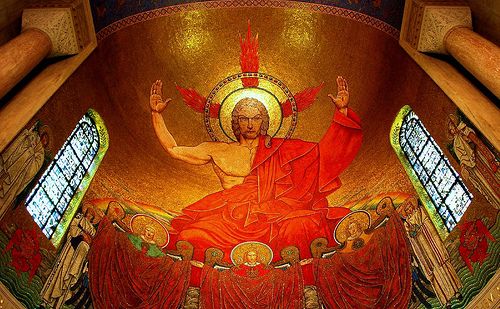
“Christ in Majesty” by Polish artist Jan Henryk de Rosen at the National Shrine of the Immaculate Conception

Then Jesus began to denounce the towns in which most of his miracles had been performed, because they did not repent. “Woe to you, Chorazin! Woe to you, Bethsaida! For if the miracles that were performed in you had been performed in Tyre and Sidon, they would have repented long ago in sackcloth and ashes. But I tell you, it will be more bearable for Tyre and Sidon on the day of judgment than for you. And you, Capernaum, will you be lifted to the heavens? No, you will go down to Hades. For if the miracles that were performed in you had been performed in Sodom, it would have remained to this day. But I tell you that it will be more bearable for Sodom on the day of judgment than for you.” (NIV)

Today’s New Testament lesson from the Gospel of Matthew, recounting the words of Jesus, are not filled with unicorns and butterflies, to say the least. We might be somewhat unfamiliar with these not so famous, maybe even infamous, words from our Lord. Before Jesus tells who is accepted in the kingdom of God (Matthew 11:28-30) he tells us who is not accepted. These scathing words are specifically leveled to the towns in which Christ had performed his ministry of healing and miracles.

We need to hear the hard words of Jesus. Up to this point in Matthew’s Gospel, he has laid out the birth narrative of incarnation in chapters 1-2; the preparation for Christ’s ministry in baptism and being sent to the desert in chapters 3-4; Christ’s teaching on what constitutes a genuine follower of God, the Sermon on the Mount, chapters 5-7; and, chapters 8-10, recording ten miracles which were meant to demonstrate that the kingdom of God has broken into history in the person of Jesus Christ. In chapter 11, Jesus begins leveling a rebuke to the crowd who had observed his ministry and did nothing in response to his works.

For Jesus, the height of hubris was to simply ignore his righteous works of gracious teaching and benevolent healing.

If you are not a fan of Monday Night Football, let me explain a pre-game segment each week during the season called, “C’mon, man!” Each commentator picks out a bonehead play from the previous week that would cause someone to shake their head in dismay and say “c’mon, man!” They are typically situations where the player’s head just was not in the game and they ended up, in some cases, costing their team points or even the game.

Cmon man

Reading Christ’s words sounds a lot like Jesus picking out the towns in which he performed his miracles, and saying to them: “C’mon, man!”  “You saw me cleanse a man from leprosy, heal paralyzed people and a woman with a chronic disease, calm a great storm, exorcise demons from people, give sight to the blind and speech to the mute. You saw all of this, but it has not changed you one bit. You still live the same way you always have and have not come to me as the source of your deliverance… “C’mon, man!”

Notice that Jesus’ denunciation comes not because he was experiencing opposition or persecution; he was denouncing them for their bonehead lack of response and refusal to change their lives to conform to what they were seeing right in front of their faces. The crowd heard his teaching and saw his miracles, and it had no effect on them. So, Jesus gave them a great big “C’mon, man!” Judgment becomes the lot of someone who is unaffected and unresponsive to the vast sea of human need around them, viewing Jesus as just another voice, and living a life of mediocrity in the face of opportunity.

So, what would the segment “C’mon, man!” look like today? What would Jesus say to us? Keep in mind we are people with access to Christ’s teaching. We have the Sermon on the Mount to read, study, meditate upon, and live by – yet, too many [Christians] don’t take the time to examine it with the intent of seeing Jesus and allowing him to change their lives… “C’mon, man!”

The Holy Spirit has been provided, who is the power source of the Christian life. We possess all the resources of grace necessary to step into this world and make a difference, yet so many do nothing but occupy a place in the pew [or couch] because they are too afraid to sacrifice their time in meaningful ministry… “C’mon, man!”

There are neighbors, relatives, and co-workers who are lost and lonely, in need of the kind of grace Jesus gives, yet too many of us are oblivious to them and instead are constantly worried about things that, in the end, don’t really matter at all… “C’mon, man!”

We have opportunities to grow in the grace and knowledge of Jesus Christ through a vast array of available ministries, yet many do not take the chance to change and be spiritually stretched… “C’mon, man!”

Today the words of Jesus are right in front of our faces, and some of us will have the audacity to read them and remain unchanged, unchallenged, and unresponsive… “C’mon, man!”

If our highest values in life are sameness, stability, and security, we may very well, at the least, miss Jesus altogether, and, at worst, find ourselves under his condemnation. These verses are for those whom Jesus has become all too familiar, as if he is just another piece of furniture in the living room – the coffee table with a dusty Bible resting on it.

Perhaps this post may seem a bit out of place on a website which promotes itself as caring. I would like to think of it as obnoxiously caring. I trust you will accept today’s writing and the words of Jesus as caring enough to confront. There are times when Mid-West nice gets us nowhere and we must have hard conversations. Yes, conversations, and not verbal rockets launched from one group to another. Jesus did not denounce from a distance; he did it up close and personal. Furthermore, he was specific and not generic about why he was speaking in the way he did.

So, may you be able to pray this prayer of repentance today with heartfelt conviction:

Almighty God, Father of our Lord Jesus Christ, Sovereign Lord of the universe, Creator of humanity, we, your unfaithful children, are sorry for our sins and the lives that we have lived apart from your grace. We sincerely believe and confess in our hearts that only through the precious blood of our Lord Jesus Christ on the cross, can we obtain your forgiveness.

We repent that: in thought, word, and deed, we have committed serious offences against you and our neighbors. Through spiritual laziness and prideful lust for power, we have provoked hatred, division, despair, and hurt within our communities.

Through our greed, deceit, and indifference, we have inflicted serious damage, unnecessary conflict, and aggravated destruction to those different than us.

Through our selfishness, insensitivity, and bias (both conscious and unconscious) we have encouraged and emboldened those who inflict hurt, pain, and sorrow on those who are already oppressed and poor.

In the name of religion, doctrine, and even of Christ himself, we have wounded fellow believers and those who genuinely pursue a faith different than ours. In stubbornness, pride, and arrogance, we have caused division and strife within your church and among your people.

Mercifully send your Holy Spirit, the Spirit of order and comfort, to cleanse us from all unrighteousness; to restore in us true faith in Christ which brings truth, peace and harmony; and, to help us walk together with our brothers and sisters in the peace of our Lord Jesus Christ, to the glory of your name. Amen.

1 John 4:1-6 – Don’t Believe Everything You Hear

Christ by Carl Abrahams
Christ by Carl Abrahams, 1911-2005

My dear friends, don’t believe everything you hear. Carefully weigh and examine what people tell you. Not everyone who talks about God comes from God. There are a lot of lying preachers loose in the world.

Here’s how you test for the genuine Spirit of God. Everyone who confesses openly his faith in Jesus Christ—the Son of God, who came as an actual flesh-and-blood person—comes from God and belongs to God. And everyone who refuses to confess faith in Jesus has nothing in common with God. This is the spirit of antichrist that you heard was coming. Well, here it is, sooner than we thought!

My dear children, you come from God and belong to God. You have already won a big victory over those false teachers, for the Spirit in you is far stronger than anything in the world. These people belong to the Christ-denying world. They talk the world’s language and the world eats it up. But we come from God and belong to God. Anyone who knows God understands us and listens. The person who has nothing to do with God will, of course, not listen to us. This is another test for telling the Spirit of Truth from the spirit of deception. (MSG)

The Apostle John gave some spiritually sage advice to a group of his disciples. They were being influenced by people who claimed Christian faith yet were not the real deal. Lots of people make claims, but the real muster of a Christian is in embracing an embodied spirituality that truly meets the holistic needs of others.

For John, there was no room for the Platonic Greek dualism of body and spirit. Jesus was a real man with a very real body. To deny this was to deny the faith. Ethereal musings about the insignificance of the body were flatly rejected by John. The apostle was concerned that the supreme Christian ethic of love be practiced through attention to both body and soul.  This means words are not enough; actual demonstrations of love are needed to communicate Christ to others.

I will be the first guy to insist on some deep theological reflection on the great spiritual, cultural, and social issues of our day. Yet, if our theology does not lead to tangible acts of love based on that reflection, then we have not yet been called God’s friend. Correct doctrine will always lead to loving actions of faith.

We are to glorify God with both speech and service, and never just one without the other.

The early church councils condemned the denigration of Christ’s full humanity for good reason. Not only did Jesus have a real flesh and body experience while on this earth, Christ did actual flesh and body healing and actual physical miracles. In other words, Jesus Christ met both the spiritual needs of forgiveness and reconciliation, and the needs of the body. What is more, Jesus had no ranking system, as if the spiritual needs were the real commitments whereas tangible needs were just a means to the end of meeting intangible obligations.

The Gospel is both body and soul and are equally together significant.

To exalt one above the other is, frankly, heresy. So, let’s put this in more practical terms: Love is more than an expression of good feelings and goodwill toward others; love has skin on, using both physical actions and words formed from our vocal chords to bring goodness to others.

Jesus never separated or parsed out a distinction between spiritual and physical needs. No, that would be us who have done that. To be more specific, it is the spiritual charlatan and the huckster preacher who speak out of one side of their mouths about spiritual salvation with no bodily human help or uplift. Those who are against Jesus, the spirit of the antichrist, talk a good line but when push comes to shove, they have no intention of paying attention to both body and soul.

If we go to our gut and listen to it, we know we can trust it. That feeling we cannot quite shake when we are around someone has real meaning. The spirit within us is greater than the spirit of the world.

Just because we may not be able to respond very well to another, or give clear voice to what is inside us, does not necessarily mean that the other person is okay or right.

A proper Christian response to others incorporates head, heart, and gut. The interaction and alignment of all our faculties is needed. If we draw upon our entire selves, both body and soul, we will overcome the spirit of the antichrist through loving words and actions toward those who need it most. The Antichrist wants us to get caught up in putting all our focus fighting theological battles and debating philosophical ideas – while our neighbor next door is dying of cancer; our co-worker is experiencing covert racism; and, our friend is stuck in poverty.

Since Jesus is fully human, that fact alone ought to impel us toward meeting the needs of the body – without wondering if it is the spiritual thing to do, or not. You already know this to be true. So, don’t let some esoteric preacher or teacher tell you otherwise.

God Almighty, the creator and preserver of all humanity, I humbly ask: Please make your ways known to everyone and your saving health to all nations. I also pray for the Church everywhere: That it may be guided and governed by your good spirit; that all who profess and call themselves Christians may be led into the way of truth, and hold the faith in unity of spirit, in the bond of peace, and in righteousness of life. I lift to your fatherly goodness all those who are afflicted or distressed, in mind, body, or spirit. Comfort them and meet their every need, giving them patience under their sufferings, and a good outcome of all their afflictions. This I ask for the sake Jesus Christ your Son, my Lord, who with you and the Holy Spirit reign forever. Amen.