Romans 15:14-21 – Paul the Missionary

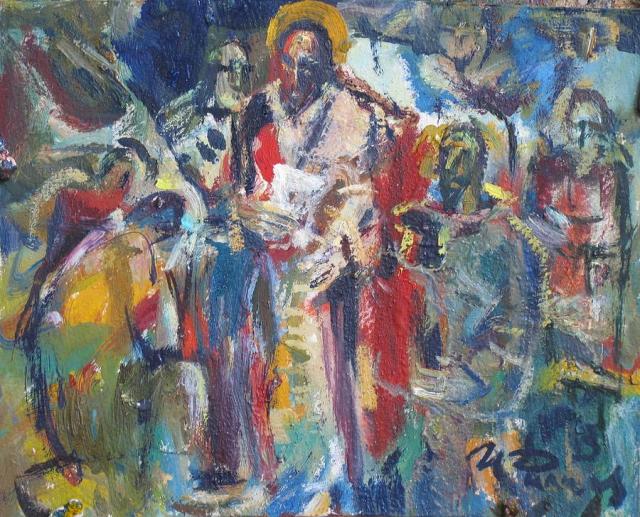
Apostle Paul by Ivan Filichev

My brothers and sisters, I know without a doubt that you are full of goodness and have all the knowledge you need. So, you are certainly able to counsel each other. But I have written to you very openly about some things that I wanted you to remember. I did this because God gave me this special gift: to be a servant of Christ Jesus for those who are not Jews. I serve like a priest whose duty it is to tell God’s Good News. He gave me this work so that you non-Jewish people could be an offering that he will accept—an offering made holy by the Holy Spirit.

That is why I feel so good about what I have done for God in my service to Christ Jesus. I will not talk about anything I did myself. I will talk only about what Christ has done with me in leading the non-Jewish people to obey God. They have obeyed him because of what I have said and done. And they obeyed him because of the power of the miraculous signs and wonders that happened—all because of the power of God’s Spirit. I have told people the Good News about Christ in every place from Jerusalem to Illyricum. And so, I have finished that part of my work. I always want to tell the Good News in places where people have never heard of Christ. I do this because I don’t want to build on the work that someone else has already started. But as the Scriptures say,

“Those who were not told about him will see,
and those who have not heard about him will understand.” (ERV)

Paul was an Apostle – a person commissioned by God for a specific purpose. His task was to go to the Gentiles – non-Jewish people. Although a Jew himself, Paul was sent as the missionary to places where Gentiles were the dominate culture. Through the Apostle Peter, and then Paul, the good news of Jesus spread to persons that were beforehand considered unreachable. Paul viewed himself as having no limits as to who could hear and respond to the gospel of new life in Jesus Christ.

The Apostle Paul understood himself as standing between heaven and hell, interceding, and pleading on behalf of people in need.

It is quite likely there are persons in our sphere of influence for whom we think would never respond to the message of Christ’s redemption. In these dog days of summer’s ordinary time in which we may be just trying to beat the heat; and, we might see family that we typically don’t throughout the rest of the year; it could be easy to lose sight that attending a virtual meeting, family gathering, and/or interaction with a person outdoors, there are those who need the kind of life which Jesus invites us to – and we will never know if God is wooing them to himself unless we share life with them.

Perhaps we need to see ourselves as Paul did – standing in the gap and always trying to find ways to speak good news to people who need deliverance from empty ways of life. The cousin or uncle, co-worker or friend, neighbor, or new acquaintance, can be forgotten by us as to their very real need to discover faith and the spirituality which resides within.  We, my friends, are the conduit that God has ordained to bring the life-giving message to people all around us – people for whom we might have already written off as unreachable.

Sometimes the Apostle Paul gets a bad rap as moving beyond the bounds of his apostolic authority in dedicating his life to reaching the non-Jewish person, as if Gentiles were not really on the radar of Jesus. Yet, Paul took pains to demonstrate biblically that his mission was really God’s mission. Indeed, Paul did not fabricate including Jew and Gentile together as one people of God. Romans 15 is filled with Old Testament quotes pertaining to God’s agenda that all peoples of the earth would come and worship together.

It has always been God’s vision to restore humanity, Jewish and Gentile alike, to a life-giving place of beauty and joy in the Garden.

So, Paul had a healthy pride in his work as an Apostle sent from God to the task of reaching the vast numbers of non-Jewish people. I sit here today, two millennia later, the spiritual progeny of the Apostle’s great effort. Because Paul kept pioneering new churches, pushing ever farther into places which knew little to none about Jesus, and being concerned for people very different from himself, Christians today enjoy a rich legacy of faith and works to draw upon in our own lives.

Yes, as an historian I am quite aware of the complicated history between the Jewish people and their Gentile neighbors. I perhaps know more than the average bear about how the Church has far too often brought harm and not help to the world. Yet, this in no way mitigates the incredible new life which has occurred for so many people and cultures throughout the past two-thousand years of Christian history. In fact, in the light of today’s New Testament lesson, it behooves us Christians to establish gracious and loving connections with our Jewish brothers and sisters, as well as all of humanity. Their pain of persecution and difficulty through the centuries is our pain, as well.

May the power of God’s Spirit come upon us all. May we all become a community of priests and prophets proclaiming peace, love, and joy – the life we are all meant to experience and share together.

We praise you, O God, for the ministry and success of your servant, the Apostle Paul, through whom we who are Gentiles owe our own faith and calling.  Grant us a vision like his, the conviction and commitment to pursue it, and the grace which confirms and prospers it.  Amen.

Psalm 119:105-112 – Light for the Journey

Your Word is a Light

Your word is a lamp to guide my feet 
    and a light for my path. 
I’ve promised it once, and I’ll promise it again: 
    I will obey your righteous regulations. 
I have suffered much, O Lord; 
    restore my life again as you promised. 
Lord, accept my offering of praise, 
    and teach me your regulations. 
My life constantly hangs in the balance, 
    but I will not stop obeying your instructions. 
The wicked have set their traps for me, 
    but I will not turn from your commandments. 
Your laws are my treasure; 
    they are my heart’s delight. 
I am determined to keep your decrees 
    to the very end. (NLT) 

Two qualities which stand out to me in these verses are the psalmist’s attitude and affection. This is a person who is determined to hold onto God’s Word because it is his heart’s delight. Yes, our attitudes and our affections are meant to be like a hand in a glove. It is our attitudes which help us to push through the pain to realize better days. And it is our affections which drive us forward, allowing us to experience joy in the present moment as we await our hope of ultimate deliverance. 

Commitments are fluid, always moving – which means they need to be continually rehearsed and refreshed. We are constantly either fulfilling our promises or reneging on them. There is really no such thing as a one-time vow. Commitments must have reinforcement from our attitudes and our affections. Otherwise, they languish on the trash heap of good intentions. This is one reason why the psalms are designed for constant use. 

It is important to have spiritually healthy habits ensconced in our lives well before any suffering and hard times roll in. If we have been nourished and supported by a daily sustenance of God’s Word, then we have both a breadth and a depth of robust theology to draw upon when the going gets rough. In addition, the sheer force of habit brings us back again and again to the treasure chest of divine instruction which informs our decisions and illuminates the treacherous road ahead. 

All the psalms are designed to reframe our own difficult situations. Even and especially when a person’s life hangs in the balance, we have the opportunity of viewing such hard and awkward circumstances through the window of the psalmist. Although circumstances change and we never quite know what to expect, God’s Word remains as our ballast and our rock. Divine love and morality are unchanging. Jesus Christ is the same yesterday, today, and forever. The Spirit is always with us, through each wave of hardship. 

Life is a continual journey, an exploration into the unknown of the future. The path is shadowy and unclear. We are unsure of what is just around the bend. Yet, God’s Word is like a never-ending flashlight helping us navigate forward. Maybe Jesus had this psalm in mind when he said:  

“I am the light of the world. Whoever follows me will never walk in darkness but will have the light of life.” (John 8:12, NRSV) 

In the Christian tradition, the Word is embodied in Jesus Christ so that he is both example and fulfillment of all God’s promises. Within today’s psalm, a sequence of four metaphors runs through these verses: my feet (light for my feet to walk in the way of God); my mouth (deliberate verbal commitment to God’s words); my hands (doing God’s will despite the circumstances); and my heart (desiring God’s decrees and commands).

With Jesus as Word and Light we have a constant companion walking alongside us for the journey; we have an intercessor who takes our wordy or malformed prayers and presents them before our heavenly Father; we use our hands by observing the Master who washed the feet of others; and, our hearts find their rest in the One who loved us and gave himself for us. 

In sum, our attitudes and affections are transformed into sustainable faith for the long journey; our hope is made sure through the promises of God; and, our love finds a resting place in the person of Jesus. Faith, hope, and love are the shoes which enable us to walk the long hard road uphill, as well as absorbing the shock as we run with abandon downhill – into the loving arms of God. 

soap

Let us come to Holy Scripture and liberally digest its life-giving message. I encourage you to find what works best for you in developing helpful spiritual habits. In reading the Bible, I often take the following approach using the acronym S.O.A.P…. 

Scripture 

  • Open your Bible and slowly, meditatively, read the portion of Scripture in your reading plan for today.
  • Write the reference of what you read in a journal along with the date.
  • As you read, ask God’s Spirit to highlight the verse(s) that speak to your life and write it in your journal.

Observation 

  • Make observations about what you just read and write them in your journal.
  • Think about: What is going on? What is the context?  Who are the people being spoken to? What is the background or setting for this verse?
  • Paraphrase and write this scripture down in your journal, in your own words.
  • What do you think God is saying to you in this scripture?

Application 

  • Personalize what you have read by asking yourself how it relates to your life right now.
  • Ask yourself how you can apply what you just read to your own life and write it in your journal.
  • Ask yourself how your life will be different or changed as a result of God speaking to you in this Scripture.

Prayer 

  • Write out a prayer to God in your journal.
  • Your prayer should relate to the verse that you highlighted. It could be asking for help, thanking God, etc. Write down what your heart desires to say to God in response to his Word.

May the words of your mouth, the meditations of your heart, the work of your hands, and the movement of your feet be to the glory of Jesus Christ. Amen. 

John 13:1-17 – Do as I Have Done for You

Jesus washing feet

It was just before the Passover Festival. Jesus knew that the hour had come for him to leave this world and go to the Father. Having loved his own who were in the world, he loved them to the end.

The evening meal was in progress, and the devil had already prompted Judas, the son of Simon Iscariot, to betray Jesus. Jesus knew that the Father had put all things under his power, and that he had come from God and was returning to God; so he got up from the meal, took off his outer clothing, and wrapped a towel around his waist. After that, he poured water into a basin and began to wash his disciples’ feet, drying them with the towel that was wrapped around him.

He came to Simon Peter, who said to him, “Lord, are you going to wash my feet?”

Jesus replied, “You do not realize now what I am doing, but later you will understand.”

“No,” said Peter, “you shall never wash my feet.”

Jesus answered, “Unless I wash you, you have no part with me.”

 “Then, Lord,” Simon Peter replied, “not just my feet but my hands and my head as well!”

Jesus answered, “Those who have had a bath need only to wash their feet; their whole body is clean. And you are clean, though not every one of you.” For he knew who was going to betray him, and that was why he said not everyone was clean.

When he had finished washing their feet, he put on his clothes and returned to his place. “Do you understand what I have done for you?” he asked them. “You call me ‘Teacher’ and ‘Lord,’ and rightly so, for that is what I am. Now that I, your Lord and Teacher, have washed your feet, you also should wash one another’s feet. I have set you an example that you should do as I have done for you. Very truly I tell you, no servant is greater than his master, nor is a messenger greater than the one who sent him. Now that you know these things, you will be blessed if you do them. (NIV)

One of the reasons I like Jesus Christ so much is that he loves me as I am, and not as I should be. Jesus loves me even with my dirty stinky feet, my herky-jerky commitment to him, and my pre-meditated sin. Jesus loved even Judas and washed his feet. Jesus serves people because they need his love, and not so that they will love him back.

I recently read about a man who lives in Paris. His wife has Alzheimer’s. He was an important businessman and his life was filled with busyness. Yet, he said when his wife fell sick, “I just couldn’t put her into an institution, so I kept her. I fed her. I bathed her. Through the experience of serving my wife every day, I have changed. I have become more human. The other night, in the middle of the night, my wife woke me up. She came out of the fog for a moment, and she said, ‘Darling, I just want to say thank you for all you are doing for me.’ Then she fell back into the fog. I wept for hours to know this grace.”

Sometimes Christ calls me to love people who either cannot or will not love me in return. They live in the fog of some sort of disability, depression, poverty, or common spiritual blindness. As I serve them, I may only receive brief glimpses of gratitude. Just as Jesus loves me within my own spiritual confusion, so I desire to continue loving others as they walk through whatever fog they are in.

I can truthfully say that I have no interest in anything but the love of God which in Christ Jesus.  Lord willing, my life will be useful through my words and my witness. If God desires, my life will bear fruit through my prayers, my service, and my love. Yet, the usefulness of my life is God’s concern, not mine; it would be indecent of me to worry about that. I simply desire follow my Lord’s example.

dirty dishes

Neither many Christians nor churches wash feet anymore. So, the following is today’s Gospel lesson put in a slightly different context:

It was just before the biggest and most important feast of the year, Passover. Jesus knew that it was finally the time for him to face the cross and die for the world’s sins. Having spent the past three years loving his followers, he now wanted to leave them with a clear demonstration of his love that they would never forget.

The evening meal was being served, and the devil had already gotten a hold of Judas Iscariot to betray Jesus to those who wanted him dead and gone. But it was all according to plan. Jesus knew that his heavenly Father had given him all authority because he was his Son, and he was ready to do what needed to be done to secure salvation and return to his rightful place at his Father’s right hand.  So, Jesus got up from the meal, rolled up his sleeves, put an apron on, and ran a sink full of hot water.  Jesus told the servants to take the night off, and he began taking the dishes from the dinner table and started washing them, taking care to do all that waiters and dishwashers would do.

When Jesus came to take care of Simon Peter’s dishes and serve him dessert and coffee, Peter said to him, “Lord, are you going to serve me?” Jesus replied, “I know you do not understand why I am doing this since it seems like something that is beneath me to do, but later you will look back on this night and understand completely what I am doing.”

“No,” said Peter, “this is not right – you are the Master, and this is not what a well-respected rabbi does – you are only disrespecting yourself and making us all look foolish. You are not going to take my dishes and wash them.”

Jesus answered, “Unless I wash these dishes and serve you, you are not going to be able to follow me anymore and you will have no part of what I am doing in this world.”

“Well, then, Lord,” Simon Peter replied, “if that is the way it really is, then don’t just wash the dishes – come on over to my place and clean out the fridge and scrub the kitchen floor!”

Jesus answered, “A person who has had a decent meal needs only to wash the dishes so that he can enjoy the freedom of hospitable relationships with me and those around him.  And all of you here have had a decent meal, though not every one of you.”  For Jesus knew that Judas was only picking at his food in anticipation of betraying him.

When Jesus was all done washing the dishes and serving his disciples, he took his apron off, rolled his sleeves back down, and returned to the table.  He looked them all squarely in the eye and said, “Do you understand what I just did for you?  You call me ‘Teacher’ and ‘Master,’ and rightly so, for that is exactly what I am.  So, now that I, your Master, and your Teacher have washed your dishes, you also should wash one another’s dishes.  I have set you an example that you should do as I have done for you.  I am telling you the plain truth that no follower is greater than the one he follows, nor is a preacher greater than the one he preaches about.  Now that you know that it is your task in this life to provide humble loving service, you will have God’s stamp of approval on your life if you quit thinking about how to possess and use power for your own purposes, and start thinking about how to use the authority I am giving you to love other people into the kingdom of God.

Loving Lord Jesus, how shocking it was for your disciples to be served by you in such a humble manner.  But I cannot be spiritually cleansed unless I allow you to love me in an almost embarrassing fashion.  Help me not to be so proud that I neither refuse your humble loving service toward me, nor neglect to offer that same kind of service to others.  May love be the word, the idea, and the action that governs my every motivation and movement in your most gracious Name, I pray.  Amen.

Romans 3:1-8 – The One People of God

A simple graphic entwined tree illustration

What advantage, then, is there in being a Jew, or what value is there in circumcision? Much in every way! First of all, the Jews have been entrusted with the very words of God.

What if some were unfaithful? Will their unfaithfulness nullify God’s faithfulness? Not at all! Let God be true, and every human being a liar. As it is written:

“So that you may be proved right when you speak
and prevail when you judge.”

But if our unrighteousness brings out God’s righteousness more clearly, what shall we say? That God is unjust in bringing his wrath on us? (I am using a human argument.) Certainly not! If that were so, how could God judge the world? Someone might argue, “If my falsehood enhances God’s truthfulness and so increases his glory, why am I still condemned as a sinner?” Why not say—as some slanderously claim that we say—“Let us do evil that good may result”? Their condemnation is just! (NIV)

Paul’s letter to the Roman church is a hefty sixteen chapters of some dense material and several extended arguments through intense reasoning. Likely, Paul felt compelled to dig in and provide so many words because of the church’s situation.

The Roman Church at the time of Paul’s writing was made up of both Jewish and Gentile believers in Jesus. Jews and Gentiles have a complicated history together. And the Roman Empire was still firmly in control of Palestine and did not always treat the Jewish people well. In addition, the religious backgrounds of each were as different as you can get. Whereas the Jewish Christians had a long rich history with God and the Old Testament, the Gentile Christians were fresh from centuries of paganism and esoteric rituals. Now, they were together in one place worshiping Jesus and it made for a potentially combustible situation.

Throughout the letter to the Romans, Paul goes back and forth addressing the two groups of Jews and Gentiles. The overarching problem was this: The Jewish believers tended to look down on the Gentile Christians and thought they needed to become Jewish to really be the kind of Christians God was looking for. On the other hand, the Gentile believers tended to dismiss their Jewish brothers and sisters as backward and stuck in tradition. In short, each group thought the other must become like them.

So, Paul, bless his apostolic heart, had a huge mess in the making with these believers. Here, in our New Testament lesson for today, Paul is directing his comments more specifically toward the Gentile Christians. Paul really wanted the Gentile believers to gain some appreciation for the Jewish people. After all, they were chosen by God to become a nation of priests and prophets for the world. Discounting that history would be to neglect and even invalidate their shared salvation.

For Paul, to have two churches, one Jew and the other Gentile, would have been a complete travesty of Christ’s redemption for humanity. Jesus was all about bringing disparate peoples together and not keeping them divided. The cross freed us by eliminating the barriers which separate us. The Roman Church was just going to have to work together at being one people under the lordship of Christ. There was going to be no ethnic, religious, or political one-upmanship on Paul’s watch.

Truth be told, both Jew and Gentile did not always do so well with their respective histories. So, there is no ground for boasting or trying to argue for their own way. In fact, the unfaithfulness of people simply shows the incredible faithfulness of God in greater relief.  If there were no sin, grace would not be needed; no cross would have existed. Just because the foulness and degradation of sin brings out the gracious, faithful, and forgiving character of God in Christ, does not mean that sin is okay or that we can flippantly wave it off with uttering some mumbo-jumbo cheap grace which devalues the majesty of God.

For example, when antebellum southern slaveholders in nineteenth-century America argued for their peculiar institution by saying that snatching black Africans from their homes was a good thing so that they could get out of their religious animistic worldview and be exposed to Christianity, I am positively sure that the Apostle Paul rolled over in his grave and begged Jesus to resurrect him early and send him to tackle such an affront to the cross of Christ! Sin is never to be excused through twisted human mental gymnastics.

Paul worked laboriously to unite the churches he established and bring differing people groups together under Christ. What this does not mean is that all cultural and personal distinctions are ignored or erased. What it does mean is that we value one another’s differences and gather around the shared value of knowing Jesus Christ. The Church was neither going to become Jewish nor Gentile but something altogether new – one new people out of the two. Paul framed the matter this way to the Ephesian Church:

Therefore, remember that formerly you who are Gentiles by birth and called “uncircumcised” by those who call themselves “the circumcision” (which is done in the body by human hands)— remember that at that time you were separate from Christ, excluded from citizenship in Israel and foreigners to the covenants of the promise, without hope and without God in the world. But now in Christ Jesus you who once were far away have been brought near by the blood of Christ.

For he himself is our peace, who has made the two groups one and has destroyed the barrier, the dividing wall of hostility, by setting aside in his flesh the law with its commands and regulations. His purpose was to create in himself one new humanity out of the two, thus making peace, and in one body to reconcile both of them to God through the cross, by which he put to death their hostility. He came and preached peace to you who were far away and peace to those who were near. For through him we both have access to the Father by one Spirit. (Ephesians 2:11-18, NIV)

Solitary righteousness is an oxymoron. Righteousness can only be truly lived and expressed with other people. Yes, there is freedom in Christ. Yet, that freedom must be continually applied through making every effort to keep the unity of the Spirit through the bond of peace.

O God, the Father of our Lord Jesus Christ, our only Savior, the Prince of Peace: Give us grace to seriously lay aside all unhappy divisions. Take away all hatred and prejudice, and whatsoever else may hinder us from godly union and harmony: that, as there is but one Body, and one Spirit, and one hope of our calling, one Lord, one faith, one baptism, one God and Father of us all; so may we be forever all of one heart, and of one soul, united in one holy bond of truth and peace, of faith and love, and with one mind and one mouth glorify Jesus Christ our Lord. Amen.