1 John 3:11-16 – Live in the Realm of Love

Love One Another

For this is the message you heard from the beginning: We should love one another. Do not be like Cain, who belonged to the evil one and murdered his brother. And why did he murder him? Because his own actions were evil and his brother’s were righteous. Do not be surprised, my brothers and sisters, if the world hates you. We know that we have passed from death to life because we love each other. Anyone who does not love remains in death. Anyone who hates a brother or sister is a murderer, and you know that no murderer has eternal life residing in him.

This is how we know what love is: Jesus Christ laid down his life for us. And we ought to lay down our lives for our brothers and sisters. (NIV)

It would be good for us to get a few words defined and explained before we look at the message of the Apostle John. “Death” and “life” are full of meaning in Holy Scripture. Whereas we tend to use death and life as referring chiefly to the body, they are primarily relational terms in the Bible. So, then, death is a separation from God and others; and, life is connection with God and others. In addition, death and life are biblically understood as forces or realms of being within or without. When someone moves from death to life, they are leaving the realm of separation with its loneliness, lostness, lethargy, and lack of meaningful and helpful interaction with God and others to a place of connection in which there is love.

There is no love in the realm of death. Love is not a solitary affair – it requires another. Death is awful in the sense that it places one outside of love. Like death and life, love is also a relational term and a force or power which exists. In fact, love is such a huge realm of being and such a large domain that it almost defies definition. We are mostly left to describe love because all attempts to nail down love with a precise definition will never do it justice. Therefore, the Apostle Paul, in his great ode to love, did not even try to define it, but merely attempted to characterize love:

Love is patient. Love is kind. Love isn’t jealous. It doesn’t sing its own praises. It isn’t arrogant. It isn’t rude. It doesn’t think about itself. It isn’t irritable. It doesn’t keep track of wrongs. It isn’t happy when injustice is done, but it is happy with the truth. Love never stops being patient, never stops believing, never stops hoping, never gives up. (1 Corinthians 13:4-7, GW)

Consistent with the force and relational nature of death, life, and love, hate is not primarily a feeling toward another but exists as a stance toward another within the domain of darkness and death. To hate is to deliberately and volitionally separate from another person and/or from God. It is to consider someone as the “other” who is not like me, and so, I will neither associate nor interact with “those” people.

Love, however, thrives in the vast multi-dimensional realm of life. Love seeks connection with another and desires to act through discovering needs and meeting them. Although emotions of love are very real, those feelings are the result of calculated actions and words which benefit humanity and the common good of all persons.

With all the understanding of hate and death, love and life, now plug that into the Apostle John’s message. We need to make clear decisions to pursue life and love others. And Jesus is our model for this. Christ is the ultimate Connector, bringing vibrant life, even eternal life, through loving actions. Jesus intentionally entered the dark realm of death and absorbed all the hate of the world for you and me. In a great and loving reversal, Jesus Christ’s death – his separation from God and others – brought connection with God and others.

MLK quote 3

Likewise, followers of Jesus will learn to take on the world’s hatred, not fearing death’s ability to disconnect, and love others as they themselves have been loved by Christ. Christians are known by the way they act toward those in the realm of death who use the tool of hatred to stay there.

On the flip side of love, the biblical character Cain is Exhibit A of modeling the way of hatred and death. He separated himself from his brother, Abel, in every way possible – relationally, emotionally, mentally, and finally, physically through outright killing of the body.

The message from John is this: Do not be like Cain. Be like Jesus. Love others, and not hate them. Live for others, die to self.

Murder is also a relational term in Scripture. It is, of course, a tool forged from the flames of hell to be used by the hand of hatred to bring death’s realm of separation. Jesus clearly understood murder in this manner:

You know that our ancestors were told, “Do not murder” and “A murderer must be brought to trial.” But I promise you that if you are angry with someone, you will have to stand trial. If you call someone a fool, you will be taken to court. And if you say that someone is worthless, you will be in danger of the fires of hell. (Matthew 5:21-22, CEB)

Christians are people who put love where love is not – which means they brave death’s door to pull others from the flames. As the little New Testament book of Jude says:

But you, dear friends, must build each other up in your most holy faith, pray in the power of the Holy Spirit, and await the mercy of our Lord Jesus Christ, who will bring you eternal life. In this way, you will keep yourselves safe in God’s love. And you must show mercy to those whose faith is wavering. Rescue others by snatching them from the flames of judgment. Show mercy to still others, but do so with great caution, hating the sins that contaminate their lives. (Jude 20-23, NLT)

May your soul be blessed with love’s kiss.

May the grace and kindness of love bring you life and continue to be life-giving for you.

May the hardness of hatred be far from you.

May death’s destructive power dwindle to nothing in the face of Christ’s love working in and through you to the glory of God.

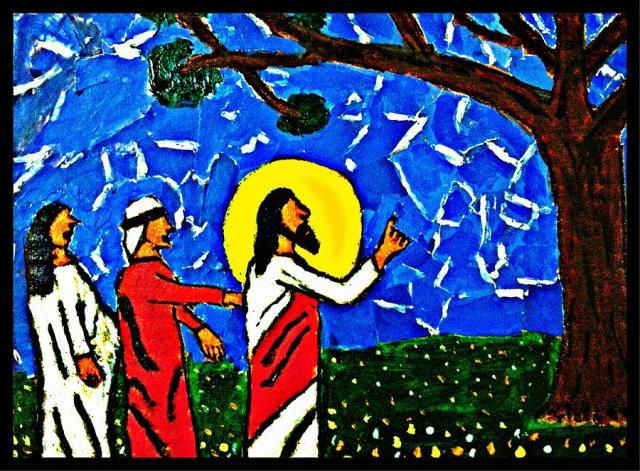
Matthew 21:18-22 – Faith and Prayer

Jesus Cursing the Fig Tree
Jesus Cursing the Fig Tree by Ganosh Kelagina Beedu Shenay, 2016

Early in the morning, as Jesus was on his way back to the city, he was hungry. Seeing a fig tree by the road, he went up to it but found nothing on it except leaves. Then he said to it, “May you never bear fruit again!” Immediately the tree withered.

When the disciples saw this, they were amazed. “How did the fig tree wither so quickly?” they asked.

Jesus replied, “Truly I tell you, if you have faith and do not doubt, not only can you do what was done to the fig tree, but also you can say to this mountain, ‘Go, throw yourself into the sea,’ and it will be done. If you believe, you will receive whatever you ask for in prayer.” (NIV)

God wants us to pray! Prayer happens from a place of faith because to pray, one must believe that God is good and answers prayer. Conversely, prayerlessness is faithlessness.  A person of little faith prays only a little. A person full of faith cannot stop praying.

God’s world revolves more around promise than command – which means that Jesus merely exhorting the disciples to pray would fall flat; they needed a deep change of heart. God calls us all to transformation. Lasting change takes place at the roots of our lives. When there is a drought, pouring lots of water on our backyard trees at the first sign of withering leaves is too late. The tree may look fine on the outside, but on the inside, it is dying from lack of water. Real change comes from the inside-out.  It is the root of a person’s life, below the surface where others do not see, that needs change, and not merely the outward behavior.  Prayer must be directed to the root, to the heart of the issue.

In today’s Gospel story, Jesus was up early and going to Jerusalem. He was hungry and wanted some breakfast, so he approached a fig tree. Figs were known back in Christ’s day as the poor man’s food. Fig trees were everywhere. Approaching a certain fig tree, Jesus found one that looked fine, but no figs. He chose to use the tree as a teachable moment for his disciples. Christ cursed the tree and immediately the entire tree withered.  So, why did Jesus curse the tree?

Jesus cursed the fig tree because it looked good on the outside, but it was already dead on the inside. The tree had everything a tree needed: branches, leaves, and a trunk – except fruit.  The tree served as an illustration for the disciples of believing prayer. The tree looked fine, and had the promise of fruit, yet, none was found.  The point of the tree illustration is this: Jesus is looking for faith in his followers.

In the prophet Jeremiah’s day, the nation of Judah had enjoyed a long stretch of prosperity and good circumstances. By all outward appearances they were doing fine. Temple attendance was at its peak and everyone was offering their sacrifices. But something was wrong….

I will put an end to them,
declares the Lord;
there are no grapes on the vine,
no figs on the tree,
only withered leaves.
They have squandered what I have given them!
(Jeremiah 8:13, CEB)

Although fine on the outside, the people of Judah trusted in themselves, their ability to produce a harvest, and their outward show of how many cattle and sheep they brought to the temple. But what God was looking for was fruit, not nice leaves. He was watching for offerings of believing prayer, born of a faith that is confident in the goodness of God. And the Lord is still looking for people’s faith in God alone – rather than in religiously outward forms of success.

Jesus wants his followers to understand and believe that our words and prayers can have the immediate effect of changing the world.  We can even speak to a mountain and it will have to move if we tell it to. We probably do not go around talking to mountains, but all of us go around talking to ourselves about mountain-like problems. The power that levels mountains is prayer that speaks confidence and boldness.  If you believe, you will receive whatever you ask for in prayer.

Doubt sometimes stands in the way of prayer – not doubt in ourselves because we do not answer our own prayers. The Apostle James said:

“If any of you needs wisdom, you should ask God for it. He is generous to everyone and will give you wisdom without criticizing you. But when you ask God, you must believe and not doubt. Anyone who doubts is like a wave in the sea, blown up and down by the wind. Such doubters are thinking two different things at the same time, and they cannot decide about anything they do. They should not think they will receive anything from the Lord.” (James 1:5-8, NCV)

Both James and his brother Jesus refer to an unshakable faith in the goodness of God. This is faith in the person of God, and not faith in faith itself. If we are honest, every one of us who has made a difficult prayer request, mustering-up all the faith we can, and then being disappointed when it did not happen, has been hurt. The unstable person vacillates when this happens, doubting whether God is good (playing the he-loves-me, he-loves-me-not game). The person of faith believes God answers prayers according to his will, and that if the prayer is not answered, God knows what he is doing and will answer it in his own good timing and purposes.

Maybe you have even indulged your inner-critic, a Job-like friend, telling you that you have a failure of faith, or not enough faith, and that is why your prayer was not answered. Yet, positive thinking is not the same as Christian faith.  It is neither a matter of being optimistic, nor of sending $19.95 to some hack preacher who promises to give you the secret of answered prayer, along with a free gold cross.

God’s will for our lives is sometimes, maybe even oftentimes, a mystery. However, we do know what God’s will is for a lot of things. For example, God is not willing that any should perish but all be brought to eternal life.  So, we can pray with confidence for a person’s deliverance from sin.  We can be bold about trusting in God’s promises – he will do what he says he will do.  Boldness is only as good as the truth it is based upon.

Imposing Mountain View and Lake Glacier National Park
Imposing Mountain View and Lake Glacier National Park. Many Glacier Area. Swiftcurrent Lake.

We have every right, based in our union with Jesus Christ and our redemption in him, to ask God confidently and boldly for the removal of mountains.  We have the authority in Christ to do so.  Therefore, we do not need to offer tepid, milquetoast, mumbling prayers with sighs and hunched shoulders (i.e. “Well, God, if it is your will, could you help me?”).

It is time for men to step out and give God some healthy hairy-chested prayers.  And, this is not the time for women to be worried about what the men do, or not do. Everyone is to be bold in prayer.

“God desires of us nothing more ardently than that we ask many and great things of him, and he is displeased if we do not confidently ask and entreat.” –Martin Luther

Jesus wants faithful and fruitful prayer. He still scans the horizon of our spiritual lives looking for believing prayer. Christ desires from those who follow him bold prayers which curse and wither fruitless and feckless places. When my children were small there was an adult store in our neighborhood. It disturbed my spirit. Each time I passed it I confidently prayed that the pornography and exploitation of women would dry up and cease in Jesus’ name, and that those who worked in that establishment would find more gainful and ethical employment. And that is exactly what happened.

Aggressive prayer against the enemy of our souls is needed, prayer that claims the authority which has been given us in Christ, prayer that is based in solid biblical truth and robust theology. So, let us pray in faith and confidence….

Heavenly Father, we praise you for the grace we possess through the Lord Jesus Christ.  We rejoice in Christ’s teaching and the victory you have provided for us to live above sin and failure.  We come before you in confession and to plead your mercy over our sins, the sins of other believers, and the sins of our world.  We confess the sin of prayerlessness, faithlessness, apathy, complacency, and indifference to those who are lost.  We also acknowledge before you the wickedness of our world through the evil machinations of injustice, oppression, and exploitation of others.

We praise your holy name, O God, that there is plenty of grace through the person and work of the Lord Jesus.  We plead the blood of the cross and the power of the resurrection against the sins and rebellion of people against you.  We pray and wait for you, Holy Spirit, to bring us all to new life in Jesus Christ. 

We recognize that Satan and the kingdom of darkness have plotted and laid strategies against new spiritual life, keeping your people from believing prayer.  So, in the name of the Lord Jesus Christ, we claim our place as children of God. We smash and pull down all the strongholds which Satan has erected against humanity – and pray that the power of Christ’s resurrection would hinder and frustrate the plans formed against us. 

We pull down demonic strongholds of prayerlessness and carelessness with the Word of God. We claim back for the Lord Jesus Christ the ground Satan is claiming as a means of hindering faith, hope, and love; and, we affirm that Satan’s plans were fully defeated through the cross and resurrection of Jesus. We pull down all of Satan’s plans to divert fresh faith when it comes. Blessed Holy Spirit, may you send a renewal to the hearts and souls of all people. May it bring a wondrous season of peace and joy.

We, your people, accept the role of standing in the gap for others in prayer.  You yourself, God, said that we, in Christ, are mighty through God to the pulling down of strongholds.  So, we bring all the work of the Lord Jesus Christ to focus directly against the powers of darkness that blind people and keep them in bondage.  We pray the victory of Christ’s incarnation, crucifixion, resurrection, ascension, and glorification directly against all of Satan’s power in their lives.  We now bind all powers of darkness set to destroying them, and we unbind those demonic bonds and blinders from them in the mighty name of Jesus. 

By faith we claim humanity for fruitful lives of spiritual abundance, social justice, and sanctified relationships in the name of Jesus Christ our Lord, who defeated all powers and principalities of this world.  Amen.


Romans 13:1-7 – Good Citizenship

1960 Elementary Classroom

Be a good citizen. All governments are under God. Insofar as there is peace and order, it’s God’s order. So live responsibly as a citizen. If you’re irresponsible to the state, then you’re irresponsible with God, and God will hold you responsible. Duly constituted authorities are only a threat if you’re trying to get by with something. Decent citizens should have nothing to fear.

Do you want to be on good terms with the government? Be a responsible citizen and you’ll get on just fine, the government working to your advantage. But if you’re breaking the rules right and left, watch out. The police aren’t there just to be admired in their uniforms. God also has an interest in keeping order, and he uses them to do it. That’s why you must live responsibly—not just to avoid punishment but also because it’s the right way to live.

That’s also why you pay taxes—so that an orderly way of life can be maintained. Fulfill your obligations as a citizen. Pay your taxes, pay your bills, respect your leaders. (MSG)

Back in the day (way back!) when I was in elementary school every student received a grade on their report card for “citizenship.”  Even further back, my Dad’s report cards had grades for “deportment.” Both citizenship and deportment were words used by the public-school system to gauge how well individual students conducted themselves with the teacher’s authority, behaved with fellow students, and handled the responsibilities of their studies. It was a grade given for the overall obedience and submission of students with their duties and obligations, or the lack thereof.

Today’s New Testament lesson is one of those Scripture texts which has been used and abused throughout history. Since we no longer give grades on citizenship and deportment, a careful consideration of both what this biblical passage is, and is not, must be observed.

What Citizenship is Not: Irresponsible and Disobedient Injustice

Advocating a favored political philosophy or party to the point of avoiding a rival party or power and resisting their government through lack of submission, being uncivil and disrespectful, and stubbornly disobedient is poor deportment and will earn an “F” from God on the report card of life.

Picking-and-choosing which laws I will obey and which ones I will not is extremely far from the biblical teaching given. Rebellion against laws I do not like will only result in getting punished from the principal for being shortsighted and stupid.

On the other hand, blind and unthinking adherence to a government is irresponsible and can be unethical. Unjust leaders and immoral laws which merely champion certain people and not the common good of all need to be dislodged and dismantled. When one simply says, “I’m just doing my job,” or “I don’t want to get in trouble,” in the face of unjust laws and leadership, then we are complicit in the perpetuating of the evil person or system. Blind obedience keeps abusive people in the classroom.

Vigilante-ism is a form of “recess justice.” It is a refusal to accept what is taking place and takes matters into one’s own hands. Just before explaining citizenship, the Apostle Paul said, “Do not take revenge but leave room for God’s wrath,” and, “Do not be overcome by evil but overcome evil with good” (Romans 12:19, 21). There is no place for vigilante justice in the kingdom of God. At its basest form, vigilantes are resisting God’s justice and being extremely impatient with the divine plan.

Good Citizenship

What Citizenship is: Responsible and Submissive Justice

Submission is a choice. The word “submit” in the New Testament means “to place oneself under authority.” In other words, to submit to another person, group, system, or government is a human volitional choice. Obedience through coercion, as in totalitarian regimes, is not submission – it is oppression.

Good citizenship begins with humble submission to governing authorities who are trying to do their best and have everyone’s best interests at mind with responsible laws which benefit the common good of all. Most parents and school boards would do well to remember that.

Justice is primarily about provision, and not about being punitive. I realize that many, if not most, people use the term justice in the penal sense – wanting convictions and incarcerations when someone has committed a crime against the state and/or humanity. And, although this is a very important work of government, the biblical sense of justice is about provision – giving people their rights to life and liberty and ensuring that we all exist in an equitable form of union together as one people.

When people fall through the cracks of bureaucracy and do not have what they need to survive, let alone thrive, then this is an injustice which needs remedy sooner than later – without putting it off to another election cycle. So, put the spanking paddles of shame away (yes, kids at school got the paddle in my day) and instead find ways to uplift and support one another.

Responsible citizenship involves a proper deportment of volitional submission, careful obedience, proper payment of taxes for the benefit of all, and providing due respect to public servants. Keep in mind that the Apostle Paul originally wrote about how to conduct ourselves with government smack in the middle of a Roman Empire which was often fickle and careless about the rights of Christians, Jews, and others.

We submit not because we must, but because it is the right thing to do. To do otherwise is to not only violate the law but our consciences, as well.

Our consciences also need to be clear and clean about the need for justice in this old fallen world of ours. Christians have a continuing and outstanding debt to love one another. Having justice for some and injustice for others is not going to cut it with a Just God. Our Creator and Sustainer desires that every single individual on planet earth – regardless of race, gender, ethnicity, sexual orientation, class, or any other human contrived social construct – have their needs met without prejudice, favoritism, or cronyism.

God’s original plan for the world includes an egalitarian society, so we must be careful to remember and work toward the ideal, while at the same time dealing graciously and resolutely with the realities of injustice all around us. I wonder what grade Jesus would give us so far this year for our deportment.

Lord Jesus Christ, Son of God, just as you welcome us into your kingdom, help us to love each other deeply,
offer hospitality to one another without grumbling, encourage each to use the gifts we have received to serve others, and submit to the governing authorities with the good citizenship you have provided us so that every one of us will be a faithful steward of God’s grace in its various forms. Amen.

Psalm 121 – My Help

Mountain landscape

I lift up my eyes to the hills—
    from where will my help come?
My help comes from the Lord,
    who made heaven and earth.

He will not let your foot be moved;
he who keeps you will not slumber.
He who keeps Israel
will neither slumber nor sleep.

The Lord is your keeper;
the Lord is your shade at your right hand.
The sun shall not strike you by day,
nor the moon by night.

The Lord will keep you from all evil;
he will keep your life.
The Lord will keep
your going out and your coming in
from this time on and forevermore. (NRSV)

This is my favorite psalm.  I have read and mulled it over so many times that it is almost second nature for me to draw from its rich theological statement about God when times are difficult.  This is a psalm designed for worship – to be used by God’s people through song and prayer.  A community without Psalm 121 near to its heart is a group of people in danger. Yet, with it, there is a continual sense of security, confidence, and hope.

Psalms are meant to be spoken aloud and repeated. So, here is another version:

I look to the hills!
Where will I find help?
It will come from the Lord,
who created the heavens
and the earth.

The Lord is your protector,
and he won’t go to sleep
or let you stumble.
The protector of Israel
doesn’t doze
or ever get drowsy.

The Lord is your protector,
there at your right side
to shade you from the sun.
You won’t be harmed
by the sun during the day
or by the moon at night.

The Lord will protect you
and keep you safe
from all dangers.
The Lord will protect you
now and always
wherever you go. (CEV)

This beautiful majestic psalm can be used for any and every occasion.  So, I often use it within hospital visits, counseling in a wide array of situations, and for my own personal edification.  It seems to me that one cannot possibly overuse this psalm.  The psalm was originally used for ascending the hill into Jerusalem, anticipating meeting with God.  Just like a lover who looks forward to meeting his beloved and thinking about how wonderful she is, so the psalmist looks with adoring affection on the God he is about to encounter.

I Lift My Eyes to the Hills

Here is yet another version of this wonderful psalm:

I look up to the mountains—
does my help come from there?
My help comes from the Lord,
who made heaven and earth!

He will not let you stumble;
the one who watches over you will not slumber.
Indeed, he who watches over Israel
never slumbers or sleeps.

The Lord himself watches over you!
The Lord stands beside you as your protective shade.
The sun will not harm you by day,
nor the moon at night.

The Lord keeps you from all harm
and watches over your life.
The Lord keeps watch over you as you come and go,
both now and forever. (NLT)

The psalm is rich with a theology of grace, watch care, and loving attention.  This is a God who is powerful and merciful, a God able to help and desiring to do so.  In a world which seems so often distant and unaffected by the divine, this is a psalm to utter repeatedly in every situation of life so that the truth of the Lord is grafted deep into the soul.  In each unwanted circumstance the psalm can be spontaneously used as an immediate prayer, and with every anticipated event it can provide the words to address the most pressing of needs.  Let the words resonate within you as people created in the image of God, connecting with him on both the cerebral and visceral levels of your life in this last version:

I will lift up my eyes to the hills—
From whence comes my help?
My help comes from the Lord,
Who made heaven and earth.

He will not allow your foot to be moved;
He who keeps you will not slumber.
Behold, He who keeps Israel
Shall neither slumber nor sleep.

The Lord is your keeper;
The Lord is your shade at your right hand.
The sun shall not strike you by day,
Nor the moon by night.

The Lord shall preserve you from all evil;
He shall preserve your soul.
The Lord shall preserve your going out and your coming in
From this time forth, and even forevermore. (NKJV)

 Amen.