The Shadow Self

20171020_081145

In my line of work, I meet a lot of different people.  Some folks are a delight to be around, others not so much; some people talk a lot, some barely any words, at all; and, many people are nice and civil in conversation, and some can be brutal with their words concerning others.  For the most part, I know what I’m walking into when I engage with another person because there are some common types of people.  But, once-in-a-while I find a person who is as rare as blood type AB negative (which is only 1% of the world’s population).  That person is one who has no shadow.

Even Peter Pan had a shadow, even though it usually wasn’t anywhere near his body.  Everybody has a shadow.  When the light strikes us, a shadow is created beside us.  The shadow is not so much us, but the dark reflection of us.  Now I’m not talking about physical shadows, but the common condition of people who only let others see their shadow, the nebulous reflection, and not the real self.

Here’s an admission: One reason I don’t go to very many Christian conferences, and even some churches, is that there is so much preening, posturing, and pretending going on.  Far too many people only show their shadow selves and only present a silhouette of their real selves.  Pastors’ Conferences, I might add, are the worst.  Shadows are everywhere.

The shadow self thinks the dark reflection is who he/she is.  The shadow has grandiose thinking, and believes that external behavior is who you are.  The shadow needs to be the up-front show for all to see, as to disguise what is creating the shadow.  When a person is overwhelmed by her weaknesses and has a difficult time looking at the real person in the light, she looks to the shadow self to serve her.  Keeping up the shadow for others to look at, instead of the real deal, becomes the modus operandi of life.  Other folks just rabbit hole themselves in an imposed solitary confinement and don’t come out.  They literally hide in their homes.  That way no one will see them, and they won’t have to deal with other people’s shadow selves.

Let’s get a solid biblical theological truth out there in the light for you to see, without any shadow: God likes you.  God loves you, cares for you, knows you intimately inside and out, and still likes you, a lot.  God created you in His image and likeness, and, despite any weakness, ignorance, and imperfection on your part, has demonstrated his enduring commitment by sending his Son, the Lord Jesus, to teach, save, and empower you in life.  God’s love is not only for other people, but for you.

The love of God is the light of the world – manifested, fulfilled, and demonstrated by Jesus.  The light shows all the imperfections, flaws, disobedience, and rationalizations.  The light exposes everything, but also creates the shadow.  This is where your choice comes into play: Will you embrace the light, or turn and face the shadow?

The true self knows God in her, and knows herself in God.  She believes she is united with Christ.  She doesn’t need to prove anything.  This rarest of person can say with peace and confidence, “I am who I am, just me, warts and all, with no window treatments around me.”  The laws of physics are suspended; there is no shadow.

To live into the true self is to be fully detached from your shadow, your self-image, and live into God’s image within you – which embraces both the good and the bad.  It is the peace and serenity of knowing that I don’t have to present a different self before others, and especially to God.

Evil relies upon denial and disguise, and lives in the shadows.  Righteousness trusts in the love of God, the person of Christ, and the presence of the Holy Spirit.  The shadow self improvises with personal ingenuity.  The true self plans to risk all on the grace of God in Christ.  The shadow refuses to change; it is always a dark reflection. The real person is a transformed person; like Moses, their faces shine with the glory of God.

The only way to live without any shadow is to be completely open to God, full face in front of him, and vulnerable to others.  When we enter a vital union with Jesus, his very rare AB negative blood is given to us and new blood engorges our spiritual veins.  Christ changes us.  Where there is fresh blood there is life.

20180112_080015

You will meet a lot of different people, maybe today, maybe over the course of the next months and years.  Who are you to them?  Who are they to you?  What kind of self is there?  Are you in a place of shadows?  Will you live in the light?

My Dog has FOMO

20180119_140704

Drives me nuts.  There are too many times when my dog, Max Power, sits at the door and annoyingly whines because there is another dog or some person or something going on outside that he wants in on.  I don’t like whining.  I don’t like it that the dog has more toys than he needs, plenty of food, generous times of walking him, and more lap-time and pets than you can imagine – and he still sits at the door and whines like some disadvantaged creature who needs to be out there.  I think my dog suffers from FOMO.

FOMO is an acronym that means “Fear of Missing Out.”  Well, then, my dog has it bad.  The term “FOMO” came into being because of social media.  The “fear of missing out” is anxiety that an exciting or interesting event may currently be happening elsewhere, usually aroused by posts seen on social media sites.  It happens when Zelda sees on social media that Xena or a group of friends are having some interesting, rewarding, or amazing experience and Zelda is not a part of it – she’s missing out.  More than that, now Zelda is glued to her electronic device with the apprehension and compulsion to keep abreast of all that is going on in her social media world so that she will not miss out on the fun, the experience, the happenings that are going on.  Zelda is determined to make the right decision about her time that allows for the maximum amount of enjoyment in life, and not to make the wrong decision that will leave her whining at the door with anxiety about what’s going on outside.  Thank God Max Power doesn’t have an iPhone!

Maybe we need a “come to Jesus meeting” about FOMO – not about social media (because that’s not the heart issue) but about the age-old condition of envy.  Its envy not about a physical object that another person has that you want, but an experience that someone else is feeling that you or I want to feel and experience.

The garden of Eden was the original place of FOMO.  Adam and Eve enjoyed unhindered relationship with God and each other.  Everything they needed was right there in front of them.  But the serpent put his post on FaceGarden: “God understands what will happen on the day you eat fruit from that tree [the one tree in the garden they were not allowed to eat from].  You will see what you have done, and you will know the difference between right and wrong, just as God does.” (Genesis 3:4-5).

The temptation was the fear of missing out – the anxiety that God was having a party for which they weren’t a part – that somehow God was holding out on them.  The term “FOMO” might be a recent acronym, but the compulsive feelings and behavior is nothing new.  Previous generations called this believing that “the grass is greener on the other side of the fence.”  It is the social envy over what we do not have, instead of resting content with the largess which we do have.

I’m neither here to rail on the sin of envy, nor to be a crank-a-saurus about technology and social media.  Yes, the Scripture says that envy rots the bones.  But the gracious way to look at this is that people, all people everywhere, crave meaningful connection with other people.  We were built and designed for relationships and enjoyable experiences.  It’s just that, like anything in life, we take a good thing and fixate on having more – more friends, more experiences, more connection, more fun, more memories.

Today I was reminded of the middle of one Bible-verse tucked away at the end of a small epistle by the Apostle Paul: “Encourage anyone who feels left out.” (1 Thessalonians 5:14, CEV).  We can turn FOMO on its head by seeking to include, help, and come alongside the timid and the marginal, the outsider and the loner, the newbie and the plain-Jane, rather than only seeking to get our foot in the door of society for ourselves.  Unlike listening to the serpent, who encouraged an aggressive taking of the forbidden fruit, we can invite and include others into our little garden of paradise.  The Holy Scripture calls it “hospitality.”

Our spiritual development is not only formed through solitude and silence, but through active communal inclusion of the other person into our lives.  Showing hospitality is the true antidote to FOMO.  It is the focus on others which alleviates the anxiety of the age we live in.  Maybe Max Power just needs a few of the people he hears outside to be invited inside.  After all, why pluck some other tree’s fruit when there’s plenty in my own garden.

On the Need for Humility

Univeristy College Student Lifestyle

One of the reasons I like being around millennials and college students is that they have a very well attuned BS barometer.  Unlike children, and unlike more mature adults, this group of people live in a nexus between an emerging awareness of the world without having yet been crusted over with bitterness or disillusionment.  They can spot a disingenuous person across the room like an eagle eyes the difference between a fish and a rock at 5,000 feet in the air.

You know the experience.  You might not be able to explain why, but you’ve had the encounter with the person who seems off, just a bit contrived and manipulative in his speech or behavior.  He/she might talk a good line, but your instincts tell you different.

One of the things that is difficult for many people is that life isn’t about learning a certain skill set, as if life is like a trade school.  The skills approach simply thinks that you learn to say certain things, do certain things, and press certain buttons in others and you will get a solid expected outcome.  That kind of approach is where the BS meter goes off in others.  They sense that this person talking to them is not bringing anything of themselves to the discussion; they’re just talking without listening; they just go on without a sense of dialogue in which they learn from you or reveal anything of themselves to you.

I truly believe that the virtue of humility is so very important and necessary.  Without humility, there is no sense of the majesty and dignity of the other person.  Without humility, there is only competition – I conquer, and you are the conquered.  Without humility, life is a trade school in learning to get what I want on the backs of others.

But with humility, who I am as a person matters.  I bring my feelings, my thoughts, my beliefs, my experiences, and my questions into the conversation or situation and seek to, in turn, discover what you think and feel.  Then, together, we come to a third way of seeing that honors our collective sharing.  That isn’t a skill set; its just being a good human being.

The trade school approach wants to know how one becomes humble.  However, humility is a posture, not a skill.  It is taking a position of learning, growth and development.  It is to sit with uncertainty and mystery so that genuine relationship has a real go at happening.  Humility is much more sitting on the floor at Jesus’ feet and discovering something about yourself, God, and the interaction between each.

rich young ruler

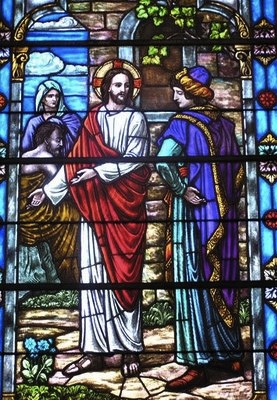
The rich young ruler wanted a clear, concise, and certain answer to his question: “Good teacher, what can I do to have eternal life?” In-other-words: “What skill set do I need that I don’t already have to get eternal life?” Wrong question.  Jesus didn’t even begin to touch it because he had the most attuned BS meter ever in history.

Jesus asked his own question: “Why do you call me good?”  That question was way off from what the rich young ruler wanted or expected.  But the question was meant by Jesus to evoke a sense of humility that would lead to discovery and trust of God.  Jesus finally got around to telling the man what he needed to do: “Go sell everything you own. Give the money to the poor… Then come and follow me.” (Mark 10:17-27)

The humble emptying of oneself is necessary in awakening to a new awareness that God is with you.  It may not mean that you give everything you own away, but it will mean coming face to face with yourself.  It will mean exploring God.  It will mean living in the awkward in-between of assurance and uncertainty, being loved but not knowing where that love will take you, and following Jesus without a pre-negotiated plan.

You can’t BS your way through the Christian life.  You need the posture of humility.  Jesus will be your Teacher, but you will need to bring yourself to the mix because Christianity is not dispassionately taking notes and then forensically regurgitating it all on an exam.  Instead, Christianity is a dynamic spiritual encounter between you and God through the person of Jesus.  It begins with humility.

MLK & CJ

MLK

Yes, it’s once again Martin Luther King Day.  It also happens to be my middle daughter Charissa’s birthday.  I often call her “CJ.”  Today I’ve been thinking about the two of them.  From the outside looking in there doesn’t seem to be much similarity.  But the two of them are interconnected in ways that I believe honor the hope and vision of each.

CJ is a lily-white girl (okay, she’s 28 years old today and a woman, but, hey, I’m her Dad) who gets a sunburn from just thinking about sunshine.  She’s clearly got my Northern European stock.  CJ is also a teacher, and a darned good one.  I admit my chest swells a bit thinking about the kind of impact she has in her school.  She’s not famous in the world.  But, she’s famous to me.  I’m a big fan.

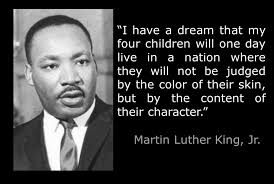
Dr. King was an African-American preacher who left his indelible print on our nation.  His courage and agitation for a better world is encapsulated in his picking up the vision of the Old Testament prophet Amos – to see justice roll down for all people.  His “I Have a Dream” speech resonates deeply with me and for many people not only in this nation but around the world.

Only from the outside looking in do these two people look so dissimilar.  Yet, a closer inspection reveals a connection worth noting.  You see, CJ teaches in an inner-city school.  Only the outsider would look at this as a white teacher in a black school.  But in the school, CJ is just a teacher and the students just students.  This is exactly where CJ wants to be – her dream job is not in the suburbs – it’s right where she is.

I can’t help but think today about the fact that this is just what Dr. King envisioned: White and black together, not distinguished by their color but viewing one another by the content of their character.  CJ is not shaping and forming African-American children near as much as she is teaching and building into the lives of precious people created in the image and likeness of God, just like her.  These students love her, not because they aspire to be white or see her that way, but because she loves them and is faithful to do whatever she can to further their education.

So, today is a celebration.  For me, it’s a celebration of seeing two people, from very different backgrounds, from different generations, and from different cultures meet in a similar vision that is being realized each day in a non-descript school in Midwest America.  And it is this kind of current reality that transcends politics and religion and is the real hope for a new day for all Americans.