Keep It Real

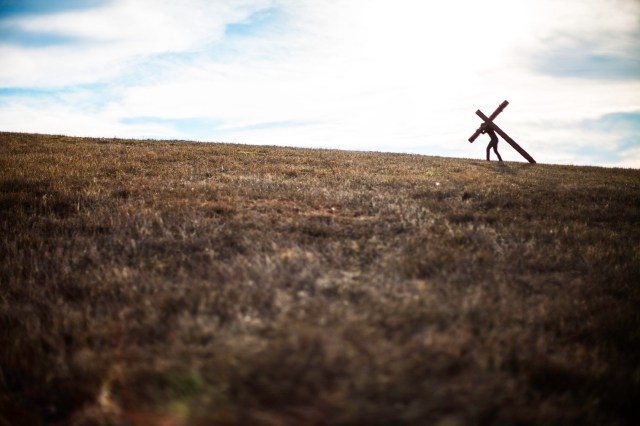
take up your cross

Keep it real.  The only true path to Christian discipleship is through being a real person.

You know the disingenuous type.  The dude who sits in the church pew looking like he’s never passed gas in his life.  The lady who can purse her lips so tight she looks like her head’s going to implode.  The poor kid who wants to break it down in the church aisle, but Mom and Dad are so into how it all looks that they shush him like a steamroller over marshmallows.

Then, there’s the pastor.  Sometimes he (it always seems to be a he, not a she) is either so stiff and bashes on every people group on the planet except his own that you wonder if the guy’s ever been seen in public without a chaperone, or he’s overly trying to be hip and cool to the point of looking like a hippo stuffed into skinny jeans.

C’mon, man, let’s just keep it real, okay!?

How about we drop the pretense, the preening, the posturing, the positioning, the pedigree-ing, and any other p-word we can come up with?  Let’s try on something else on for size: humility; vulnerability; authenticity; genuineness; and, being real.  That’s the cost of discipleship.

Let’s consider Jesus for a minute.  I just can’t bring myself to ever picture the Lord of the universe looking like any of the dubious aforementioned persons in the church.  But I certainly can envision him just the opposite of them all.

I’m not trying to make Jesus in my image.  I’m just attempting to gain a glimpse of the unfiltered Jesus, minus the weird white-European-I’m-stuffing-all-my-emotions-down-to-my-intestines Jesus.  The unvarnished Jesus we see in the New Testament Gospels is a God-Man who gets angry at injustice, cries with others over a death of a loved one, has unbounded words of grace for marginal people, heals those who know they need it, and has no problem knocking down proud Pharisees to size, instead of cuddling up and trying to make them happy.  The Lord I see is a complicated bundle of emotions, paradoxes, seeming contradictions, and eagle-eyed and laser-focused on doing his Father’s will.

I don’t know about you, but I want to be like Jesus, not anybody else.  I want to learn to love with abandon, teach like I mean it, be secure and confident in my own skin, and constantly commune with Father God.  I want to get rid of anything that gets in the way between me and doing God’s will, and to speak with authority without being a jerk about it.

Maybe you, like me, are concerned for all the “none’s” out there, that is, the persons who don’t affiliate themselves with any religion, much less Christianity.  I feel like I understand them.  In a way, I feel like I’m one of them.  I find myself having a zero tolerance for pretentious “Christians.”  The fact that I keep sensing the need to put adjectives in front of the word “Christian” tells me that something is terribly awry in the church – “real” Christians, “fake” Christians, “authentic” Christians, “Pharisaical” Christians, “grace-filled” Christians, “legalistic” Christians… on-and-on ad nauseum.  Sometimes I get fed-up with the adjectives and just want to start labeling myself a “fartknocker” Christian just to keep everybody on their toes.

If you’ve stuck with me this far, I’m finally going to get around to quoting some Scripture.  Jesus said:

“Then Jesus told his disciples, “If any want to become my followers, let them deny themselves and take up their cross and follow me.  For those who want to save their life will lose it, and those who lose their life for my sake will find it.” (Matthew 16:24-25, NRSV)

“I will follow you, Lord; but let me first say farewell to those at my home.” Jesus said to him, “No one who puts a hand to the plow and looks back is fit for the kingdom of God.” (Luke 9:61-62, NRSV)

“There is still one thing lacking. Sell all that you own and distribute the money to the poor, and you will have treasure in heaven; then come, follow me.” (Luke 18:22, NRSV)

“Those who serve me must follow me. My servants will be with me wherever I will be. If people serve me, the Father will honor them.” (John 12:26, GW)

And the Apostle Paul said:

“Be imitators of me, as I am of Christ.” (1 Corinthians 11:1, NRSV)

“You imitated us and the Lord. In spite of a lot of suffering, you welcomed God’s word with the kind of joy that the Holy Spirit gives.” (1 Thessalonians 1:6, GW)

Christians are people who follow Jesus, period.  They live into the words and the ways of Christ.  Many of the “none’s” just can’t reconcile their experience of church and their observations of Christ, so they jettison the church while finding Jesus compelling.

But what if they found church compelling, as well?  What if, instead of seeing pursed lipped women, uptight men, and restricted kids they instead found a bunch of fartknockers just trying to discover Jesus and live for him?

Maybe I’m preaching to the choir, or perhaps I’m ruffling some peacock feathers.  It could be that I’m being too banal with sacred things, like some cornfed yokel.  But it might be that I’m not being hackneyed enough and need to go further into the ordinary.  Maybe we have come to the place of so much bromide religion that we are left with a vapid soul.  In short, we’ve lost our way.

Well, if that’s the case, Jesus is the only person who’s going to save us from our humdrum life and platitudinous pandering of kitschy Christianity (there I go with the adjectives again).  It’s likely high time we leave it all behind, get real with ourselves and follow him.  Wax figures sitting in pews can’t follow anybody – only real blood and guts people with actual insides can do that.

Lent is almost over.  If you haven’t gotten around to reading one of the Gospels, hurry-up!  Get to it!  Okay, I’ll throw you a bone: The Gospel of Mark is the shortest of the four.  For the compulsive overachievers out there, Luke is the Gospel for you.  Whether you need to get up earlier or stay up later at night, I encourage you to make it happen.  I’ve never known anyone who has read an entire Gospel in one or two sittings and not walked away profoundly changed in some way.

If you do it, come back and tell me what it was like to read a Gospel. I’m curious and wonder what you get from it.

And give it to me straight.  Keep it real.

How to Overcome Suffering

bear

There is a way to overcome suffering.  There’s a path that you can follow which will lead to the overcoming of your struggle against sin; your dealing with the meanness of others; your chronic physical pain; your continual facing of financial trouble; your estranged relationship(s); your past bad decisions that keep coming up to bite you in the present; your constant feeling of angst about the state of the world’s great needs and problems; your Anfechtung (spiritual oppression and depression); and, a hundred other reasons for suffering in this broken old world.  The road ahead, however, will be completely counter-intuitive to how you might currently be thinking about overcoming suffering.  It might be so far off your radar that you might just discard what I’m about to say to you.

Before I get to that, I’ll just say first that suffering is endemic to the human condition.  Everyone suffers.  Since we live in a fallen world, there is not one person who hasn’t suffered in some way, whether it is physical, spiritual, mental, or emotional.  None of us will ever be immune to affliction.  There is no way to insulate yourself from pain.  If you are not currently suffering in some way, it just means that you are either coming off a time of hardship or are about to enter a new period of distress.

Holiness and godliness don’t keep suffering at bay.  In fact, the Lord Jesus himself promised us that following him will involve a kind of suffering that those who are not Christians will never face.  “While you are in this world, you will have to suffer,” are the blunt words of Christ to his disciples (John 16:33).  The Apostle Peter, who was part of Christ’s inner circle of followers, came to understand this reality.  “Dear friends, don’t be surprised or shocked that you are going through testing that is like walking through fire.  Be glad for the chance to suffer as Christ suffered” (1 Peter 4:12).  Peter understood that all Christians are not above their Master.  If Christ suffered, his followers will suffer, as well.

James, the Lord’s brother, understood that everyone faces difficulty.  But he wisely discerned that suffering can become a teacher for the Christian.  “My friends, be glad, even if you have a lot of trouble.  You know that you learn to endure by having your faith tested” (James 1:2).  All the adversity the Christian faces are the means of producing maturity, strengthening faith, and developing patience.

The Apostle Paul, a man who was more acquainted with suffering than any follower of Jesus in history, had this to say about all those terrible circumstances: “Anyone who belongs to Christ Jesus and wants to live right will have trouble from others” (2 Timothy 3:12).  “We gladly suffer, because we know that suffering helps us to endure.  And endurance builds character, which gives us a hope that will never disappoint us” (Romans 5:3-5). “God has generously granted you the privilege, not only of believing in Christ but also of suffering for Christ’s sake” (Philippians 1:29).

The New Testament writers have a perspective on suffering which is very different than how we typically think of it.  Yes, we will have to suffer.  It’s part of being in the world.  Yet, Jesus said, “but cheer up! I have defeated the world” (John 16:33, Contemporary English Version).  Or, in another translation, “In the world you have distress. But be encouraged! I have conquered the world” (Common English Bible).  Yet another translation, “In this world you will have trouble. But take heart! I have overcome the world” (New International Version).

Now, let’s wheel back around to the overcoming of suffering.  Here is the truth and the practice we must adopt when it comes to suffering:  the truth about overcoming suffering comes not from us, but through Christ; and, the practice of overcoming suffering doesn’t come from fighting against it but by sitting with it and learning from it.

Okay, let me state this again in a different way.  Jesus has overcome the world through his death, resurrection, and ascension.  On the cross, he has absorbed all the sin and suffering of everyone.  Your suffering, then, might hurt and it might be senseless, but no matter it’s source, that suffering will always rule over you unless you invite it to take a seat with you and have a conversation with it.

Let me say it another way, and to the point: Quit fighting against your suffering. Stop kicking and screaming long enough to look your suffering square in the face and learn from it.

In other words, your suffering is trying to tell you something.  But if you keep taking the stance of a pugilist trying to punch it away, it will just keep moving forward at you and never topple.  You can’t beat suffering.  You can only learn from it.  And you’ll only learn from it, even overcome it, when you embrace it.  So, here’s the counter-intuitive, counter-cultural practice that you might not like and might think I’m off my rocker for suggesting: Submit to suffering.  Yes, I will say it again: Submit to suffering.

Don’t hear what I’m not saying.  I’m not trying to sanitize your troubles, adverse circumstances, or even your terrible trauma.  Evil is evil, bad is bad, and no amount of saying otherwise will change the leopard’s spots.  However, only through submitting to the process of what suffering teaches us will we ever have power over it.

Perhaps an illustration is in order.  Let’s liken suffering to encountering a bear in the wilderness.  The National Park Service gives us this advice if facing a bear while out hiking:

“Once a bear has noticed you and is paying attention to you, these strategies can help prevent the situation from escalating.

  • Identify yourself by talking calmly so the bear knows you are a human and not a prey animal. Remain still; stand your ground but slowly wave your arms. Help the bear recognize you as a human. It may come closer or stand on its hind legs to get a better look or smell. A standing bear is usually curious, not threatening.
  • Stay calm and remember that most bears do not want to attack you; they usually just want to be left alone. Bears may bluff their way out of an encounter by charging and then turning away at the last second. Bears may also react defensively by woofing, yawning, salivating, growling, snapping their jaws, and laying their ears back. Continue to talk to the bear in low tones; this will help you stay calmer, and it won’t be threatening to the bear. A scream or sudden movement may trigger an attack. Never imitate bear sounds or make a high-pitched squeal.
  • Hike and travel in groups. Groups of people are usually noisier and smellier than a single person. Therefore, bears often become aware of groups of people at greater distances, and because of their cumulative size, groups are also intimidating to bears.
  • If the bear is stationary, move away slowly and sideways; this allows you to keep an eye on the bear and avoid tripping. Moving sideways is also non-threatening to bears. Do NOT run, but if the bear follows, stop and hold your ground. Bears can run as fast as a racehorse both uphill and down. Like dogs, they will chase fleeing animals. Do NOT climb a tree. Both grizzlies and black bears can climb trees.”

Fighting suffering is about as useful as taking on a bear.  Bears, like suffering, can be dangerous.  We don’t blame bears if they act like bears.  Likewise, we ought not to be surprised when suffering hurts.  But we can learn a lot about suffering and even come to the point of oddly admiring it for it’s large ability to teach us things we would not learn otherwise.

I suggest we treat suffering like facing a bear in the wilderness of trouble.  Calmly identify yourself.  Talk in low tones to your suffering.  That’s right, speak to it.  Remember who you are.  You belong to God.  Treat suffering as if it is curious about you.  For God’s sake, stay calm.  Doing the big freak-out is only going to encourage suffering to do damage.  If you’re alone, that’s not good.  Walking with others in Christian community is one of the best practices of the Christian life.  Suffering is intimidated by groups of people encouraging one another and showing hospitality to each other.  Keep your eye on suffering.  Don’t ignore it, or pretend it isn’t there.  Don’t run.  Face suffering.  Keep it in front of you.  It will pass, but you must be patient and calm.  Once it is gone, then you can reflect on what happened and debrief with others about the experience.

The path to overcoming suffering is to acknowledge it, respect it, submit to it, and let it pass.  Then, you will be able to consider “it pure joy… whenever you face trials of many kinds, because you know that the testing of your faith produces perseverance.  Let perseverance finish its work so that you may be mature and complete, not lacking anything” (James 1:2-4).

Stop fighting.  Start maturing.  Stop going it alone.  Start living in vital and vulnerable community.  Stop being a martyr.  Start letting the martyrdom of Christ be your center of life.  Stop talking.  Start listening.  Stop treating your suffering as an adversary.  Start talking to suffering as a companion to learn from.

Strong as an Oak

oak tree

I like oak trees.  In one of my many jobs I’ve had in my life, I was once a delivery driver with a mostly rural route to cover.  I enjoyed those times when I had to deliver to someone way out in the sticks on a faraway gravel road.  Early mornings were the best.  On a cool summer morning I would begin to smell the distinctive odor of a woodworker in his shop, as I drove along.  Entering the woods, untouched by the farmer’s plow, with small creeks winding through the trees, there was enormous oaks.  Yes, even in this day-and-age, there are remote untouched places of pristine beauty – you just need to know where to find them.  I delivered my package, wanting to linger for as long as I could in the celebration of senses.  Off I went, hoping that another day would bring another package to the faraway woods.

Oak trees are majestic.  Strong root systems, thick trunks, unique twisted branches, and beautiful leaves become home for all kinds of bugs, squirrels, birds, and the occasional possum and raccoon.  To have an oak piece of furniture is to have something of permanence.  The wood from an oak is heavy, attesting to its great strength.

Those who seek, discover, and respond to Jesus Christ are much like an oak tree.  Strong, lasting, giving life and shelter to all kinds of creatures.  Read carefully these words from the prophet Isaiah and take note of who the prophecy is directed toward, and what they shall be called:

The spirit of the Lord God is upon me,
because the Lord has anointed me;
he has sent me to bring good news to the oppressed,
to bind up the brokenhearted,
to proclaim liberty to the captives,
and release to the prisoners;
to proclaim the year of the Lord’s favor,
and the day of vengeance of our God;
to comfort all who mourn;
to provide for those who mourn in Zion—
to give them a garland instead of ashes,
the oil of gladness instead of mourning,
the mantle of praise instead of a faint spirit.
They will be called oaks of righteousness,
the planting of the Lord, to display his glory. (Isaiah 61:1-3, New Revised Standard Version)

You might quickly observe that these are the words the Lord Jesus quoted in the temple at the beginning of his ministry (Luke 4:18).  Our Lord Christ is the one who fulfills these words and gives them their greatest meaning.  Remember those to whom Jesus directed his ministry toward, the very people mentioned in these verses: the oppressed; the brokenhearted; the captives; the prisoners; and, those who mourn.

Jesus clearly discerned that the kingdom of God is flip-flopped from how many people think about it.  God’s kingdom is not made up of the rich and powerful, that is, those who don’t think they need a Savior.  The kingdom is populated with the financially least, the socially lowest, the spiritually lost, the emotionally as well as the physically lame.  While others might believe these are the people who are weak, the prophet and the Lord have something different to say about it.

It is those for whom the bulk of society would consider incapable and/or unworthy of strength and position who are the truly strong in God’s upside-down kingdom.  The weak are incredibly strong, and the strong are woefully weak; the poor are wildly rich, and the rich are pathetically poor; the lost are joyfully found, and the found are slack-jawed in their lostness; the lame are more than able, and the able are laughingly lame.  In short, all these marginal people are described by God as “oaks of righteousness.”

oak tree 2

These people for whom are seemingly forgotten by so many are the ones God will use to display his glory to the world.  God does not choose the wise, the learned, and those with prestige and power.  God pursues those who are discarded by others; who seem useless to the rest of society; and, who appear worthless as emissaries of the King of Kings (1 Corinthians 1:18-25).

Maybe oak trees have such an appeal to me because they are a reminder that the truly strong and majestic of this world are made up of people just like you and me – common ordinary sinners and saints who just want to know Jesus better.  To be rooted and established in Christ gives us a quiet strength the world can’t touch (Colossians 2:6-13).

Most of us will never win an Oscar.  None of us will ever be an Arnold Schwarzenegger (whose nickname back in the day was the “Austrian Oak”).  We’ll never play in a Super Bowl; command a Fortune 500 company; or, wow millions of fans with our superior talents.  Instead, we have something better.  We are growing and developing, straining and struggling to become a mighty oak of righteousness.  Perhaps no one will ever notice, but that’s okay.  We are giving life and happiness to all those woodland creatures who need us.

The world is not changed through the power which comes with position, prestige, and pedigree.  This old broken world is mended, repaired, and set right again by the God who uses oaks of righteousness – the quiet enduring strength of you and me – in a kingdom which will never end.  So, may you be encouraged today and every day with the God who is growing you into someone who is mighty and strong.

Perspective Changes Everything

perspective is everything

Today is one of my bad back days.  It’s days like today that remind me: perspective is everything.  You see, thirteen years-ago this coming May me and my family were in a car accident.  I was traveling on a highway in Iowa where we were living at the time, and a small car on a gravel road blew right through the stop sign without even slowing down.  There was nothing I could do.  I plowed into the rear quarter panel of the oncoming car, and it literally spun like a top off the highway and came to a stop.  Both the driver and his girlfriend passenger were not injured.

Two of my daughters were in the very back seat of our mini-van (which I had just bought only a month before), with my wife and dog as front seat passengers.  The car was totaled.  My girls were not harmed.  But my wife tore her shoulder’s rotator cuff protecting the dog and had to have an agonizing surgery to repair it.  My lower back was injured, but not in a way which surgery could repair.  To this day I live with chronic pain.  Some days it’s not bad, maybe a one or two on the pain scale.  But on my bad days I can barely walk across the room, and I need cane to get around.  Today is one of those days.

20180226_154906_resized

I have played the scene of the accident in my mind hundreds of times.  I have thought time and again about what I could have done to prevent the accident.  But there was no way to avoid it.  I thought about the fact that if we just would have left a minute earlier or a minute later from my parents’ house from where we were visiting, all would be fine.  Yet, I know that kind of thinking is a fool’s errand.  I have pondered every possible scenario in my head and have gotten nowhere.

It also took me awhile to forgive the young man who was driving the other car.  He changed my life, and not in a good way.  Although his insurance took care of everything and he was very repentant about the whole thing, I was understandably mad for a long time.  I did, over time, come to the point of forgiving him.

Through the years I have learned to live with my limitations.  I have now accepted the pain as part of my life.  But, on occasion, I sometimes I can’t help but think of how my life would be today if I hadn’t been in that stupid accident.

About three years ago I was praying alone in the church for which I was a pastor.  And God brought the accident to my mind.  I said to God, “Lord, we’ve been through this accident hundreds of times together.  I don’t want to think about it anymore.  Why are you bringing this up now?”

I’m not sure I really wanted an answer, but God brought it up because he knew I was finally ready to get his perspective on the accident.  Out of the hundreds of times I went over that accident in my mind, the one perspective I never took was that of the young man – the other driver.  God invited me to take a different view, from the other driver.  So, I did.  I know that intersection like the back of my hand, so it wasn’t a hard exercise.

I put myself in the driver’s seat of his car.  I’m driving down the gravel road not paying attention to the fact that a stop sign is coming up.  I blow through the sign onto the highway and right in front of a minivan who slams on the brakes just enough to crush the rear quarter panel.  I spin out like a top and come to rest only a few feet from a huge Iowa grain elevator.

For the first time in my life I finally understood.  God had a divine appointment for me that day.  You see, if I had not come along just when I did, that young man and his girlfriend would have blown through the stop sign and struck that grain elevator.  It would have killed them both instantly.

perspective changes everything

Suddenly, my perspective changed 180 degrees.  Previously, I had always thought about myself and my family.  I always considered my hardship and my change of life.  But now I saw that God sent his servant to save two lives that day.  Had I not struck his car, causing him to spin and come to a rest unharmed, two people would have died.

Now, every time my back acts up, like today, and it effects how my life is lived, I’m reminded that it is a very small price to pay for the lives of two human beings.  Perspective is everything.

The biblical meaning of “repentance” is literally to have a change of mind – to see a different perspective.

The Bible invites us to view our lives with new lenses.  Our hurts and our pains, our sorrows and our sufferings, our changes and our limitations, are all part of something much bigger that God is doing in the world.  We are not always privy to his plans and purposes.  But his Word challenges us to take a perspective of the world, of humanity, and of ourselves that is counter to how we often think only about ourselves.

The thread of God’s moral perspective, his view of human ethics, runs through the entirety of the Bible.  The psalmist reminds us that this Word is good, sweet, and more precious than gold (Psalm 19).  The Apostle Paul reminds us that this Word is our wisdom to live by (1 Corinthians 1:18-25).  And Jesus, as the Word made flesh among us, lived that loving and gracious Word with perfect moral and ethical goodness.  The temple, as the place where God’s Word was read and observed, was not to be adulterated with the view of making a profit – which was why Jesus drove out the money-changers (John 2:13-22).  Later, after Jesus died and rose from death, his disciples gained a new perspective.  They remembered their master’s words and affirmed them as being the Word of God.  They believed.  Their repentance and faith changed the world.

20180226_155620

God is inviting us to take up his Word and see our lives, the lives of others, and every event and situation through that lens.  We are to see Jesus, not only as a great teacher, a moral and good person, and a loving healer – but also as Lord and Savior.  In a very small way I suffered so that someone else could live.  But Jesus suffered sin, death, and hell in our place so that you and I could live – so that we might have the eternal life of enjoyment with God forever.

Allow the Word of God to shape your lives and form your thinking today and every day.  You might not always know what God is doing, but you can be assured that everything he does is just, right, and good.

May you know Christ better in this season as you reflect upon our Lord’s great sacrifice on our behalf.  May you know the love of God the Father, the grace of the Lord Jesus, and the encouragement of the Holy Spirit.  Amen.