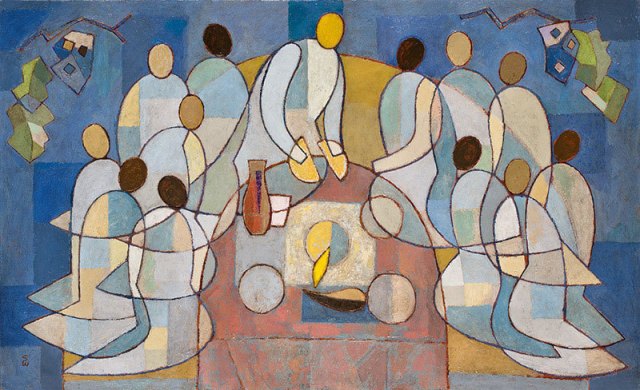
The Community of the Redeemed

Devoted to Fellowship

It seems everyone has their own ideas about church – what it is and what it should be – whether one needs to be part of a local congregation, or not. No matter the view, we all intuitively know that:

We are created and hardwired for community.

The book of Acts in the New Testament of the Bible presents Christian community as the primary means of becoming spiritually formed (Acts 2:42-47). And that community dynamic revolves around Jesus Christ. From a biblical perspective, Christians are not just any old community and not just some random benevolent organization. Christians together are the Church. They are the Community of the Redeemed, purchased from the slave market of sin with the blood of Christ, and devoted to knowing Jesus and making him known.

The early church possessed a group dynamic second to none. To be sure, they had their issues (e.g. antagonisms between Jews and Greeks, and bogus converts attracted by the power). Yet, problems are to be expected because the Light is always going to attract some bugs.

The early church consisted of new converts, having responded to the Apostle Peter’s preaching about Jesus. The transformation of these early followers of Jesus is nothing less than amazing. Many of these very same people had applauded the murder of Jesus. However, after Christ’s ascension, the people realized they were complicit in the death of Jesus and were cut to the heart and changed their minds. In a mass conversion, thousands embraced the grace of God in Christ. They quickly became a group of Christians:

Committed to learning more and more about Jesus; sharing their burdens and blessings together; enjoying communion and eating together; praying with and for each other, confessing sin and seeing new life and fresh spiritual health come in amazing ways.

Two major commitments of the new believers were the basis of the church: They devoted themselves to the apostles’ teaching and to the fellowship. Within that close fellowship were firm undertakings to eat and pray together. It is no wonder this curious bunch of people became noticed. After all, sharing food and providing prayer are compassionate activities. In a world starved for basic human kindness, the believers’ attention to the feelings and needs of others must have been a respite to the people around them.

Devoted to One Another

The Christians were hungry for instruction. They craved teaching and fellowship so much that they met every day. They gathered in the Jewish temple, and in homes. That reality of the church so long ago is a clue for the modern church that both large group meetings and small group gatherings are paramount for healthy spiritual growth and development. The gatherings of the early Christians were characterized by a deep engagement of Scripture with one another and of heartfelt participation in fellowship.

Mutual learning and sharing are for everyone – not just for a select few, or for extroverts.

That is why throughout the New Testament the metaphors used to describe the Church emphasize its communal nature. Church as the Body of Christ (biological metaphor), the Temple of God (building metaphor), and as the army of the Lord (battle metaphor) are all images that emphasize the redeemed community’s vital need to work, worship, and have a wide reach together. Indeed, true discipleship happens because of life together.

Metaphors are important; they pack meaning to ideas. So, it is important to be aware of church metaphors which emphasize only the individual and ignore the community. For example, imagining the church as a gas station where you fill up your spiritual gas tank when you’re running low neglects the community. Get a good sermon and some energizing worship and hopefully you will make it through the week to another service without running out of gas. For other folks, the church is imagined as a movie theatre – which disregards our contribution to community. The emphasis is on a place that offers an hour of escape, and leaving your problems at the door, with the goal of coming out of church feeling better than when you came in. Or some might imagine the church as a pharmacy – a place where you can fill a prescription which will deal with your pain in a slip-in and slip-out sort of way. Others might opt for imagining the church as a big box retailer – a place that “offers the best products in a clean and safe environment for you and your family,” along with a marketing model of evangelism: “Come to our church; we offer great service and great programs at a great low price.”

Please, don’t hear what I’m not saying. The church, without question, ought to serve and meet individual needs. And there are times and seasons of life when all an individual can do is consider their own spiritual and emotional health. The problem arises when we only ever function as independent persons who have no intention of being interdependent with others through living the Christian life together. The early church was faithful to learning the Word of God together. They committed themselves to fellowship with one another. They practiced hospitality. The new Christians prayed with each other every day.

The early church’s teachable spirit along with an emphasis on fellowship brought amazing results. Everyone was filled with awe of God. Everyone saw and experienced miraculous events. Everyone looked out for the common good of all. Everyone was glad and content with their simplicity of life. Everyone praised God. Everyone enjoyed the favor of the non-Christians around them. And, all this behavior brought numerous people to faith. This was a group who demonstrated deliverance from empty lives and presented an alternative way to live – a life filled with receiving grace and giving grace to others.

Stained Glass Window

To have that kind of group dynamic, the path the church took was a dedication to Holy Scripture and Christian community every day! Indeed, for healthy churches everywhere, and in all times, congregations continually exhibited courage and vulnerability. The word “fellowship” in Scripture (κοινωνία – pronounced “coin-o-nee-a”) literally means to be “yoked together.” Just as two oxen in a yoke must work together and plod forward being mindful of each other’s steps, so Christians have the invitation to yoke with Jesus and learn from him. Gentleness and humility are sorely needed in this polarized and often petty world we live in. So, the loving participation of fellowship is more than important and influential – it is vital and urgent.

The earliest Christians are portrayed as a group of people who intensely desired the apostles’ teaching and could not get enough of sharing life together as followers of Jesus. They were such curious learners and had such a depth of love and concern for one another that the poor among them knew no shame, and the rich knew no pride. It was a community where the uneducated felt open and free to discover more about Jesus, and the leadership graciously and humbly gave instruction that they had gained from being with Christ.

The type of community life which the early church had might seem to be an ideal which is not possible today. I wholeheartedly disagree. Because I myself have experienced such a group dynamic in my own life. In my college days there were dozens of us who became Christians in a short period of time, much like in the book of Acts. We were a rag-tag group of new believers who deeply hungered for spiritual food and craved the fellowship of one another. We met every day in dorm rooms and cafeterias, at the student union and in the library, and even sometimes in off-campus bars.

Everything we had we shared with each other – both our possessions as well as our hearts and lives.

And there was a solid two year stretch in which the Lord added to our numbers daily those who were being saved. We were attached to our Bibles as if they were a fifth appendage on our bodies. There was no separating us from each other. We needed one another’s Christian fellowship and spiritual support every day. In fact, we needed one another so much that we all ended up marrying each other so that the fellowship did not end.

Oh, my friends, how much we need one another! How much this old fallen world needs a yoke that is gentle, kind, gracious, and loving! Christian disciples are formed and shaped in the context of community. The collective conversations of our experiences and insights; the use of our hands and feet to work together; and, the sharing of our resources and of our time are all necessary for becoming spiritually mature in Christ and blessing the world. Confidence is gained through practice, and the spiritual practice of community is what’s needed.

May the group dynamic and the results of those earliest believers so long ago be our communal experience, as well, as we devote ourselves to the teaching and to the fellowship.

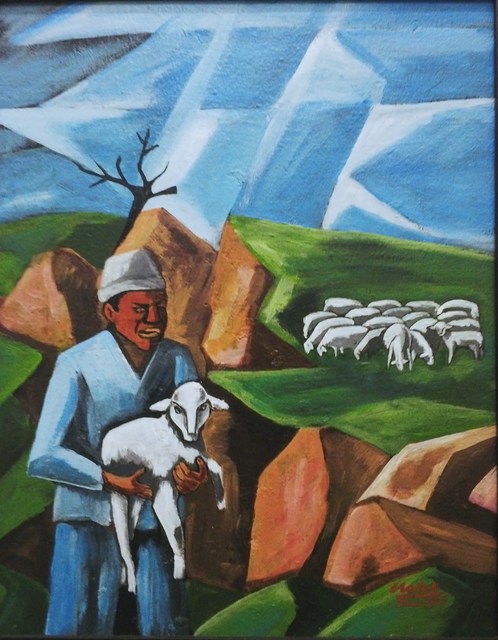
Luke 15:1-7 – One Lost Sheep

The Shepherd and the Lost Sheep
“The Shepherd and the Lost Sheep.” By Peter Clarke, 1969

A lot of men and women of doubtful reputation were hanging around Jesus, listening intently. The Pharisees and religion scholars were not pleased, not at all pleased. They grumbled, “He takes in sinners and eats meals with them, treating them like old friends.” Their complaining triggered this story:

“Suppose one of you had a hundred sheep and lost one. Wouldn’t you leave the ninety-nine in the wilderness and go after the lost one until you found it? When found, you can be sure you would put it across your shoulders, rejoicing, and when you got home call in your friends and neighbors, saying, ‘Celebrate with me! I’ve found my lost sheep!’ Count on it—there’s more joy in heaven over one sinner’s rescued life than over ninety-nine good people in no need of rescue. (MSG)

Lost people matter to God.  They matter so much to him that one lost soul found is the grounds for a big celestial party.  Please note this simple observation of today’s Gospel reading: If there is rejoicing in the presence of angels in heaven over one sinner who repents, then who is doing the rejoicing?  God!  God himself is crazy giddy with joy over one lost person being found.

Celebration is an important activity for the Christian. God throws the best parties, filled with plenty of joy and recognition of persons restored to fellowship. As people created in the image and likeness of God, we are hardwired for celebration. If God can go uncorked with joy and celebration, I’m going to say with confidence that open unabashed blowouts rejoicing over people’s transformation and new life is welcome and expected. Folks baptized in pickle juice can join the grumbling of all the high mucky-muck dudes who smugly look down on the marginal persons among us. Hopefully, the party-poopers won’t be heard because of all the noise at God’s party.

This parable of Jesus is meant to give us a glimpse of God’s own heart.  He would do anything to find a lost person, to restore and reconcile a person back to himself.  God would go dumpster diving and wade through the stinky nasty garbage to find that one lost valuable person.

Why should reaching out to marginal people with the grace and love of Jesus Christ be a high priority?  Because restoring lost people is a high priority for God.  God has placed the highest of priorities on recovering those who are spiritually lost and wandering around life without a purpose or a place to call home. Such people matter so much to him that God sent his Son, the Lord Jesus, to this earth.  Jesus went to the greatest lengths possible through enduring a cruel death on a cross in order to reconcile a broken lost relationship between people and God.

I can still remember what it felt like to be separated from God and estranged from the church – it was lonely and sad, like being in a deep black hole with no way of getting out and no one around to help.  But God, in his great mercy, sent spiritual commandos to extract me from my captivity of the soul. So, my greatest desire is to live my life basking in the grace shown to me, grateful for new mercies which come every day, and giving that same grace to others – especially those considered as the lost, the least, and the lonely in society.

In leaving the ninety-nine and going after the one sheep, God gave preferential attention to the lost. So, because of this, I ask a sincere and probing question which I believe needs to be asked:  Can you live with that?  My own answer is: “I sure can, because I was once that lone lost sheep!”

Jesus, you are the Good Shepherd.  Thank you for going after me when I was lost.  Help me to remember that you will often leave my pasture to go after others. I’ll be willing and happy to go with you when you do. Let’s also take the Spirit with us.  Amen.

Click Compassion Hymn by Keith and Kristyn Getty to remember the lengths of love God went to in restoring us.

Psalm 23 – Trust and Rest

Rest

In this sacred season of Eastertide on the Church Calendar, Christians deliberately spotlight on what new life is and how it can bring transformation from fearing adversity to believing God through the adversity; from wondering where the heck my needs are going to be met to trusting in God’s willingness to provide; from worrying about the future to resting in the present.  Psalm 23 is just the right message for both the season and our world circumstances of pandemic and hardship.

Because of the psalm’s familiarity, some might only associate it with funerals and miss its relevance for the here-and-now. That would be quite unfortunate because this is a beautiful poem of trust which is prescient for us to face the vicissitudes of faith and life on this earth and be able to rest in the field of God’s benevolent kingdom.

Therefore, I am offering here my contemporary version of this most famous of psalms for the Church:

Jesus is my Pastor, and I lack absolutely nothing because of it.

My merciful overseer is watching me while I rest secure on a nice soft bed of grace;

             he leads me into an unhurried life; he is thawing out my cold anxious soul.

He leads me in all the right ways for the sake of his great name.

Even though I get lost and find myself in a dark alley,

             I really have no fear of evil;

for I know God is with me,

             his Word and Sacrament – they are more than sufficient to comfort me.

I have a big ol’ appetite and hunger for you, God,

             and you satisfy it,

             even though I have enemies within arm’s length;

you encourage my mind with joyous thoughts,

             so that my heart overflows with hope.

I am quite sure that goodness and mercy will follow me for a lifetime,

             and I will live in peace despite any adverse circumstances my whole life long. Amen.

Click The Lord’s My Shepherd by Stuart Townsend as we find rest for our souls.

The True Self and the False Self

“Be yourself, everyone else is taken.” – Oscar Wilde.

True Self False Self

People are complicated. They cannot be reduced to simple categories, as if an individual person can be neatly labeled as good or bad, nice or naughty, magnificent or mean, altruistic or selfish. No, people are wondrously intricate beings with a vast inner world of values and motivations. The reality of humanity is that we are a befuddling mix of virtue and vice with capabilities of much greater good than we realize along with an unfortunate capacity for heinous words and actions in the world. We are both blessed with the enduring mark of God’s image and cursed with not acknowledging our inherent worth through using cheap parlor tricks to prove we matter to others. As a result of these two often competing realities, we all tend to inhabit a sort of spiritual schizophrenia which vacillates between the true self and a false self.

What is the true self?

The true self is a person’s pursuit of realizing their own potential of gifts and abilities to be used for the common good of all. The true self embraces authenticity, vulnerability, and courage in their desire for growth and development of the inner person. The true self is open, being curious about self and others. Wanting to realize the full implications of God’s image within them, the true self is free to explore the vast potential of good which resides inside. The true self loves others from a place of invitation and patience. The true self is a master of one’s own inner wisdom and, so, has ability to rest and have peace.

What is the false self?

The false self is a person’s compulsion to achieve an idealized form of themselves. Such a self seeks the adulation of others since they lack awareness of their true self. The false self holds on to secrets, avoids emotions, and seeks perfection. The false self is closed, being afraid that others might reject them, if they knew the true self. Thus, the tragedy of the false self is that – in seeking self-protection – they do not find the self-realization and love they long for. Obsessively attempting to present an image to the world of having it all put together, the false self does not risk being brave. Instead, it fears others might see the bad within them, and so, judge and reject them. The false self uses love to manipulate others to love them back. The false self has no mastery of self because it attempts to become a master of a small world over others. The false self is never at rest and obsessively moves from one project to another.

Why does a person have a false self?

When someone has a great deal of inner stress, they might become estranged or alienated from their true self. For example, if someone has experienced trauma, they might direct their energy toward molding themselves into an idealized self. The hope of such a misadventure is to become impervious to any further trauma and pain. In short, the false self seeks power over others through doing everything the right way all the time so that they can feel a sense of security, superiority, and/or control in every situation.

How do I realize the true self?

The following is by no means an exhaustive list of connecting with our true selves. Indeed, you will likely come up with many more ways. After all, you have potentialities within you which I do not possess!

  1. Pay attention to your spiritual self. Just as our physical spine supports us and we need to take good care of it, so we have a spiritual spine which supports us when we need it – that is, if we pay attention to it and maintain good habits of self-care.
  2. Believe in the inherent good you possess – that it will eventually win and have the day. The image of God permanently resides within us; the curse of the fallen world does not. Have faith that goodness will prevail in your life.
  3. Focus primarily on exploring your true self through a positive plan; and, only secondarily focus on combating the false self. Compulsively trying to suppress the false self is, ironically, giving it power to call the shots in your life.
  4. Develop new habits and routines which are life-giving for you. Avoid implementing long lists of do’s and don’ts which are cumbersome and burden your soul with an unnecessary heavy load. A good rule of thumb here is that if your plan and routines are serving you well, then you are probably on a healthy path. If you find yourself constantly a slave to your routines, then you are serving the plan and are likely on an unhealthy road.
  5. Create a safe space for yourself in which your true self can arise. This means developing healthy rhythms of giving and receiving love; and, sharing your story and listening to others share their stories. And these occur when we have a safe space to inhabit. Safe spaces typically don’t fall into our laps. We need to take some initiative to find them.
  6. Take your emotions seriously. Many people have learned from their family of origin and/or their church or faith community that thoughts are more important than feelings; and, to not show emotions or even really acknowledge them. This, perhaps more than any other reason, pushes a person toward pursuing an idealized false self. In truth we are emotional creatures and our feelings are significant, valid, and vital. As we take those feelings seriously through talking about them and sharing them with trusted individuals, our true self begins to emerge.
  7. Seek support through finding groups who share your desire for self-realization and discovering persons who model what you are looking for. For example, for me, Jesus Christ is the ultimate model. When tempted with a devil’s pact for achieving salvation through self-idealization, Jesus did not take it. Instead, he chose the hard road of self-realization and was satisfied doing the will of God.

Some quotes on realizing the true self:

“If you don’t get lost, there’s a chance you may never be found.” – Anonymous

“Owning our story and loving ourselves through that process is the bravest thing we’ll ever do.” — Brené Brown

“There are three things extremely hard: steel, a diamond, and to know one’s self.” – Benjamin Franklin

“Always be a first-rate version of yourself and not a second-rate version of someone else.” – Judy Garland

“The path to great confidence is not in becoming invincible, flawless, and seemingly perfect. But rather, it is in embracing your humanity, in all its messy glory and tender vulnerability.” – Aziz Gazipura

“Embrace the glorious mess that you are.” – Elizabeth Gilbert

“Knowing your own darkness is the best method for dealing with the darkness of other people.” – Carl Jung

“Live life as though nobody is watching and express yourself as though everyone is listening.” – Nelson Mandela

“Be who you are and say what you feel, because those who mind don’t matter and those who matter don’t mind.” – Dr. Seuss

“The freedom to be yourself is a gift only you can give yourself. But once you do, no one can take it away.” – Doe Zantamata