Who Is Your Master?

oversize backpack

We all carry an invisible backpack. Sometimes it is light, sometimes heavy. At other times, the backpack becomes a crushing load. We are unable to carry it because we kept adding things to it and did not take the time to unload anything. Every day, many people lug such an invisible backpack around everywhere they go. Over time, the backpack begins to smell because unacknowledged grief, unawareness of emotions, and the pile up of life’s difficulties become like a pair of stinky gym socks that got tossed in the backpack with hard feeling after hard feeling caked on top of it.

Something unfortunate then happens: The backpack becomes our Master. It begins to influence the way we talk, what we do, and do not do. It becomes a heavy and even crushing load because rather than Christ, the Spirit, and the Scriptures informing and influencing what we say and do, the invisible backpack calls the shots. It is the weight of sin.

The dominate word for “sin” throughout the New Testament means to miss the mark or to fall short.

It is not a word meaning some terrible egregious wrong committed against another. Rather, it is the most common form of sin there is – simply failing to deal with what humanity needs to deal with – and so, out of sight, out of mind. Unfortunately, those items are never out of the heart’s view.

The Apostle Paul’s way of framing this situation is this: Do not offer our lives to wickedness but offer ourselves to God (Romans 6:12-23). When we have become so accustomed to the invisible backpack as our master that we cannot imagine life without carrying it around, we must take it off. We need to carefully unpack each item we have stuffed into it and allow ourselves to face the pain and hurt and take up Christ’s easy backpack, his yoke.

Since we are redeemed people, baptized into the death of Jesus Christ, we no longer need nor ought to carry a load of sin any longer.

We were meant to have a Master and to carry a backpack – just not the backpack of our shortcomings and failures. Instead, we are to throw over our shoulders the backpack of mercy and righteousness and follow the Master, Jesus Christ. Who is your Master? is not meant to be a scolding question. It is an encouraging question, an invitation to unburden ourselves.

Jesus Christ, by his grace, took the backpack of sin that you and I were carrying and took it upon himself.  He took the crushing weight of our backpacks of sin for us.  Jesus took out those stinky gym socks; they were then nailed with him to the cross. We no longer need to carry this smelly load of sin any longer because Jesus already carried it for us and took care of it. Yet, so many of us still insist on taking up the invisible backpack and keep putting stuff in it.

Therefore, we must deliberately and intentionally take off that invisible backpack. Since the backpack is invisible, most of us would never guess that another carries such a heavy load. Instead, what we do see is the backpack causing another to work himself into the ground so as to continue ignoring the hurt, to keep everything completely clean and in control on the outside because on the inside it is emotional chaos.

What appears on the outside may not be true of the inside.  

For example, when you see my ten-year-old grandson you would never know on the outside that his brain is having immense struggles with epilepsy and seizures on the inside.  And when we look at one another in the church and the world, we cannot assume that just because everything may seem okay on the outside that the inside is fine.  Our stronghold of secrecy and invisibility needs to be broken and pulled down in Jesus’ name!

Brothers and sisters, Jesus took on your backpack for you – you need no longer carry it.  Take it off, unpack it, and let the healing of Christ’s cross bring you freedom from your weight. It is time to put off the backpack of sin and put on Christ’s righteousness.  It is time to say with some flavor, “I will not carry you any longer, old Master, because I belong to God!”

light backpack

Often our struggle is with opposing forces operating within us: righteousness opposed to sin; freedom opposed to slavery; and, a gift opposed to wages. The main point is one of mastery: Who is your Master? The hard work we must do is the ongoing work of confession and offering our lives to God:

  • “I will not carry a load of ignored items any longer because I belong to God.”
  • “I will not carry an unresolved load of pain any longer so that I continue using my tongue to gossip and slander and backbite another, because my tongue is not my own. My tongue belongs to God.”
  • “I will not be burdened by the clock and let it control my life, because my time is not my own. My time belongs to God and I will steward it wisely.”
  • “I will not carry the troubles of my job with me by working myself into the ground, because my job belongs to God and my Master calls me to a Sabbath rest.”
  • “I will unload this backpack of pain and deal so that I do not keep compulsively spending my money, because my money belongs to God.”
  • “The invisible backpack no longer has any power over me because I have unloaded it, grieved my hurts and losses, and have moved to taking on Christ’s backpack. I belong to Jesus Christ!”

Show me a miserable Christian, and I will show you a Christian who is carrying the crushing weight of an invisible backpack that informs and influences every decision and each action.

So, take up Christ’s backpack of grace, without trying to serve two masters: law and grace. There is always a temptation to try and make deals with God – to unload some of the backpack but not all of it. We might also have a kind of spiritual Stockholm Syndrome which has affinity with the old master, even it was abusive. Holy Scripture never advocates an attitude adjustment or behavior modification; it talks of doing away with the backpack completely because Christ has already taken care of it.

Watchman Nee was a twentieth-century Chinese Christian leader and a contemporary of Chairman Mao in China. In exhorting his fellow Chinese to live for Christ, he said,

“The trouble with many Christians today is that they have an insufficient idea of what God is asking of them.  How glibly they say: ‘Lord, I am willing to do anything for you.’  Do you know that God is asking of you your very life?  There are cherished ideals, strong wills, precious relationships, much-loved work, that will have to go; so, do not give yourself to God unless you mean it.  God will take you seriously, even if you did not mean it seriously.”

We are meant to deal with the pain and the hurts we have accumulated but have not lamented over. There is no spiritual growth and development apart from doing this. We cannot have Christ as our Master until we get rid of all competing masters first. In fact, what has the backpack every really done for you?  What benefit do you receive from lugging it around everywhere?  The wages of continually carrying the non-confessed load on our backs will eventually catch up to us. But the gift of God is freedom from sin and a life under the new management of Jesus Christ.  Praise be to God!

Luke 17:1-4 – A Person Is a Person, No Matter How Small

Horton Hears a Who

Jesus said to his disciples: “Things that cause people to stumble are bound to come, but woe to anyone through whom they come. It would be better for them to be thrown into the sea with a millstone tied around their neck than to cause one of these little ones to stumble. So, watch yourselves.

“If your brother or sister sins against you, rebuke them; and if they repent, forgive them. Even if they sin against you seven times in a day and seven times come back to you saying, ‘I repent,’ you must forgive them.” (NIV)

“A person’s a person no matter how small” said Horton the elephant to all the people that were completely unconcerned for the residents of Whoville living on a clover. The people were uninterested because the Who’s were invisible to them. Dr. Seuss chose to make Horton an elephant, a large creature able to hear with big ears and be attentive to the small.

Largeness can only come through becoming small.

“Little ones,” people who no one sees or notices, matter to Jesus, and so they ought to matter to us, too. Invisible people need to become visible to us. They need to become visible to us because Jesus sees them – they are not invisible to him. Jesus often mingled with little people – children, women who had no rights, social misfits like lepers, the chronically ill, religious outsiders, tax collectors, and prostitutes. Our world is filled with similar people – angry adolescents, unwanted babies, forgotten old people, the mentally ill, moral failures, immigrants and refugees, and, if we have eyes to see and big ears to hear, lots of underprivileged people who reside on the dark underbelly of society. They are around us, even if they are invisible to us.

Jesus envisioned a community that sees, honors, and protects little people. Truth be told, we are all little people before God, and he notices us. And, so, we are to become humble enough to see the little people around us. The only way to become great in the kingdom of God is to descend, not ascend, into greatness. The chief enemy of any community is a desire to be prominent, to be the Big Cheese – it is called “pride” and it will separate us from God if we hold onto it.  Which is why we must do all we can to radically cut it out of our lives.

This is a big deal to Jesus. So, here’s the deal: We are not to welcome people because they are great, wise, rich, powerful, good-looking, and look like you and me – we are to welcome others because they are noticed by Jesus. Like Horton the elephant,

Christ the Lord hears the cry from the place of smallness and is determined to do something about it.

The proud person who seeks prominence is always looking for greener pastures and impressing others. The proud connect with people who will help advance them up the ladder of success. Through that process of advancement, the proud do not care who they step on along the way. The Christ follower, however, is to be different. Christians are to give small, insignificant people of society the time of day, treat them as important, and advocate for their needs.

It was the Apostle Peter, a guy who learned the hard way about paying attention to those different from himself, who quoted the Old Testament in saying, “love covers over a multitude of sins.” (1 Peter 4:9) That is, basic love for another prevents them from committing the sins they would have if they were unloved. If we do not love, it would be better for us to be killed in a tragic millstone death. Jesus does not want people acting like leeches, just sucking the life out of others to get what they want.

So, what do we do about it? How shall we then live? A person’s a person no matter how small. We need humility. We need to lower our sights and our bodies to see little people. We cannot truly see a two-year-old toddler unless we lower ourselves to view them as equal and important.

The way to see another requires slowing down, observing, and stooping or sitting to look them in the eye and give them the dignity of attention they deserve.

The danger of reading a post like this is the thought that all this stuff is really for someone else. After all, I don’t want to hurt anyone or see anybody deprived, so maybe the experts and professionals ought to handle it all. Yet, the fact remains that we do no one any good when we neglect getting on the floor. When we assume blessing for ourselves without the intent of giving it to others, we have come under the judgment of Christ. Perhaps we fear forgiveness – either accepting an apology from another or offering one to someone we have wronged. Out of sight, out of mind, is the approach of the one who causes others to stumble and make them fall.

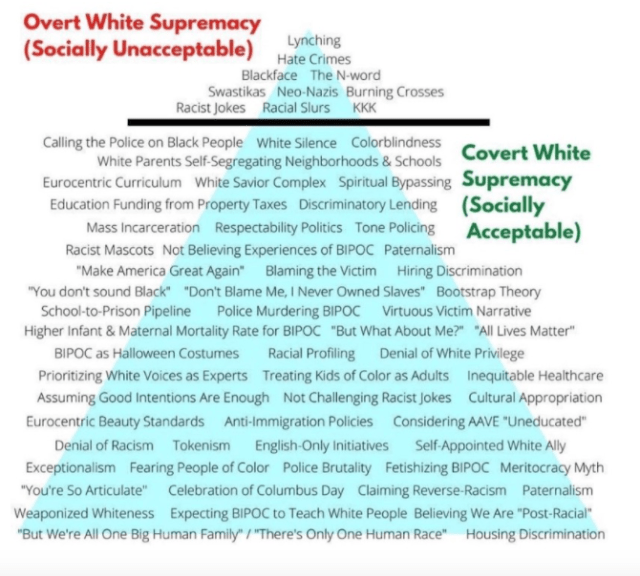
Christ’s admonition is to watch ourselves, to be vigilant of both overt and covert sins against the unseen and forgotten among us. The pyramid below concerning racism is just one example of many other forms of causing others to stumble and fall:

white supremacy pyramid

Even though I write this warning, dear friends, I am confident of better things in your case—the things that have to do with salvation, deliverance, and liberation for all persons. God is not unjust; he will not forget your work and the love you have shown him as you have helped others and continue to help them. Continue to show this same diligence so that what you hope for may be fully realized; and, imitate those who through faith and patience are doing good work. May the Lord be with you.

For those deprived of their human needs and their human rights: Just God, may they may be given the dignity by others which you confer on all his people.

For all who are forgotten and unseen, especially the poor, the sick, and the aged: All-seeing God, may you move us to love them as the image of Christ.

For all who are lonely or afraid, for teenagers on the street, the elderly in nursing homes, prisoners with no one to visit them, and all whom the world has forgotten: Lord Christ, may you lead us to them.

For those who suffer mental illness or disorder: Attentive God, may we cherish the gifts you have given them, and in their lives hear the voice of your love.

For each human life: Creator God, may we value every person as you do. We pray in the name of Jesus Christ, our Savior. Amen.

Psalm 13 – How Long, O Lord?

The Scream by Edvard Munch
“The Scream” by Edvard Munch, 1893.

How long, O Lord? Will you forget me forever?
How long will you hide your face from me?
How long must I make decisions alone
with sorrow in my heart day after day?
How long will my enemy triumph over me?

Look at me! Answer me, O Lord my God!
Light up my eyes,
or else I will die
and my enemy will say, “I have overpowered him.”
My opponents will rejoice because I have been shaken.

But I trust your mercy.
My heart finds joy in your salvation.
I will sing to the Lord because he has been good to me. (GW)

Faith is more than the mind’s affirmation of theological beliefs. Faith is also visceral, an expression from deep in the gut about what is going on around us. For faith to be truly faith it needs to hold the whole person, not merely the brain.

Today’s psalm is the reaction of a person of faith to God when the world as they knew it was crumbling and broken. This is a psalm of lament which moves and deepens the faith of the worshiper.

When the world around us changes and all seems horribly awry, we understandably become disoriented – we lose our normal bearings and feel confused and lost.

One of the simplest observations we can make about this psalm, along with all psalms of lament, is that, whether the content is ethically pure or not, the words of the psalmist directed toward God reflect the pain and agony of  people in the middle of world-shattering circumstances. In such dire situations, there are no simplistic answers or easy diagnoses of problems. Complicated layers of grief exist, and mere cerebral responses will always fall short of adequately being in the present moment, sitting with emotions, and getting in touch with the gut.

I am leery of folks who quickly affirm trust in God when a terrible event has just occurred. Bypassing the gut and the heart cannot bring a whole person response to that event and will inevitably result in a cheap faith which cannot support the immensity of the situation. Even worse, it leads to a bootstrap theology where people are expected to pull themselves up in a free-willpower way that is impossible to even do. Sometimes failure of faith comes not because of a person’s weakness but because the faith being espoused is not faith, at all.

Biblical faith expresses weakness, need, help, curiosity, and doubt with a healthy dose of emotional flavor and visceral reaction.

If we had just one psalm of lament as an example, that would be enough. In fact, we have dozens of them, with more sprinkled throughout Holy Scripture. We even have an entire book of the Bible, Lamentations, a deep reflection of the prophet Jeremiah’s grief.

So, let us now be honest with ourselves and each other. All of us, at one time or another, have given a cry of “How long, O Lord!” There are times when our prayers seem unheard and unnoticed, as if they only bounce off the ceiling and fall flat. There are hard circumstances which continue to move along unabated with evil seeming to mock us. We long for divine intervention, we long for deliverance, we long for healing – and when it does not come our disappointment and frustration boils over into an unmitigated cry of wondering where God is in all the damned thick crud.

When a person and/or a group of people are traumatized not once but over-and-over again, how can we not cry aloud, “How long, O Lord!?” When despair settles in the spirit, disappointment seeps in the soul, and depression becomes our daily bread, how can we not muster up the voice that yells, “How long, O Lord!?” When powerful people cause the lives of others to be downtrodden and despised, how can we not scream, “How long, O Lord!?” When the covert actions of others demean and denigrate, leaving us with private pain which no one sees, how can we not bring forth the words, “How long, O Lord!?” If you have never uttered this kind of wondering about God, then perhaps a profound disconnect with your own spirit exists.

A full orb faith names the awful events and sits with the feelings surrounding those events with God.

Psalm 13 is important because it gives us words when the bottom falls out of our lives and everything is upside-down. This psalm helps us admit that life is not as well-ordered as a simple Sunday School faith may pretend. The psalm acknowledges that life is terribly messy, and the psalmist protests to heaven that this quagmire of injustice is plain unfair. What is more, this psalm helps move the sufferer to a new place.

God is big enough to handle everything we throw at him — our pain, our anger, our questions, our doubts. Genuine biblical faith is comfortable challenging God. And God is there, listening, even if we cannot perceive it. Just because we might need to endure adversity does not mean there is something wrong with us, or God.

We likely will not get an answer to our “how long?” We will get something else: mercy. Mercy is compassion shown to another when it is within one’s power to punish. If we widen our horizon a bit, we will observe a God who cares:

“The Lord isn’t slow to keep his promise, as some think of slowness, but he is patient toward you, not wanting anyone to perish but all to change their hearts and lives.” (2 Peter 3:9, CEB)

The only thing better than the joy of personal salvation is the joy of many people’s deliverance and collective emancipation. Patience, perseverance, and endurance through hardship will require expressions of faith with words of affirmation, along with words of agony. The psalms help us with both.

Lord God Almighty, I pray for the forgotten and the unseen – the stranger, the outcast, the poor and homeless – may they be remembered and seen by you.

Merciful God, I pray for those who struggle with mental illness, anxiety, depression, and suicidal ideation – may there be resources to help, enough staff employed, and finances given, toward mental health services. May there be basic human kindness available for the hurting.

Compassionate God, I pray for those who wrestle with sorrow – may they know your comfort within the dark thoughts which currently seem to triumph.

Attentive Lord, I pray for the crestfallen and the ones considered fallen by those around them – may they receive your restoration and reconciling grace. Protect them from judgment and shield them with your mercy.

Lord of all creation, I trust in your steadfast love and rely upon your infinite grace. May our tears turn to songs of joy, to the glory of Jesus Christ. Amen.

Galatians 5:2-6 – Faith Expressing Itself Through Love

The Sneetches

Mark my words! I, Paul, tell you that if you let yourselves be circumcised, Christ will be of no value to you at all. Again, I declare to every man who lets himself be circumcised that he is obligated to obey the whole law. You who are trying to be justified by the law have been alienated from Christ; you have fallen away from grace. For through the Spirit we eagerly await by faith the righteousness for which we hope. For in Christ Jesus neither circumcision nor uncircumcision has any value. The only thing that counts is faith expressing itself through love. (NIV)

Everyone needs the grace of faith expressing itself through love. I didn’t grow up committed to learning the Bible or following Christ. I pretty much went my own way throughout childhood, and especially the teenage years. I still remember what it felt like to not follow in the way of Christ. My view of the world was jaded, believing that most of humanity were basically uncaring self-absorbed creatures. I also knew the darkness of my own heart. When people, as I did long ago, view the world and self this way, there is a tragic loneliness where no one reaches out to the other, since everyone is guarded. A person and a world devoid of grace and reliant on law is, at best, a harsh place; and, at worst, a sort of dystopian nightmare.

It seems people who have a graceless past and only looked out for themselves often have a temptation to embrace strict rules when they become Christians. They know what it feels like to not have Jesus in their lives, so they sometimes, out of fear of returning to the old life, go beyond Scripture and impose standards on themselves, and then others, to keep on the straight and narrow to avoid sin.

If, or when, that happens, the Apostle Paul has something to say about it.  Embracing certain practices to obtain or maintain righteousness mean diddly-squat in God’s kingdom.  Here is how the Common English Bible version translates Paul’s words to the church who went down the path of strict outward rule-keeping:

“You people who are trying to be made righteous by the Law have been estranged from Christ. You have fallen away from grace! We eagerly wait for the hope of righteousness through the Spirit by faith. Being circumcised or not being circumcised doesn’t matter in Christ Jesus, but faith working through love does matter.” (Galatians 5:4-6, CEB)

A form of Christianity which ignores God’s grace in favor of controlling one’s own faith through certain rules is not Christianity at all, and Paul would have nothing to do with it. His position was clear and pointed:

“You were called to freedom, brothers and sisters; only don’t let this freedom be an opportunity to indulge your selfish impulses but serve each other through love.” (Galatians 5:13, CEB)

Grace is the currency of God’s kingdom, flowing freely through love. God has your back. With him we need not be guarded. God’s grace forgives, and never runs out. God’s love endures and never withdraws. When we get a hold of this essential and beautiful truth about God, the only rule we want to keep is Paul’s admonition to the Roman church:

“Let no debt remain outstanding, except the continuing debt to love one another, for whoever loves others has fulfilled the law.” (Romans 13:8, NIV)

So, are there any practices, rules, beliefs, or doctrines you impose on yourself which are burdensome to you?  Why do you do them? Do you expect others to do them, too? What would change if you threw grace and love in the mix?

It must continually be borne in mind that love does not foster an antinomian spirit of being against the law because love itself is the fulfillment of law. Paul, again, explained his reasoning:

The commandments, “You shall not commit adultery,” “You shall not murder,” “You shall not steal,” “You shall not covet,” and whatever other command there may be, are summed up in this one command: “Love your neighbor as yourself.” Love does no harm to a neighbor. Therefore, love is the fulfillment of the law. (Romans 13:9-10, NIV)

The Apostle Paul’s issue was not so much with circumcision itself as it was why the church wanted to practice it to begin with. Circumcision has always been an outward sign of an invisible reality – for the Jewish people – a truth which seemed lost on the Gentile churches. Paul’s agitation and frustration had to do with the church’s reason for considering circumcision. Much like the star-bellied Sneetches of Dr. Seuss’s classic story, the impetus behind wanting circumcision was to leverage power and superiority over others.

A vision of a new egalitarian society of redeemed persons based in the finished work of Jesus Christ (grace) was at risk, and Paul was going to address any imposed practices of exclusion (law) which would compromise and erode true community. Methinks the Apostle Paul and Dr. Seuss would have gotten along well together:

The day they decided that Sneetches are Sneetches

And no kind of Sneetch is the best on the beaches

That day, all the Sneetches forgot about stars

And whether they had one, or not, upon thars.

—The Sneetches, by Dr. Seuss, 1961

Gracious God, your love has extended so far as to give your one and only Son on our behalf.  Through Jesus, I embrace the faith and love gifted to me through his redeeming work.  Help me to daily die to myself and my propensity for outward rule-keeping, and to live the gracious life you died to procure for me in the power of your Holy Spirit.  Amen.