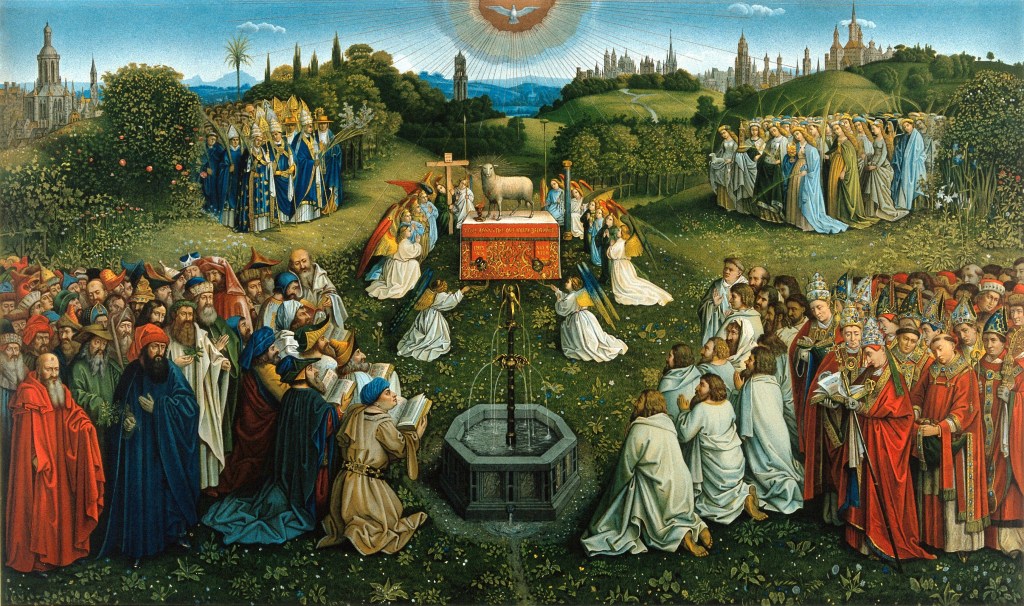
Adoration of the Lamb by Renaissance artist Jan van Eyck, 1432
After this I heard what sounded like the roar of a great multitude in heaven shouting:
“Hallelujah! Salvation and glory and power belong to our God, for true and just are his judgments. He has condemned the great prostitute who corrupted the earth by her adulteries. He has avenged on her the blood of his servants.”
And again, they shouted:
“Hallelujah! The smoke from her goes up for ever and ever.”
The twenty-four elders and the four living creatures fell and worshiped God, who was seated on the throne. And they cried:
“Amen, Hallelujah!”
Then a voice came from the throne, saying:
“Praise our God, all you his servants, you who fear him, both great and small!”
Then I heard what sounded like a great multitude, like the roar of rushing waters and like loud peals of thunder, shouting:
“Hallelujah! For our Lord God Almighty reigns. Let us rejoice and be glad and give him glory! For the wedding of the Lamb has come, and his bride has made herself ready. Fine linen, bright and clean, was given her to wear.”
(Fine linen stands for the righteous acts of God’s holy people.)
Then the angel said to me, “Write this: Blessed are those who are invited to the wedding supper of the Lamb!” And he added, “These are the true words of God.” (NIV)
Things will not always be this way. There is coming a time when pandemics and poverty will end. In the age to come there will be no more grief, tears, oppression, hardship, and suffering. The day will arrive when, together with all saints past and present, and along with the angelic host, we will collectively shout, “Hallelujah!”
Time is simply the relationship between events. When all events are ended, there will be no more time – only unending eternity in the presence of God. For the Christian, this is our hope and ultimate salvation. Our deliverance from sin, death, and hell will be complete.
So, we wait and watch, preparing ourselves for the consummation of God’s kingdom. Meanwhile, we are truly in an awkward time between the two advents of Christ. It is the already/not yet time. We are already saved, yet not fully; we are holy, yet not completely; we have our adoption papers as children of God, yet still wait for our celebration feast with Christ.
Second Coming by English painter Kevin Derek Moore
There are few times more awkward, agonizing, joyful, and hopeful than a marriage engagement. Its as if two people are inextricably connected but not yet completely together. I still remember the downright weird feeling of the six months between my engagement to my heart’s love and standing at the altar marrying my bride.
Those months included every emotion imaginable, from exuberant happiness to terrible impatience, along with hopeful anticipation and sheer nervousness. It was a time, for me, of unique joy and unwanted suffering. Since I was separated by two-thousand miles from my beloved for most of our engagement, it was an unparalleled longing for the marriage to occur.
That is likely how believers have felt throughout the ages as they anticipate the second coming of Christ. In a period of hardship and even persecution, Christians long for their Savior – to be with Jesus forever and be shed of the world, the flesh, and the devil.
In this present age, we have received the Holy Spirit as a sort of engagement ring, a continual sign and presence to help us until the marriage happens with Christ as groom and the Church as bride. Since we have not yet experienced this, it is difficult for us to anticipate just how incredible and inconceivable the coming age will be.
Yet, the Christian intuitively knows, by means of the Spirit, that the upcoming marriage supper will be a heavenly paradise – and so we long for it, especially in these days of uncertainty and difficulty.
Presently, the great harlot attempts to seduce the believers, if that were possible, away from Christ. However, along with all God’s holy angels, we will join in the heavenly chorus which continually sings, “Hallelujah!” to Father, Son, and Spirit.
The book of Revelation describes the end of history for the purpose of encouraging the saints of God in the present. God will once and for all destroy evil and faithful believers will be united with Christ forever in glory.
So, as we draw near to a close of this Christian Year with its anticipation of the new, beginning with Advent, we are mindful of both advents, both comings of Jesus. As we remember the first, we anticipate and gaze longingly for the second. Holding them both together, the past and the future, guides us in the present because Jesus Christ bookends our lives with the mercy of the cross and the grace of his coming again.
Remember Jesus Christ, raised from the dead, descended from David. This is my gospel, for which I am suffering even to the point of being chained like a criminal. But God’s word is not chained. Therefore, I endure everything for the sake of the elect, that they too may obtain the salvation that is in Christ Jesus, with eternal glory.
Here is a trustworthy saying:
If we died with him, we will also live with him; if we endure, we will also reign with him. If we disown him, he will also disown us; if we are faithless, he remains faithful, for he cannot disown himself. (NIV)
C.S. Lewis once described God as the Hound of Heaven. By that phrase he meant that God doggedly pursued him and would not let go. Lewis came into Christian faith, in his own words, “kicking and screaming” as God’s faithful pursuit won out in his life.
The Apostle Paul reminded his young protégé Timothy of some basic theology to keep him on track and encouraged in a tough ministry. Paul gave Timothy a trustworthy saying that he could easily remember and say to himself day after day, especially when the going got tough:
If we died with Christ, we will live with him. If we don’t give up, we will rule with him. If we deny that we know him, he will deny that he knows us. If we are not faithful, he will still be faithful. Christ cannot deny who he is. (CEV)
The beauty, wonder, and distinction of God is his amazing grace. There is no ambiguity with God. The Lord is not fickle but loves and holds tight even when we are unlovely and practice avoidance. When God pursues, God finds; when God holds on, there is no letting go.
This trustworthy saying of Scripture is a good, short, solid expression of theological truth to memorize, meditate upon, and say to ourselves repeatedly. We belong to Jesus Christ. God is with us. The Hound of Heaven will always sniff us out and bring us to himself.
Lewis likely got his phrase “Hound of Heaven” from an English poem of the same name by Francis Thompson (1859-1907). Thompson was a tortured soul who flirted in and out of depression, opium addiction, and suicidal thoughts for much of his adult life. Yet, he understood, perhaps better than most, that a loving God never stops pursuing a wayward heart. The poem’s beginning and end says this:
I fled Him, down the nights and down the days; I fled Him, down the arches of the years; I fled Him, down the labyrinthine ways Of my own mind; and in the mist of tears I hid from Him, and under running laughter….
How hast thou merited— Of all man’s clotted clay the dingiest clot? Alas, thou knowest not How little worthy of any love thou art! Whom wilt thou find to love ignoble thee, Save Me, save only Me? All which I took from thee I did but take, Not for thy harms, But just that thou might’st seek it in My arms. All which thy child’s mistake Fancies as lost, I have stored for thee at home: Rise, clasp My hand, and come. Halts by me that footfall: Is my gloom, after all, Shade of His hand, outstretched caressingly? Ah, fondest, blindest, weakest, I am He Whom thou seekest! Thou dravest love from thee, who dravest Me.
Theology is not an impersonal affair. Personal religion still exists. The individual’s wax and wane between faith and faithlessness shall never negate divine grace. The Lord of the universe loves you. There is a deep Divine desire to shower grace upon you, to shelter and protect you. There is no need to run. Yet, if you do, God remains steadfast in his dogged pursuit. The hunt will continue….
Thank you, O God, for your great faithfulness, even to me. I believe. Help me in my unbelief! I give unceasing praise and undying devotion to you for your grace of being the One who never lets up, through Jesus Christ my Lord. Amen.
Hello, friends! Welcome to Christ the King Sunday, a day which reminds us that in the coming Advent season, we look for both a baby and a king. Click the video below and let us acknowledge and worship King Jesus…
There is perhaps no better hymn for this day than Crown Him with Many Crowns:
For a contemporary song, it is appropriate today and every day to Sing to the King:
Now to Him who is able to keep you from stumbling, And to present you faultless Before the presence of His glory with exceeding joy, To God our Savior, Who alone is wise, Be glory and majesty, Dominion and power, Both now and forever. Amen.
Stained glass window at the Annunciation Melkite Church in Roslindale, Massachusetts
Christ the King Sunday is intended to help us see the cosmic reality that Jesus reigns over all creation as the only rightful Sovereign of the universe. This Sunday always comes just before Advent so that we remember to anticipate both a baby and a king.
Christ as Lord of all exposes three problems humanity faces:
Building our own petty kingdoms and setting ourselves up as masters over our own small worlds. People who have been hurt (all of us) often attempt to seize power for themselves in order to avoid ever being hurt again, or in the belief that wielding power could have prevented others from being hurt. The classic villains of movies and literature are ones who seek to destroy the earth so that they rebuild it in their own idea of how the world should operate. It is protection of self and loved ones from pain. The irony is that much hurt is inflicted to alleviate such pain.
Bowing to other kings besides King Jesus. When we are distressed, we might rely on alternative authorities to address our hard circumstances. We might expect other people to give us only what Jesus can. Instead of repentance and faith in Christ, we may run to the politicians or pastors we have set up in his place to cope with whatever is going on in our lives.
Lacking awareness of the power we possess as subjects of King Jesus. Christians possess authority in Jesus Christ. As believers in Jesus, we reign with him and can exercise authority over every dominion that exists, especially the dominion of darkness.
The Apostle Paul’s letter to the Ephesian believers provides God’s design for the church. It is a plan for believers in Jesus to know their spiritual blessings and exercise the power they have as Christians united to Christ. God wants us to understand this power and authority, and to actively use it. We will know King Jesus better by availing ourselves of his authority given to us as believers. (Ephesians 1:15-23)
We have a clear understanding from Ephesians of how to pray: To know Jesus better. There is probably no higher prayer. Paul prayed that believers in Jesus would know the hope to which we have been called and the incomparably great power accessible to us.
The word for “power” in the New Testament (Greek dunamis, pronounced “doon-a-miss”) is where we get our English word “dynamite.” When I was a kid, we had a neighbor who had a fondness for playing with dynamite, especially when he drank too much. Even though he lived a mile down the road, when he blew up a tree stump or anything else on his property, it would shake our house and feel like the windows were going to break. One stick of dynamite is nothing compared to God’s power, an incredible might without equal.
This divine power is for us who believe in Jesus the King. It is the same power used to raise Jesus from the dead and which exalted Christ as Lord of the universe. The rule and reign of Jesus is far above any other existing authority – including powers and authorities of the dark domain.
When it comes to dealing with the powers of darkness, we have the authority of Jesus Christ. We have a vital and inseparable union with Jesus Christ, because of his resurrection and exaltation. Jesus redeemed us and we belong to him. We are adopted children of God. Since all earthly and spiritual powers are subject to Christ, they are also subject to us. The imagery of Jesus as Head, and believers in Jesus as the Body of Christ means we have an inseparable union together. Since we are united with Christ, we share his authority over all spiritual powers.
It is one thing to know this information; it is quite another thing to use it. God wants us to experience Christ’s power through exercising our authority as believers. We are to pray in a way which links faith and knowledge together in a confident use of spiritual authority. We have unimaginable rights as blood-bought children of God.
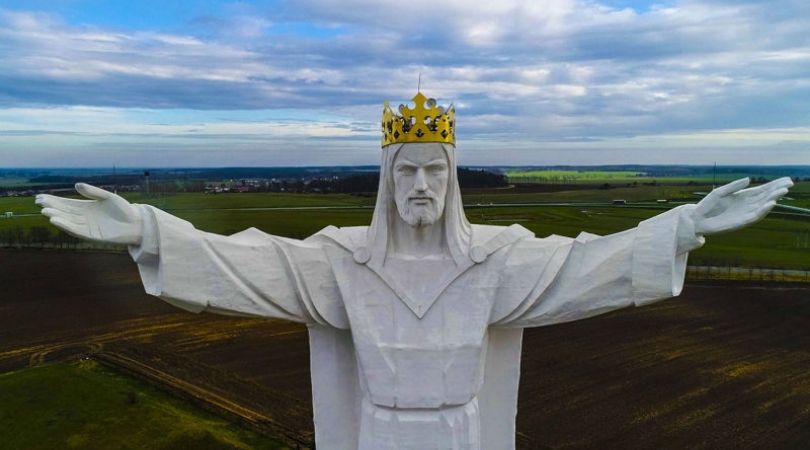
The 118 feet high Christ the King statue in Świebodzin, Poland
Tackling the forces of darkness needs to be a communal activity; going it alone is dangerous. So, let us pray the following prayer together, united in Christ and with one another in spiritual bond a million times stronger than superglue. This is a prayer that boldly exercises authority in Jesus Christ. So, let us come confidently before the throne of God’s grace.
God Almighty, we bow in worship and praise before You. We thank you that the Lord Jesus Christ is King over all creation, and that he is the rightful Sovereign of the universe. We thank you that because of this truth, we have power together with Jesus. Since Jesus is King, we surrender ourselves completely in every area of our lives to You. Since Christ’s authority extends over every dominion, including the dominion of darkness, we now take a stand against all the work of Satan that would hinder us now in prayer. We address ourselves only to the True and Living God and refuse any involvement of Satan in our prayers.
Therefore, Satan, we command you, in the Name of the Lord Jesus Christ, to leave our presence with all your demons. We bring the blood of Jesus Christ between us.
Sovereign God, we recognize You are worthy to receive all glory, honor, and praise. We renew our allegiance to You and ask that the Holy Spirit will enable us to pray. We are thankful, Lord God, that You have loved us from eternity past and that You sent the Lord Jesus Christ into the world to die as our substitute. We are thankful that Christ has completely forgiven us; You have adopted us into Your family; You have given us eternal life; You have offered Yourself to us to be our daily help and strength.
Glorious God open our eyes so that we will see how great You are and how complete Your provision is for today. We are thankful the victory Jesus Christ won for us on the cross and in His resurrection has been given to us and that we are seated with the Lord Jesus in heaven. We take our place with Him and recognize by faith that all wicked spirits and Satan himself are under our feet. We declare that Satan and his demons are subject to us in the name of the Lord Jesus Christ.
We are thankful for the spiritual armor You have provided. We put on the belt of truth, the breastplate of righteousness, the sandals of peace and the helmet of salvation. We lift the shield of faith against all the fiery arrows of the enemy; and we take in our hands the sword of the Spirit, the Word of God. We choose to use Your Word against all the forces of evil in our lives. We live and pray in complete dependence upon You, Holy Spirit.
We are grateful the Lord Jesus Christ disarmed all power and authorities, triumphing over them by the cross. We claim all victory for our lives today. We reject all the insinuations, accusations, and temptations of Satan. We affirm that the Word of God is true, and we choose to live today in the light of God’s Word. Almighty God, we choose to live in obedience to You and in fellowship with You. Open our eyes and show us the areas of our lives that do not please You. Cleanse us from anything that would give Satan a foothold against us. We stand into all that it means to be Your adopted children and we welcome all the ministry of the Holy Spirit in our lives today.
By faith and in complete dependence upon You we now put off the old sinful person and stand into all the victory of the crucifixion where the Lord Jesus Christ provided cleansing from the sinful nature. We put on the new person and stand into all the victory of the resurrection and the provision Christ has made for us to live above sin.
Today we put off the old sinful nature with its selfishness and put on the new nature with its love. We put off the old nature with its fear and put on the new nature with its courage. We put off the old nature with its deceitful lusts and put on the new nature with its righteousness, purity, and honesty.
In every way we stand into the victory of Jesus Christ’s ascension and glorification, in which everything was made subject to Him. We claim our place in Christ as victorious with Him over all the enemies of our souls. Holy Spirit, we pray that you would fill us with the righteousness of Christ. Break down every idol and cast out every enemy of our souls.
We are thankful, mighty God, that You have blessed us with every spiritual blessing in Christ. We are grateful You have given us new life into a living hope by the resurrection of Jesus from the dead. We are thankful You have made provision for us so that today we can live filled in the Holy Spirit with love, joy, peace, patience, kindness, goodness, gentleness, and self-control. We recognize and affirm that this is Your will for us and so we reject and resist all the attempts of Satan and his demons to rob us of God’s will.
We are thankful, Blessed Holy Trinity, that our spiritual weapons have divine power to demolish demonic strongholds, arguments, and every pretention that sets itself up against the knowledge of God. We take captive every thought to make it obedient to Christ. Therefore, we tear down the strongholds of Satan and smash the plans of Satan that have been formed against us. We affirm You have not given us a spirit of fear but a spirit of power, love, and self-discipline. We choose to make right decisions of faith.
Powerful God, show us the ways Satan is hindering, tempting, lying, and distorting the truth in our lives. Help us to be aggressive in prayer and faith. Help us to think rightly, and actively practice Your Word. Help us to give You Your rightful place in our lives. We now cover ourselves with the blood of the Lord Jesus Christ and pray that You, Holy Spirit, would bring all the work of Christ’s crucifixion, resurrection, ascension, and all Your work of Pentecost into our lives today. We deliberately surrender ourselves to King Jesus. We refuse to be discouraged because You are the God of all hope. You have proven Your power by resurrecting Jesus from the dead, so we claim this victory over all satanic forces in our lives, our families, our neighborhoods, our workplaces, and our faith communities. We pray in the Name and through the blood of the Lord Jesus Christ with thanksgiving. Amen.