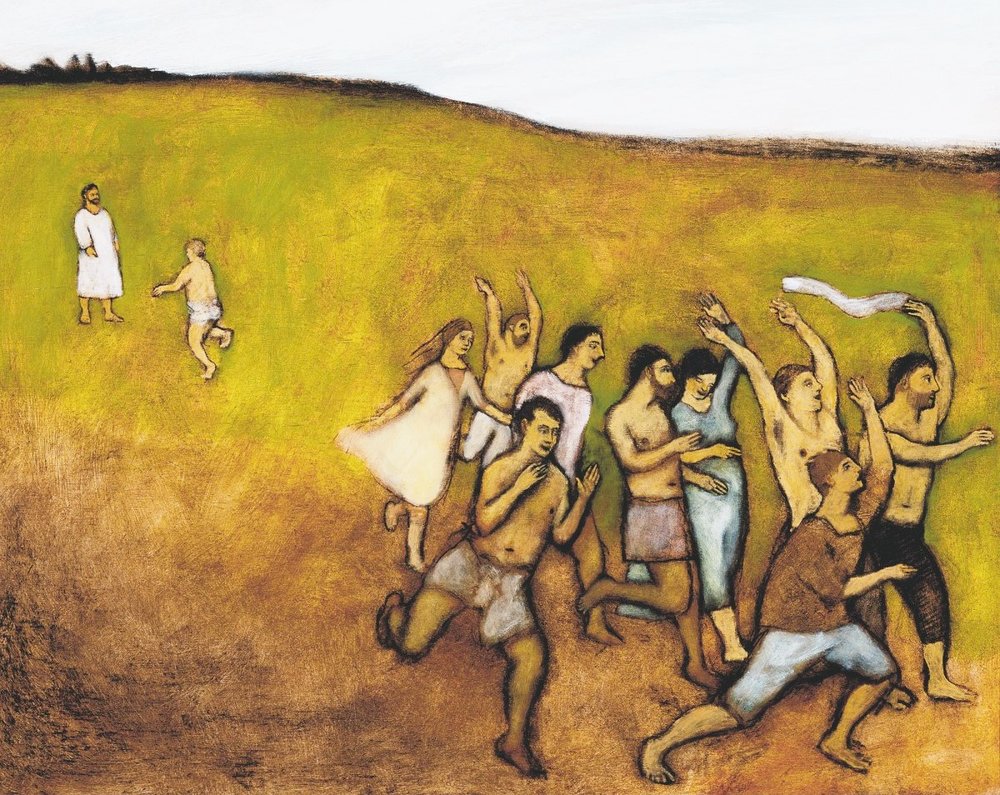
Isaiah 40:1-11 – Comfort for the Weary

The Shepherd by Indian artist P. Solomon Raj (1921-2019)

Comfort, comfort my people,
    says your God.
Speak tenderly to Jerusalem,
    and proclaim to her
that her hard service has been completed,
    that her sin has been paid for,
that she has received from the Lord’s hand
    double for all her sins.

A voice of one calling:
“In the wilderness prepare
    the way for the Lord;
make straight in the desert
    a highway for our God.
Every valley shall be raised up,
    every mountain and hill made low;
the rough ground shall become level,
    the rugged places a plain.
And the glory of the Lord will be revealed,
    and all people will see it together.
For the mouth of the Lord has spoken.”

A voice says, “Cry out.”
    And I said, “What shall I cry?”

“All people are like grass,
    and all their faithfulness is like the flowers of the field.
The grass withers and the flowers fall,
    because the breath of the Lord blows on them.
    Surely the people are grass.
The grass withers and the flowers fall,
    but the word of our God endures forever.”

You who bring good news to Zion,
    go up on a high mountain.
You who bring good news to Jerusalem,
    lift up your voice with a shout,
lift it up, do not be afraid;
    say to the towns of Judah,
    “Here is your God!”
See, the Sovereign Lord comes with power,
    and he rules with a mighty arm.
See, his reward is with him,
    and his recompense accompanies him.
He tends his flock like a shepherd:
    He gathers the lambs in his arms
and carries them close to his heart;
    he gently leads those that have young. (NIV)

As we journey through the Christian Year, we have spent the past twenty-five weeks in the longest season on the Church Calendar: ordinary or proper time. It is only appropriate that the dog days of summer and the bulk of autumn should be within this time.

Most of the Christian’s life is lived in the mundane yet necessary work of mission. Small and seemingly obscure acts of kindness, careful yet often discreet acts of love, and graciously chosen words of encouragement which may not be noticed by many are what mostly characterize the daily pilgrimage of faith.

I am sure the ancient Jewish people felt that, for an awfully long time, they were plodding along as faithfully as they could with often little to show for it. Yet, they knew it would not always be this way. God’s people anticipated that a time was coming when their pedantic service would see the light of day.

I am sure we, too, have times when it feels as if our prayers are only bouncing off the ceiling. In such times, words of comfort and assurance come as a breath of fresh air. When we least expect it, God speaks to us tenderly and with compassion. The Lord steps into our weariness and exhausting work and says, “Enough!”

Whereas our walk with God may often feel like trudging up and down hills, sloshing through muddy valleys, and traversing hard terrain, the proclamation of comfort assures us that it will not always be this way. The way to God will be made level so that we can connect with the Lord post haste.

No matter how much our worldly circumstances break us down, even shattering our expectations and dreams, we carry with us an unflagging vision of wholeness, integrity, and hope. God is our true home, our polestar, our ultimate destiny. Feeling displaced, out of sorts, or like we just do not belong are signs that we long for our place with God.

And when we find our home with God, all might be going to hell around us, yet we are buttressed and sustained by living divine words. For those with eyes to see, ears to hear, and hearts attuned to grace, there is John the Baptist, smoothing the highway to our Lord – preparing the way to Jesus. (Mark 1:1-4)

God, as both the warrior who powerfully fights our battles, and the shepherd who lovingly tends to our needs, firmly takes the initiative to bring us home, going out of the way to gently pick us up and carry us back to the place we belong.

The good news is that the world is changed by God. The world around us is no longer the way we thought it was or was supposed to be. Despair gives way to confident expectation, and discouragement is slowly replaced by consolation. The long exile is coming to an end. Jesus is coming soon. All will be made right; justice and peace will have the day.

Let your hearts be true and humble, as befits God’s holy reign. For the glory of the Lord is on the earth and will be from everlasting to everlasting.

Glory to God in the highest, and on earth, peace to people of goodwill. We praise you; we bless you; we adore you; we give thanks to you for your great glory. Amen.

Psalm 100 – The Lord is Good

Enter His Gates with Thanksgiving by Canadian painter Melani Pyke

Make a joyful noise to the Lord, all the earth.
    Worship the Lord with gladness;
    come into his presence with singing.

Know that the Lord is God.
    It is he that made us, and we are his;
    we are his people, and the sheep of his pasture.

Enter his gates with thanksgiving,
    and his courts with praise.
    Give thanks to him, bless his name.

For the Lord is good;
    his steadfast love endures forever,
    and his faithfulness to all generations. (NRSV)

The way we approach God is significant.  No matter the circumstances, entering the presence of God by means of thanksgiving and praise helps us to rightly acknowledge that God is good.  And God will continue to be good because love is intrinsic to the Lord’s character. 

Perhaps there are days or extended periods of time we do not feel like God is good.  Chronic world and national problems such as COVID-19, poverty, and injustice; continued personal, family, or communal bouts of physical or emotional pain; out of control situations with no resolution in sight – these and many more realities may cause us to question God’s goodness, much less give us reason to praise the name of the Lord.

Yet, here is where this psalm needs to be as familiar and common to us as putting on our shoes in the morning.  Saying the psalm aloud repeatedly, despite how we feel, is the kind of spiritual medicine we need to alter our sour dispositions and change the face of our anxious attitudes. 

Declaring the psalm multiple times in the day – not in a legalistic or magical sense as if it were some rabbit’s foot to ward off evil – will allow biblical truth and solid theology to slowly and deliberately sink down deep in our souls.

I believe psalm reading (and singing) ought to be a noisy affair. Tepid narrations and mumbled song bring out a mere milquetoast form of spirituality. Say it and sing it with some flavor! When we have a reason to praise, this is not difficult. Fully internalizing our worship of the Lord will seep us in praise. To know God is to experience God – and when we experience the divine, oh, what rapture it is!

The psalms enable us to put words and emotions to our confession – that the Lord is reliable, worthy of all our worship and praise, and fully able to bear our burdens and our faith. God reigns, and because God is good, there is a benevolent rule over all creation. God cares.

It is this theological view of God as a good, caring, and benevolent ruler which elicits joy from worshipers. Exuberance and enthusiasm organically rise from a heart that knows God experientially.

Lord God Almighty, I praise your glorious Name!  You are always good, and your love endures forever!  May my character and my life reflect your grace operating within me.  Help me to have an attitude of thanksgiving in all circumstances.  To the glory of Jesus, I pray.  Amen.

Matthew 24:45-51 – The Master is Coming

Expert explains about plagues, Armageddon and Jesus' return

Jesus said, “Who then is the faithful and wise servant, whom the master has put in charge of the servants in his household to give them their food at the proper time? It will be good for that servant whose master finds him doing so when he returns. Truly I tell you, he will put him in charge of all his possessions. But suppose that servant is wicked and says to himself, ‘My master is staying away a long time,’ and he then begins to beat his fellow servants and to eat and drink with drunkards. The master of that servant will come on a day when he does not expect him and at an hour he is not aware of. He will cut him to pieces and assign him a place with the hypocrites, where there will be weeping and gnashing of teeth.” (NIV)

Satan once called on some demons of hell and wanted to send one of them to earth to ruin some souls. One demon came forward and said, “I will go.” The devil said, “If I send you, what will you tell the humans?” He said, “I will tell those humans that there is no heaven.” Satan said, “They will not believe you, for there is a bit of heaven in every human heart. In the end everyone knows that right and good must have the victory. You may not go.” 

Then another demon came forward, darker and fouler than the first. The Accuser said, “If I send you, what will you tell humanity?” He said, “I will tell them there is no hell.” Satan looked at him and said, “Oh, no; they will not believe you, for in every human heart there’s a thing called a conscience, an inner voice which testifies to the truth that good will be triumphant and evil defeated. You may not go.” 

Then one last demon came forward, this one from the darkest place of all. The devil said to him, “And if I send you, what will you say to women and men to aid in the destruction of their souls?” The demon said, “I will tell them there is no hurry.” Satan said, “Go!”

Most people’s crime in not gross sin but in plain indifference, without much thought to a future judgment day. Jesus said that such persons will not know what hit them because the Day of the Lord is coming, and it may be soon. Therefore, the question for Christians is not “When will Christ return?” because no one knows the answer.  Rather, the question for us is:

Are you ready for Christ’s return?

Today’s Gospel lesson is part of what is known as the Olivet Discourse, Christ’s final sermon before he faced the cross. Jesus was looking for his disciples to keep watch, to stay alert, to be ready, like a watchman on a tower scanning the landscape for an invading army.  We are to remain vigilant and remember Jesus is coming again.  We are to live each moment considering the promise of Christ’s coming, not knowing the day when it will happen.

Keeping watch, being ready, and staying alert means being witnesses to a world going about their merry way unaware that there is a doomsday.  We are to be active, like Noah building the ark, anticipating the great flood of coming judgment. We are not to waste time creating prophecy charts and trying to connect current events to the Lord’s return. Instead, we are to prepare for the coming judgment through living godly, upright lives. (2 Peter 2:4-9)

We keep watch by being faithful stewards in God’s household. 

We are to avoid being like the unfaithful teenager who, when given the responsibility of watching over the house while his parents are gone for the weekend, has a big party and trashes the house.  The parents will come home at a time the teenager does not expect, and then there will certainly be weeping and gnashing of teeth! 

The faithful and wise steward is busy doing the master’s business – the mundane work of taking care of the master’s house. Preparing for Christ’s return leads to down-to-earth acts of love and care, without passively or nervously sitting around and waiting.  The unfaithful servant in Christ’s story is careless, cruel, and carouses because he pays no attention to the fact that the master could return at any moment.

When Christ returns, none of us knows who will be taken and who will be left – because people might look like the same on the outside, doing the same work side by side, but can be very different persons on the inside.

As believers wait for their Lord’s return, they may become impatient and get caught up in petty day to day problems, losing sight of what is tremendously important.  One day, a man named Denis Waitley, was trying to catch a flight but was running late. So, he ran through the airport terminal.  He got to the gate the split second the gate agent closed the door.  Denis explained his situation, that he had a speaking engagement to get to, but the agent did not budge. 

Denis’s frustration turned into fuming.  He stormed out of the boarding area and back to the ticket counter to register a complaint and reschedule his flight.  The anger intensified as he waited for more than twenty minutes in a line that barely moved.  Just before he got to the counter an announcement over the intercom changed his life.  The flight he missed, flight 191 from Chicago to Los Angeles, crashed on takeoff and killed every person on board the plane. 

Denis Waitley never registered his complaint.  In fact, he never returned his invalidated ticket.  He took it home and pinned it on a bulletin board in his office to remind him whenever he got frustrated or upset that life is more than day to day impatience, worry, and complaints.  It is about serving a lost world destined to slide away from God apart from the grace that can turn judgment into blessing.

We are to keep watch for the Lord’s return because it could be today. 

In the meantime, we are to be faithful by serving a world in tremendous need of getting on the ark and being saved from the coming judgment. Perhaps the best way to overcome our own chronic unhappiness and struggles is to serve the world and be the servant God wants us to be.

God Almighty, you are our hope in this life and the life to come, as we wait for Christ’s return, help us to work for the good, as if each day is our last; and let our hope for a new day shape how we live now. We look forward to the time when all will be made right. Even so, come Lord Jesus. Amen.

1 Thessalonians 5:12-18 – Give Thanks

Now we ask you, brothers and sisters, to acknowledge those who work hard among you, who care for you in the Lord and who admonish you. Hold them in the highest regard in love because of their work. Live in peace with each other. And we urge you, brothers and sisters, warn those who are idle and disruptive, encourage the disheartened, help the weak, be patient with everyone. Make sure that nobody pays back wrong for wrong, but always strive to do what is good for each other and for everyone else.

Rejoice always, pray continually, give thanks in all circumstances; for this is God’s will for you in Christ Jesus. (NIV)

A lot of problems would resolve themselves if gratitude was a default way of life. Giving thanks in all circumstances creates peace; causes encouragement to flow freely; warns those who are busybodies; builds patience; and spreads goodness.

It can be easy to give thanks when things go our way.  It is quite another matter when circumstances are difficult, and our expectations are not realized.  The Apostle Paul’s letter to the church at Thessalonica was written to people caught between a rock and a hard place.  In fact, it was so hard that the believers focused completely on the return of the Lord. 

When times are tough, Christ’s second coming comes forth from the recesses of our minds and straightaway to the forefront of our thinking.  Gratitude is typically not a first response to trouble and hardship. Instead, we may look to escape. We long for Christ’s return as a way out of trouble.

Although we know we should be thankful, we often are not.  Envy and resentment are the twin enemies continually looking to subvert our gratitude. In our frustration of missed expectations and unwanted situations, ingratitude can easily slip into our spirits.

A life of unhappiness awaits those who are resentful of what they do not possess. Those who envy shall never be satisfied because they are always dreaming about how much better life would be without their troubles.

No matter how good we have it, someone else has it better.  To envy is to be overly future-oriented, like the Thessalonians, always thinking about how the grass is greener on the other side of the fence. And it squelches gratitude. For example, according to a study by the Templeton Foundation, gratitude has all but gone missing from the workplace.  Their research found that only 39% of people are grateful for their current employment; 74% of employees have rarely or never expressed gratitude to their bosses; and, 60% have rarely or never expressed gratitude to anyone of their fellow employees.  Workplace dissatisfaction is nearly a guarantee apart from gratitude.

If we want to live happy contented lives, then we will observe the biblical exhortation to give thanks in any kind of circumstance.  It can be a challenge to give thanks during hard times.  Yet, that might be the most important time to do it.

In her book, The Hiding Place, the late Corrie ten Boom tells about an incident that taught her the principle of giving thanks in all things. It was during World War II. Corrie and her sister, Betsy, had been harboring Jewish people in their home, so they were arrested and imprisoned at a concentration camp.  The barracks was extremely crowded and infested with fleas.

One morning they read in their tattered Bible the reminder to give thanks in all things.  Betsy said, “Corrie, we’ve got to give thanks for this barracks and even for these fleas.”  Corrie replied, “No way am I going to thank God for fleas.” But Betsy was persistent and persuasive, and they did thank God even for the fleas.  During the months that followed, they found that their barracks was left relatively free, and they could do Bible study, talk openly, and even pray in the barracks. It was their only place of refuge. Several months later they learned that the reason the guards never entered their barracks was because of those blasted fleas.

Sometimes we neither understand what God is doing nor perceive that the Lord is up to anything.  You may feel as if you are sitting still right now, yet, planet Earth is spinning around its axis at a speed of 1,000 miles per hour.  We are also hurtling through space at an average velocity of 67,108 miles per hour. Even on a day when you feel like you did not get much done, remember you traveled 1,599,793 miles through space!

That is amazing, yet we do not feel it. So, it is off our spiritual radars.  When was the last time you thanked God for keeping us in orbit? I am guessing you likely never prayed, “Lord, I wasn’t sure we’d make the full rotation today, but you did it again!” Yet, we are to learn to thank God in every circumstance, both big and small.  If we can trust God to keep our feet on the ground with a big thing like gravity, then we can have faith in any and every situation we experience.

Here are three simple ways of being intentional about gratitude

Pray with prayers of thanksgiving. 

I am a believer in using biblical prayers for ourselves rather than just saying what is always on our minds and hearts – because we might never get around to gratitude. But Scripture does. The Apostle Paul typically began every discussion with gratitude. For example, when beginning his letter to the problem filled church at Philippi, he said: 

I thank my God every time I remember you.  In all my prayers for all of you, I always pray with joy because of your partnership in the gospel from the first day until now, being confident of this, that he who began a good work in you will carry it on to completion until the day of Christ Jesus….  And this is my prayer:  that your love may abound more and more in knowledge of depth of insight, so that you may be able to discern what is best and may be pure and blameless until the day of Christ, filled with the fruit of righteousness that comes through Jesus Christ – to the glory and praise of God” (Philippians 1:3-4, 9-11, NIV).

Write your thanksgiving.

Cards, letters, emails, social media messages, and whatever other ways are available, use them to express thanksgiving to God and others. Again, Paul ended his letter to the Philippians just as he began it, with gratitude:

It was good of you to share in my troubles.  Moreover, as you Philippians know, in the early days of your acquaintance with the gospel, when I set out from Macedonia, not one church shared with me in the matter of giving and receiving, except you only; for even when I was in Thessalonica, you sent me aid again and again when I was in need” (Philippians 4:14-16, NIV).

Keep a gratitude journal.

Identifying and writing down at least three things you are thankful for everyday has healing power. Any common fool can bellyache about how bad things are and play armchair Deity about how to fix all the world’s ills.  However, it takes a wise person to find gratitude and choose to give thanks for all the good things God has done and is doing, being careful to give thanks in all circumstances for this is God’s will in Christ Jesus.

Almighty God, we give you humble thanks for all your goodness and kindness to us and to all whom you have made. We bless you for our creation, preservation, and all the blessings of this life. Above all, we are grateful for your immeasurable love in the redemption of the world by our Lord Jesus Christ, for grace and the hope of glory. Give us such an awareness of your mercies, that with truly thankful hearts we may show forth your praise, not only with our lips, but in our lives, by giving ourselves to your service, and by walking before you in holiness and righteousness all our days. We pray with thanksgiving through Jesus Christ our Lord, to whom, with you and the Holy Spirit, be honor and glory throughout all ages. Amen.

Don Moen – Give Thanks | Live Worship Sessions