

Then, standing there in front of the place of worship, you must pray:
My ancestor was homeless,
an Aramean who went to live
in Egypt.
There were only a few
in his family then,
but they became great
and powerful,
a nation of many people.
The Egyptians were cruel
and had no pity on us.
They mistreated our people
and forced us into slavery.
We called out for help
to you, the Lord God
of our ancestors.
You heard our cries;
you knew we were in trouble
and abused.
Then you terrified the Egyptians
with your mighty miracles
and rescued us from Egypt.
You brought us here
and gave us this land
rich with milk and honey.
Now, Lord, I bring to you
the best of the crops
that you have given me.
After you say these things, place the basket in front of the Lord’s altar and bow down to worship him. (Contemporary English Version)
Forty years of wandering throughout the desert, in the backside of the wilderness. Having been delivered out of Egypt by the mighty hand of God, the Israelites were on a very circuitous journey to the Promised Land.
The Book of Deuteronomy is a restatement of the people’s history and God’s law for the generation about to enter the land of Canaan. Moses told the people that when they enter the land and have their first harvest of crops, they are to remember and give thanks for all their blessings.

People need to be reminded of important things. Sometimes, in the middle of success and good fortune, we can forget to savor the moment, neglect to appreciate what it took to get to this place, and fail to celebrate with others the God who has made good things happen.
Interestingly, in appreciation for the abundance of a harvest, Moses did not tell the people to give thanks for the weather or the crops themselves. Rather, they were exhorted to recall and retell the story of Israel and their ancestors.
Through historical narrative, the Israelites tethered themselves to their present reality. They located themselves in the past, as contemporary links in a holy chain that stretched generations, all the way back to the patriarch Jacob.
This sort of relational and generational gratitude is in stark contrast to what current cultural appreciation and thanksgiving is, for cars, homes, jobs, resources, and stuff. Although thankfulness is appropriate and necessary for those things, none of it is lasting and sustainable.
Beneath all of the purchased things and electronic devices is a longing for connection, a desire to know who we are, where we came from, and what our true roots are.
Greater emotional health comes from knowing where we came from. Our connections to family, friends, church, and community are a vital and essential piece of living a good life with satisfaction and contentment.
Healthy roots enable us to respond well to the challenges of life with strength and resilience.
One way to recall and remember is to recite a creed. Sadly, many churches today recoil at reciting creeds and confessions, as if this were a bad thing. But there is significance and power to a group of people who stand and recite an ancient creed together.
The Christian ecumenical church creeds, including the Apostles’ Creed, Nicene Creed, and Athanasian Creed, capture the settled convictions of early believers in Jesus as they struggled to express their faith in the church and the world.
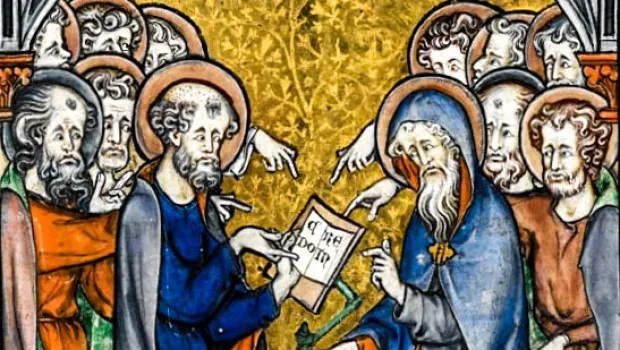
Those creeds are a part of us, and of our collective spiritual history as the people of God. There are yet other kinds of creeds, as well. We have an even more ancient creed expressed in today’s Old Testament lesson – the sort of creed that tells a story.
Moses gave the Israelites some parting instructions to follow for their future worship in the Promised Land. When they enter the land a bring in their harvest, they were to bring the first-fruits of their crops to the priest, and then profess a creed, which is really a story, a historical narrative of God’s people.
Every Jewish farmer and worshiper who brought their crop to the priest would recite the creed about their ancestors suffering in Egypt and being redeemed by God through a great deliverance. God granted them the gift of land, a promised place to call their own.
We as the people of God must discern the importance of embracing the story of redemption, of crying out and being delivered from the shackles of sin, death, and hell. We receive this salvation with thanksgiving and joy.
Christians tell their story of deliverance not only through the ancient ecumenical creeds, but also through the sacramental means of communion. The Table proclaims the life and death of Christ, given for us, and for our salvation. It is a story with deep roots in the life of Israel.
Believers in Jesus are invited to participate is something bigger than themselves. The Christian’s story begins not at Pentecost in the New Testament, but in the promise to Abraham way back in the Old Testament.
The blessing given to Abraham was a blessing for all nations, not just Israel (Genesis 12:1-3). Knowing the roots of our spiritual life and Christian faith helps inform us how we are to live out that faith and life in this present time.
Within Christianity, our history and story is much bigger than Europe and Western civilization. The earliest church began in the Middle East. Ancient Christian traditions and churches still exist, and worship today in places like Egypt and Ethiopia. There are presently large numbers of Christians in every part of the world, especially in Latin America, Asia, and Africa.
Essentially, we are the lost, the last, the forgotten, the outsiders who cried out to God. And the Lord rescued us, blessed us with every spiritual blessing in Christ, and gave us the privilege of being ambassadors for Christ in the world.
We belong to God. Along with believers throughout the ages, and across the world, we declare:
I believe in God, the Father almighty,
creator of heaven and earth.
I believe in Jesus Christ, his only Son, our Lord.
He was conceived by the power of the Holy Spirit
and born of the Virgin Mary.
He suffered under Pontius Pilate,
was crucified, died, and was buried.
He descended to the dead.
On the third day he rose again.
He ascended into heaven,
and is seated at the right hand of the Father.
He will come again to judge the living and the dead.
I believe in the Holy Spirit,
the holy catholic Church,
the communion of saints,
the forgiveness of sins,
the resurrection of the body,
and the life everlasting. Amen.

 Rev. Tim Ehrhardt