

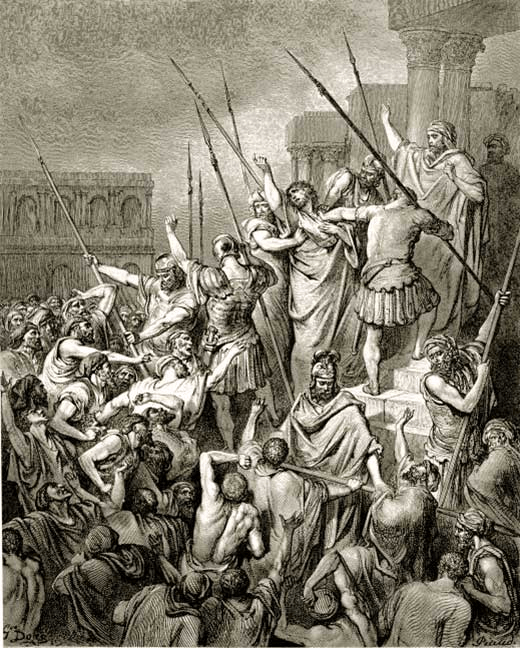
When the seven days were nearly over, some Jews from the province of Asia saw Paul at the temple. They stirred up the whole crowd and seized him, shouting, “Fellow Israelites, help us! This is the man who teaches everyone everywhere against our people and our law and this place. And besides, he has brought Greeks into the temple and defiled this holy place.” (They had previously seen Trophimus the Ephesian in the city with Paul and assumed that Paul had brought him into the temple.)
The whole city was aroused, and the people came running from all directions. Seizing Paul, they dragged him from the temple, and immediately the gates were shut. While they were trying to kill him, news reached the commander of the Roman troops that the whole city of Jerusalem was in an uproar. He at once took some officers and soldiers and ran down to the crowd. When the rioters saw the commander and his soldiers, they stopped beating Paul.
The commander came up and arrested him and ordered him to be bound with two chains. Then he asked who he was and what he had done. Some in the crowd shouted one thing and some another, and since the commander could not get at the truth because of the uproar, he ordered that Paul be taken into the barracks. When Paul reached the steps, the violence of the mob was so great he had to be carried by the soldiers. The crowd that followed kept shouting, “Get rid of him!”
As the soldiers were about to take Paul into the barracks, he asked the commander, “May I say something to you?”
“Do you speak Greek?” he replied. “Aren’t you the Egyptian who started a revolt and led four thousand terrorists out into the wilderness some time ago?”
Paul answered, “I am a Jew, from Tarsus in Cilicia, a citizen of no ordinary city. Please let me speak to the people.” (New International Version)
The Apostle Paul arrived in Jerusalem, after a sojourn in Greece and the province of Asia. He had been gathering a collection for the believers in need. In his journey, Paul received messages, warnings, and even prophecy that he would be arrested if he went to Jerusalem.
Since the prophecy did not tell Paul to stay away, he kept going, ready not only to be arrested but to also die for his faith, if need be. (Acts 21:10-14)

The first week of being Jerusalem entailed the status quo for Paul: He dealt with yet another church conflict between Jews and Gentiles. Then, the prophecy began to unfold and become reality.
Jews from Asia, who had seen Paul in the Temple and recognized him as a Christian agitator, immediately jumped to the conclusion that Paul was up to no good. It appeared to them that Paul had taken a Gentile into the Temple, thus defiling it, which in fact, he had not.
But when you have a grudge against someone, and an axe to grind, you begin making mental correlations and causations that aren’t really there.
So, the Jews from Asia got the crowd all stirred up by judging Paul as a person who teaches everyone everywhere against the people, the law, and the Temple. In other words, they accused Paul of being anti-Semitic and fomenting violence against the Jews.
Ironically, however, that is just what the Asian Jews did themselves. Without just evidence, they evoked the crowd’s emotions enough to drag Paul from the Temple. And they weren’t inviting him to tea. It seems they had every intention of doing him in, and not by throwing sugar cubes at him.
The only thing that stopped a death that day was the Roman authority getting in between Paul and the crowd. As per the prophecy, Paul was arrested and bound with chains.
The crowd had turned so riotous that the Roman commander could not ascertain Paul’s identity. The mob became violent, so Paul was whisked away by the Roman soldiers. As he left, the shouts of “Away with him!” could be heard throughout the city.
Jesus had a similar experience, but went to his death without any opportunity for a defense speech before an angry crowd.
Paul requested, however, to address the mob. And the Roman commander was aghast to learn that Paul spoke Greek – supposing that he was just another annoying religious nut on the street corner who got up into everyone’s grill a bit too much.
Yet, the commander quickly discovered that he was dealing with a citizen of the Empire who was no kooky preacher. Here we see a turn of events and a flip-flop between two groups of people.
It’s the Roman army who upheld proper justice and protected the interests of the individual; whereas the Jewish crowd became vigilante, ironically violating their own law by trying to put an innocent person to death without justification.
In a twist of history, the Roman arrest of Paul was his deliverance from a Jewish mob. Go figure.
Today’s story opens for me a set of questions that are both genuine, as well as a bit rhetorical:
- How often do we – as both individuals and churches – accuse others of being unfaithful and/or unbiblical, when it is we ourselves who are going rogue from Holy Scripture?
- In what ways do we handle false charges, judgmentalism, and unjustified criticism from others who misunderstand and/or misinterpret us?
- What do we do (and not do) whenever there are differences within the church, family, community, workplace, or nation?
- Does our manner of approaching conflict include the verbal violence of gossip and slander and/or actual physical violence through passive-aggressive behavior?
- Am I looking too closely and/or critically under the hood of your soul? What will you do with me, let alone Jesus?
If you can receive this, I recommend taking some time and space today for answering those questions honestly through writing them in a journal and/or talking about them with a trusted friend.
May God have mercy upon our human institutions, societies, and relationships. To God be the glory. Amen.

 Rev. Tim Ehrhardt