If we want to know what worship truly looks like, the story of the two men talking with Jesus along the Emmaus road shows us (Luke 24:13-35). Worship is not just us talking, praying, and singing to God. Worship is meant to be a conversation between us and God – a dialogue in which we hear from God and reply to him. Worship, then, is both God’s revelation and the people of God’s response.
The term “liturgy” describes what we do in worship. Liturgy is a Greek term that means “the work of the people.” Every church has a liturgy. All gatherings of believers have some sort of prescribed ways of moving through their worship. Liturgy is not only a reference to more traditional forms of worship. Contemporary styled worship may have less liturgical elements to it, but it still has a liturgy of several praise and worship choruses (in which the people know when to stand and sit), and an extended time of preaching.
After Christ’s resurrection, it was Jesus who approached the men. In this divine movement of liturgy, God is always the initiator of salvation and worship. If it were not for God approaching us, most fully expressed in Christ’s incarnation of coming to this earth, then we have no hope. Humanity in the vice grip of sin needs someone to help. So, when we begin worship, it is God himself who starts the conversation.
As the two men continued with their conversation, Jesus engaged them in the Scriptures. He went to the Old Testament and explained to them what it had to say about the Christ. They heard from God. To understand Holy Scripture, we too, need to walk with Jesus and converse with him. Liturgy exists to encourage a relationship between us and God. It is designed to create space whereby God and God’s people can be in a meaningful dialogue with each other.
Maybe it goes without saying, this means we must listen well. We cannot listen well if we our minds are wandering, and our hearts are somewhere else. Sometimes we intentionally make our lives overwhelmingly busy so that we either cannot or do not have time to listen to God. We might create noise and keep moving because we are much too uncomfortable with silence. We may not want to hear what is in our hearts. Getting to the place of relaxing enough to listen can seem, for some, like a daunting task. This is not a plea for you to do more (i.e. “hear more, listen better!”). It is really giving you permission to do less so that you can enjoy a conversation with Jesus. A good place to begin is to practice the Sabbath, and use the day, not just the morning, to connect with God.
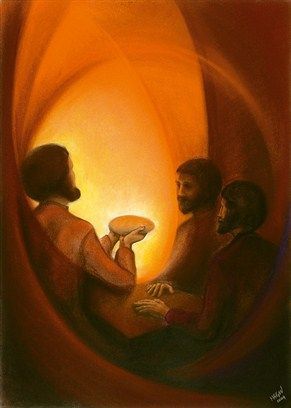
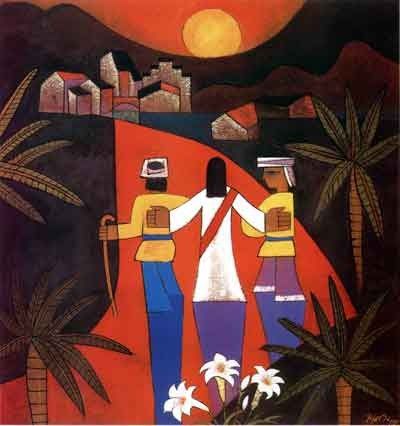
Jesus became known to the two Emmaus friends through table fellowship. It was at the table that the two men’s eyes were opened to who Jesus really was. This would not have happened unless they were in meaningful conversation with Jesus. Then, after Jesus left them, the two men were inspired in their going. They went out as witnesses telling others of what they had seen and heard from their conversation with Jesus.
“Road to Emmaus” by He Qi
In this liturgical rhythm, this conversation between us and God, the good news of Jesus is presented. God first acts by seeking and desiring fellowship with us; God sent his Son, the living Word, to restore the fractured relationship – Jesus is the divine Word who has accomplished the restoration between us and God. This revelation, this realization of what God has done for us in Christ begs a response from us. We praise him for wanting fellowship with us. Having glimpsed how holy God is, we realize how sinful we are, and, so we confess our sins to him. God, in his grace, forgives us our sin and assures us of our pardon. In our gratitude for that grace, we joyfully listen and live according to his Word. And, so, back-and-forth we go, with the liturgy proclaiming the gospel to us in a divine dialogue that blesses both us and God.
Now, if you think about it, all of life is liturgical. We each have routines, habits, and life patterns that shape how we get things done. For example, in the first year of marriage, my wife and I experienced a clash of liturgies. Her family had their ways of doing things, and my family had theirs. I quickly learned what a proper liturgy was for folding towels.
A worship liturgy is neither only for Sunday morning nor to be always within a church building. We can deliberately build spiritual rhythms and spiritual conversation throughout each day in our homes, at our jobs, and throughout our daily lives. For example, our daily call to worship is when we wake up, realizing that we have been called into wakefulness to enter praise for a new day. My own personal daily prayer when I get out of bed is:
“Almighty God, thank you for bringing me in safety to this new day. Preserve me with your mighty power that I may not fall into sin, nor be overcome by adversity. In all I do today direct me to the fulfilling of your purposes through Jesus Christ my Lord.”
As we go through our day, we can recognize sin when it happens, and be quick to confess it and accept God’s forgiveness. We can be intentional about hearing from God, by creating space and setting aside time for reading Scripture. When our heads hit the pillow at night, we receive the blessing of God in sleep, until a new day begins.
Whatever way we go about it, we have the privilege of developing spiritual rhythms and habits of approaching God, listening to God, and responding to God. And, we need to acknowledge that something can trip us up in this attempt to live a godly life. There are other secular liturgies that vie for our attention and our hearts. We just might be influenced as much or more by a different competing liturgy. For example, the shopping mall’s version of liturgy is to gather shoppers and develop practices of buying in us. If we shop because we feel that we would have a better life with new clothes, or more stuff, we might have a competing liturgy working in our lives. If we feel we need to shop because there is something we lack in our personhood, as if we are not enough, then we just might have another liturgy that wants our loyalty over God.
The point is not to avoid shopping malls (you have to anyway!); the point is to realize that there are competing loyalties to God’s kingdom, and that we are to be shaped as followers of Jesus as our primary commitment in life. Our lives are to revolve around the person and work of Jesus, and so we must intentionally cultivate liturgical practices in our daily lives and train ourselves to be godly.
Christianity is not merely a system of beliefs; it is a way of life. The kind of habits that we develop in that life will determine what kind of disciples we will be. So, we must choose well the kinds of routines that we need in order to walk well with Jesus and carry on a delightful conversation with him.
It seems strange sitting here in my home with no anticipation of being around children waving palm leaves. It feels awkward facing the beginning of Holy Week with the prospect of no physical gatherings of Christian believers. Perhaps with the exception of this year, every year on Palm Sunday thousands of Christians, from all over the world, gather in the small town of Bethphage, located just two miles outside of Jerusalem – to walk to Jerusalem like Jesus did in his triumphal entry on a donkey. Many of those pilgrims carry palm and olive branches. All the people sing hymns as they walk up the Mount of Olives, down into the Kidron Valley, and then up Mount Moriah into the Old City of Jerusalem. It is a worship experience filled with gratitude. “Give thanks to the Lord, for he is good; his steadfast love endures forever!” (Psalm 118:1)
Every year there are others along the pilgrim path appearing out of place for such a joyous journey. Spread out along the way are Israeli military soldiers wearing full combat gear, carrying automatic weapons over their shoulders and gazing on the spectacle of worshiping Christians before them. Other Israeli Jews look on with a mix of indifference or concern. Maybe we can imagine that Jesus encountered a similar experience with people laying palm branches along his path; Roman soldiers all around; and, Jews looking on with curiosity. It might have been easy for Jesus to avoid Jerusalem and not face the cross that he knew was coming at the end of the week. It might be easy for us to avoid adversity and suffering. Yet, Jesus continued his journey into Jerusalem because of joy and gratitude. Psalm 118 ends like it begins: “O give thanks to the Lord, for he is good, for his love endures forever.”
Joy and gratitude can be our strength in times of adversity. Yet, it will only come as we join the spiritual pilgrimage.
Psalm 118 is a liturgy for worshipers coming to Jerusalem and the temple from all parts of Israel in order to celebrate Passover. Like the Christian pilgrims on Palm Sunday, the ancient Jewish worshipers ascended Jerusalem with great anticipation. They sing of God’s love and remember the deliverance from Egypt and slavery into the freedom of the Promised Land.
The word for “love” throughout Psalm 118 is my favorite word in the Old Testament. It is a rich word which is difficult to translate in English because the term is so dense with meaning. The Hebrew word is “chesed” and the New International Version translates it in various ways: grace, covenant loyalty, mercy, compassion, kindness, and consistently translated in Psalm 118 as “love.” It is the kind of love that is graciously given despite whether a person deserves it or not. It is a steadfast love that holds on and does not let go.
God is a God who consistently gives grace when we fall short; shows unflagging commitment where we are fickle; gives unbounded mercy when we are broken; provides constant compassion when we have been hurt; provides kindness even when we are unkind; and, dispenses enduring love which, for the Christian, finds its ultimate expression in the person of Jesus Christ, our Savior, who embodied “chesed” for us so that we might experience life to the full. Give thanks to the LORD, for he is good; his love endures forever.
We may be under directives to stay at home, yet, we have the gracious opportunity to walk on a spiritual pilgrimage every day to the very heart of God and meet love face to face. How might you and I do that?
One way is through walking a Labyrinth. This is an ancient practice of the Church meant for spiritual centering, contemplation, and prayer. Entering the serpentine path of a labyrinth, one walks slowly while quieting the mind and focusing on a spiritual question or prayer. A labyrinth is not a maze. It has only one winding path to the center and back out. The wisdom of the Labyrinth is that it reflects life, that is, our lives are not about the destination – life is about the long circuitous journey. The Christian life is consistently described in the New Testament as a road or a way. We walk with Jesus.
Although many Labyrinths are typically found within churches, church grounds, or in park spaces (and many or most of these are currently closed) we can utilize “finger” Labyrinths. Rather than physically walking, you can slowly trace the path with your finger. You might also get creative and make your own homemade Labyrinth in a space of your home or yard. Click The Labyrinth Society to get free printable Labyrinths, as well as take a virtual Labyrinth walk.
The Labyrinth is not meant to be a race to the center; it only “works” if we move at a pace which enables us to meditatively pray, paying attention to what God is doing within us. Generally, there are four stages to the walk:
Releasing on the way toward the center – letting go of all that weighs us down in the Christian life. “Let’s throw off any extra baggage, get rid of the sin that trips us up, and fix our eyes on Jesus, faith’s pioneer and perfecter.” (Hebrews 12:1-2, CEB)
Receiving in the center – accepting the love God has for you. Jesus said, “Ask and you will receive, so that your joy may be complete.” (John 16:24, NRSV)
Returning through following the path back out – integrating what you have received for the life of the world. “I will give them a heart to know me, God. They will be my people and I will be their God, for they will have returned to me with all their hearts.” (Jeremiah 24:7, The Message)
Responding to the love of God through gratitude – thus finding joy, even in the most troubling of circumstances. “O give thanks to the Lord, for he is good; his steadfast love endures forever!” (Psalm 118:1, NRSV)
The penitent heart will resonate deeply with the psalms as worship liturgy. This is because liturgical practices impress the spirit and bring spiritual freedom. We will only find this odd if we have nothing to repent of. Turning from sinful liturgies of life and turning to a new liturgy of following Jesus is like walking through a gate into a new reality and rejoicing with all the other redeemed pilgrims who are walking the road to Jerusalem to be with Jesus. Our Lord himself said,
“I am the gate; whoever enters through me will be saved. He will come in and go out and find pasture. The thief comes only to steal and kill and destroy; I have come that they may have life and have it to the full” (John 10:9-10, NIV).
In this time of virtual presence and electronic communication, I take comfort in the reality that we do not need to text or email God and hope he answers – we have the joyous opportunity of walking the pilgrim way and crawling into the lap of God.
Just like everything else, what you put into something is going to affect what you get out of it. If we go into the Labyrinth half-hearted, we will leave half-hearted. If we go into prayer or worship thinking only of the obligation, we will only fulfill the obligation. Yet, if we come ready to meet God, if we come ready to receive his grace, if we come expectantly – Who knows what God can do?
So, let us enter prayer, reading of Scripture, virtual fellowship, and the worship of God each day with the heart of a pilgrim. Let us enter with a song on our lips and joy in our hearts. Let us enter knowing that worship is the place where we connect with the love of God through the Son of God. Let us enter expecting to come out of worship changed, carrying in our hearts the anticipation of great things to happen.
This is likely my favorite psalm. I have read it so many times and mulled it over that it is almost second nature for me to draw from its rich theological statement of God when times are difficult. This is a psalm meant for worship. In other words, it is designed to be used by God’s people – to be sung, quoted together, and prayed. A church without Psalm 121 always near to it is a church in danger. But with it, there is a continual sense of security, confidence, and hope. Well, enough of my comment. Let this Contemporary English Version of Psalm 121 wash over you and grace you with God’s abundant mercy:
I look to the hills!
Where will I find help? 2 It will come from the Lord,
who created the heavens
and the earth.
3 The Lord is your protector,
and he won’t go to sleep
or let you stumble. 4 The protector of Israel
doesn’t doze
or ever get drowsy.
5 The Lord is your protector,
there at your right side
to shade you from the sun. 6 You won’t be harmed
by the sun during the day
or by the moon at night.
7 The Lord will protect you
and keep you safe
from all dangers. 8 The Lord will protect you
now and always
wherever you go.









 Rev. Tim Ehrhardt