Luke 2:1-20 – The Sound of Salvation

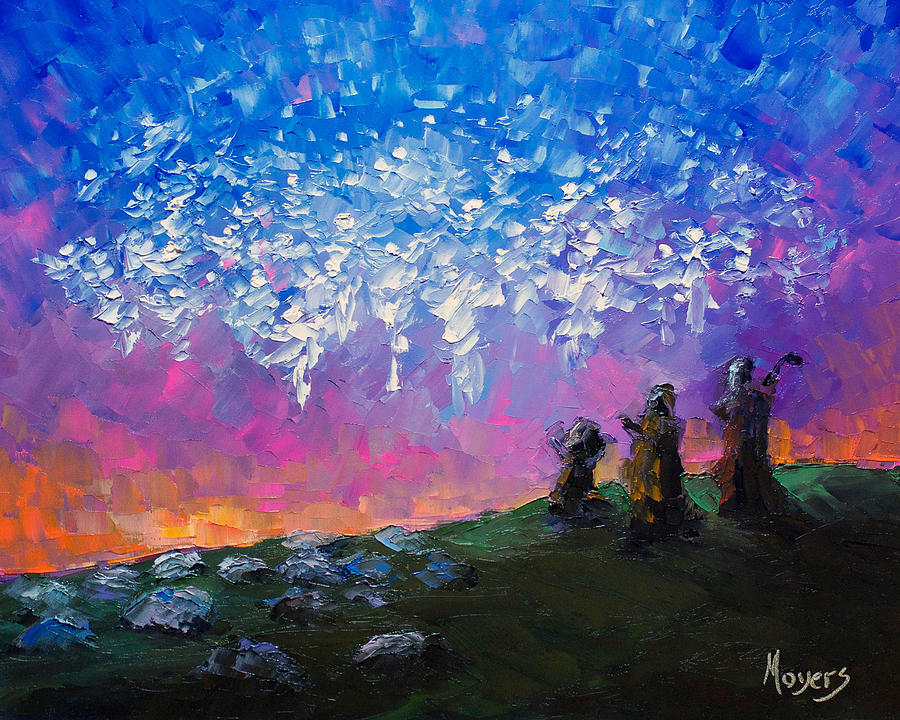
Host of Angels by Mike Moyers

In those days Caesar Augustus issued a decree that a census should be taken of the entire Roman world. (This was the first census that took place while Quirinius was governor of Syria.) And everyone went to their own town to register.

So, Joseph also went up from the town of Nazareth in Galilee to Judea, to Bethlehem the town of David, because he belonged to the house and line of David. He went there to register with Mary, who was pledged to be married to him and was expecting a child. While they were there, the time came for the baby to be born, and she gave birth to her firstborn, a son. She wrapped him in cloths and placed him in a manger, because there was no guest room available for them.

And there were shepherds living out in the fields nearby, keeping watch over their flocks at night. An angel of the Lord appeared to them, and the glory of the Lord shone around them, and they were terrified. But the angel said to them, “Do not be afraid. I bring you good news that will cause great joy for all the people. Today in the town of David a Savior has been born to you; he is the Messiah, the Lord. This will be a sign to you: You will find a baby wrapped in cloths and lying in a manger.”

Suddenly a great company of the heavenly host appeared with the angel, praising God and saying,

“Glory to God in the highest heaven,
    and on earth peace to those on whom his favor rests.”

When the angels had left them and gone into heaven, the shepherds said to one another, “Let’s go to Bethlehem and see this thing that has happened, which the Lord has told us about.”

So, they hurried off and found Mary and Joseph, and the baby, who was lying in the manger. When they had seen him, they spread the word concerning what had been told them about this child, and all who heard it were amazed at what the shepherds said to them. But Mary treasured up all these things and pondered them in her heart. The shepherds returned, glorifying and praising God for all the things they had heard and seen, which were just as they had been told. (New International Version)

Out of all the sounds of the season, the best of all is the sound of salvation.

The Sound of Activity

The Roman census brought a crowd of people to small village of Bethlehem. Because most were related to one another, it was like one big family reunion. There was lots of noise, with people talking, laughing, and sleeping.

We are a busy society and a busy people. The Christmas season only seems to exacerbate our busy-ness. Jesus can get lost in all the noise. We can miss the point of it all because of our preoccupations with all those seemingly necessary things in our lives. And it can be hard to hear and to listen to God. The sound of activity eventually needs to give way to another sound….

The Sound of Silence

Bethlehem was so busy that no one paid attention to the most cataclysmic event ever to take place. But out in the fields, all was quiet. The shepherds were there, quietly watching over their sheep. In the silence, they were able to experience the sound of good news.

Like a good pot of tea, we must allow the Word of God to seep in us, allowing the heat to do its work so that we might listen well to the divine voice. If we come at the Word with a cold heart, it will likely not do us a lot of good – we need to be hot and receive the Word with humility and respond to the Word with wisdom. As we allow God to seep in us, we become acutely aware of a beautiful sound….

The Sound of Joy

The shepherds heard good news of great joy from the angels. And then they shared their joy and went to worship the newborn Christ. It was a great celebration. After all, how often do a multitude of angels show up with an unsolicited concert of joy!?

We can imagine the sound of the shepherds’ unbounded joy at hearing the good news that the promised Savior has come! They just had to go and see Jesus, and then told everyone about it. And all who heard it were amazed at what the shepherds said to them.

There’s nothing quite like hearing good news, then sharing good news. Sadly, however, the story does not end there because not everyone was happy about Jesus being born as the King….

The Sound of Crying

King Herod saw Jesus as a potential rival, and he callously had every baby boy in Bethlehem killed when he found out the news. (Matthew 2:1-18)

We must keep in mind that not everyone is joyous at Christmas. Past grief associated with the holiday season can make it difficult to participate in the celebration. So, we need to be aware of the lamenting folks around us and hear their sad crying so that we can be agents of comfort and grace.

And let us also not forget, another sound of crying is the baby Jesus. Yes, he really cried. Jesus is truly human with all the sounds and experiences that go with being human. (Hebrews 2:10-17)

Conclusion

The sounds of activity, silence, joy, and crying are all part of Christmas and the birth of Jesus. To truly experience a full-orbed Christian spirituality, we will pay attention to the range of sounds occurring around us at this time of year.

Eternal God, who breathed this world into being, and placed stars into the heavens: You are the God who entrusted Jesus to the care of ordinary people, becoming vulnerable so that we might know the power of Love – a mystery so deep it is impossible to grasp, and so beautiful it is impossible to ignore.

Circle us, Lord, with the light of your presence, bright within this dark world. Enable us to be overcomers of fear and temptation, and victors over sin and despair. Circle this world with the joy of your salvation. Where there is sickness and disease, bring healing. Where there is hunger and despair, bring hope. Where there is bondage, bring freedom. Lord of our salvation, circle this world with the light of your presence. Amen.

Isaiah 12:2-6 – Grace Changes Us

The Prophet Isaiah by Marc Chagall, 1968

“Surely God is my salvation;
    I will trust and not be afraid.
The Lord, the Lord himself, is my strength and my defense;
    he has become my salvation.”
With joy you will draw water
    from the wells of salvation.

In that day you will say:

“Give praise to the Lord, proclaim his name;
    make known among the nations what he has done,
    and proclaim that his name is exalted.

Sing to the Lord, for he has done glorious things;
    let this be known to all the world.
Shout aloud and sing for joy, people of Zion,
    for great is the Holy One of Israel among you.”
(New International Version)

The large Old Testament book of Isaiah is thick with a message of judgment for both Israel and the surrounding nations. The sins of ancient Israel, seven-hundred years before the birth of Christ, were many. The primary offenses were injustice toward the needy; the have’s taking advantage of the have-not’s; and empty worship rituals toward God.

Social and spiritual corruption was rampant. God pleaded with the people through the prophets to stop doing wrong and start doing right by encouraging the oppressed and defending the powerless. (Isaiah 1:10-17)

Although God’s judgment was imminent, via the powerful Assyrian Empire, God would not annihilate the people. God promised a Righteous Branch would grow from the seemingly dead stump of Israel. A child will be born, a Messiah given. There will be hope in Israel. Heartfelt praise, and proclamation of God’s great name, will again fill the air.

For me, what is so remarkable about all this is the grace of God. The Lord made promises to Israel not based upon what they would or would not do; God made promises to the people by God’s own radically free love. This wasn’t a matter of playing Let’s Make a Deal with God saying, “If you get your act together, then I will be good to you.” No, before Israel even had a chance to return to the Lord, God was already choosing to be merciful.

I am absolutely convinced with the firmest conviction possible that the Scriptures of the Old and New Testaments are all about God and God’s own unbounded, unfettered, free, crazy, illogical, and wildly wonderful grace. Because God is love, the Lord constantly goes out of the way to be gracious so that we will be together and enjoy our divine/human relationship.

If we miss the message of God’s grace in the Holy Scriptures, we have missed salvation – because only grace can save us. Without grace, we are lost. Today’s Old Testament lesson is full of praise because it’s a response to the undeserved grace which God freely gives. 

Any Christian preacher worth their salt is a preacher of grace. Grace is the very thing that is distinctive about Christianity. Grace is love that seeks you out when you have nothing to give in return. Grace is recklessly generous. Grace does not use carrot sticks, scorecards, or power politics. Grace never demands – it only gives. 

Grace is unconditional acceptance given to an undeserving person by an unobligated giver. 

That is what God did for Israel… and for us. And when we get a hold of this truth, even a little bit, our hearts become bubblers of praise.

The prophecy of Isaiah is an adventure of God’s reckless love toward unlovable people, which is why it is one of the most quoted books of the Old Testament by Jesus. Jesus came because of grace. 

Jesus came to release us from our obsessive need to be right, our compulsion to be rewarded, and our demands to be respected. 

Because Jesus came to set sinful captives free, life does not have to be a joyless effort to justify and validate ourselves before others. The grace of God in Christ is a game-changer. And with but a glimpse of it, we are forever undone by its mercy.

Grace causes us to praise God.

There was once a pastor who had a three-year old daughter who was going around the house singing the chorus “We Exalt Thee” except that she kept mispronouncing one of the words: “I exhaust thee, I exhaust thee, I exhaust thee, O Lord!” Perhaps she was right. Maybe too many folks are exhausting God with folded arms instead of hands raised in praise and worship.

Grace causes us to trust God.

Grace alleviates our fears. For, if God is for us, who can be against us? God takes care of us despite our weaknesses and failures. 

Grace causes us to have joy in God.

With joy we draw water from the wells of salvation. Jesus is the Living Water we can continually draw from and drink. Grace keeps giving without an end in sight. We get to keep coming to God with an inexhaustible supply of fresh grace.

Grace causes us to give thanks to God in prayer.

Gratitude to God ought to characterize our corporate gatherings. Expressing thanks is more than for the individual in their prayer closet – it is to be offered in the gathered assembly of believers. Grace eliminates self-consciousness altogether because there is nothing to be self-conscious about with God. The Lord has seen you at your worst, and still loves you.

What’s more, we need not be self-conscious about appearing ignorant, looking silly, or not having all the answers in making known among the nations what God has done. If we are influenced by grace, then we can freely speak of God to all kinds of people we encounter. 

“God forbid that I should travel with anybody a quarter of an hour without speaking of Christ to them.”

George Whitefield (1714-1770)

Grace causes us to sing together to God. 

When grace takes hold of a congregation, there is no mumbling of songs – there are loud shouts and singing for joy because God is good! God wants some noisy worship! 

Grace brings such gladness that we don’t care how we appear to other people; we are going to shout, sing, and express our joy! Yes, there is an important place for contemplative, reverent, and reflective worship. And there is also a place for letting go, becoming unhinged, and dancing before Jesus!

The world mostly ignores God. Even some Christians take God’s grace for granted.  Israel’s greatest sin was assuming everything was fine. But it wasn’t. There was no grace. And with no grace there is no God. Eventually, Israel found joy in the most unlikely of places – in exile. God’s grace would transform a terrible time of trouble into raising of voices in song.

Isaiah’s prophecy is about returning to the Lord. The season of Advent is all about God’s relentless pursuit of wayward people – the anticipation of grace coming in the form of an infant – and the bringing of grace to a people living in darkness.

Let us, then, return to the Lord. Let us be captivated by grace. Let us renew our love for Jesus. Let us lose ourselves in praise and adoration of the One who gave everything for us. Let us worship Christ the King. Let us proclaim the name of Jesus as exalted over everything.

Great God of grace, be merciful to us as we limp to you with all of our wounds and brokenness. We have made such a mess of our lives with our bad attitudes, ugly words, selfish actions, and our ignoring of you through it all. So, we come to you with nothing but ourselves in all of our sin. Forgive us, cleanse us, renew us, revive us, refresh us, and reform us according to the ways of Jesus Christ. Thank you for your undeserved grace. We give you praise for the lengths you went to secure our forgiveness. With a joy too deep for words, we humbly offer to you our lives so that the name of Jesus will be exalted in us individually and corporately. Amen.

Psalm 63 – I Will

You are my God. I worship you.
    In my heart, I long for you,
    as I would long for a stream
    in a scorching desert.

I have seen your power
and your glory
    in the place of worship.
Your love means more
than life to me,
    and I praise you.
As long as I live,
    I will pray to you.
I will sing joyful praises
and be filled with excitement
    like a guest at a banquet.

I think about you
    before I go to sleep,
    and my thoughts turn to you
    during the night.
You have helped me,
    and I sing happy songs
    in the shadow of your wings.
I stay close to you,
    and your powerful arm
    supports me.

All who want to kill me
    will end up in the ground.
Swords will run them through,
    and wild dogs will eat them.

Because of you, our God,
    the king will celebrate
with your faithful followers,
    but liars will be silent. (Contemporary English Version)

Regulars to this blog know that I believe the Old Testament Psalms to be a vast untapped resource of devotion and prayer for many Christians. The biblical psalms provide believers with words for prayer, song, and thought so that we might remain close and connected to the Lord.

I Will Worship

Worship involves gratitude to God for God’s inherent love; and praise to God for divine works done in the world.

God’s people, gathered together for worship, affords a wonderful opportunity to express gratitude and praise, as well as listen to the stories of others who have experienced the gracious works of God in their lives.

Therefore, both personal and corporate worship is needed. Personal worship, even if engaged daily, will inevitably lead to a truncated understanding of God and God’s Law without corporate worship – because we need the encouragement and the accountability of others for mature spiritual growth. In addition, to only participate in corporate worship, without attending to daily personal worship, leads to a bifurcation between Sunday and our Monday-Friday workaday existence.

Worship isn’t so much an event, as it is a life. So, it makes sense to have healthy rhythms of personal and corporate worship which enable us to glorify God in our neighborhoods, families, workplaces, and faith communities.

I Will Pray

In those dark times when we don’t know what to pray, how to lament, or what to say to God; in the joyful times when we want to proclaim praise, give thanks, or express our blessings and longings; in every season of our lives the psalms help give voice to our relationship with the God of all creation.

Today’s psalm was originally uttered to God when David was roaming in the wilderness avoiding King Saul’s malevolent intent. David prayerfully expressed his yearning, desire, and hope to connect with God and be guided by the Lord, step by step. David praised God in an awkward and adverse circumstance, longing to be satisfied with spiritual food and drink.

I Will Sing

Just as we are to pray the psalms, we are to also speak the psalms out loud with singing. The Psalter Hymnal of old, as well as many contemporary praise and worship songs, are words from the psalms, meant to help, encourage, and give voice to our own current experiences.  

Inspired by the psalms, take a few minutes today to sing and/or listen to songs such as, “God You Are My God” by Michael W. Smith, or check out a compilation of music from the psalms, like, “The Psalms Project,” which aims to put all 150 psalms to music. Maybe even craft your own tune to today’s psalm and sing it to the Lord.

I Will Think

Specifically, the psalmist mentions thinking about the Lord before retiring for sleep, as well as turning to God when awake during the night.

In today’s modern (and postmodern) society, anxiety and racing thoughts are ubiquitous – the result of overthinking and fixating on particular troubling thoughts. Contemplating God through reflecting on the psalms can be a way of taming the out-of-control thinking, while positively engrafting sound theology into the inner workings of our brains.

There’s a reason why the daily lectionary has a reading from the psalms every day. It is one of the best sources for practical spirituality and heartfelt worship, as well as transforming the way we think.

I Will Stay Close

Whatever we do, whatever we say, and wherever we go, let the psalms help form and shape within you a profound spirituality which helps foster a deeper connection with the God we long to know more and more. 

May our celebrations be raucous and robust because the God of the psalms has showed up and given grace and mercy to our troubling circumstances.

Soli Deo Gloria

2 Kings 23:15-25 – Repent, Renew, and Reform

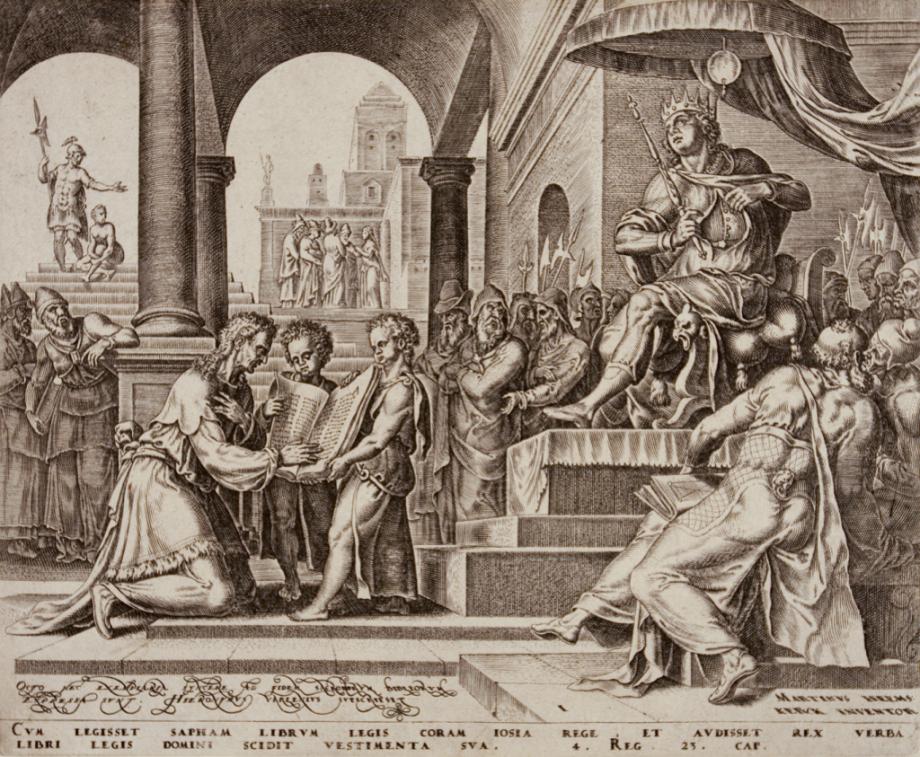
The Book of the Law, Read to King Josiah by Dutch artist Maerten van Heemskerck, c.1569

The king smashed all the altars to smithereens—the altar on the roof shrine of Ahaz, the various altars the kings of Judah had made, the altars of Manasseh that littered the courtyard of The Temple—he smashed them all, pulverized the fragments, and scattered their dust in the Valley of Kidron. The king proceeded to make a clean sweep of all the sex-and-religion shrines that had proliferated east of Jerusalem on the south slope of Abomination Hill, the ones Solomon king of Israel had built to the obscene Sidonian sex goddess Ashtoreth, to Chemosh the dirty-old-god of the Moabites, and to Milcom the depraved god of the Ammonites. He tore apart the altars, chopped down the phallic Asherah-poles, and scattered old bones over the sites. Next, he took care of the altar at the shrine in Bethel that Jeroboam son of Nebat had built—the same Jeroboam who had led Israel into a life of sin. He tore apart the altar, burned down the shrine leaving it in ashes, and then lit fire to the phallic Asherah-pole.

As Josiah looked over the scene, he noticed the tombs on the hillside. He ordered the bones removed from the tombs and had them cremated on the ruined altars, desacralizing the evil altars. This was a fulfillment of the word of God spoken by the Holy Man years before when Jeroboam had stood by the altar at the sacred convocation.

Then the king said, “And that memorial stone—whose is that?”

The men from the city said, “That’s the grave of the Holy Man who spoke the message against the altar at Bethel that you have just fulfilled.”

Josiah said, “Don’t trouble his bones.” So, they left his bones undisturbed, along with the bones of the prophet from Samaria.

But Josiah hadn’t finished. He now moved through all the towns of Samaria where the kings of Israel had built neighborhood sex-and-religion shrines, shrines that had so angered God. He tore the shrines down and left them in ruins—just as at Bethel. He killed all the priests who had conducted the sacrifices and cremated them on their own altars, thus desacralizing the altars. Only then did Josiah return to Jerusalem.

The king now commanded the people, “Celebrate the Passover to God, your God, exactly as directed in this Book of the Covenant.”

This commanded Passover had not been celebrated since the days that the judges judged Israel—none of the kings of Israel and Judah had celebrated it. But in the eighteenth year of the rule of King Josiah this very Passover was celebrated to God in Jerusalem.

Josiah scrubbed the place clean and trashed spirit-mediums, sorcerers, domestic gods, and carved figures—all the vast accumulation of foul and obscene relics and images on display everywhere you looked in Judah and Jerusalem. Josiah did this in obedience to the words of God’s Revelation written in the book that Hilkiah the priest found in The Temple of God.

There was no king to compare with Josiah—neither before nor after—a king who turned in total and repentant obedience to God, heart and mind and strength, following the instructions revealed to and written by Moses. The world would never again see a king like Josiah. (The Message)

The Book of the Law Found, Unknown artist, 1913

To say that King Josiah cleaned house is a significant understatement. Having found the Book of the Law, which was lost for generations deep within the temple, Josiah took its words to heart and set about a campaign of reformation like no king before him. 

Indeed, Josiah was determined to restore and implement the Law in the life of the nation of Judah. His zeal knew no bounds. Josiah was doggedly relentless and actively radical in returning the Jews to the true worship of Yahweh.

Josiah did more than reinstitute the Passover and other festivals of the Lord. The king first upended the alternative pagan worship which had become embedded in Judah like a death-dealing cancer. Josiah surgically removed it with ruthless precision. 

King Josiah made ashes out of Asherah poles; put pagan priests out of business permanently; and did away with everything contrary to the worship of the One true God, including spiritual mediums, household gods, and sacrificial high places. In order to turn his heart fully to God, he did away with all competing gods.

Repentance, renewal, and reformation requires a two-fold process: 1) Turning away from what is false; and 2) Turning toward what is true.

Turning from spiritually unhealthy ways of living – without turning to God – is merely a half repentance. Furthermore, turning to God – without turning one’s back on damaging lifestyles – is a form of denial and is dangerous. 

We are to put off the old clothes of spiritual insensitivity and social injustice. We are to put on the new clothes of righteousness and peace. We are to forsake the old inner person of shame in order to embrace the new life of freedom and joy. 

There needs to be a radical removal of sin, so as to replace it with what is just and right. And, keep in mind, that none of this is pretty or romantic. Repentance and renewal is a messy ugly process of dispelling darkness and letting light shine. It is not for the faint of heart.

Where to begin? Make a fierce, brutally honest spiritual inventory of your life. No one can turn from something they are not really aware of. So, create in your schedule some time in the week to connect with God and do the following: 

  • Identify some areas for change, then list the obstacles to turning away from them (e.g., fear, despair, financial repercussions, etc.). Face those obstacles honestly and forthrightly. 
  • Form a rudimentary plan to forsake the old ways and embrace new paths of righteousness. This is only a beginning. Let God take that process and direct it in redemptive and purifying ways.

Holy God, you are jealous for your own glory. Today, I decide to identify and put away all that is contrary to your righteousness and will for my life. And I choose to turn to you with all my heart. In body, soul, and spirit I belong to you. Amen.