Exodus 35:1-29 – Real Worship Isn’t Boring

Gathering to Build the Temple by Yoram Raanan

Moses gathered together the whole Israelite community and said to them: These are the things that the Lord has commanded you to do:

Do your work for six days, but the seventh day should be holy to you, a Sabbath of complete rest for the Lord. Whoever does any work on the Sabbath will be put to death. Don’t start a fire in any of your homes on the Sabbath day.

Moses said to the whole Israelite community, This is what the Lord has commanded: Collect gift offerings for the Lord from all of you. Whoever freely wants to give should bring the Lord’s gift offerings: gold, silver, and copper; blue, purple, and deep red yarns; fine linen; goats’ hair; rams’ skins dyed red; beaded leather; acacia wood; the oil for the light; spices for the anointing oil and for the sweet-smelling incense; gemstones; and gems for setting in the priest’s vest and in the priest’s chest pendant.

All of you who are skilled in crafts should come forward and make everything that the Lord has commanded: the dwelling, its tent and its covering, its clasps, its boards, its bars, its posts, and its bases, the chest with its poles and its cover, the veil for a screen, the table with its poles and all its equipment, the bread of the presence, the lampstand for light with its equipment and its lamps, the oil for the light, the incense altar with its poles, the anointing oil and the sweet-smelling incense, the entrance screen for the dwelling’s entrance, the altar for entirely burned offerings with its copper grate, its poles, and all its equipment, the washbasin with its stand, the courtyard’s drapes, its posts, and its bases, and the screen for the courtyard gate, the dwelling’s tent pegs and the courtyard’s tent pegs, and their cords, the woven clothing for ministering in the sanctuary, and the holy clothes for Aaron the priest and his sons for their service as priests.

The whole Israelite community left Moses. Everyone who was excited and eager to participate brought the Lord’s gift offerings to be used for building the meeting tent and all its furnishings and for the holy clothes. Both men and women came forward. Everyone who was eager to participate brought pins, earrings, rings, and necklaces, all sorts of gold objects. Everyone raised an uplifted offering of gold to the Lord. And everyone who had blue or purple or deep red yarn or fine linen or goats’ hair or rams’ skins dyed red or beaded leather brought them. Everyone who could make a gift offering of silver or copper brought it as the Lord’s gift offering. Everyone who had acacia wood that could be used in any kind of building work brought it. All the skilled women spun cloth with their hands and brought what they had spun in blue and purple and deep red yarns and fine linen. All the women who were eager to use their skill spun the goats’ hair. The chiefs brought gemstones and gems to be set in the priest’s vest and the chest pendant, spices and oil for light and for the anointing oil, and for the sweet-smelling incense. All the Israelite men and women who were eager to contribute something for the work that the Lord had commanded Moses to do brought it as a spontaneous gift to the Lord. (Common English Bible)

At first glance, today’s Old Testament lesson might seem a bit tedious, perhaps even boring. After all, being informed of all the details on the furnishings for building the tabernacle (the Ark of the Covenant, the utensils for worship and sacrifice, and the tent that houses it all) appears like some ancient engineer wrote it. It’s just downright laborious. 

But that’s the point. It took a great deal of planning, effort, and commitment to realize it all. Although Moses received the instructions and revelation from God on the mountain, he still had to communicate it to the people and solicit their help.

There is a wonderful synergy here, between God and the people, a kind of divine/human cooperative, a spiritual rhythm of revelation and response. 

The contributions and the work were done by people whose hearts were stirred to give of their resources and their labor. The people freely offered their things and themselves in order to realize the tabernacle’s construction. 

The epicenter of worship is a divine dialogue between us and God. That is, God speaks, and the people respond. God reveals the divine will, and the people’s hearts are stirred. 

Whenever worship becomes a mere duty and drudgery, it is cheapened. Worship that degenerates into mere obligation becomes dull and flat. Duty without delight is boring. Such worship has no impact or effect on us.

Contemporary problems of Christian worship are typically viewed as liturgical issues. Many modern worshipers disparage particular prayers, Scriptures, or readings said every week as being vain repetition. The Lord’s Table may be celebrated only occasionally, so as to not lose something of it’s specialness.

Yet, none of us looks down at eating every day, praying multiple times in a day, and using the same daily phrases of greeting and saying good-bye to others. We don’t create new shoe stores which have no shoelaces because tying our shoes every day is so boring and pedantic.

The real issue is us – not the form of worship. It’s about our own hearts. The ancient Israelites gave of their time and resources in worship because they wanted to, not because they had to. They weren’t looking to be highly entertained, emotionally captivated, or mentally stimulated. The people simply wanted to please their God and to truly connect with the Lord.

Worship isn’t a monologue. It’s not a one-way communication in which we, the people, passively sit and soak-in what’s in front of us. Worship is work. It’s active. It’s participative. And it’s a process which involves some tedious and sometimes slow patient effort. 

Moses and God’s people were genuinely enthused to participate in what God was calling them to do. Worship that comes from willing hearts is a beautiful thing, because encountering God and being stirred within by a Divine call is a wonderful and mystical thing – and it isn’t boring.

Gracious God, just as you laid it upon the hearts of people long ago to participate in the work of worship, so impress my heart with your mission in this world.  I give you my life along with my possessions so that my entire self will be dedicated to the worship of Jesus Christ. Amen.

2 Chronicles 34:1-7 – Getting Rid of Idolatry

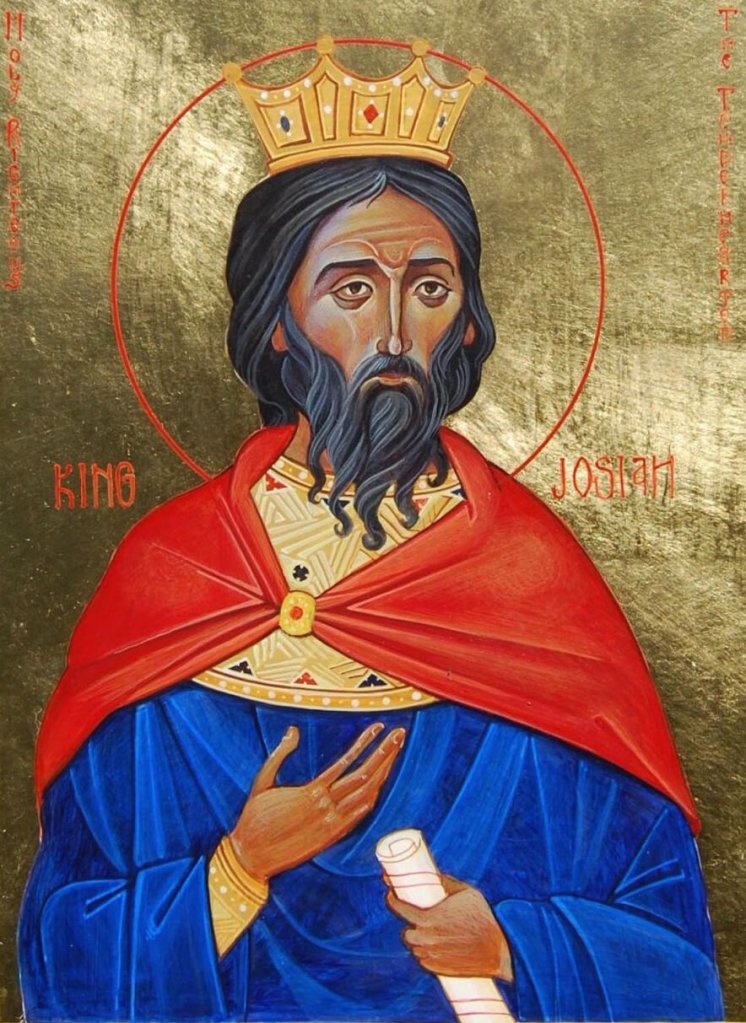
Russian Orthodox icon of Judah’s King Josiah (640-609 B.C.E.)

Josiah was eight years old when he became king of Judah, and he ruled thirty-one years from Jerusalem. He followed the example of his ancestor David and always obeyed the Lord.

When Josiah was only sixteen years old he began worshiping God, just as his ancestor David had done. Then, four years later, he decided to destroy the local shrines in Judah and Jerusalem, as well as the sacred poles for worshiping the goddess Asherah and the idols of foreign gods.He watched as the altars for the worship of the god Baal were torn down, and as the nearby incense altars were smashed. The Asherah poles, the idols, and the stone images were also smashed, and the pieces were scattered over the graves of their worshipers. Josiah then had the bones of the pagan priests burned on the altars.

And so, Josiah got rid of the worship of foreign gods in Judah and Jerusalem. He did the same things in the towns and ruined villages in the territories of West Manasseh, Ephraim, and Simeon, as far as the border of Naphtali. Everywhere in the northern kingdom of Israel, Josiah tore down pagan altars and Asherah poles; he crushed idols to dust and smashed incense altars.

Then Josiah went back to Jerusalem. (Contemporary English Version)

Josiah started out as a boy king. Evidently, he had some good training because by the time he became a teenager, Josiah was raring and ready to exercise his kingship in the best sense of leadership. 

After generations of kings before him who followed other gods and gave the stiff-arm to the Lord, as well as to justice and righteousness, Josiah committed himself fully to Israel’s one true God.  And, as a twenty-year old king, he showed the real muster of his reign.

Josiah took responsibility and initiative to do what was right in the eyes of God – no matter the consequences. 

King Josiah continually performed the dual action of worshiping God and aggressively taking active steps to rid the kingdom of all the ubiquitous false gods. 

The king did much more than simply stick his toe in the water to test what the response might be to removing a high place of Baal worship or an Asherah pole. Instead, Josiah jumped right in and put his entire kingship on the line. 

All of the power brokers who were dealing in false gods could not have been happy about this turn of events in Judah. But any kind of pushback did nothing to prevent Josiah from doing what was right in the eyes of the Lord by thoroughly eradicating idol worship.

“Let us all be the leaders we wish we had.”

Simon Sinek

Josiah had a clear sense of purpose. That sense of vocational direction ordered his kingly steps. It led him to do the things he did. Josiah was determined and devoted to leading the people back to God. 

This desire and determination for spiritual revival directed toward the worship of the Lord is not limited to the ancient world. God is still in the kingdom business of bringing all creation under a divine and benevolent rule. 

Therefore, there still remains an abiding purpose to lead others, caught in a web of unhealthy routines and habits of living through idolatrous practices, back to the one true God. 

Like the ancients before us, there is still a need to exercise courage and confidence in following the Lord by making disciples who will worship God with all their heart, soul, mind, and strength. 

So, reconnecting with our overarching purpose in life is imperative for taking bold steps of faith in this idolatrous world which worships at the altar of exorbitant eating, shopping, and drinking.

It is no wonder the current zeitgeist of so many of our communities is full of anxiety, discouragement, and anger. There is no justice in the public square. Competing voices, other than the merciful words and ways of Jesus, drown the divine regulations for living a good life of integrity, wholeness, peace, and joy in the Holy Spirit.

It is almost as if the collective efforts of idolatrous people have surgically removed the spiritual spine of society. We are now bereft of genuine support, spineless and unable to move toward a life of truth, justice, and a courageous concern for the common good of all persons.

King Josiah shows us a better way. We must radically remove all that is toxic and damaging to our souls. We need a clear purpose in life, to go hard after God and rediscover how the Divine fits into all of life and gives us meaning.

Any old fool can complain about how bad things are in the world. But the one determined to make a difference amidst all the surrounding crud and helps to make things better – that is the wise person who is in touch with their own spirit, who is able to see the spiritual within others.

So, how then will you live?

May your living be in a healthy spiritual groove of loving God and loving neighbor so that worshiping the banal becomes a thing of the past.

Holy God, you are the Sovereign of the universe. Expose the things in my life that I might be trusting in, other than you. Wean me away from evil and bend my heart and mind to truth, justice, and goodness. Help me to be aggressive in my Christian walk so that I steadfastly follow Jesus Christ in the power of the Holy Spirit, leading others to faith along the way. Amen.

Romans 12:1-8 – On Being Worshipers and Servants

Brothers and sisters, in view of all we have just shared about God’s compassion, I encourage you to offer your bodies as living sacrifices, dedicated to God and pleasing to him. This kind of worship is appropriate for you. Don’t become like the people of this world. Instead, change the way you think. Then you will always be able to determine what God really wants—what is good, pleasing, and perfect.

Because of the kindness that God has shown me, I ask you not to think of yourselves more highly than you should. Instead, your thoughts should lead you to use good judgment based on what God has given each of you as believers. Our bodies have many parts, but these parts don’t all do the same thing. In the same way, even though we are many individuals, Christ makes us one body and individuals who are connected to each other. God in his kindness gave each of us different gifts. If your gift is speaking what God has revealed, make sure what you say agrees with the Christian faith. If your gift is serving, then devote yourself to serving. If it is teaching, devote yourself to teaching. If it is encouraging others, devote yourself to giving encouragement. If it is sharing, be generous. If it is leadership, lead enthusiastically. If it is helping people in need, help them cheerfully. (God’s Word)

China and Clay

Every person is important. Everyone is needed. Each individual is to offer their entire lives to God through worship and using their spiritual gifts. Every believer is to be active in building up others. 

When I was growing up, we had a fine China set that my parents kept in a beautiful China cabinet.  The set and the cabinet are old and were a prominent part of our house. However, we almost never used it. I can only remember once or twice that my Mom got the China out to use.

God is not looking for fine China believers who sit unused in a cabinet church. Instead, the Lord is looking for rough-and-tumble clay pots—the kind that can be used every day. God wants ordinary table-wear that can be handled in a crash-and-bang world.

Followers of Jesus Christ are to be like a working kitchen, where well-worn pots are filled again and again to dispense their life-giving contents to a thirsty world; and, where common plates and cups are used again and again to provide a hungry population with the Bread of Life.

Jews and Gentiles

Within the ancient Roman Church were both Jews and Gentiles – two groups vastly different from each other.  They tended to keep to themselves and only operate within their familiar and comfortable circles of friends and relatives.  But the Apostle Paul wanted them united through using their spiritual gifts for the benefit of the entire congregation, and not only within their respective groups.

We are to give ourselves in service to one another because of God’s mercy in Christ. Since God has saved us from our guilt and shame, we are to have a grateful response of worship that is dedicated to serving everyone. 

Worship and Service

The word “worship” in today’s New Testament lesson is where we get the word “liturgy.” That is, Paul’s vision for the church was to have daily liturgical rhythms of spiritual worship, not just on Sunday when we might pull out the fine China and try to impress people.

Paul did not guilt people into serving. Rather, he straightforwardly exhorts all Christians to appropriately respond to God’s grace by offering their lives in sacrificial service as a form of gratitude to God. For this response, our mental faculties must be renewed through saturation in Scripture. It is here we discern our spiritual gifts, know what God wants us to do with those gifts, and use them effectively in the church and the world. 

Grace and Gifts

Grace is given to every believer in Jesus, not just a select few. We all have different gifts and are graced with abilities for the benefit of other, without exception. When everyone collectively exercises their spiritual gifts, then there is clarity in knowing the will of God.

All Christians must share and work together by utilizing God’s grace, instead of getting burned-out because others are not serving. Grumbling about what others are not doing begs the question of whether we are over-functioning, or not.

It could be that we have succumbed to the danger the Apostle Paul warned us about: thinking so highly of ourselves that we believe our gifts are superior to others, so we need to maintain our control and hegemony in the group. This is a terribly misguided notion. 

Each of you should use whatever gift you have received to serve others, as faithful stewards of God’s grace in its various forms. If anyone speaks, they should do so as one who speaks the very words of God. If anyone serves, they should do so with the strength God provides, so that in all things God may be praised through Jesus Christ. To him be the glory and the power for ever and ever. Amen.

1 Peter 4:10-11, NIV

We belong to one another. Therefore, one major way of giving to God is through offering ourselves to each other with equity and without favoritism. We must not separate Christ from his church. To say that we need God, but do not need the church is to really say that we do not need God because the two are inseparable. Nowhere in Holy Scripture do we find individual Christians doing their own thing, isolated from a committed group of people, the church.

When Jesus called people to follow him in service to God and a world in need, some gave him excuses that they were busy and had other pressing matters to attend to before they could follow him. Jesus simply left them and told them they were not fit for the kingdom of God. (Luke 9:57-62)

When people were pre-occupied with building wealth, or gaining power, or jockeying for influence, Jesus told them to stop it, exercise some faith, and seek first the kingdom of God.  Build your treasure in heaven, Jesus said, because it will be permanent; and, not on earth where it is temporary. (Matthew 6:19-34)

Spiritual Gifts and Abilities

We are graced by God with abilities which God fully expects us to use. “Cheap grace” is merely embracing Christ as a personal Savior but not welcoming him as the Lord in whom we must sacrificially give our lives to service in the church and the world. Spiritual health and vitality cannot exist apart from every person using God’s given grace to contribute to the functioning of the Body of Christ. 

The list of spiritual gifts Paul provided is not exhaustive but represents a combination of speaking and serving gifts necessary to bless humanity. Paul exhorted the church not to restrain people’s service but let them go at using their spiritual gifts, full bore:

  • Speak what God has revealed. Prophets do not foretell the future. Rather, they have “inspired speech” from God that addresses what God’s people are to do in consideration of Scripture. 
  • Serving. Servants give themselves to all types of hands-on service. 
  • Teaching. Teachers instruct the faithful in all the revealed will of God. 
  • Encouraging others. Encouragers both speak and serve, coming alongside others and helping them to do something with both verbal coaching and tangible help. 
  • Sharing. Givers live a simple life so they can give generously and contribute to the needs of others. 
  • Leadership. Leaders get out in front and show the way in obtaining the will of God. 
  • Helping people in need. Helpers show mercy by seeing down-and-out hurting people and being a conduit of God’s grace to them.

There is no one person who possesses all these gifts. That’s why everyone must work together to have a spiritually healthy community. A spiritually toxic community is the inevitable result of only a few people using their giftedness.

To avoid relational toxicity, and embrace communal harmony, our minds need transformation through renewing practices of godly sacrifice, regular worship, pursuing unity, and becoming aware of our spiritual gifts.

Here’s three ways we can discover our gifts:

  1. Pay attention.  Every spiritual gift reflects God’s grace and character, and so, you will find joy and satisfaction in expressing it. Your spiritual gift will be a place of deep spiritual formation and growth in your life, as God uses it both to powerfully connect you spiritually and to expose areas of your soul that need forgiveness and redemption. 
  2. Try. Give it a whirl. Volunteer. Connect with a service or ministry or try doing what you feel might be something God wants you to do. Gifts are primarily discovered from others observing and affirming your gift and not so much by going through a research process. The encouragers among us will be happy to affirm the gifts of others.
  3. Develop. All spiritual gifts need growth, cultivation, and development. Paul told his young protégé, Timothy, to fan into flame the gift of God. (2 Timothy 1:6)

We will find our greatest delight in life through engaging in worship of God and service to others. That leads to a spiritually healthy Christian community that loves God, loves one another, and loves the world.

God of grace, stir up the spiritual gifts of your people. May the gifts your Holy Spirit has decided to give us be activated and used for your glory and the edification of others. May you grant peace and joy in churches everywhere so that no one will be jealous or covetous about anyone else’s gifts. May these gifts grow and develop in love so that the fruit of the Spirit will be truly manifested. May you receive all praise honor and glory through Jesus Christ, our Lord.  Amen.

What Does the Lord Require of Us?

Welcome, friends! Micah 6:1-8 lets us know exactly what God desires for us as God’s people: to act justly, to love mercy, and to walk humbly with our God. Click on the videos below, and we will consider the Word of the Lord together.

Blessed God and Father of our Lord Jesus Christ, fill the hearts of your people with the fire of your love and mercy, and with the desire to ensure justice is done for the common good of all persons. Amen.