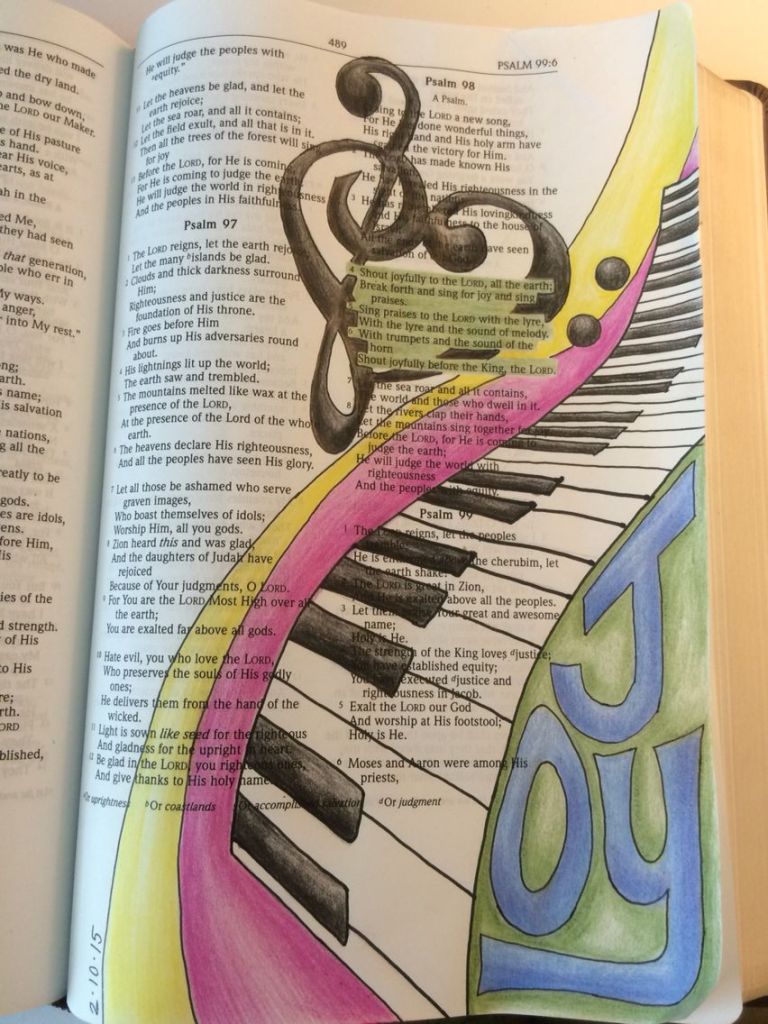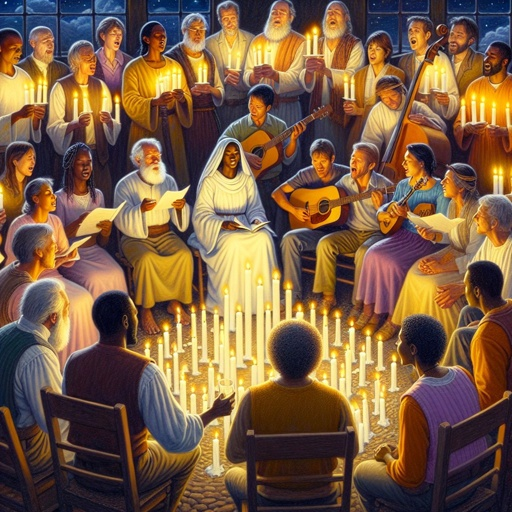
Sing Psalms and Hymns and Spiritual Songs to One Another (Ephesians 5:15-20)

By Bible Art

Be careful, then, how you live, not as unwise people but as wise, making the most of the time, because the days are evil. So do not be foolish, but understand what the will of the Lord is. Do not get drunk with wine, for that is debauchery, but be filled with the Spirit, as you sing psalms and hymns and spiritual songs to one another, singing and making melody to the Lord in your hearts, giving thanks to God the Father at all times and for everything in the name of our Lord Jesus Christ. (New Revised Standard Version)

It’s unlikely I need to tell anyone that the days are evil. The world is upside-down and topsy-turvy with injustice, waywardness, and narrow partisanship. In fact, there is a lot of similarity to the Apostle Paul’s time. Maybe that’s why Paul exhorted the church not to drown their sorrows in a bottle of spirits, but to be filled with the Spirit.

Perhaps, because of the times we live in, you don’t feel much like singing. You might not be finding much in your life right now to sing about. Yet, maybe singing is the very thing we need.

An inebriated person says and does things that they would not typically say or do when they’re sober. The Apostle’s point about being filled with the Spirit is that, instead of doing and saying foolishness, we are to be so filled with God that we do and say wisdom that we wouldn’t typically do and say, if not filled with God. 

Without the fullness of God’s Spirit, we end up mumbling, not singing; worrying, not making music in our hearts; complaining and arguing, not giving thanks. Half-filled Christians can only practice a half-hearted Christianity. And they’re only half-baked in their service and devotion to Christ.

Why sing? 

Because singing is part of being filled with the Spirit of God. Singing happens when we experience God’s overflowing grace in our lives through the blessings of being chosen, adopted, and redeemed into God’s new community. (Ephesians 1:3-11)

Music is powerful. It’s not only a means of expressing praise and commitment to Christ and each other, it is also a powerful means of remembering.

For example, when we first teach kids the alphabet, we teach it in a song. Trying to teach letters in a rote fashion doesn’t work well for pre-school kids. But words set to music is why we can still remember words from old TV shows, because those words were set to a catchy tune (alas, the lyrical theme from Gilligan’s Island will forever be in my head).  Music is why an Alzheimer’s patient doesn’t remember her daughter’s name, yet can flawlessly sing all four verses of Amazing Grace.

Singing is an offering and a sacrifice of praise to God (Hebrews 13:15). And singing is also a vehicle whereby we are taught, encouraged, and built up in the community of believers. We sing to God, one another, and even to ourselves.

Christian music, then, is to be both a means of praising God and a practice of encouraging each other. We accomplish this through singing psalms, hymns, and spiritual songs.

Sing Psalms

The word “psalm” helps us rightly think of the biblical book of Psalms. Singing the psalms is an ancient practice, going all the way back to the Israelites singing psalms in the temple and synagogue. The early church maintained this practice, especially as a means of being faithful to praying without ceasing. 

However, over time, medieval congregations began neglecting the practice. In fact, European congregations eventually gave up most singing altogether. Almost all the singing was done by church choirs and professional musicians employed by the king (there was no separation of church and state) to write, compose, and perform in worship services. 

Five-hundred years ago, during the Reformation, Martin Luther reinstituted congregational singing. He gave music back to the people. One of the results of this change was putting the book of psalms to song – the Psalter.  For many Protestant denominations, the Psalter became the primary means of singing. The Psalter chiefly set prayers to song. It was both a means of expressing prayer to God and learning Scripture.

Singing Hymns

There have always been hymns in the church. Yet, it was not until the Reformation that hymns began to be written and sung by congregations. For the Reformers, hymns were used to teach sound doctrine and theology, as well as a means of confessing the faith together

A mighty fortress is our God,
a bulwark never failing;
our helper he, amid the flood
of mortal ills prevailing.
For still our ancient foe
does seek to work us woe;
his craft and power are great,
and armed with cruel hate,
on earth is not his equal. (Martin Luther, 1529)

Singing Spiritual Songs

Spiritual songs are the present day equivalent of praise and worship choruses, or what some refer to as contemporary songs. These are songs purposefully designed to be emotional expressions of praise to God and to give powerful testimony for what God has done or is doing.

Remember When You Sing…

  • Psalms are used to pray and learn Scripture.
  • Hymns are used to teach us sound doctrine and confess the faith together.  
  • Spiritual songs are an important way of expressing praise to God and being encouraged in the faith. 

Therefore, church music is to serve as both a revelation from God, and as a response from God’s people.

There are two important deductions from the Apostle Paul’s exhortation:

  1. A variety of songs is inferred and expected
  2. Their use is commanded

The reason worship style seems always to be a controversial topic is because everyone has their personal preferences. And yet, if we are to be faithful to today’s New Testament lesson, we will do more than focus on what I want. 

Truth be told, we are selfish people when it comes to music. We want what we want, and we don’t care what somebody else wants. And we’ll persist in that self-absorbed spirit until somebody calls us on it… That somebody is the Apostle Paul. Scripture calls us to encompass psalms, hymns, and spiritual songs – all three of them – in our worship.

I have an old friend who is an accomplished church musician and worship pastor. I once asked him how I can lead a worship service among such a variety of preferences concerning music. He answered my question with a question:

“How highly do people, including and especially your musicians, value the unity of the church? Do they love each other so much that they can allow for a wider range of style, and do so without vocally complaining about it?”

My friend went on to say, “When I arrived at one church as their pastor, some people were in a rather bad habit of saying very openly, ‘Oh I hate that song,’ or, ‘If I hear this song one more time I’m walking out.’ What I tried to do was teach people that this is not the most loving or mature approach; and it does little to build up the rest of the Body of Christ.”

If a group of people are being faithful to Scripture, and doing their best musically, then – if the music seems lifeless, dull, or strange to us – the real issue isn’t style but our hearts.    

A heart filled with the Spirit of God will speak to others using the Psalter, time-honored hymns, and fresh new contemporary songs. The result is believers built up in the faith.

Gracious God, give us grace to take to heart the great dangers we are in by our unhappy divisions about all kinds of things, including music. Take away all hatred and prejudice, and whatever else may hinder us from godly union and harmony, so that as there is but one body and one Spirit, one hope of our calling, one Lord, one faith, one baptism, one God and Father of us all, we may from this time forward be all of one heart and of one soul, united in one holy bond of peace; and may with one mind and one mouth glorify you, through Jesus Christ our Lord. Amen.

Worship Is a Lifestyle (1 Chronicles 15:1-2, 16:4-13)

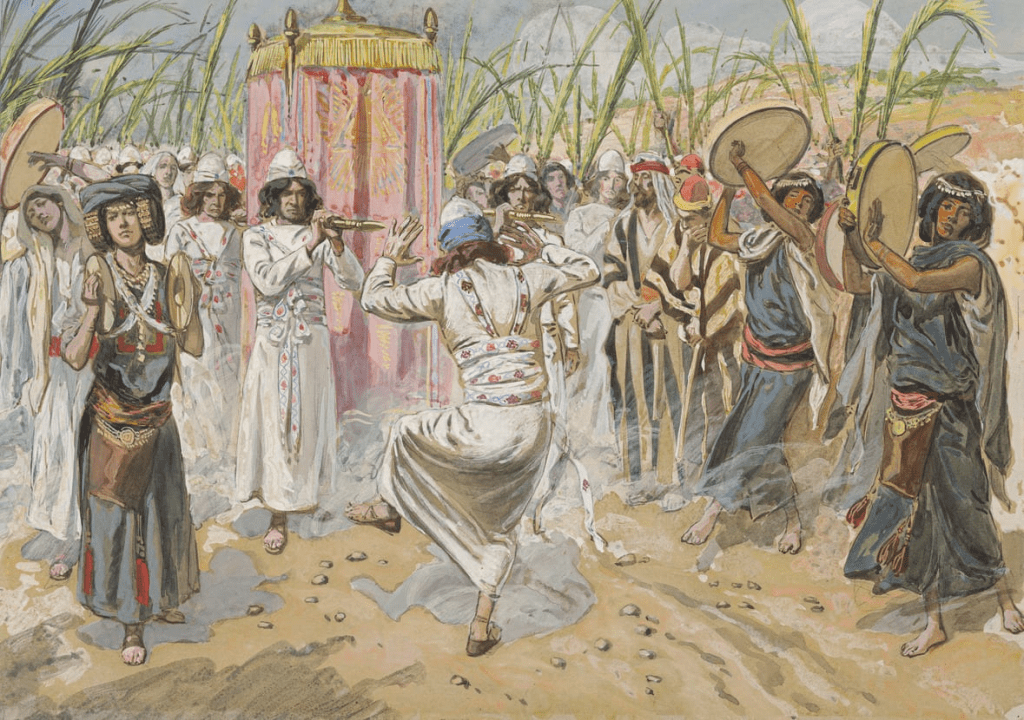
David Dancing Before the Ark, by James Tissot, c.1900

David built houses for himself in Jerusalem. Then he prepared a place for the Ark of God, and he set up a tent for it. David said, “Only the Levites may carry the Ark of God. The Lord chose them to carry the Ark of the Lord and to serve him forever….”

Then David appointed some of the Levites to serve before the Ark of the Lord. They had the job of leading the worship and giving thanks and praising the Lord, the God of Israel. Asaph, who played the cymbals, was the leader. Zechariah was second to him.

The other Levites were Jaaziel, Shemiramoth, Jehiel, Mattithiah, Eliab, Benaiah, Obed-Edom, and Jeiel. They played the lyres and harps. Benaiah and Jahaziel were priests who blew the trumpets regularly before the Ark of the Agreement with God. That day David first gave Asaph and his relatives the job of singing praises to the Lord.

Give thanks to the Lord and pray to him.
    Tell the nations what he has done.
Sing to him; sing praises to him.
    Tell about all his miracles.
Be glad that you are his;
    let those who seek the Lord be happy.
Depend on the Lord and his strength;
    always go to him for help.
Remember the miracles he has done,
    his wonders, and his decisions.
You are the descendants of his servant, Israel;
    you are the children of Jacob, his chosen people. (New Century Version)

Art by Sefira Lightstone

David was anointed as the future king by the priest and prophet Samuel, because God had rejected Saul as king. Yet, King Saul was still on the throne, still in power.

It’s a credit to David that he was faithful to the Lord, trusted God, and did nothing morally wrong or ethically suspect, such as trying to kill Saul. But King Saul certainly tried to kill David!

Saul’s jealousy morphed into murderous intent and evil machinations. Saul eventually died in battle, and David became king of Judah, then of all Israel. He did it the Lord’s way, and not his own.

So, it’s no surprise that once King David was securely on the throne, he paid attention to the Ark of the Covenant – the symbol of God’s presence with Israel – and made plans to have it in a protected and central place within the life of the Jewish people. What’s more, David sought to obey all of God’s laws and instructions which were graciously given to the people through Moses.

King David relocated the Ark from the house of Obed-Edom to Jerusalem – with the Levitical priests handling all of the sacred objects, as prescribed in the law of God.

The liturgical procession which moved the Ark of the Covenant was a grand and festive group, including military commanders, the elders of Israel, and the Levites. It was a celebration involving plenty of music, singing, and sacrifices. (1 Chronicles 13-14; 2 Samuel 6:12-19)

David prepared a tent for the Ark, in the tradition of the Tabernacle of Moses, to be located in Jerusalem at the heart of Jewish life.

After God’s Ark was moved and established in the new capitol, King David then organized the Levites for continued ministry around it. The work of the Levites was prayer, music, song, and praise, with Asaph as their leader.

Asaph along with Zechariah and eight other Levites, were responsible to ensure that musical instruments were played and trumpets blown before the Ark. (1 Chronicles 15:17-18)

All of the praise, singing, and music was to be a permanent ministry, because for David and the Jews, worship was a lifestyle, and not just an event.

So, we see that one of King David’s first initiatives in coming to power was to establish dozens of full-time Levites in the work of worship. David clearly knew where his royal position came from, and how he was supposed to rule. The king ensured that all of Jewish life was going to revolve around God, not himself. And he proved it both by his words and his actions as Israel’s leader.

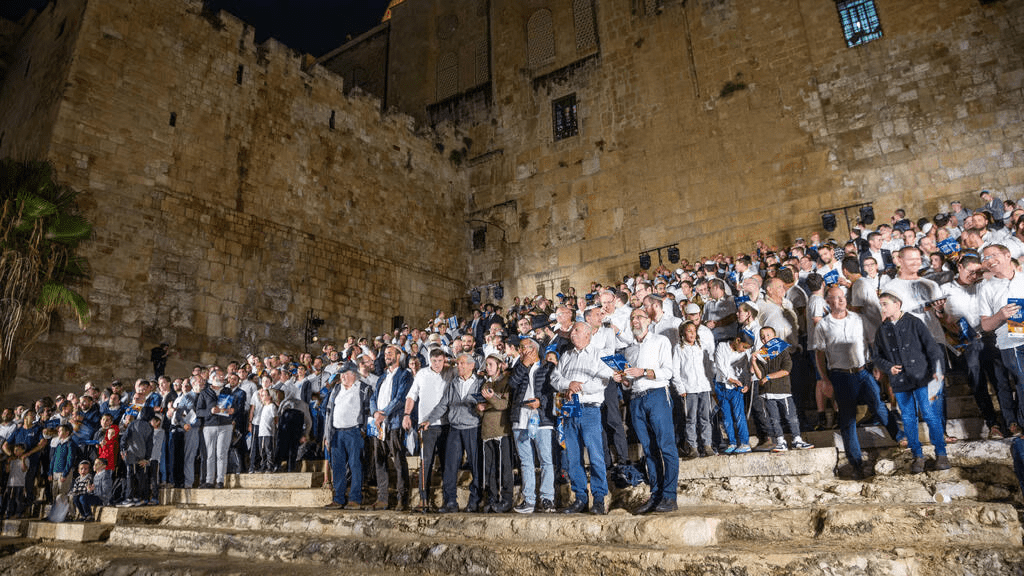
Levites singing chapters from Psalms in Jerusalem, photo by Dor Pazoelo

The approach and attitude of David makes sense, because he was the one, along with Asaph the musical director, who crafted songs of praise such as Psalm 96. We might imagine a great Levite choir singing out with lots of spiritual gusto:

Sing to the Lord a new song;
    sing to the Lord, all the earth.
Sing to the Lord and praise his name;
    every day tell how he saves us.
Tell the nations of his glory;
    tell all peoples the miracles he does,

because the Lord is great; he should be praised at all times.
    He should be honored more than all the gods,
because all the gods of the nations are only idols,
    but the Lord made the heavens.
The Lord has glory and majesty;
    he has power and beauty in his Temple.

Praise the Lord, all nations on earth;
    praise the Lord’s glory and power.
Praise the glory of the Lord’s name.
    Bring an offering and come into his Temple courtyards.
Worship the Lord because he is holy.
    Tremble before him, everyone on earth.
Tell the nations, “The Lord is king.”
    The earth is set, and it cannot be moved.
    He will judge the people fairly.
Let the skies rejoice and the earth be glad;
    let the sea and everything in it shout.
Let the fields and everything in them rejoice.
Then all the trees of the forest will sing for joy
before the Lord, because he is coming.
    He is coming to judge the world;
he will judge the world with fairness
    and the peoples with truth. (Psalm 96, NCV)

Amen.

2 Samuel 6:16-23 – Shameless Worship

As the Ark of the Lord came into the city, Saul’s daughter Michal looked out the window. When she saw David jumping and dancing in the presence of the Lord, she hated him.

David put up a tent for the Ark of the Lord, and then the Israelites put it in its place inside the tent. David offered whole burnt offerings and fellowship offerings before the Lord. When David finished offering the whole burnt offerings and the fellowship offerings, he blessed the people in the name of the Lord All-Powerful. David gave a loaf of bread, a cake of dates, and a cake of raisins to every Israelite, both men and women. Then all the people went home.

David went back to bless the people in his home, but Saul’s daughter Michal came out to meet him. She said, “With what honor the king of Israel acted today! You took off your clothes in front of the servant girls of your officers like one who takes off his clothes without shame!”

Then David said to Michal, “I did it in the presence of the Lord. The Lord chose me, not your father or anyone from Saul’s family. The Lord appointed me to be over Israel. So, I will celebrate in the presence of the Lord. Maybe I will lose even more honor, and maybe I will be brought down in my own opinion, but the girls you talk about will honor me!”

And Saul’s daughter Michal had no children to the day she died. (New Century Version)

“God wants worshipers before workers; indeed the only acceptable workers are those who have learned the lost art of worship.”

A.W. Tozer

A true celebration of God was underway, enjoying the blessing of God. The sacrifices before God were sweet smelling because they were done in a spirit of obedience and humility, and according to the specifications of worship with the Ark of God’s Covenant.

However, David’s wife, Michal, the daughter of the former king, Saul, did not worship. She critically observed David and the others and evaluated the worship service by how it appeared to her. Michal was not with everyone else giving herself to the true worship of God. She did not like how her husband went about worship. 

The acceptable worship of God was not acceptable to her, and she gave David an earful about it. Yet, David was undaunted. He had his focus where it ought to be.

We get a cryptic last note on Michal, describing that she was barren to the day of her death – it is a note on her meant to convey both a physical reality of her body, and a spiritual reality of her soul.

So, how are we to worship God? In the New Testament Gospels, Jesus said about worship: 

“Indeed, the time is coming, and it is now here, when the true worshipers will worship the Father in spirit and truth. The Father is looking for people like that to worship him. God is a spirit. Those who worship him must worship in spirit and truth.” (John 4:4:23-24, GW) 

Neither good intentions alone (in spirit) nor appropriate actions alone (in truth) constitute acceptable worship.  We must possess both. The worship Jesus talked about was literally “to prostrate oneself before God.”  In other words, it is to embrace both the disposition and the attitude of submission and humility toward God, seeking to obey the Lord as rightful Ruler, rather than superimpose our desires on him. 

Furthermore, God is both near to us and far away from us, all at the same time. God is close to us through the person and work of Jesus Christ, and now in the person of the Holy Spirit. God exists supreme and far above us, calling the shots of how we ought to be living our lives.

We must appreciate both divine transcendence and divine immanence.

The presence of God is both comforting and dangerous. God’s holiness is like a fire, giving us light and warmth – get too close to the flame and you will get burned, even destroyed. We do not get to tell God what we are to be doing and how to go about it. We have collective promises and blessings given to us as God’s people. Yet, at the same time, we have a responsibility to know God’s will and to do it in God’s way.

God cares about worship. If we worship any old way we want without consideration of how God wants it done, or if we just critically watch worship without engaging in it, then we ought not to expect blessing. However, if pay attention to God and are careful to do what God wants in God’s way, then we will enjoy God’s approval.

The Church is first and foremost a worshiping community of redeemed persons through the blood of Christ, which are given to the world in order to glorify God:

Everyone on this earth,
    sing praises to the Lord.
Day after day announce,
    “The Lord has saved us!”
Tell every nation on earth,
“The Lord is wonderful
    and does marvelous things!
The Lord is great and deserves
    our greatest praise!
He is the only God
    worthy of our worship.
Other nations worship idols,
but the Lord created
    the heavens.
Give honor and praise
    to the Lord,
whose power and beauty
    fill his holy temple.”

Tell everyone of every nation,
“Praise the glorious power
    of the Lord.
He is wonderful! Praise him
and bring an offering
    into his temple.
Worship the Lord,
    majestic and holy. (1 Chronicles 16:23-29, CEV)

The text in 1 Chronicles, a restatement of our Old Testament lesson for today, goes on to say:

David left Asaph and his coworkers with the Chest of the Covenant of God and in charge of the work of worship; they were responsible for the needs of worship around the clock.

He also assigned Obed-Edom and his sixty-eight relatives to help them. Obed-Edom son of Jeduthun and Hosah were in charge of the security guards. The priest Zadok and his family of priests were assigned to the Tent of God at the sacred mound at Gibeon to make sure that the services of morning and evening worship were conducted daily, complete with Whole-Burnt-Offerings offered on the Altar of Burnt Offering, as ordered in the Law of God, which was the norm for Israel.

With them were Heman, Jeduthun, and others specifically named, with the job description: “Give thanks to God, for his love never quits!” Heman and Jeduthun were also well equipped with trumpets, cymbals, and other instruments for accompanying sacred songs. The sons of Jeduthun formed the security guard. (1 Chronicles 16:37-42, MSG)

David exerted his kingly authority by instituting that in Israel the worship of God was to take place every day – not just one day a week. He hired hundreds of musicians, singers, and worship leaders to minister before the Lord every single day, twice a day. 

“I must take time to worship the One whose name I bear.”

Oswald Chambers

Many believers bemoan the morality and lack of spirituality in our world. Yet, if God’s people are not first and foremost a worshiping community, then we have nowhere else to look to institute the change which is needed.

In addition, every conceivable instrument and voice was used to praise God in worship. New songs were written continually by David, and arranged by Asaph, the worship leader. 

While we make plans and conceive of ideas for our lives, God is waiting for us to worship. It would be good to spend some time each morning when we arise, and each evening at bedtime, in worship following the example of David: remembering God, and who we are; singing to the Lord; confessing sin; claiming forgiveness; reading Scripture; and, praying. 

If we all devoted ourselves to worship without shame, then we might begin to imagine God opening to us blessing upon blessing.

*Above sketches of King David dancing before the Lord, by Rebecca Brogan

Psalm 98 – Sing a New Song

Sing to the Lord a new song
    because he has done wonderful things!
His own strong hand and his own holy arm
    have won the victory!
The Lord has made his salvation widely known;
    he has revealed his righteousness
    in the eyes of all the nations.
God has remembered his loyal love
    and faithfulness to the house of Israel;
    every corner of the earth has seen our God’s salvation.

Shout triumphantly to the Lord, all the earth!
    Be happy!
    Rejoice out loud!
    Sing your praises!
Sing your praises to the Lord with the lyre—
    with the lyre and the sound of music.
With trumpets and a horn blast,
    shout triumphantly before the Lord, the king!
Let the sea and everything in it roar;
    the world and all its inhabitants too.
Let all the rivers clap their hands;
    let the mountains rejoice out loud altogether before the Lord
    because he is coming to establish justice on the earth!
He will establish justice in the world rightly;
    he will establish justice among all people fairly. (Common English Bible)

Please notice the point of today’s psalm: Sing to the Lord a new song. Yes, a “new” song. This means we have an obligation to bring fresh music to our worship of God. This is a summons to get an original voice. Rather than going down the same ruts in our speaking and living, we are to exercise some creativity.

It seems as if those who want to stick with the “tried and true hymns” of the church have forgotten those hymns are only a few hundred years old in a church which is two-thousand years old. Back in the nineteenth century, a bitter worship battle ensued between those who wanted to sing the new hymns and those who had been singing the psalter for the past few hundred years.

The reason we sing new songs is because God is continually performing wonderful deeds in every generation. God has not only worked in the past; the Lord is doing the miraculous in the present, as well. The psalmist is thinking in cosmic, not provincial, terms. Included in the praising of new songs are a variety of creatures, along with all of creation.

Rivers Will Clap and Mountains Shout by Itamar Raz

We sing because of what God has done in the past, is doing in the present, and will do for the future. Creative and fresh praise that remembers previous divine works, experiences the now of the Spirit, and anticipates the coming of the Lord is the sort of praise called for in the psalm.

Being attentive to God’s mighty deeds helps us breakout into new vistas of living. Considering God’s works through new songs can become so invigorating that everyone and everything on earth is encouraged to join into the imaginative expression of praise.

We are to praise the Lord in this present time because of what God has done in the past, with a continual eye to the future when Christ will come again. If we don’t make the effort to offer praise that is fresh, creative, and thoughtful for our present time, then we ought not be surprised when a watching world gives a shoulder-shrugging “meh” to our tepid singing. And if such vibrant praise seems foreign, then the time is past due for a renewed focus on the works of God because the Lord really has done miraculous things for us.

Let’s jump start your creativity a bit:

  • Do some prayer walking through your neighborhood. See the community through another’s eyes.
  • Write in a journal or collect photos of significant experiences. No one needs to read or see it unless you want them to. Although, it’s a good idea to share with others.
  • Sketch, paint, or sculpt. Make a visual depiction of your joy or experience. It doesn’t matter if it looks like a second grade art project. It’s the process of creating that matters.
  • Participate in a new activity, like taking an online class or developing a different routine.
  • Don’t just do what somebody else did. Reflect on what is important to you. Then, make something to remind you of its value.

You are already a creative artist. You just might not know it, yet. Since you carry within yourself the DNA of a creative God, the Lord’s image and likeness within wants a creative outlet. Open yourself to the possibility of smelling colors, talking to trees, and listening to what animals have to say to you. In doing so, you just might discover that the miraculous has been under your nose all along.

Mighty God, your holy arm of power has done incredible works in history. What’s more, you have done influential works in my life, especially through deliverance from evil and transformation of heart.  For this, and for all your miraculously good work, I praise the gracious and wonderful name of Jesus Christ, my Savior and Lord. Amen.