Sing Psalms and Hymns and Spiritual Songs to One Another (Ephesians 5:15-20)

By Bible Art

Be careful, then, how you live, not as unwise people but as wise, making the most of the time, because the days are evil. So do not be foolish, but understand what the will of the Lord is. Do not get drunk with wine, for that is debauchery, but be filled with the Spirit, as you sing psalms and hymns and spiritual songs to one another, singing and making melody to the Lord in your hearts, giving thanks to God the Father at all times and for everything in the name of our Lord Jesus Christ. (New Revised Standard Version)

It’s unlikely I need to tell anyone that the days are evil. The world is upside-down and topsy-turvy with injustice, waywardness, and narrow partisanship. In fact, there is a lot of similarity to the Apostle Paul’s time. Maybe that’s why Paul exhorted the church not to drown their sorrows in a bottle of spirits, but to be filled with the Spirit.

Perhaps, because of the times we live in, you don’t feel much like singing. You might not be finding much in your life right now to sing about. Yet, maybe singing is the very thing we need.

An inebriated person says and does things that they would not typically say or do when they’re sober. The Apostle’s point about being filled with the Spirit is that, instead of doing and saying foolishness, we are to be so filled with God that we do and say wisdom that we wouldn’t typically do and say, if not filled with God. 

Without the fullness of God’s Spirit, we end up mumbling, not singing; worrying, not making music in our hearts; complaining and arguing, not giving thanks. Half-filled Christians can only practice a half-hearted Christianity. And they’re only half-baked in their service and devotion to Christ.

Why sing? 

Because singing is part of being filled with the Spirit of God. Singing happens when we experience God’s overflowing grace in our lives through the blessings of being chosen, adopted, and redeemed into God’s new community. (Ephesians 1:3-11)

Music is powerful. It’s not only a means of expressing praise and commitment to Christ and each other, it is also a powerful means of remembering.

For example, when we first teach kids the alphabet, we teach it in a song. Trying to teach letters in a rote fashion doesn’t work well for pre-school kids. But words set to music is why we can still remember words from old TV shows, because those words were set to a catchy tune (alas, the lyrical theme from Gilligan’s Island will forever be in my head).  Music is why an Alzheimer’s patient doesn’t remember her daughter’s name, yet can flawlessly sing all four verses of Amazing Grace.

Singing is an offering and a sacrifice of praise to God (Hebrews 13:15). And singing is also a vehicle whereby we are taught, encouraged, and built up in the community of believers. We sing to God, one another, and even to ourselves.

Christian music, then, is to be both a means of praising God and a practice of encouraging each other. We accomplish this through singing psalms, hymns, and spiritual songs.

Sing Psalms

The word “psalm” helps us rightly think of the biblical book of Psalms. Singing the psalms is an ancient practice, going all the way back to the Israelites singing psalms in the temple and synagogue. The early church maintained this practice, especially as a means of being faithful to praying without ceasing. 

However, over time, medieval congregations began neglecting the practice. In fact, European congregations eventually gave up most singing altogether. Almost all the singing was done by church choirs and professional musicians employed by the king (there was no separation of church and state) to write, compose, and perform in worship services. 

Five-hundred years ago, during the Reformation, Martin Luther reinstituted congregational singing. He gave music back to the people. One of the results of this change was putting the book of psalms to song – the Psalter.  For many Protestant denominations, the Psalter became the primary means of singing. The Psalter chiefly set prayers to song. It was both a means of expressing prayer to God and learning Scripture.

Singing Hymns

There have always been hymns in the church. Yet, it was not until the Reformation that hymns began to be written and sung by congregations. For the Reformers, hymns were used to teach sound doctrine and theology, as well as a means of confessing the faith together

A mighty fortress is our God,
a bulwark never failing;
our helper he, amid the flood
of mortal ills prevailing.
For still our ancient foe
does seek to work us woe;
his craft and power are great,
and armed with cruel hate,
on earth is not his equal. (Martin Luther, 1529)

Singing Spiritual Songs

Spiritual songs are the present day equivalent of praise and worship choruses, or what some refer to as contemporary songs. These are songs purposefully designed to be emotional expressions of praise to God and to give powerful testimony for what God has done or is doing.

Remember When You Sing…

  • Psalms are used to pray and learn Scripture.
  • Hymns are used to teach us sound doctrine and confess the faith together.  
  • Spiritual songs are an important way of expressing praise to God and being encouraged in the faith. 

Therefore, church music is to serve as both a revelation from God, and as a response from God’s people.

There are two important deductions from the Apostle Paul’s exhortation:

  1. A variety of songs is inferred and expected
  2. Their use is commanded

The reason worship style seems always to be a controversial topic is because everyone has their personal preferences. And yet, if we are to be faithful to today’s New Testament lesson, we will do more than focus on what I want. 

Truth be told, we are selfish people when it comes to music. We want what we want, and we don’t care what somebody else wants. And we’ll persist in that self-absorbed spirit until somebody calls us on it… That somebody is the Apostle Paul. Scripture calls us to encompass psalms, hymns, and spiritual songs – all three of them – in our worship.

I have an old friend who is an accomplished church musician and worship pastor. I once asked him how I can lead a worship service among such a variety of preferences concerning music. He answered my question with a question:

“How highly do people, including and especially your musicians, value the unity of the church? Do they love each other so much that they can allow for a wider range of style, and do so without vocally complaining about it?”

My friend went on to say, “When I arrived at one church as their pastor, some people were in a rather bad habit of saying very openly, ‘Oh I hate that song,’ or, ‘If I hear this song one more time I’m walking out.’ What I tried to do was teach people that this is not the most loving or mature approach; and it does little to build up the rest of the Body of Christ.”

If a group of people are being faithful to Scripture, and doing their best musically, then – if the music seems lifeless, dull, or strange to us – the real issue isn’t style but our hearts.    

A heart filled with the Spirit of God will speak to others using the Psalter, time-honored hymns, and fresh new contemporary songs. The result is believers built up in the faith.

Gracious God, give us grace to take to heart the great dangers we are in by our unhappy divisions about all kinds of things, including music. Take away all hatred and prejudice, and whatever else may hinder us from godly union and harmony, so that as there is but one body and one Spirit, one hope of our calling, one Lord, one faith, one baptism, one God and Father of us all, we may from this time forward be all of one heart and of one soul, united in one holy bond of peace; and may with one mind and one mouth glorify you, through Jesus Christ our Lord. Amen.

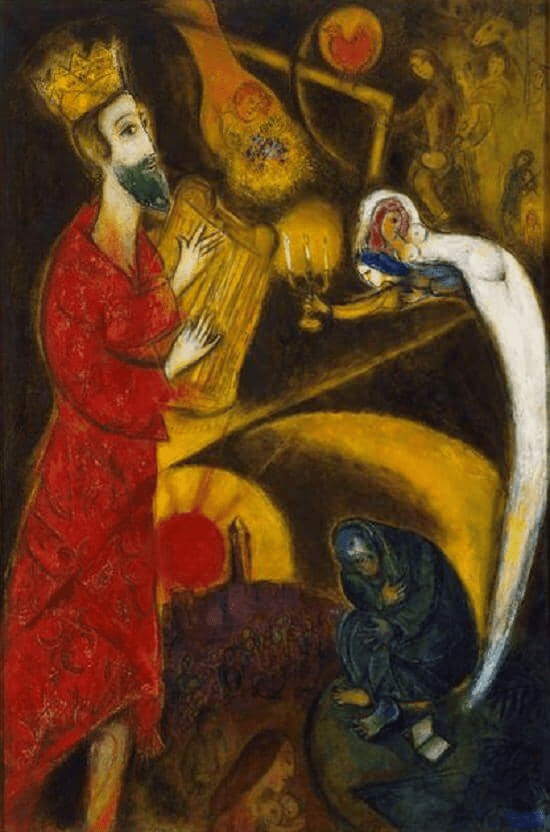
Pillow Thoughts (Psalm 132:1-12)

King David, by Marc Chagall, 1962

O Lord, remember in David’s favor
    all the hardships he endured;
how he swore to the Lord
    and vowed to the Mighty One of Jacob,
“I will not enter my house
    or get into my bed;
I will not give sleep to my eyes
    or slumber to my eyelids,
until I find a place for the Lord,
    a dwelling place for the Mighty One of Jacob.”

We heard of it in Ephrathah;
    we found it in the fields of Jaar.
“Let us go to his dwelling place;
    let us worship at his footstool.”

Rise up, O Lord, and go to your resting place,
    you and the ark of your might.
Let your priests be clothed with righteousness,
    and let your faithful shout for joy.
For your servant David’s sake
    do not turn away the face of your anointed one.

The Lord swore to David a sure oath
    from which he will not turn back:
“One of the sons of your body
    I will set on your throne.
If your sons keep my covenant
    and my decrees that I shall teach them,
their sons also, forevermore,
    shall sit on your throne.” (New Revised Standard Version)

King David took great pains in providing for the house of the Lord; and was very concerned about the worship of Yahweh. He went well out of his way to ensure that a temple would be built for his God.

David made as many preparations as he possibly could before his death, so that his son Solomon could follow through and build the temple. The editor of the Book of Chronicles commented on this:

David gave orders to gather together the aliens who were residing in the land of Israel, and he set stonecutters to prepare dressed stones for building the house of God. David also provided great stores of iron for nails for the doors of the gates and for clamps, as well as bronze in quantities beyond weighing, and cedar logs without number—for the Sidonians and Tyrians brought great quantities of cedar to David. 

For David said, “My son Solomon is young and inexperienced, and the house that is to be built for the Lord must be exceedingly magnificent, famous and glorified throughout all lands; I will therefore make preparation for it.” So David provided materials in great quantity before his death. (1 Chronicles 22:2-5, NRSV)

The king did all of this because God came to David and let him know that he would not be the one to build the temple; that job would fall to his son Solomon. (2 Samuel 7:4-13)

David’s final instruction to Solomon and the people had to do with the construction of a house for the Lord his God:

“Now set your mind and heart to seek the Lord your God. Go and build the sanctuary of the Lord God so that the ark of the covenant of the Lord and the holy vessels of God may be brought into the house built for the name of the Lord.” (1 Chronicles 22:19, NRSV)

The worship of God, for David, was to be the central feature of the Jewish people. All Israel and Judah were to encourage one another in worship at God’s house, the Lord’s Temple, in Jerusalem.

The priests of God wore special clothing, and handled the holy implements and the Ark of the Covenant of God. Yet, they were to be also clothed with righteousness, making sure that their outward ceremonial rituals reflected an inner moral purity and holiness before God.

David was bound and determined to not only worship the Lord himself, but to see that the entire nation of Israel had the opportunity to worship together in a central place.

Maybe a question arises for you about why David was so driven to construct a house for God. What is it that motivated King David to spend so much of his planning and energy on making sure that a temple would be constructed for the Lord?

Now when the king was settled in his house and the Lord had given him rest from all his enemies around him, the king said to the prophet Nathan, “See now, I am living in a house of cedar, but the ark of God stays in a tent.” Nathan said to the king, “Go, do all that you have in mind, for the Lord is with you.” (2 Samuel 7:1-3, NRSV)

A lot of events had transpired for David to be in the position of king, with peace all around him. The Lord had been with David, and brought him through the sort of adversities most of us will never know.

Once King David was at the pinnacle of peace and success, his thought were not about how to hold onto power, or to get more of it. He would lay his head on his pillow at night and wonder how he could give back to God for being so faithful.

And considering all that God had accomplished for him and for Israel, it seemed a travesty that he was luxuriating in a fine house, while the Ark of the Covenant – the objective presence of God among the people – was sitting in an old tent. So, David became determined to change that situation, because he could.

I wonder if when you and I are at a place in our lives where we feel safe and secure, prosperous and happy, our thoughts and dreams turn toward how we might give back to God in a worshipful way which will honor the Lord, as well as bless all the people of God.

I am curious what sort of things occupy your mind at night while your head is on your pillow, when you are feeling good about how your life is going.

Many, if not most, people will think about themselves, and what to do with what they have gained and/or accomplished. But what about you?

How will you respond to God’s grace, goodness, deliverance, and protection in your own life? What sort of ideas arise in your mind? What is in your heart to do for God and God’s people?

What are your pillow thoughts at night?

Presence itself is a great gift. The presence of God is incredibly gracious, good, and miraculous. And human presence, with each individual stamped with the image and likeness of God upon them, is also a wonderful gift from the Creator. And very much needed.

David enjoyed the presence of God, and longed for all the people to experience that divine presence. Although the Lord needed no temple to live in, David had in mind to provide one.

I imagine that King David understood that each person is a luminous icon of presence, reflecting God’s image, and needing the presence of God and others in order to have a nation who worships God as commanded in the Mosaic law.

Through communal worship at a designated site in Jerusalem, the Israelites could enjoy the beauty of God’s presence together, as well as the encouragement of one another.

Wherever there is presence and the acknowledgement of God and each other, there is freedom to offer affection, understanding, and respect.

It seems to me that these were the sort of thoughts that ran through King David’s mind, which made him determined to build a house for the Lord his God.

So, what will you do with your thoughts and your life?

Almighty God of all hope, of our thoughts and dreams: In humility, we give you thanks for all of creation; and for everything you give us. We praise you for forgiving us of our guilt and shame, even before we ask. You raise us from our broken state and make us whole. You give us the peace we yearn for.

Blessed God, fill us, your people, with your divine Spirit. Be our light in the darkness. Envelop us with your presence. Orient our hearts toward your justice; and help us always praise you. Let us ever be mindful of your power and grace in the world. Let us live as one with you in grace and in truth. Amen.

Telling a Story of Faith (Deuteronomy 26:5-10)

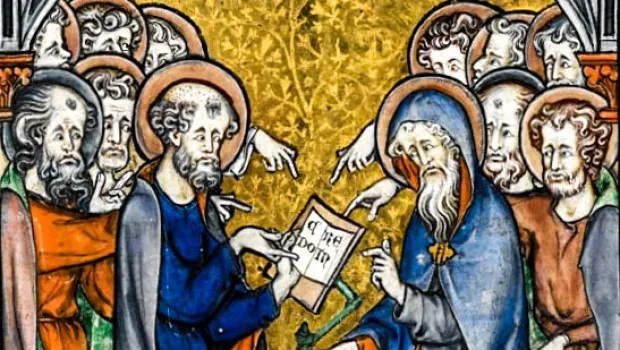
A 13th century artwork depicting the Apostles writing the Creed

Then, standing there in front of the place of worship, you must pray:

My ancestor was homeless,
an Aramean who went to live
    in Egypt.
There were only a few
    in his family then,
but they became great
and powerful,
    a nation of many people.

The Egyptians were cruel
    and had no pity on us.
They mistreated our people
    and forced us into slavery.
We called out for help
to you, the Lord God
    of our ancestors.
You heard our cries;
you knew we were in trouble
    and abused.
Then you terrified the Egyptians
with your mighty miracles
    and rescued us from Egypt.
You brought us here
and gave us this land
    rich with milk and honey.
Now, Lord, I bring to you
the best of the crops
    that you have given me.

After you say these things, place the basket in front of the Lord’s altar and bow down to worship him. (Contemporary English Version)

Forty years of wandering throughout the desert, in the backside of the wilderness. Having been delivered out of Egypt by the mighty hand of God, the Israelites were on a very circuitous journey to the Promised Land.

The Book of Deuteronomy is a restatement of the people’s history and God’s law for the generation about to enter the land of Canaan. Moses told the people that when they enter the land and have their first harvest of crops, they are to remember and give thanks for all their blessings.

People need to be reminded of important things. Sometimes, in the middle of success and good fortune, we can forget to savor the moment, neglect to appreciate what it took to get to this place, and fail to celebrate with others the God who has made good things happen.

Interestingly, in appreciation for the abundance of a harvest, Moses did not tell the people to give thanks for the weather or the crops themselves. Rather, they were exhorted to recall and retell the story of Israel and their ancestors.

Through historical narrative, the Israelites tethered themselves to their present reality. They located themselves in the past, as contemporary links in a holy chain that stretched generations, all the way back to the patriarch Jacob.

This sort of relational and generational gratitude is in stark contrast to what current cultural appreciation and thanksgiving is, for cars, homes, jobs, resources, and stuff. Although thankfulness is appropriate and necessary for those things, none of it is lasting and sustainable.

Beneath all of the purchased things and electronic devices is a longing for connection, a desire to know who we are, where we came from, and what our true roots are.

Greater emotional health comes from knowing where we came from. Our connections to family, friends, church, and community are a vital and essential piece of living a good life with satisfaction and contentment.

Healthy roots enable us to respond well to the challenges of life with strength and resilience.

One way to recall and remember is to recite a creed. Sadly, many churches today recoil at reciting creeds and confessions, as if this were a bad thing. But there is significance and power to a group of people who stand and recite an ancient creed together.

The Christian ecumenical church creeds, including the Apostles’ Creed, Nicene Creed, and Athanasian Creed, capture the settled convictions of early believers in Jesus as they struggled to express their faith in the church and the world.

Those creeds are a part of us, and of our collective spiritual history as the people of God. There are yet other kinds of creeds, as well. We have an even more ancient creed expressed in today’s Old Testament lesson – the sort of creed that tells a story.

Moses gave the Israelites some parting instructions to follow for their future worship in the Promised Land. When they enter the land a bring in their harvest, they were to bring the first-fruits of their crops to the priest, and then profess a creed, which is really a story, a historical narrative of God’s people.

Every Jewish farmer and worshiper who brought their crop to the priest would recite the creed about their ancestors suffering in Egypt and being redeemed by God through a great deliverance. God granted them the gift of land, a promised place to call their own.

We as the people of God must discern the importance of embracing the story of redemption, of crying out and being delivered from the shackles of sin, death, and hell. We receive this salvation with thanksgiving and joy.

Christians tell their story of deliverance not only through the ancient ecumenical creeds, but also through the sacramental means of communion. The Table proclaims the life and death of Christ, given for us, and for our salvation. It is a story with deep roots in the life of Israel.

Believers in Jesus are invited to participate is something bigger than themselves. The Christian’s story begins not at Pentecost in the New Testament, but in the promise to Abraham way back in the Old Testament.

The blessing given to Abraham was a blessing for all nations, not just Israel (Genesis 12:1-3). Knowing the roots of our spiritual life and Christian faith helps inform us how we are to live out that faith and life in this present time.

Within Christianity, our history and story is much bigger than Europe and Western civilization. The earliest church began in the Middle East. Ancient Christian traditions and churches still exist, and worship today in places like Egypt and Ethiopia. There are presently large numbers of Christians in every part of the world, especially in Latin America, Asia, and Africa.

Essentially, we are the lost, the last, the forgotten, the outsiders who cried out to God. And the Lord rescued us, blessed us with every spiritual blessing in Christ, and gave us the privilege of being ambassadors for Christ in the world.

We belong to God. Along with believers throughout the ages, and across the world, we declare:

I believe in God, the Father almighty,
creator of heaven and earth.

I believe in Jesus Christ, his only Son, our Lord.
He was conceived by the power of the Holy Spirit
and born of the Virgin Mary.
He suffered under Pontius Pilate,
was crucified, died, and was buried.
He descended to the dead.
On the third day he rose again.
He ascended into heaven,
and is seated at the right hand of the Father.
He will come again to judge the living and the dead.

I believe in the Holy Spirit,
the holy catholic Church,
the communion of saints,
the forgiveness of sins,
the resurrection of the body,
and the life everlasting. Amen.

Worship Is a Lifestyle (1 Chronicles 15:1-2, 16:4-13)

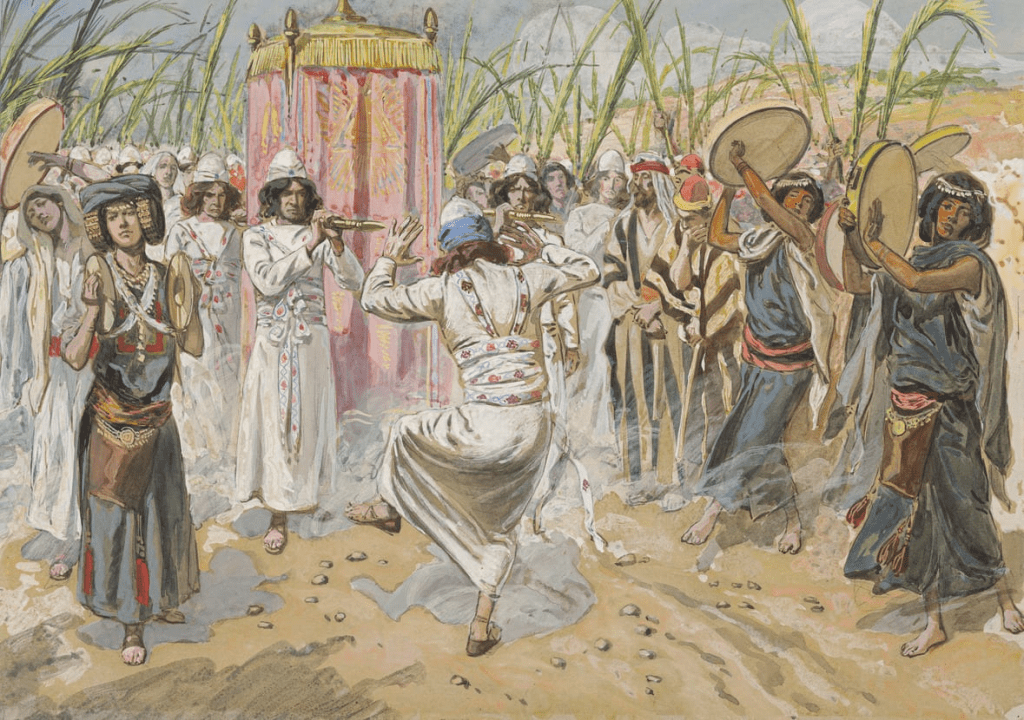
David Dancing Before the Ark, by James Tissot, c.1900

David built houses for himself in Jerusalem. Then he prepared a place for the Ark of God, and he set up a tent for it. David said, “Only the Levites may carry the Ark of God. The Lord chose them to carry the Ark of the Lord and to serve him forever….”

Then David appointed some of the Levites to serve before the Ark of the Lord. They had the job of leading the worship and giving thanks and praising the Lord, the God of Israel. Asaph, who played the cymbals, was the leader. Zechariah was second to him.

The other Levites were Jaaziel, Shemiramoth, Jehiel, Mattithiah, Eliab, Benaiah, Obed-Edom, and Jeiel. They played the lyres and harps. Benaiah and Jahaziel were priests who blew the trumpets regularly before the Ark of the Agreement with God. That day David first gave Asaph and his relatives the job of singing praises to the Lord.

Give thanks to the Lord and pray to him.
    Tell the nations what he has done.
Sing to him; sing praises to him.
    Tell about all his miracles.
Be glad that you are his;
    let those who seek the Lord be happy.
Depend on the Lord and his strength;
    always go to him for help.
Remember the miracles he has done,
    his wonders, and his decisions.
You are the descendants of his servant, Israel;
    you are the children of Jacob, his chosen people. (New Century Version)

Art by Sefira Lightstone

David was anointed as the future king by the priest and prophet Samuel, because God had rejected Saul as king. Yet, King Saul was still on the throne, still in power.

It’s a credit to David that he was faithful to the Lord, trusted God, and did nothing morally wrong or ethically suspect, such as trying to kill Saul. But King Saul certainly tried to kill David!

Saul’s jealousy morphed into murderous intent and evil machinations. Saul eventually died in battle, and David became king of Judah, then of all Israel. He did it the Lord’s way, and not his own.

So, it’s no surprise that once King David was securely on the throne, he paid attention to the Ark of the Covenant – the symbol of God’s presence with Israel – and made plans to have it in a protected and central place within the life of the Jewish people. What’s more, David sought to obey all of God’s laws and instructions which were graciously given to the people through Moses.

King David relocated the Ark from the house of Obed-Edom to Jerusalem – with the Levitical priests handling all of the sacred objects, as prescribed in the law of God.

The liturgical procession which moved the Ark of the Covenant was a grand and festive group, including military commanders, the elders of Israel, and the Levites. It was a celebration involving plenty of music, singing, and sacrifices. (1 Chronicles 13-14; 2 Samuel 6:12-19)

David prepared a tent for the Ark, in the tradition of the Tabernacle of Moses, to be located in Jerusalem at the heart of Jewish life.

After God’s Ark was moved and established in the new capitol, King David then organized the Levites for continued ministry around it. The work of the Levites was prayer, music, song, and praise, with Asaph as their leader.

Asaph along with Zechariah and eight other Levites, were responsible to ensure that musical instruments were played and trumpets blown before the Ark. (1 Chronicles 15:17-18)

All of the praise, singing, and music was to be a permanent ministry, because for David and the Jews, worship was a lifestyle, and not just an event.

So, we see that one of King David’s first initiatives in coming to power was to establish dozens of full-time Levites in the work of worship. David clearly knew where his royal position came from, and how he was supposed to rule. The king ensured that all of Jewish life was going to revolve around God, not himself. And he proved it both by his words and his actions as Israel’s leader.

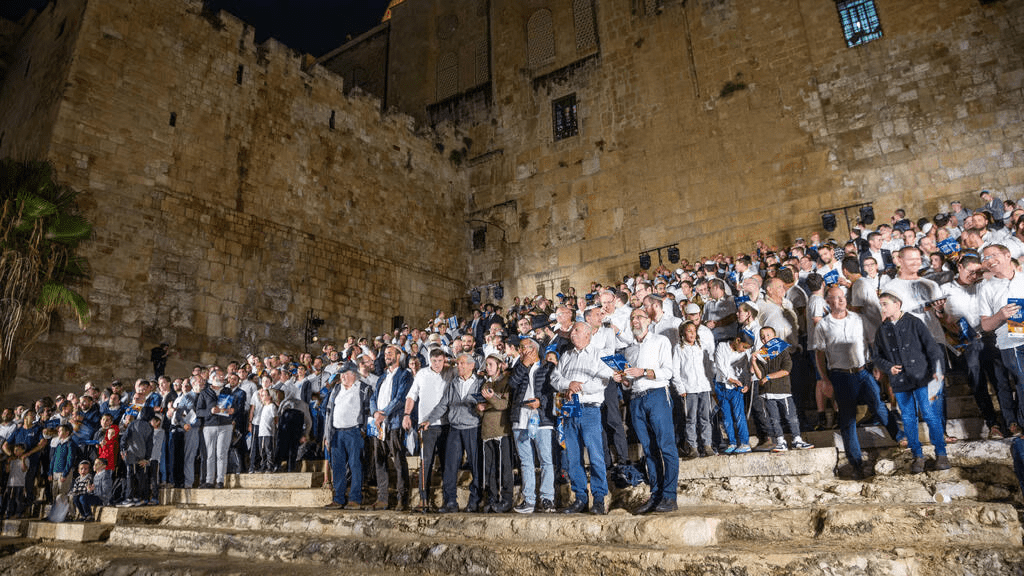
Levites singing chapters from Psalms in Jerusalem, photo by Dor Pazoelo

The approach and attitude of David makes sense, because he was the one, along with Asaph the musical director, who crafted songs of praise such as Psalm 96. We might imagine a great Levite choir singing out with lots of spiritual gusto:

Sing to the Lord a new song;
    sing to the Lord, all the earth.
Sing to the Lord and praise his name;
    every day tell how he saves us.
Tell the nations of his glory;
    tell all peoples the miracles he does,

because the Lord is great; he should be praised at all times.
    He should be honored more than all the gods,
because all the gods of the nations are only idols,
    but the Lord made the heavens.
The Lord has glory and majesty;
    he has power and beauty in his Temple.

Praise the Lord, all nations on earth;
    praise the Lord’s glory and power.
Praise the glory of the Lord’s name.
    Bring an offering and come into his Temple courtyards.
Worship the Lord because he is holy.
    Tremble before him, everyone on earth.
Tell the nations, “The Lord is king.”
    The earth is set, and it cannot be moved.
    He will judge the people fairly.
Let the skies rejoice and the earth be glad;
    let the sea and everything in it shout.
Let the fields and everything in them rejoice.
Then all the trees of the forest will sing for joy
before the Lord, because he is coming.
    He is coming to judge the world;
he will judge the world with fairness
    and the peoples with truth. (Psalm 96, NCV)

Amen.