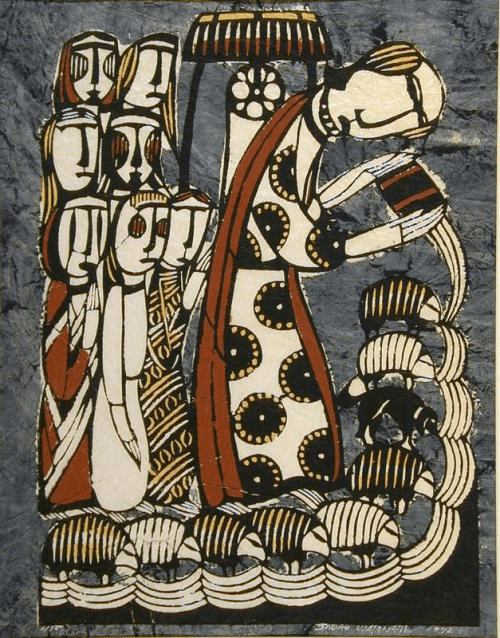
On a Time Out (Exodus 2:11-15)

Moses in Midian, by Japanese artist Sadao Watanabe, 1972

One day, after Moses had grown up, he went out to where his own people were and watched them at their hard labor. He saw an Egyptian beating a Hebrew, one of his own people. Looking this way and that and seeing no one, he killed the Egyptian and hid him in the sand. The next day he went out and saw two Hebrews fighting. He asked the one in the wrong, “Why are you hitting your fellow Hebrew?”

The man said, “Who made you ruler and judge over us? Are you thinking of killing me as you killed the Egyptian?” Then Moses was afraid and thought, “What I did must have become known.”

When Pharaoh heard of this, he tried to kill Moses, but Moses fled from Pharaoh and went to live in Midian, where he sat down by a well. (New International Version)

Faith is dynamic, not static. It flows and moves, waxes and wanes, strengthens and weakens. Faith isn’t like a kitschy trinket you buy in a quaint downtown shop, and then place it as a nice object in a prominent place of your house or office. Rather, faith is much more subjective, like taking an adventure down some whitewater rapids, not quite knowing what’s going to happen.

Moses needed to learn how to make healthy decisions of faith, just like the rest of us. Just because we stand at this point in history and can look back at what a religious titan he was, doesn’t mean that Moses was always a paragon of faith and patience. In fact, quite the opposite.

An eighty year old Moses became the human agent of God’s deliverance of the Israelites from the Egyptians, after a forty year stint in the backside of the desert. This tells us that it took him awhile to mature into being the sort of leader God wanted to bring God’s people out of slavery. 

Even though the forty year old Moses may have had a sense that the Israelites needed freedom from slavery and acted on that sense by killing a ruthless Egyptian, his method, maturity, and misplaced timing were off.

There is a time for everything, said the Teacher of wisdom (Ecclesiastes 3:1). Wisdom – the ability to apply faith to concrete situations with appropriate forms – is often in the timing of things. To know when to speak and when to listen, when to act and when to wait, is an important facet of faith. 

The ancient Israelites were slaves in Egypt for a long time, 400 years. Moses knew they were suffering, and he acted in “good faith.” Yet, it was not yet time, and it was a rash action, in killing the Egyptian. Eventually, the Jewish cry of suffering arose to God, and God heard them, remembering the divine covenant. 

Questions of why God did not act sooner, or use Moses earlier, is information that is only privy within God, and likely will not be answered satisfactorily for us, this side of heaven.

In order to develop a strong and wise faith – with an opportune sense of timing – we need to rely on God. Trusting in ourselves, our own efforts, and our own gauge of how things ought to proceed, will usually not end well. We may, like Moses, find ourselves taking a “time out” from God in obscurity until we learn to wait on him.

Some might think of a “time out” as being negative, even punitive, such as giving a time out to a toddler because of naughtiness, or calling a time out in sports because the team is playing poorly. However, a time out can also be a positive experience. The following are some advantages of the “time out:”

Reflect

Little did Moses know at the time, but he would have the next 40 years to reflect on his life and actions in Egypt. Reflection is important. It gives us a chance to step back, learn from what happened, and adjust for the next time we experience a similar situation. Taking this time acts like a mirror, enabling us to gain some clarity on what we’ve said and done.

So I reflected on all this and concluded that the righteous and the wise and what they do are in God’s hands, but no one knows whether love or hate awaits them. All share a common destiny—the righteous and the wicked, the good and the bad, the clean and the unclean, those who offer sacrifices and those who do not. (Ecclesiastes 9:1-2, NIV)

Refocus

Upon taking the time to reflect, it then provides us with the opportunity to refocus our efforts with wisdom. To refocus means to come back around in giving close attention and concentration on what’s most important to us. The desire of Moses was admirable in being concerned about his fellow Israelites. He just went too far and needed to fix his eyes on the Lord and how to best go about freeing them.

We must focus on Jesus, the source and goal of our faith. He saw the joy ahead of him, so he endured death on the cross and ignored the disgrace it brought him. (Hebrews 12:2, GW)

Renew

Reflecting on the past and refocusing in the present are not quite enough to get us back in the game of life. We also need renewal. To be renewed involves fresh commitment to the things we have learned. I believe it’s best to renew our commitments with some sort of ritual, because rituals help us psychologically and spiritually to launch into the focused endeavors ahead of us. That’s why athletes always have a short ritual of breaking their huddle before returning to the contest.

Don’t be conformed to this world, but be transformed by the renewing of your mind, so that you may prove what is the good, well-pleasing, and perfect will of God. (Romans 12:2, WEB)

Return

A “time out” is designed to be temporary. Eventually, a “time in” happens. We get back in the game. We return to what we were doing, hopefully with a better understanding and grasp of what needs to happen and how to go about it.

In the fullness of time, the Apostle Paul said to the Galatians, Jesus came, born of a woman, born under law, to redeem those under the law (Galatians 4:4-5). God knows what he’s doing, even though it might seem like the Lord is sometimes slow to act. Yet, God sees, and God delivers – and does it according to divine timing.

If we live, we live for the Lord; and if we die, we die for the Lord. So, whether we live or die, we belong to the Lord. For this very reason, Christ died and returned to life so that he might be the Lord of both the dead and the living. (Romans 14:8-9, NIV)

Redeeming God, you control all things, including the clock. Give me wisdom so that my sense of timing might reflect your will and your way, through Jesus Christ, your Son, who with you and the Holy Spirit reign supremely as one God, now and forever. Amen.

Listen To Lady Wisdom (Proverbs 3:13-18)

Tree of Life, by Margarita Kriebitzsch, 2013

You’re blessed when you meet Lady Wisdom,
    when you make friends with Madame Insight.
She’s worth far more than money in the bank;
    her friendship is better than a big salary.
Her value exceeds all the trappings of wealth;
    nothing you could wish for holds a candle to her.
With one hand she gives long life,
    with the other she confers recognition.
Her manner is beautiful,
    her life wonderfully complete.
She’s the very Tree of Life to those who embrace her.
    Hold her tight—and be blessed! (The Message)

I like it that the author chose to personify wisdom as a woman. Maybe that’s because I have a wife and three daughters. Perhaps it has something to do with the fact that they, along with most of the women in my life, seem to have an almost mysterious quality of insight and understanding which transcends my very cerebral and logical approaches to life.

What I’m trying to say is that wisdom isn’t measured with a one-dimensional test of a person’s mental reasoning powers, but also requires emotional intelligence, social intelligence, interpersonal and relational intelligence, and spiritual intelligence, just to name a few.

And Lady Wisdom has it all. She’s the perfect combination of all the intelligent factors which make for a complete, fulfilling, and good life.

Everyone desires a good life. Nobody wakes up in the morning, sits on the edge of the bed, and thinks to themselves, “I really hope to have a bad day today!” A person might get up on the wrong side of the bed and grump their way through the first hours of the day, but no one makes a conscious decision to deliberately have a disappointing life. 

Indeed, we all want a good life. Students go to school hoping to have a good experience. Marriages begin with the hope of having a good life together. New employees start with the wish that there will be satisfaction in doing a job well done. Parents dream of their kids growing up to have a good life. 

We want the kind of life that brings contentment, joy, and happiness. So, how does it come?

A good life comes through embracing Lady Wisdom. And she has always been there, as the very Tree of Life:

“I was there when God set the heavens in place,
    when he marked out the horizon on the face of the deep,
when he established the clouds above
    and fixed securely the fountains of the deep,
when he gave the sea its boundary
    so the waters would not overstep his command,
and when he marked out the foundations of the earth.
    Then I was constantly at his side.” (Proverbs 8:27-30, NIV)

A good life has a basic respect and honor for God at the heart of it. Lady Wisdom understands this, first hand. She knows we are prone to being afraid. So, she assures us that the pursuit of true wisdom is worth it. With Lady Wisdom at our side, we have calm and confidence; we know when to take risks and when to be patient.

Most of all, our insecurities and anxieties begin to melt away as we connect with the image of God within us. Trust bubbles up from the depths of our soul, and we are no longer afraid of the unknown and what may happen to us.

The fear of the Lord is the beginning of wisdom, and knowledge of the Holy One is understanding.

Proverbs 9:10, NIV

The fear of the Lord means to honor and obey God, to be loyal and submissive. We know there is a good God from which our own good lives derive.

In a state of trust, of calm and confidence, we are able to listen and hear Lady Wisdom’s sage instruction. So, if you want to live a good life – and not just survive but thrive – then we must adopt a posture of listening.

The prerequisite to any semblance of a good life is to have a teachable spirit, to give focused attention to Wisdom. A fool is a fool, first and foremost, because he does not listen. Instead, he is negative, complains, and spews advice based in partial information.

But the person who hugs Lady Wisdom and does not let go, has learned to be attentive to the voice of God.

Continual fear of people is a death-dealing practice. But the person who fears God by listening to wise counsel discovers a life-giving practice that will serve them well for a lifetime. 

The teachable spirit bends the ear to hear good advice. Such a wise spirit inclines toward acquiring knowledge and learning the skillset needed to live a spiritually abundant life.

For the Christian, therefore, we cannot learn if do not read. The Bible is a book. If the Bible was a car, I would tell us all to learn to be mechanics; if it were a fish or a deer, I would tell us all to learn the best ways to hunt and fish; or if it was a store, I would encourage us to learn about being good shoppers and consumers. 

Yet, the Bible is a book. So, we must read it, memorize it, meditate on it, and learn from it. Becoming familiar with the contents of Holy Scripture, and immersing ourselves in it’s wisdom, will mold us in the ways of humility and form us spiritually for a lifetime of peace, love, and joy. 

Maybe you aren’t a tree hugger. But I encourage you to become one. Embracing Lady Wisdom is the surest way to avoiding unnecessary problems and finding purpose in life. Indeed, because she is good, we become good.

Today, God of Wisdom, let me experience your good and gracious heart. Draw me into your very being, into the core of your love for me, others, and the world. Give me a glimpse of others from your good, right, and just perspective, in loving them, forgiving them, and delighting in the way they give glory to God through their very existence. Help me to discern out of that place of deep affection for humanity, that I, too, might be a useful conduit of your love in the world. Amen.

Make Wise Choices (Proverbs 3:5-12)

Trust in the Lord with all your heart. Never rely on what you think you know. Remember the Lord in everything you do, and he will show you the right way. 

Never let yourself think that you are wiser than you are; simply obey the Lord and refuse to do wrong. If you do, it will be like good medicine, healing your wounds and easing your pains. 

Honor the Lord by making him an offering from the best of all that your land produces. If you do, your barns will be filled with grain, and you will have too much wine to store it all.

My child, when the Lord corrects you, pay close attention and take it as a warning. The Lord corrects those he loves, as parents correct a child of whom they are proud. (Good News Translation)

“The choice to make good choices is the best choice you can choose. Fail to make that choice and on most choices you will lose.”

Ryan Lilly

The biblical book of Proverbs is a collection of short pithy statements based in experiential truth. That is, they are wisdom sayings.

Wisdom is a gradual accumulation of understanding, over time, with a combination of observation and practice.

The Teacher (the Collector of the proverbs) highlights the wisdom needed to navigate life. It’s a bit like learning the basic laws of the universe, such as respecting the force of gravity by not walking off the roof of your house.

Wisdom observes and pays attention; then applies the understanding gained to reality.

Failing to cultivate a wise life (foolishness) creates all kinds of problems.

Notice the realities we need to respect in our Old Testament lesson for today: God, God’s guidance, God’s honor, God’s discipline.

And then notice the verbs which tell us how to respond wisely: trust, remember, obey, honor, pay close attention. Submitting to reality, respecting others, and accepting situations as they are, and not as we want them to be, is evidence of a sage life.

In contrast to the sage response, foolish reactions are made up of pride, avarice, and hate.

Both wisdom and foolishness are evidenced by their outcomes.

The wise person, having been taught a respect for God and the ways of grace, will most likely have the experience of receiving guidance, health, abundance, and love. Conversely, the fool who ignores divine counsel will probably experience misplaced trust, health issues, short-sighted financial decisions, and cruddy attitudes.

“You can’t choose your potential, but you can choose to fulfill it.”

Theodore Roosevelt

All things being equal, the wise person who deliberately and carefully applies knowledge and understanding to life will have an abundant spirit full of satisfaction – whereas the fool who improvises everything will struggle to live in a small world of holistic poverty and want.

The gist of today’s verses is that one cannot live as an island. We all need to practice consultation and collaboration to achieve a good life. Instruction and correction are necessary to obtain the good life. To spurn both divine and human connections in favor of radical personal independence is plain old foolish; it leads to a lousy life.

In short, the fool incessantly airs opinions with useless sophistry to an empty room; and, the sage is an observant student to universal rhythms and has learned the timing of proper words and of silence.

I am going to state this all in a different way: Relying on God and others through making and keeping promises to one another is the basis of a solid community and a gratifying personal life. Relying merely on one’s self is a one-way road to spiritual pain and emotional damage, not to mention physical illness and financial scarcity.

Fools always think they know best. Sages always know better than that.

The collection of Proverbs we have in the biblical canon is a presentation, a dialectic, a contrast and a setting forth of two ways of approaching how to live in the world:

  • foolishness or wisdom
  • independence or interdependence
  • cognitive pride or mental humility
  • negligence of evidence-based research or consultation through books, literature, and reading
  • exploitation of resources or submission to the natural laws and rhythms of the land
  • holding-on with clenched fists or generosity with open hands
  • Grinch-like attitudes or God-like dispositions
  • incessant criticism or heartfelt tribute
  • blaming or recognizing other’s contributions
  • shame or vulnerability
  • bitterness or forgiveness
  • resistance to correction or acceptance of discipline
  • hate or love
  • judgment or grace

There is always a fork in the road. And standing at those intersections of life, we must choose whether to take the difficult path of wisdom, or amble down the broad highway of foolishness.

The two paths will lead to either life or death, joy or despair, hope or disappointment, faith or fear.

How will you choose? Which way will you go?

Choose wisely, my friend.

Almighty God, the fountain of all wisdom, you know our necessities before we ask and our ignorance in asking: Have compassion on our weakness, and mercifully give us those things which for our unworthiness we dare not, and for our blindness we cannot ask; through the worthiness of your Son Jesus Christ our Lord, who lives and reigns with you and the Holy Spirit, one God, now and forever. Amen.

Trust In God’s Timing (Exodus 2:15-25)

Moses fled from Pharaoh and went to live in Midian, where he sat down by a well. Now a priest of Midian had seven daughters, and they came to draw water and fill the troughs to water their father’s flock. Some shepherds came along and drove them away, but Moses got up and came to their rescue and watered their flock.

When the girls returned to Reuel their father, he asked them, “Why have you returned so early today?”

They answered, “An Egyptian rescued us from the shepherds. He even drew water for us and watered the flock.”

“And where is he?” Reuel asked his daughters. “Why did you leave him? Invite him to have something to eat.”

Moses agreed to stay with the man, who gave his daughter Zipporah to Moses in marriage. Zipporah gave birth to a son, and Moses named him Gershom, saying, “I have become a foreigner in a foreign land.”

During that long period, the king of Egypt died. The Israelites groaned in their slavery and cried out, and their cry for help because of their slavery went up to God. God heard their groaning and he remembered his covenant with Abraham, with Isaac and with Jacob. So God looked on the Israelites and was concerned about them. (New International Version)

Faith is active, not static; it’s a dynamic experience of growth, not a possession that sits on your desk to admire. The experience of faith is much like a muscle that needs exercise and growth in order to be strengthened. 

Moses needed to learn and grow in faith, just as much or more than the rest of us. He didn’t always get it right. Wanting to show solidarity with his own people, and to help them by doing what he could, Moses killed an Egyptian overseer who was abusing a Hebrew slave.

Even though Moses tried to hide what he did, the word got out. And having grown up in the royal court of Pharaoh, he knew it was only a matter of time before he was found out. So, he left, at forty years old, knowing nobody outside of Egypt that he might connect with.

For the next forty years, Moses was in Midian, having received the hospitality he needed to survive. He married, settled down, and lived a very different life than the one he once had in Egypt. I doubt he forgot about his people in slavery. But I am pretty sure Moses doubted himself and saw no connection between himself and being able to do anything about his people’s awful situation.

Little did he know what was coming in his future.

“God is too good to be unkind. Too wise to be mistaken; and when you cannot trace his hand you can trust his heart.”

Charles Haddon Spurgeon

The fact that Moses was eighty years old before he became the human agent of God’s deliverance, after a forty year stint in the backside of the desert as a shepherd, tells us that it took him awhile to mature. Even though Moses may have had a sense that the Israelites needed freedom from slavery, and acted on that sense by killing a ruthless Egyptian, his sense of timing was not good.

There is a time for everything, said the writer of Ecclesiastes. Wisdom, the ability to apply faith in concrete situations, is often in the timing of things. To know when to speak and when to listen, when to act and when to wait, is an important facet of faith. 

The ancient Israelites were slaves in Egypt for centuries. Moses knew they were suffering, and he acted impetuously. But it was not yet time. The groans of the people, however, did not go unnoticed. Eventually, the Jewish cry came up to God, and God heard them. The Lord remembered his covenant with them. 

But why did God not act sooner, or use Moses earlier? Why did the Hebrew people have to suffer for so long? That, my friend, is information that is only privy within the mind of God. The Lord has the big picture of what is happening in the universe; and I don’t.

The perspective of time surely looks much different when you can stand above it and see the past, present, and future all in one look.

For us, if we are to develop in faith and gain a wise sense of timing, we will need to rely on God. Trusting in ourselves, our own efforts, and our own perceived timing of how things ought to proceed will usually not end well. 

We may, much like Moses, find ourselves taking a “time out” from God in obscurity, until we learn to wait on the Lord’s deliverance.

Moving into the New Testament, in the fullness of time, Paul said to the Galatians, Jesus came, born of a woman, born under law, to redeem those under the law. (Galatians 4:4-5)

Faith is trusting in what God is doing, even though it might seem like the Lord is painfully slow in acting when circumstances are difficult. Yet, God sees; and God delivers. 

The Lord accomplishes deliverance according to divine timing – not ours. So, don’t be impetuous and cockeye about what needs to be accomplished, and when it needs to be done. Instead, do your best to keep up your spiritual growth, develop a good sense of timing, and rely upon the wisdom gained while you’re living in the backside of the desert.

Redeeming God, you control all things, including the clock. Give me wisdom so that my sense of timing might reflect your will and your way. Help me to persevere through suffering, and to trust in your goodness and grace, through Jesus Christ my Lord, in the strength of the Holy Spirit. Amen.