James 5:13-20 – Pray In Times of Trouble

Is anyone among you in trouble? Let them pray. Is anyone happy? Let them sing songs of praise. Is anyone among you sick? Let them call the elders of the church to pray over them and anoint them with oil in the name of the Lord. And the prayer offered in faith will make the sick person well; the Lord will raise them up. If they have sinned, they will be forgiven. Therefore, confess your sins to each other and pray for each other so that you may be healed. The prayer of a righteous person is powerful and effective.

Elijah was a human being, even as we are. He prayed earnestly that it would not rain, and it did not rain on the land for three and a half years. Again, he prayed, and the heavens gave rain, and the earth produced its crops.

My brothers and sisters, if one of you should wander from the truth and someone should bring that person back, remember this: Whoever turns a sinner from the error of their way will save them from death and cover over a multitude of sins. (New International Version)

This entire letter of the Apostle James to a suffering church is grounded in two important theological truths:  God is good; and God acts powerfully in the world for good. 

The foundation of Christian prayer is the conviction that God cares – that the Lord hears us and responds. Prayers can be lifted at any time. Yet, the God-focused and God-honoring prayer has a price. It will cost us time, effort, vulnerability, and follow-through with appropriate action. Biblical prayer is more than private requests; it requires something of us as a community of believers in Jesus.

When To Pray?

We are to pray whenever there is trouble in our lives which causes us to suffer. Whether physical trouble, emotional suffering, or relational difficulty, we are to pray about it all. We are to pray even when we do not feel like it. In short, we are to be pray continually because there is always a need for prayer.

The Apostle James practiced what he taught. The Roman historian, Eusebius, wrote concerning James that “his knees grew hard like a camel’s because of his constant worship of God, kneeling and asking forgiveness for the people.” James was in constant intercession to God for people. 

“His knees grew hard like a camel’s because of his constant worship of God, kneeling and asking forgiveness for the people.”

The fourth-century historian Eusebius, describing the Apostle James

Like James, we all need prayer is to be our default response in trouble and suffering. When in trying circumstances, a temptation is to lash out at the person who enabled the adversity. We may even become mad at God for allowing trouble in our lives.

Yet, when afflicted, suffering, or in trouble, we need to pray. Sometimes God will always take away our afflictions, suffering, or troubles. Sometimes not. However, by bringing our circumstances before the Lord and acknowledging our need for divine help, we can see God intervene in the situation we are presently facing. What’s more, prayer can give us the grace we need to endure and come closer to God.

So, when the bottom drops out; when you feel you are hanging by a thread; when circumstances are overwhelming or grow worse by the minute, we should pray. We should pray, whether afflicted, sick, or overcome by guilt and shame.

The cost of prayer is time. For many people, time is as precious as money. So, we try to fit prayer into our lives without ever altering our schedules. That will not do. Prayer takes time because it is a conversation with God, and it requires extended focused attention.

Who Should Pray?

Everyone is to pray – including everyone in the church who are happy, suffering, healthy, or ill. Specifically, James tells us the elders of the church are to pray for those who are sick – including physical suffering, mental illness, emotional hurt, and spiritual sickness. Prayer is for all those who are weak, weary, and worn down by life circumstances.

Notice the chain of responsibility here in today’s New Testament lesson. The onus is on the sick person to contact the elders of the church. Scripture clearly puts the need for communicating an adverse situation on the person who is undergoing the trouble. For many people, this is humbling and difficult, so they simply don’t do it. Prayer has a price: openness and vulnerability.

When the needy person communicates the trouble, then the elders are to anoint the person in the name of the Lord and offer a prayer of faith for the afflicted person. It is the leadership’s job to pray. In the ancient biblical world, anointing with oil was a deeply symbolic act of encouragement. It was a tangible way of lifting the person out of trouble.

And all kinds of sickness are in view: physical ailments of bodily sickness; heart problems of anger or bitterness; spiritual struggles of doubt; emotional challenges of depression or anxiety; along with anything and everything that causes ill health. It all should be prayed over, with people being anointed and encouraged.

Prayer is not a strictly private affair; it is a communal activity. Consider the thought that if you are not experiencing healing, wholeness, and health – whether physical, relational, or spiritual – then perhaps God is calling you and I to more than private prayer but to corporate prayer offered by the elders of the church. 

It is not just the prayer offered by one solitary individual that makes the sick person well – it is the collective faith prayer of the church’s leadership on the troubled person.

How To Pray?

Pray in faith. Pray earnestly. Trust God for healing and wholeness with prayers that are persistent, passionate, and prolonged. Again, this will cost the troubled person a profound willingness to be vulnerable, real, and honest. No vulnerability, no healing. No gut-level honesty with the true condition, no power to raise the person up. No willingness to stop fighting and let go of the pride and perceived ability to handle it ourselves, no end to the trouble.

Today, many people throughout the world are trying to independently get out of their trouble and do not want others to help them through the ministry of prayer. The cost of letting others see their terrible situation is too high for them. So, they suffer in silence, failing to confess and receive healing prayer.

Why Pray?

The goal of prayer is total and complete healing from physical, mental, emotional, relational, and spiritual ills. In addition, it is through prayer that prodigals return from their wandering in the muck of the world.

The prayer of a righteous person is powerful and effective. The Old Testament prophet Elijah simply believed God’s Word and prayed accordingly. Elijah knew from reading the book of Deuteronomy that God said whenever God’s people wander from the truth, there will be drought, no rain. 

So, Elijah prayed the words of God. He prayed that it would not rain, and it didn’t. Then, when there was a great revival of the people back to God, Elijah prayed it would rain with passionate, sincere, believing, and persevering prayer. And it rained a gulley-washer.

So, let’s pray…

Good and gracious God, we believe you are compassionate, willing, and able to heal people in the name of Christ. Today we pray for those requiring surgery; needing confidence and courage; trying to understand their suffering; having a sense of guilt or failure; experiencing great anxiety; lacking patience; feeling disappointed; tiring of limitations; wearying of old age; lacking sleep; and wandering from the truth. For all these people and their situations of trouble, we pray to you, Lord, for healing, health, and wholeness. 

Eternal God, send your Holy Spirit upon each person we are praying for right now. Drive away all sickness of body and spirit. Make whole that which is broken. Give deliverance from the power of evil. Provide strengthening of faith in Jesus Christ, our Lord, who suffered on our behalf, yet also rose from death so that we, too, could live a new life.

Most gracious God, you are the source of healing. We give you thanks for all your gifts to us, but most of all, for the gift of your Son, the Lord Jesus, through whom you gave and still give strength and deliverance to all who believe. As we wait in eager expectation for the coming of that day when suffering and pain shall be no more, help us by your Holy Spirit to be assured of your power in our lives and to trust in your eternal love, through Jesus Christ our Lord.  Amen.

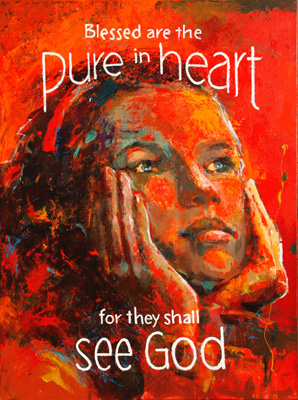
Matthew 5:8 – Blessed Are the Pure in Heart

“Blessed are the pure in heart,
    for they will see God.” (NIV)

“You’re blessed when you get your inside world—your mind and heart—put right. Then you can see God in the outside world.” (MSG)

“What bliss you experience when your heart is pure. For then your eyes will open to see more and more of God.(TPT)

“A pure heart means a single heart, a heart in which only one desire lives: love.”

Peter Kreeft

An Impure Scenario

Suppose a young man courts a young woman. They get to know one another, fall in love, and get married. On their wedding day, as they leave the church building and speed away, the young couple reminisce about love and life.

But when the groom begins to speak about a future together, the bride, with a smile on her face says, “Okay, you can pull over now.” The groom, completely smitten with his new bride, does exactly what she asks. The young woman gets out of the car and, blowing a kiss, says, “This was fun. Maybe I’ll see you around sometime.”

“I don’t think this is funny,” says the groom. “Hey, we had a great time, right!?” the perky bride says. “Yes, responds the groom, “and it will last forever.” “Oh, you are such a darling,” the bride says, and with a wry smile, “but I’ll be in touch.”

“Huh, what!?” the confused groom says. “Yeah, I’ll call. We’ll get together,” says the bride without flinching. The groom, now also feeling heartsick says, “I don’t understand. What’s going on?”

“Dear, I just need my space. It’s not like I don’t care! I have other things to do. Other men to see….”

Yes, a ridiculous and improbable scenario. Yet one which is repeated every day, multiple times a day. For the groom is the Lord God almighty; and the bride is the church….

Purity and God

Purity is a big deal to God. The phrase, “pure in heart,” is Christ’s way of upholding the biblical call to holiness. To be pure is to have no mixed motives, no hidden agendas, and no side job of moonlighting with the world while being an upstanding kingdom citizen during the day. It isn’t letting Jesus court us and marry us, only to have us walk away and do whatever the heck we want. It’s not only impure and unholy. It’s plain wrong and messed up.

Through blessing the pure in heart, Jesus was connecting us to the Old Testament ethic of being holy. The book of Leviticus, rarely the focus of any preacher or parishioner alike, is completely given to the topic of holiness. The detailed laws about daily life, including what to wear and not wear, what to eat and not eat, even who to marry and not marry, were given for a reason.

God wanted the ancient Israelites to have daily reminders that they are a holy people. So, there was to be no mixing of fabrics, no meat and cheese together, no impurities introduced into any part of life. Everything about the Jewish lifestyle was to be holy, set apart to God, reminding the people that God is their husband, committed to them with responsibilities on the part of both. It was called a “covenant.”

Leviticus 19 leaves no stone unturned on the activities of life:

The Lord said to Moses, “Speak to the entire assembly of Israel and say to them: ‘Be holy because I, the Lord your God, am holy’….

Do not steal. Do not lie. Do not deceive one another. Do not swear falsely by my name and so profane the name of your God. I am the Lord. Do not defraud or rob your neighbor….

Do not pervert justice; do not show partiality to the poor or favoritism to the great but judge your neighbor fairly….

Do not go about spreading slander among your people. Do not do anything that endangers your neighbor’s life. I am the Lord. Do not hate a fellow Israelite in your heart. Rebuke your neighbor frankly so you will not share in their guilt. Do not seek revenge or bear a grudge against anyone among your people but love your neighbor as yourself. I am the Lord.

Do not mate different kinds of animals. Do not plant your field with two kinds of seed. Do not wear clothing woven of two kinds of material.” (Leviticus 19:1-2, 11-13, 15-19, NIV)

Yes, indeed, purity is a big deal to God. The “Holy” Spirit is the Divine Person completely devoted to doing only the will of the Father and Son – never going rogue. The Spirit is the One who effects sanctification, becoming holy, within the life of the believer. Each year we celebrate “Holy” Week, a stretch of days designed to be different than the rest – devoted to journeying with Jesus and not mixing with the fickle crowd who would scream at the end of the week, “Crucify him! Crucify him!”

Purity and Us

To follow Jesus in true righteousness is to be pure in heart, that is, set apart wholly and completely for him. Purity of heart is a fruit from the trunk of righteousness, which grew up in the soil of God’s grace, with roots of humility and meekness – all watered by the tears of godly mourning.

The pure in heart are those who acknowledge their sin, deal with it, and live with a clear and clean conscience before God and the world. They have an awareness of their wrongs and shortcomings without succumbing to self-criticism because of an equal awareness of God’s grace. They keep short accounts with others concerning what they have done or what they should have done. They are holy. They are sanctified. They are pure in heart.

The pure in heart will see God. They know they cannot make themselves pure, so they keep looking to Jesus for their forgiveness because they hunger for righteousness.

One cannot whitewash a wishy-washy commitment with Jesus and be pure. This blessed Beatitude has to do with our motives and what takes place in our thinking and in our hearts.  What do you think about when your mind slips into neutral?  Is it coveting after things or people, or does thinking go toward what is true, noble, right, pure, lovely, and admirable?  Sometimes we struggle with purity of heart because we are focused not on Jesus, but on our own performance and perfection instead of letting God fill our hungry hearts.

Purity results from true righteousness.  A stalk of corn might look good, but if you shuck it and it’s filled with worms, it isn’t going to be worth much. Legalistic righteousness and empty promises of doing better are concerned to look good, not to mention they are obsessed with performance, perfection, and possessions. 

But the righteousness of God fills our hungry hearts and makes us pure and holy, set apart for divine use and divine purposes. How, then, shall we live? What will we do?

The earth is the Lord’s, and everything in it,
    the world, and all who live in it;
for he founded it on the seas
    and established it on the waters.

Who may ascend the mountain of the Lord?
    Who may stand in his holy place?
The one who has clean hands and a pure heart,
    who does not trust in an idol
    or swear by a false god.

They will receive blessing from the Lord
    and vindication from God their Savior.
Such is the generation of those who seek him,
    who seek your face, God of Jacob. (Psalm 24:1-6, NIV)

The person with integrity shall see God. Those made pure with the cleansing blood of Jesus Christ will someday stand before God at the Last Judgment and there find mercy and acceptance.

So, for now, until that time, we daily have the opportunity to focus on our one true love with loyalty and commitment, enjoying God’s presence continually. Because the Lord will never leave us, nor forsake us, even when we sometimes forsake him.

Almighty God, to you all hearts are open, all desires known, and from you no secrets are hidden. Cleanse the thoughts of our hearts by the inspiration of your Holy Spirit, that we may perfectly love you, and worthily magnify your holy name, through Christ our Lord. Amen.

John 12:1-11 – Broken and Poured Out

Six days before the Passover, Jesus came to Bethany, where Lazarus lived, whom Jesus had raised from the dead. Here a dinner was given in Jesus’ honor. Martha served, while Lazarus was among those reclining at the table with him. Then Mary took about a pint of pure nard, an expensive perfume; she poured it on Jesus’ feet and wiped his feet with her hair. And the house was filled with the fragrance of the perfume.

But one of his disciples, Judas Iscariot, who was later to betray him, objected, “Why wasn’t this perfume sold and the money given to the poor? It was worth a year’s wages.” He did not say this because he cared about the poor but because he was a thief; as keeper of the money bag, he used to help himself to what was put into it.

“Leave her alone,” Jesus replied. “It was intended that she should save this perfume for the day of my burial. You will always have the poor among you, but you will not always have me.”

Meanwhile a large crowd of Jews found out that Jesus was there and came, not only because of him but also to see Lazarus, whom he had raised from the dead. So, the chief priests made plans to kill Lazarus as well, for on account of him many of the Jews were going over to Jesus and believing in him. (NIV)

Jack Klugman as Quincy, M.E. (1976-1983)

When I was a kid there was a show on TV called “Quincy.” Quincy was a coroner. Every episode was him performing an autopsy on someone who appeared to have a rather normal death. But Quincy always found something suspicious and spent his time prying into people’s lives to confirm his investigation. His boss and the police chief would chide and warn him saying, “Leave it alone, Quincy.” Quincy’s typical response was: “But I can’t leave it alone. There’s more here than what meets the eye!”

Indeed, the Apostle John was the Quincy of his ancient generation. In his gospel there is always more going on than what meets the eye. There are double-meanings, sometimes even triple-meanings to the events unfolding.  There are deeply symbolic encounters, as well as tangible events serving as almost metaphors pointing to the spiritual.

Mary, a woman with a sordid background, had her life transformed through meeting Jesus.

Near the end of Christ’s life, as he was about to enter Jerusalem and be arrested, tried, tortured, and killed, Mary sensed what was happening. In fact, she was aware of what was happening when others did not. Mary’s own brokenness cracked open to her the true reality of life.

The surface event itself is a touching and tender moment in history. This woman, whom everyone knew as a damaged person, took a high-end perfume, and broke the entire thing open. She then proceeded to anoint Christ’s feet with it. You can imagine the aroma filling the house with an expensive perfume for all to smell.  Giving what she had to Jesus, Mary demonstrated the path of true discipleship.

But there’s more here than what meets the eye. Let’s observe some of John’s expert autopsy work:

  • The broken jar of perfume shows us the brokenness of Mary and our need to be broken. (Matthew 5:3-4)
  • Mary used an extraordinary amount of perfume, picturing her overflowing love for Jesus. (John 20:1-18)
  • Mary applied the perfume to Jesus with her hair; hair is culturally symbolic for submission and respect. (1 Corinthians 11:14)
  • The perfume directs us to the death of Jesus. (John 19:38-42)
  • The perfume highlights for us the aroma of Christ to the world. (2 Corinthians 2:15-17)
  • There is more to Judas than his words about perfume; he is not actually concerned for the poor. (Matthew 26:15)
  • Judas and Mary serve as spiritual contrasts: Mary opens herself to the sweet aroma of Christ; Judas just plain stinks.
  • The perfume presents a powerful picture of the upcoming death of Christ, for those with eyes to see; he was broken and poured out for our salvation. (Luke 23:26-27:12)

Christianity was never meant to be a surface religion which merely runs skin deep. The follower of Christ is meant for deep personal transformation, inside and out, so that there is genuine healing, spiritual health, and authentic concern for the poor and needy. 

Keeping up appearances is what the Judas’s of this world do. But the Mary’s among us dramatically point others to Jesus with their tears, humility, openness, and love.

In our social landscape of fragmented human ecology, our first step toward wholeness and integrity begins with a posture of giving everything we have – body, soul, and spirit – to the Lord Jesus. Methinks Quincy was on to something.

Loving Lord Jesus, my Savior, and my friend, you have gone before us and pioneered deliverance from an empty way of life and into a life of grace and gratitude. May I and all your followers emulate the path of Mary and realize the true freedom which comes from emptying oneself out for you. Amen.

Exodus 23:10-13 – The Primacy of Rest

“Sow your land for six years and gather in its crops, but in the seventh year leave it alone and give it a rest so that your poor may eat from it. What they leave, let the wildlife have. Do the same with your vineyards and olive groves.

“Work for six days and rest the seventh so your ox and donkey may rest, and your servant and migrant workers may have time to get their needed rest.

“Listen carefully to everything I tell you. Don’t pay attention to other gods—don’t so much as mention their names. (MSG)

One reason poverty exists and seems to continue unabated, is that it is inextricably tied to rest. Perhaps that seems counter-intuitive. However, it is not. Where work is exalted to such a degree that rest creates feelings of guilt, there you will find an entire class of poor folk who labor tirelessly without making ends meet. Those with power and wealth who eschew and denigrate rest are typically the ones who take advantage of the less fortunate and stereotype them as lazy.

Scriptural rest is not a luxury. An honest biblical sabbath rest is a vital necessity. It is important enough that God lovingly encouraged it and divinely commanded a day of rest to happen for everyone each week and a year of rest every seven, including both creature and creation. There were to be no exceptions.

Perhaps the best way to illustrate what God was thinking when he ordained his people for intentional times of rest comes from my time in a prayer chapel.  One morning I set aside a four-hour block to “rest,” get away, and pray.  I will be honest that I marched into it with a personal agenda of what I wanted God to do.  I had my list of prayer items and my thoughts of how I believed God should work. I was ready for anything but rest. I came to wrestle. Silly me.

It did not take long into my forceful striving at God to see I was on a misguided adventure in missing the point. In my desire to see prayer requests answered, I lost sight of why I was there: To simply be in presence of God and enjoy Jesus – without all the laborious work, as if simple rest and enjoyment were not enough. 

In our daily work-a-day world we poke and prod, push, cajole, and finagle to move forward and get our way on all kinds of things. To separate ourselves from our typical routine takes something of a withdrawal, and it is downright hard. Maybe that’s why many individuals are so tired, cranky, and negative all the time – we find all kinds of reasons not to rest, and even when we do, we’re still trying to impose our will on God. Silly us.

We simply need Jesus – to know Christ, be with him, and experience the depths of our wondrous and gracious union with him. And that will be difficult, unless we obey the command given by God to rest.  To rest means to relinquish our plans and agendas, just for a time, and come into God’s presence and enjoy each other’s company.

Our compulsions for performance and perfection are culprits to rest. We want to do everything right. We long to pray right, talk right, be right and live right – instead of simply coming to Jesus like a little child. Perhaps we are so profoundly dissatisfied with so many things because we are discontent with Christ. Just maybe the best or right prayer to pray is that we all may be content together no matter the circumstances. Only then might we find that our burdens are light and our life easy.

Jesus modeled the life of rest for us. If there was anyone who did not need to pull away and rest it was Jesus, and yet he continually did so. If Jesus needed a sacred space and place to commune and enjoy the Father, then how much more do we need a solid sabbath rest and a place to do it? Jesus rested and prayed to connect with his heavenly Father. There was no multi-tasking, keeping abreast of social media, or juggling other responsibilities.  There was merely the pursuit of intimate rest.

If we fail to rest and avoid sabbath, then we are expressing our confidence that money, hard work, and individual talent are really all we need rather than God. Rest is only secondarily about refueling our depleted resources; it is primarily about connecting intimately with the divine and becoming aware of our true thoughts and feelings. 

Just as we need a special room and a certain bed for sleep, so we need a consistent place and time to enjoy God.  Proper spiritual hygiene, just like proper sleep and health hygiene, includes setting aside a place to daily rest, pray, and be with God.

Real spiritual and biblical rest only “works” when we realize we are imperfect – that we are helpless and need Jesus. Apart from the rise Christ, the blind cannot see, Lazarus remains dead, and I am lost in my sin. I cannot “do” life without Christ in me and with me.

Maybe this old world is not experiencing grace and peace because God’s people have not yet learned the necessity of rest. If we try and manufacture results instead of relying on the Lord for refreshment and renewal, the good things of life will be elusive. 

Enjoy Jesus today, my friends, tap into the Holy Spirit, and allow your rest to spur you to love and good deeds for the poor and underprivileged of this world.

Glory to God in the highest, and on earth peace to people of goodwill. Amen.