Be Patient – Third Sunday of Advent (James 5:7-10)

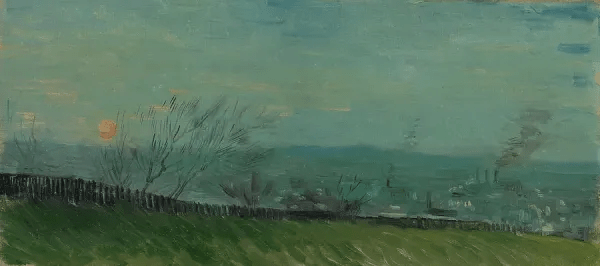
Sunset in Montmartre, by Vincent Van Gogh, 1887

Be patient, therefore, brothers and sisters, until the coming of the Lord.

The farmer waits for the precious crop from the earth, being patient with it until it receives the early and the late rains. You also must be patient.

Strengthen your hearts, for the coming of the Lord is near.

Brothers and sisters, do not grumble against one another, so that you may not be judged. See, the Judge is standing at the doors! 

As an example of suffering and patience, brothers and sisters, take the prophets who spoke in the name of the Lord. (New Revised Standard Version)

Patience is a wonderful virtue… unless you’re smack in the middle of circumstances you neither want nor asked for. Then, patience feels a whole lot more like a vice.

It’s easy to be impatient; it takes little to no effort at all. And praying for patience doesn’t help, because you’re prayer actually gets answered; God puts you in one of those unwanted situations.

The Jewish Christians for whom the Epistle of James was addressed were in that weird life-place of enduring hard circumstances. They were struggling with impatience, so much that the believers began cozying up to the rich and powerful to meet their ever-increasing needs. In their misery, they were looking to the very people who were using them and withholding wages from them. (James 2:1-7; 5:1-6)

It seemed as if God was shuffling his divine feet and not getting around to helping the Christians in their difficulty. They gave everything to Jesus and following him, to the point of being willing to suffer for the Name.

Their suffering led to outright persecution. The believers had to flee Judea for Gentile lands to the West (Acts 8:1-3). In their new homes they got double-trouble. Because they were Jews, they were looked at with suspicion. And because they were Christians, the Jewish community didn’t accept them. The believers were truly alone. All they had was Jesus.

It was enough, at least for a while. But it’s one thing to face difficulty, and quite another thing for the trouble to bleed into next week, next month, next year… When is this ever going to end?

Impatience doesn’t help. In fact, it only exacerbates an already agonizing situation. Grumbling and arguing and verbal fights begin to occur. The community starts to fracture. Blaming and shaming slowly replace the love and encouragement they once had together.

Every good thing in life takes time – lots of time! And the best things in life require a lifetime of endurance, perseverance, and patience. In order to keep going and hold onto our spiritual commitment, we need solid examples of patience, and reasonable ways to think about our situations.

I admit that it has been hard for me to be patient, as of late. I’m weary of American politics and the current administration. I’m tired of seeing my family members struggle with health issues day after day – many of them having to endure debilitating and heart-wrenching trials.

And there are some days when I’ve just had it with my own limitations. I can’t do many of the things I used to do, and it’s frustrating to tears to try and do some things that others do effortlessly.

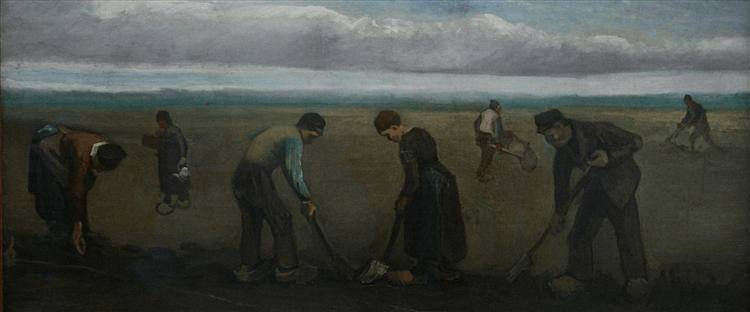
Yet the Scripture reminds me of my days growing up on the farm. Planting and harvesting never happened in a week; it takes months to realize a return on all the hard work done through the Spring and Summer to get to Fall’s mature crop.

Peasants Planting Potatoes, by Vincent Van Gogh, 1884

I’m also reminded of the biblical prophets who suffered much for their message to the people. Lately, I’ve been reading the prophecy of Ezekiel in the Old Testament. If you have never read Ezekiel, or only read bits of it, you may not realize how incredibly difficult Ezekiel’s life was in serving Yahweh.

The prophet kept up a steady stream of very challenging situations to illustrate the message of judgment he was continually giving. Needless to say, Ezekiel was not always a popular guy. Proclaiming gloom, doom, and death all day every day tends to do that. In one encounter, for month after month, the prophet laid on his side and had to use excrement to light a fire and cook his food every day. God told him to, so that the people would see what was about to happen to them. (Ezekiel 4:1-17)

We have no record of Ezekiel grumbling or talking back to God. He faithfully did all that the Lord commanded him to say and do. He endured all the grumblers around him, and all the grieving people who had been displaced from their homes in Jerusalem.

In every generation, there are people in this world that undergo difficulties and troubles which others could never even imagine. And it’s been going on for millennia. Furthermore, terrible adversity will keep happening… until Christ returns.

Yes, there will be an end to all the suffering. But we may have to persevere to the end of our lives, remaining faithful to our spiritual commitment, and keeping up our love for one another. It won’t be easy to do.

I would be nothing but a hack preacher if I told you that everything will be bunnies and butterflies if you only look to Jesus and have faith. Although there can be joy, even in our mourning, there will always be the need for an agonizing form of patience that continually watches for help, healing, and hope in the return of Christ.

This is why it is so important not to let your own family, church, and faith community break down into fissures of impatience and grumbling.

We must keep our hearts strong. Ironically and paradoxically, that happens through our weakness.

In some ways, I’m weaker than I’ve ever been in my life. Yet, in other ways, I’ve never been stronger. The Trump administration can break me down and mess with my healthcare and my finances… my illness can keep me from ministry that I long to do… and the daily crud of life may redirect me in ways I don’t like… but I can truly say that God is good; God is the strength of my life.

I know that Christmas is coming. I’m looking for the birth of the Savior. I expect to see the angels rejoicing in the sky. I fully look forward to stepping in a few cow pies and horse apples in order to get a glimpse at the baby who changes the world.

Every good thing in life comes with a bit of manure on the shoes. And the best things in life are worth all the hardship one goes through in order to see the glory and majesty of the Divine.

I may not know you, my friend, but please know that I am praying for you. No matter what happens, I can always pray, always watch, always hope, always believe, and always love my neighbor, despite all the hate in this old fallen world.

Be safe. Be strong. Be spiritual. We are all in this life together.

God of joy and exultation, you strengthen what is weak; you enrich the poor and give hope to those who live in fear. Look upon our needs this day. Make us grateful for the good news of salvation and keep us faithful in your service until the coming of our Lord Jesus Christ, who lives forever and ever. Amen.

Waiting with Hope (Romans 8:22-25)

Art depicting cracked earth, a dry riverbed, white plastic shapes, a lack of life and the red glow of fire. The figures are separated, lacking any real connection. By artist Chris De Hoog

For we know that all creation has been groaning as in the pains of childbirth right up to the present time. And we believers also groan, even though we have the Holy Spirit within us as a foretaste of future glory, for we long for our bodies to be released from sin and suffering.

We, too, wait with eager hope for the day when God will give us our full rights as his adopted children, including the new bodies he has promised us. We were given this hope when we were saved. (If we already have something, we don’t need to hope for it. But if we look forward to something we don’t yet have, we must wait patiently and confidently.) (New Living Translation)

Salvation is not only personal; it’s also cosmic.

That is, freedom from the power of sin, death, and hell is not only for an individual person, but this deliverance is for all of creation, for the entire earth.

So then, all of creation – not just people – long for and groan for the advent of Christ. My oak tree in the backyard longs for it. My dog whines for it. When it rains, the sky is wondering how long it will have to keep up its tears.

Together with the entire cosmos, we look forward to the complete fulfillment of our inheritance as God’s creation, as God’s creatures.

Since that is true, it is Christians who need to see the privilege and responsibility of conducting ourselves with unity, harmony, and non-violence. We are to live this way because we are foreshadowing the end of the world’s story.

There is a day coming when there will be no more malevolent and selfish posturing for power and control. No more oppression and victimization. No more injustice.

And we have the chance to begin living that way now, and not only in a future time. We get to do this because of Christ.

But that doesn’t mean we don’t suffer anymore. Presently, along with all creation, we have pain like that of a woman in childbirth. This is no papercut inconvenient pain; this is “I hurt like hell” pain. That sort of pain has us awaiting the redemption of our bodies.

I work as a hospital chaplain. Every day, I see suffering, some of it unimaginable. I listen to stories of people longing for healing, and grasping at hope. And I hear plenty of groaning (both the actual physical groans, as well as the more quiet internal sighs and groans).

I say to you: The human body is not meant to be destroyed. Our physical selves are not destined for elimination. No, our bodies are meant to be redeemed; they are meant for salvation. It will not always be this way!

So, we hope.

The Christian has the confident expectation that not only is the soul redeemed, but the body, as well. We can enjoy spiritual salvation now. But we must wait for the physical deliverance. There must be patience on our part until Resurrection Day.

The Apostle Paul was calling on believers to hope. Five times he said it in only two verses. Paul was emphasizing the need for spiritual endurance because we have not yet arrived.

In case you haven’t noticed, we aren’t in heaven; this isn’t a renewed earth; people around the globe are not all presently singing kumbaya together.

Therefore, it is imperative that we live with the tension between the “now” and the “not yet.” It’s a weird existence, this Christian life. But, in reality, we exist in the paradox of being saved now, and not yet being saved.

Another way of putting this is that God’s adopted children have not yet received their inheritance.

But that doesn’t mean we’ve been left to ourselves. We have the first fruits of our salvation: the Holy Spirit.

We presently, right now, enjoy a real and significant portion of God’s freedom and deliverance. We have God’s gift of presence. There is the continuing presence of Jesus Christ with us, the blessed Holy Spirit.

And this divine presence is what today helps us to endure and hold onto hope. By holding this future hope, we learn to accept, cope, and transcend our circumstances through love.

Therefore, since we have been made right in God’s sight by faith, we have peace with God because of what Jesus Christ our Lord has done for us. Because of our faith, Christ has brought us into this place of undeserved privilege where we now stand, and we confidently and joyfully look forward to sharing God’s glory.

We can rejoice, too, when we run into problems and trials, for we know that they help us develop endurance. And endurance develops strength of character, and character strengthens our confident hope of salvation. And this hope will not lead to disappointment. For we know how dearly God loves us, because he has given us the Holy Spirit to fill our hearts with his love. (Romans 5:1-5, NLT)

The very suffering which we so often try to avoid and get out of, becomes the means of connecting us with Christ and with others.

The problem becomes the answer.

The Spirit groans with our own spirit, and we all become connected together.

I point out, however, that not everyone wants this sort of connection. There are many people who want nothing to do with solidarity.

Some folks want to remain in their own little huddle or small world; and they take offense at anyone outside of their group who seeks to understand and connect with that group’s suffering.

Although everyone’s pain and suffering is unique – and no one can fully know another’s sorrow – that does not mean solidarity and connection are impossible, or undesirable.

I don’t need to have cancer in order to connect with a cancer patient. I don’t have to become victimized to show genuine empathy and extend competent comfort. Yet, sadly, some persons only want connection and consolation from a certain person or group.

But I say to that: Who are you to tell God whom God can love you through?

To suffer is one thing, because we all must suffer in some way. But to compound your suffering by your own volition is another thing altogether.

You deserve better than harming yourself through cutting off help.

It could be that today is the day you reach out to that person you know will be there for you. Or, perhaps now is the time to quite putting off making space for prayer and reflection.

Whatever it is that you need to do, it’s okay to do it, without putting it off until tomorrow.

Lord Jesus Christ, by your patience in suffering you hallowed earthly pain and gave us the example of obedience to your Father’s will: Be near me in my time of weakness and pain; and sustain me by your grace, so that my strength and courage may not fail. Heal me according to you will; and help me always to believe that whatever happens to me here is of little account if you hold me in eternal life. Amen.

The Real Thing (Hebrews 9:24-28)

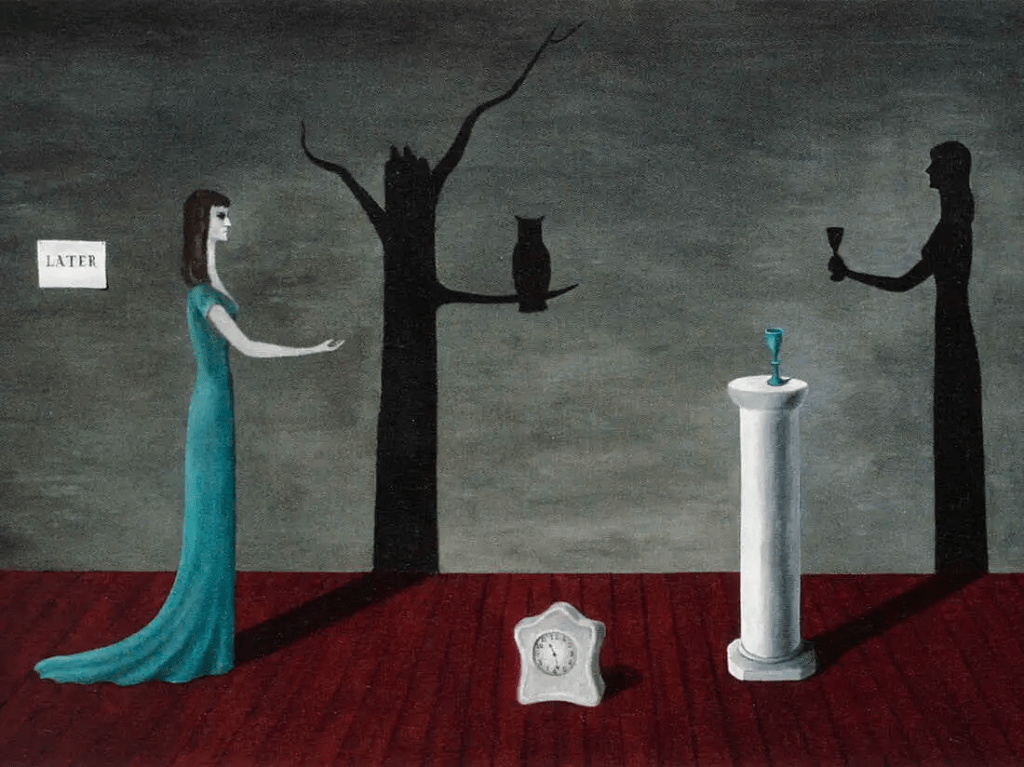
Strange Shadows (Shadows and Substance), by Gertrude Abercrombie, 1950

For Christ did not enter a sanctuary made by human hands, a mere copy of the true one, but he entered into heaven itself, now to appear in the presence of God on our behalf. 

Nor was it to offer himself again and again, as the high priest enters the holy place year after year with blood that is not his own, for then he would have had to suffer again and again since the foundation of the world.

But as it is, he has appeared once for all at the end of the ages to remove sin by the sacrifice of himself. And just as it is appointed for mortals to die once and after that the judgment, so Christ, having been offered once to bear the sins of many, will appear a second time, not to deal with sin but to save those who are eagerly waiting for him. (New Revised Standard Version)

I admit that the Book of Hebrews in the New Testament is one of my favorite books of the Bible. I also recognize that Hebrews is one of the most difficult books to deal with. And specifically, chapter 9 can be quite mind-boggling.

The author of Hebrews, whoever he was actually was, did the intellectually and theologically staggering job of establishing continuity between the two testaments of the Bible.

He compared and contrasted the old (or first) covenant with the new (or second) covenant, examining the Levitical priesthood and its sacrificial system, with Christ as the high priest whose singular sacrifice ended all sacrifices.

The old sacrificial system began on Mount Sinai. Moses sprinkled the sacrificial blood of bulls and goats on both the people and the tabernacle. He was consecrating them, and the sacrificial implements, so that everyone could participate in the worship of Yahweh.

In the new covenantal system, blood is also used to purify. Yet, the heavenly tabernacle could not be cleansed with the blood of animals. It required a better and superior sacrifice. (Hebrews 9:23)

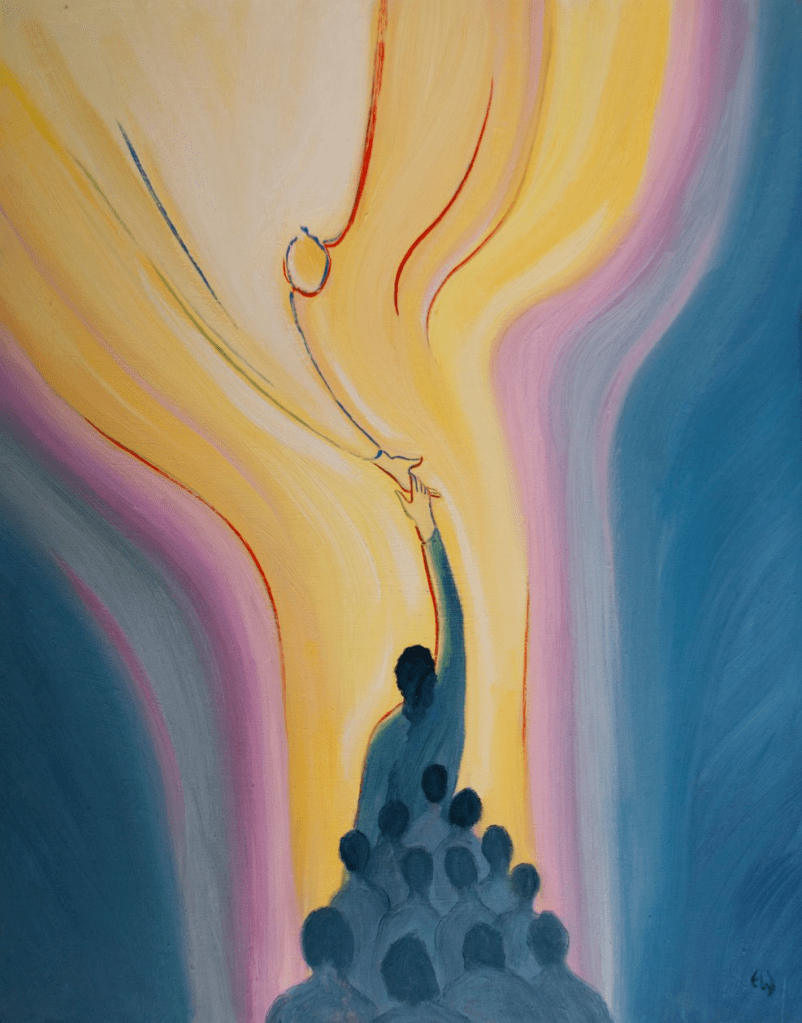
The Sacrifice of Christ, by Elizabeth Wang, 2002

That sacrifice is Jesus. He was both the high priest officiating the ritual, and the actual sacrificial offering. It is the life of Jesus, given in self-sacrificial death, which enables worshipers to come to God without any obstruction whatsoever.

Jesus does not have to keep offering himself. It was a one and done affair. One sacrifice on behalf of everyone. Once for all.

This is, of course, a distinctively Christian view and approach to the problem of guilt, shame, disobedience, and death. It has been a very compelling view for millions of people over the past two millennia.

In whatever way one seeks to understand and make sense of the author’s line of reasoning concerning a Christian approach to sacrifice and dealing with sin, what is apparent to me is that the author talked of a reality that we do not presently see.

The author of Hebrews was lifting up something important that he wanted us to notice. He was pointing out the reality of spiritual forces that have the power to both destroy and give life.

The earthly objects that we can see, touch, feel, hear, and smell are mere representations or shadows of heavenly things.

Many people, if not most people, today would say that invisible things such as our ideas and philosophies of religion are mere mental ways of understanding the objective reality in front of us that we can use our five senses to detect.

But the author of Hebrews insists – and I believe rightly so – that it’s the other way around. Everything we are presently experiencing with our objective senses is a projection of the ultimate invisible reality.

In other words, this entire world will pass away, because it is but a shadow in the history of eternity. The invisible God is the real deal. The heavenly sanctuary is reality. Love is the permanent operating system of eternity, and not your 401(k) or the next political election.

Jesus the Christ has offered himself once for all time, and for all sins. And he did it because the triune God – Father, Son, and Spirit – is a community of unitive love. That is, God is Love. So therefore, God can only do that which is love.

The end of time is not yet here. This present world with all of its inconsistent ways of doing both good and bad is still with us. But Jesus will come again.

The sin issue has been dealt with, once and for all. Christ did that. Jesus will return in order to bring salvation to those who are waiting for him.

If we must wait, let us do it patiently, with all of the faith and endurance it requires. Yet, this is not a passive waiting. We are to be busy proclaiming the good news of God’s invisible realm with both words and sacraments – with the signs and shadows and representations we have that point to the reality of God.

Everything visible and tangible on this earth is mirroring a greater, better, and superior reality which we cannot see with our eyes or touch with our hands.

Christianity is unabashed that all things point to Christ, who is the first and the last, the alpha and omega, the be all and end all of everything.

Come, Lord Jesus, Son of God, Son of Humanity. We long for you to return in glory and set us and this entire sinful world aright with your divine justice.

Be our guest, Lord Jesus, our Savior and Friend. We receive in faith your salvation. We trust that both the physical food and spiritual food you give will sustain us for our work and worship in this world.

May it be so, to the glory of God, and through the enablement of the Holy Spirit. You are one God – Father, Son, and Spirit – in one holy community of Love, now and forevermore. Amen.

What Are You Searching For? (1 Samuel 9:15-27)

Now the day before Saul came, the Lord had revealed to Samuel: “Tomorrow about this time I will send to you a man from the land of Benjamin, and you shall anoint him to be ruler over my people Israel. He shall save my people from the hand of the Philistines, for I have seen the suffering of my people, because their outcry has come to me.” 

When Samuel saw Saul, the Lord told him, “Here is the man of whom I spoke to you. He it is who shall rule over my people.” Then Saul approached Samuel inside the gate and said, “Tell me, please, where is the house of the seer?” 

Samuel answered Saul, “I am the seer; go up before me to the shrine, for today you shall eat with me, and in the morning I will let you go and will tell you all that is on your mind. As for your donkeys that were lost three days ago, give no further thought to them, for they have been found. And on whom is all Israel’s desire fixed, if not on you and on all your ancestral house?” 

Saul answered, “I am only a Benjaminite, from the least of the tribes of Israel, and my family is the humblest of all the families of the tribe of Benjamin. Why then have you spoken to me in this way?”

Then Samuel took Saul and the young man and brought them into the hall and gave them a place at the head of those who had been invited, of whom there were about thirty. And Samuel said to the cook, “Bring the portion I gave you, the one I asked you to put aside.” The cook took up the upper thigh and set it before Saul. Samuel said, “See, what was reserved is set before you. Eat, for it was kept for you for this appointed time, so that you might eat with the guests.”

So Saul ate with Samuel that day. When they came down from the shrine into the town, a bed was spread for Saul on the roof, and he lay down to sleep. Then at the break of dawn Samuel called to Saul upon the roof, “Get up, so that I may send you on your way.” Saul got up, and both he and Samuel went out into the street.

As they were going down to the outskirts of the town, Samuel said to Saul, “Tell the young man to go on before us, and when he has passed on, stop here yourself for a while, that I may make known to you the word of God.” (New Revised Standard Version)

There are many times in our lives when we are on a quest for something that is lost. Saul was on a mission to find some lost donkeys. But, all along, there was a much larger quest taking place; God was on a quest to find a leader for Israel. Saul was wandering and looking for donkeys; he tried to find the “seer” (Samuel) in order to find the animals. He found, however, that he himself was the object of a bigger search.

I wonder how often we look and seek and turn over every rock in order to find something, only to discover that we had the thing all along. And if we were to look a bit deeper into ourselves, I believe we would find that we already have what we need.

We search for an answer, seek for a person who can lead us where we want to be, or go on a quest to find the something, or that someone, which will satisfy our longing for peace, normalcy, or at least, a smidge of relief. Yet, we just might be on the wrong search.

If spiritual guidance is what we want, then what, precisely, do we need? What exactly is it which requires help? We may end up looking like a jack ass, simply because we are searching for one.

In contrast to Saul’s blind searching, Samuel sits patiently and waits, knowing exactly who he’s watching for.

Even though Samuel, as the mouthpiece of God, had warned the people against asking for king, the people still demanded one. Yet, God was flexible and moved with the will of the people. And Samuel trusted the Lord and moved with God. None of this, however, negated the situation of the people’s misguided stubbornness.

The Lord takes our human decision-making, responsibility, and accountability seriously. So, we too, are to weigh our decisions carefully so that they are consistent with good purposes. And when things go sideways, we are to own up to our decisions and actions (or inactions).

Throughout the story, even though Saul looks impressive, he is continually clueless to everything going on. He isn’t aware that the donkeys have been found. He doesn’t know where to look for the seer, and that the seer is Samuel. He isn’t aware of why he is being invited to a feast. Saul was clueless that he was being chosen for a task.

To be unaware is to be driven by the forces within us which we do not recognize. Yet, conversely, to be aware is to have the conscious power of choices; we can choose one path over another because we have awareness of where those paths lead, as well as what is going on inside of us. In other words, we can make decisions wisely with awareness of self, others, and the world.

Saul had none of this awareness. And as his story unfolds throughout the rest of the book of 1 Samuel, we can observe how much he seems out of control and disconnected from himself, others, and the situations around him.

One of things which inevitably results from a lack of self-awareness, is impatience. The life of Saul, as we shall see, is marked by having ants-in-his-pants; he had a hard time waiting. The introduction we have of Saul in today’s story begins to clue us in on the fact that he actively searches for dumb animals, intimating that he himself may not be the brightest bulb in Israel.

Samuel, however, is self-aware, and thus, patient. He is able to wait, and does not give into any anxiety to do differently. Samuel’s quest for humility, wisdom, and knowledge of God helped him become aware and confident.

Which character do you most relate to, Samuel, or Saul? Why? In what ways might you gain a greater awareness of yourself, others in your life, and your circumstances? How might you develop a better awareness of the divine?

Most of all, what is it that you are truly searching for?

Blessed God, help me to see myself and my life through your unconditional love and acceptance of me so that your love and power can flow in and through me. Help me to remember that nothing can separate me from your love. Amen.