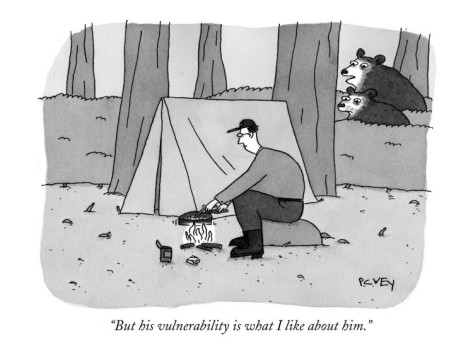
Vulnerability


            Most people aren’t crazy about the word “vulnerable.”  We might like to see it in others, but have no intention of being vulnerable ourselves to anyone.  If you have ever poured out your heart to someone or a group of people and only got blank stares in return; if you sincerely loved someone and they did not love you back; if you have ever shared your genuine thoughts on something important to you and received only criticism; then, we may think that being vulnerable is a bad thing and not worth the emotional effort.
 
            Yet, vulnerability is an important, even vital practice for Christians.  In the Gospel of John, Mary displayed vulnerability in pouring expensive perfume on Jesus’ feet and wiping them with her hair, all the while exposing her true feelings for her Lord.  In return Mary got pushback and criticism from Judas.  But Jesus upheld Mary’s actions and told Judas to leave her alone.  Mary was clearly not concerned with how she might appear to others, but was completely focused on Jesus (John 12:1-8).
 
            When we go to the book of Psalms, even a cursory reading reveals a psalmist who is not afraid to explore the depth of human emotion, misery, joy, and praise of God.  It would be weird to think of King David as a man who was self-conscious about what others thought about him.  Instead, we get a wealth of vulnerable statements:  “All my longings lie open before you, O Lord; my sighing is not hidden from you” (Psalm 38:9); “As the deer pants for streams of water, so my soul pants for you, O God.  My soul thirsts for God, for the living God.  When can I go and meet with God?  My tears have been my food day and night, while men say to me all day long, ‘Where is your God?’” (Psalm 42:1-3).  One does not get more real, raw, and vulnerable than this:  “My heart is in anguish within me; the terrors of death assail me.  Fear and trembling have beset me; horror has overwhelmed me.  I said, ‘Oh, that I had the wings of a dove! I would fly away and be at rest” (Psalm 55:4-6); “I am worn out calling for help; my throat is parched.  My eyes fail, looking for my God” (Psalm 69:3).
 
            This is all a far cry from many contemporary Christians who feel the need to wear plastic smiles and insist everything is “fine.”  Maybe we need the person who will stand up and say they are finally learning patience by being among a group of really annoying co-workers.  Perhaps instead of laboring so hard to keep a check on ourselves, church will become a place that lends itself to a person bawling their eyes out with a whole cadre of others who will just sit and cry with them.
 
            But this kind of vulnerability will not happen unless we are first real with God, who is never fooled by our deceitful hearts.  Our evil-radar might be carefully attuned to others’ sin, but we are woefully inept at identifying the blackness within ourselves.  This is what makes places like the Psalms such counter-cultural texts; the psalmist sees his sin in stark relief to the holiness of God, and it absolutely slays him to know that his sin has offended God (Psalm 51).


            What is so amazing about all this is that God himself became completely exposed, naked, abandoned, alone and vulnerable on a cruel cross.  Yet, instead of being shamed by the whole thing, Jesus scorned the shaming power of his crucifixion and embraced the suffering as the means of victory for our salvation.  Vulnerability might seem ugly, but it turns whatever it touches into beauty.  God can change our weakest, worst, and most shameful places into incredible strength and newfound love.
 
            Therefore, any ministry worth its Christian salt will not forsake the broken and despised, the struggling and the lost.  Whenever we are too afraid to walk into the mud of people’s lives, including our own, and are enamored instead with every spiritually shiny thing that comes along, we have lost sight of our Lord whom we are to imitate in his vulnerability.  When Christian leaders pretend like they have all the answers and know what always should be done, they have lost touch with the Scriptures and need to take a Sabbath hiatus to read the entirety of the Psalms and connect with God.


            So, where do you go from here?  Stop running long enough to listen well, read carefully, rest liberally, and feel passionately with emotions both good and bad.  Just maybe you will find solidarity with Mary of old and “waste” your resources on simply being with Jesus.

2 Chronicles 29:1-19

             Hezekiah was a faithful king, coming from a long line of faithless ones.  After becoming king, his first act of business was to thoroughly cleanse the temple.  Since the kings before him did not treat the temple as sacred, they defiled it by introducing practices of other gods and by sheer neglect of the holy implements.  Hezekiah assembled an impressive team of men to set about the task of getting the temple to the place where it could again be used as it ought.  The team of Levites meticulously took their time and worked diligently to consecrate the house of the LORD, and tossed everything unholy into the brook Kidron.
             Perhaps there is no better passage of Scripture than this to embody what the season of Lent is really all about.  We are to do the holy work of carefully consecrating our hearts so that our lives are prepared and ready for the new life of Easter.  It is hard and courageous work.  Just as Hezekiah had the bravery to uphold the temple’s true purpose through cleansing it, so we are to have the courage to enter the shadowy places of our hearts and bring out the sin within.  It is not a pretty process, but a necessary one.
             One of the greatest needs that believers have today is the courage to be vulnerable, to expose and bring into the light our besetting sins so that they can be tossed into the brook and be carried away.  Instead of spending inordinate amounts of energy and time trying to hide our true selves, it is much better to let the example of Hezekiah clear a path forward by confronting the darkness within.
             Holy God, my life is a temple of your Holy Spirit.  I invite you to come in and do the sort of cleansing work that needs to be done so that my words and actions are thoroughly consecrated to you.  Help me to have the courage to go to the places within that scare me.  In the name of Jesus I pray.  Amen.

Shame


            There is a vulnerability crisis in the church today.  What I mean is that far too many Christians keep up appearances and keep their human interactions on the surface level.  Simple exhortations to not be that way will do no good because at the root of the behavior is shame.  If we want to have healthy behaviors in the church, Christians will need to have their identities fully based upon the person and work of Jesus Christ.
 
            Shame is a mindset, not a behavior.  It is the notion that something is wrong with your personhood.  It is to believe that somehow you are deficient, defective, or worthless as a person.  It is to not have the ability to distinguish between what I do and who I am.  When we live with a sense of shame (either knowingly or subconsciously) we are setting ourselves up to practice idolatry.  If we really think there is something wrong with our very humanity, we will seek something to base our value and acceptance upon.  This is why the workaholic cannot stop working, because he believes that by much effort, hard work, and productivity it will make up for the deficiencies in his life.  Others will then accept him.  Indeed, he will accept himself.  This is also why so few people take Sabbath breaks or take advantage of a day off or even all their vacation time.  After all, they feel too guilty if they are idle.
 
            People who live with a sense of shame do not realize that they have the right to set personal boundaries.  If you have a terrible time of saying “no” to people, then it is a good bet that there is some level of shame working underneath the surface.  It just seems selfish to such people to refuse a request.  Living with shame is awful because one feels as though she is simply not good enough as a person compared to others.  The over-responsible, over-achieving, over-functioning person is compulsive about doing things perfectly well so as to avoid feeling ashamed of poor performance.  Conversely, others avoid responsibility, under-achieve, and under-function in the belief that if they were to do the job they will surely fail – so best to not do it at all.
 
            The real problem with all this is that it is a performance-based life.  And, so, it is crippling.  Always wondering if you measure up is a depressing way to live.  Unfortunately, there are far too many performance-based churches out there which shame people for struggling, asking honest questions, not complying with man-made rules, and not being like everyone else.  If I have not made it clear enough yet, trying harder does nothing to break the cycle of shame.  Satan has enough of the world on a self-improvement path; let’s put ourselves on God’s path to freedom.
 
            If we confess our sins, God is faithful and just to forgive us our sins and cleanse us from all unrighteousness (1 John 1:9).  Confess your sins to one another and pray for one another so that you may be healed (James 5:16).  Jesus has taken our shame away because he faced it down and achieved the victory for us that we could not achieve ourselves.  Let us fix our eyes on Jesus, the author and perfecter of our faith, who for the joy set before him endured the cross, scorning its shame, and sat down at the right hand of the throne of God (Hebrews 12:2).  The cross may have been a humiliating experience, but Jesus did not let that stop him from bringing us salvation from sin and shame.


            We do not need to wear our hearts on our sleeves in order to become more vulnerable with one another.  Struggles with life do not mean we are defective – it just means we are real people.  Unless we come to grips with scorning shame, we will live stunted Christian lives in plastic Christian churches.  Only through embracing the truth about ourselves, and accepting Christ’s sacrifice on our part, will we experience genuine spiritual and emotional freedom.  There is no need to live in the isolation of shame.  Our identity is in Jesus.