
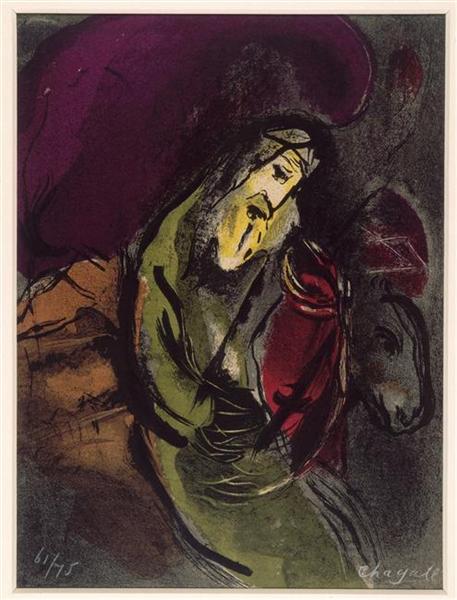
Loneliness and Silence (Jeremiah 20:7-13)

The Prophet Jeremiah, by Marc Chagall, 1956

O Lord, you misled me,
    and I allowed myself to be misled.
You are stronger than I am,
    and you overpowered me.
Now I am mocked every day;
    everyone laughs at me.
When I speak, the words burst out.
    “Violence and destruction!” I shout.
So these messages from the Lord
    have made me a household joke.
But if I say I’ll never mention the Lord
    or speak in his name,
his word burns in my heart like a fire.
    It’s like a fire in my bones!
I am worn out trying to hold it in!
    I can’t do it!
I have heard the many rumors about me.
    They call me “The Man Who Lives in Terror.”
They threaten, “If you say anything, we will report it.”
    Even my old friends are watching me,
    waiting for a fatal slip.
“He will trap himself,” they say,
    “and then we will get our revenge on him.”

But the Lord stands beside me like a great warrior.
    Before him my persecutors will stumble.
    They cannot defeat me.
They will fail and be thoroughly humiliated.
    Their dishonor will never be forgotten.
O Lord of Heaven’s Armies,
you test those who are righteous,
    and you examine the deepest thoughts and secrets.
Let me see your vengeance against them,
    for I have committed my cause to you.
Sing to the Lord!
    Praise the Lord!
For though I was poor and needy,
    he rescued me from my oppressors. (New Living Translation)

Jeremiah was a lonely man.

In reality, loneliness has little to do with geography. A person can be surrounded by people, and yet still be lonely. Loneliness is the personal sense that either no one cares, or that nobody is taking me seriously. To be alone means that a person doesn’t have another human being to share their thoughts, feelings, and beliefs with. Nobody wants to listen.

That’s how the prophet felt. Jeremiah was called by God to preach a message to the city of Jerusalem. He was faithful to do it. However, the message was very unpopular. Jeremiah was discounted, dismissed, and dissociated from others.

So, how would you feel in a similar situation?

The Prophet Jeremiah by Michelangelo, c.1545

Jeremiah felt almost betrayed by the Lord. He understood that the message would be tough to swallow by the people. What’s more, God even promised Jeremiah that no one would respond, nobody was going to repent, and not one person would listen and take the prophet seriously. In short, God let Jeremiah know up front that he was embarking on a very lonely ministry. (Jeremiah 1:4-19)

And it was this loneliness that began to gnaw at the prophet Jeremiah. Yet, what was he really going to do about it? After all, Jeremiah was compelled to speak. He just could not simply hold it in. The message was like fire in his belly; he had to let it out!

The prophet’s calling and life’s work bubbled up and out of him, no matter what he did to try and keep a lid on it. Whenever Jeremiah would try and walk away and say, “Forget it! No more God-Messages to the people from me!” then the words from God burned inside of him.

The hot furnace within had to find the outlet of preaching because Jeremiah was worn out trying to keep God’s words domesticated within him.

Maybe you can relate in some small way. It isn’t always easy talking about God to others, let alone talking about some subject other people really don’t want to hear. Yet, as the people of God, we discover it’s more painful to keep it inside than it is letting it out and taking the consequences as they may come.

Or it could be that you resonate with Jeremiah’s trying to distance himself from God. You were hurt, wounded in some way, and no matter how hard you run from God, your inner sacred space will not leave you alone – it relentlessly tracks you down and hounds you, barking to be heard and expressed.

What then should we do? How, then, shall we live? Don’t keep silent. Speak! Let your voice out. Say what is important to you. Because ignoring it, wishing that it would go away, or believing God will give-up on you isn’t going to happen.

At some point, there must be an acceptance of the way things are, and not what we want them to be. If others are not taking me seriously, nor listening at all to what I am saying, then this doesn’t mean that I remain silent. There are plenty of folks around who want that; they just want you to keep your mouth shut. But you have a voice – and your voice needs to be heard.

When the blind man, Bartimaeus, voiced his need out loud in the crowd, nobody took him seriously. People told him to shut up and leave Jesus alone. But Bartimaeus wasn’t having it. He simply lifted his voice louder. He wanted to be heard by Jesus, and he didn’t care if it upset the folks around him. (Mark 10:46-52)

Perhaps you will have to go it alone, or speak without anyone’s help. Well, then, that’s what you do. If your gut is crying out inside of you to speak, then speak! Not all silence is golden. Sometimes silence is a sign that someone is being oppressed and not allowed to talk – or, at least, isn’t being listened to.

God called Jeremiah to proclaim some very inconvenient interruptions to the people’s delusional thoughts. It left the prophet alone and hurt. But there was a message that needed proclaiming.

There are times when silence only ends up protecting the privileged over the underprivileged. The Old Testament prophets speak into this environment of unjust actions and unloving words.

Unspoken words that need to be heard by others will only fester inside your gut, that is, until you speak out. Then, when we do let the words out, let’s make sure it is precisely the message that has been locked up and kept silent. It doesn’t matter whether it is unpopular, or not; what matters is that the voice God gave you has a chance to be heard.

God Almighty, you have your ways in this world, and they don’t always make sense to me. Sticking my fingers in my ears trying to pretend you are not there isn’t working – my heart burns within me. So, help me to speak with all the confidence of the message I have, through Jesus Christ my Lord, in the power of the Holy Spirit. Amen.


Justice for All (Matthew 12:15-21)

When Jesus became aware of this [a plot to kill him] he departed. Many followed him, and he cured all of them, and he ordered them not to make him known. This was to fulfill what had been spoken through the prophet Isaiah:

“Here is my servant, whom I have chosen,
    my beloved, with whom my soul is well pleased.
I will put my Spirit upon him,
    and he will proclaim justice to the gentiles.
He will not wrangle or cry aloud,
    nor will anyone hear his voice in the streets.
He will not break a bruised reed
    or quench a smoldering wick
until he brings justice to victory.
    And in his name the gentiles will hope.” (New Revised Standard Version)

Saying the words, “I love you” is important. And it’s also significant how we say it. If our tone of voice is monotone and our affect flat, then the incongruence between the words and the manner in which they are said will leave our love unrequited. If, however, our tone is soothing and excited and our face beaming as if starstruck, then the love expressed will likely be received, and stick.

Christians have a message of love to the world. It’s a message of Jesus Christ and his love for humanity. Both the content of our message and the way we communicate it are vitally significant.

For if the words we don’t match our tone of voice and affect, then love is not what we convey. Yet, if we have been profoundly and meaningfully touched by the love of God in Christ, then that love will not be constrained; it shall find a way to express itself with appropriate mannerisms.

The way in which Christ proclaimed his message, testified that he was, indeed, the promised Savior and the rightful Ruler for God’s world.

The message of Jesus was proclaiming justice to the nations. The disciple Matthew used a quote from the prophet Isaiah to explain the reason why Jesus withdrew, and told people not to make him known. This was a curious act for a Messiah, to say the least. 

After all, we might believe Jesus should loudly proclaim who he is and what he is doing. Human ingenuity might say he ought to be advancing, not retreating – getting his name out with some notoriety in a slick marketing message so that people will come running into the kingdom of God! 

But Jesus goes a different direction. Matthew (quoting the prophet Isaiah) made it clear who Jesus is and what he is all about. Jesus is God’s servant. Jesus is God’s beloved Son with whom he is well-pleased. The Holy Spirit came on him in his baptism. Jesus became a teacher of justice to the nations, that is, to gentiles, to all kinds of people – even the ones we do not like. 

I personally find it strange that some Christian folk think justice is something which is not part of the Gospel, as if it were nice, but optional. They might believe it’s important to engage in some sort of social justice toward the downtrodden, but want to put it on a secondary shelf. Speaking the message is primary to them, as if we could or should separate the message from the messenger.

Yet, we can no more divide the good news of forgiveness in Christ from social justice any more than we can neatly separate the cross and resurrection. All of it is redeeming work; it all goes together.

In the kingdom of God, all things and all people are to be redeemed and come under the Lordship of Christ. And the practice of justice is central to making redemption a reality for humanity.

He has told you, O mortal, what is good,
    and what does the Lord require of you
but to do justice and to love kindness
    and to walk humbly with your God? (Micah 6:8, NRSV)

Mercy and justice go together like corn on the cob and butter, and like pork ribs with barbeque sauce (I’m from Iowa, after all!). Kindness and mercy refers to God’s unconditional grace and compassion. Justice treats all people with equity, without any favoritism.

Biblical justice is not primarily punishment for wrongdoing; it gives people their rights – and this concept is overwhelmingly taught in Holy Scripture – over 200 times in the Old Testament alone. Jesus Christ’s back to the Bible movement rightly emphasized justice.

God loves and defends the weak, the poor, and the powerless:

He gives justice to the oppressed
    and food to the hungry.
The Lord frees the prisoners.
    The Lord opens the eyes of the blind.
The Lord lifts up those who are weighed down.
    The Lord loves the godly.
The Lord protects the foreigners among us.
    He cares for the orphans and widows,
    but he frustrates the plans of the wicked. (Psalm 146:7-9, NLT)

We, as God’s people, are to share the Lord’s passion for justice:

Speak out on behalf of the voiceless,
    and for the rights of all who are vulnerable. (Proverbs 31:8, CEB)

“Cursed is anyone who obstructs the legal rights of immigrants, orphans, or widows.” All the people will reply: “We agree!” (Deuteronomy 27:19, CEB)

Since believers are justified by faith in Christ, we bring justice to our communities, in both word and deed, by advocating for the least, the lost, the last, and anyone else without social or economic power in this world.

We are to use our voice for both us and for those who have no voice. The voice of justice is the voice of action.  To be concerned for the justice of God is to actively work for God’s rule and reign to enter every inch of this world, to penetrate every nook and cranny of our homes, neighborhoods, and schools. 

“If you are a Christian, and you refrain from committing adultery or using profanity or missing church, but you don’t do the hard work of thinking through how to do justice in every area of your life – you are failing to live justly and righteously” Tim Keller, Generous Justice

The Christian life is much more than avoiding sin; it’s about actively pursuing God’s will through words and acts of justice on behalf of the needy. Jesus came to this earth to proclaim justice, and, as his followers, he expects us to do it, too. For this to happen, we must overcome our prejudices toward anybody unlike us so that we will stand with the weak, the poor, the oppressed, the lowly, and the pained, all around us.

The probing question for all of us is: Am I able to see the image of God in someone different from me?

Jesus did. Christ will not quarrel or cry out; no one will hear his voice. That is, Jesus is gentle, humble, and meek. He did not look for dramatic confrontations with others, but instead went quietly about his Father’s business. 

Jesus was no bullhorn guy, loudly proclaiming his message on a street corner. Instead he interacted with and ministered to the lowliest people of society who had no power and nothing to give in return. Jesus did everything to connect with them, and not to avoid them.

Along the Jordan River in Israel, reeds grew by the millions, in Christ’s day. They had little value because there were so many of them. Reeds were used to make baskets, pens, flutes, and a variety of other things. A perfect reed is fragile, and a bruised one is useless. 

The reference that God’s servant will not break a bruised reed, means that Jesus will treat the weak with sensitivity. A smoldering wick is also not worth much; if it’s damaged, you just get another one. A contemporary example might be a paper clip; it’s not worth much to us, and a damaged one we simply discard and use another. 

The point is: Jesus handles hurting people with care. Society’s poor, disadvantaged, and struggling will not be callously overlooked and tossed aside by Jesus.

Jesus Christ discovered his own island of misfit toys. He then demonstrated to the world that are a needed part of society. Small wonder, then, that droves of the lowliest people throughout history have come to Jesus, placing their hope in him.

For we do not have a high priest who is unable to sympathize with our weaknesses, but we have one who has been tempted in every way, just as we are – yet was without sin.  Let us then approach the throne of grace with confidence, so that we may receive mercy and find grace to help us in our time of need. (Hebrews 4:15-16, NIV)

Our help is in the name of Lord who made heaven and earth. May you find Christ, God’s servant, as your anchor and hope in the world. Amen.

The Voice of the Lord and the Power of Words

The Power of Words by Tiffany Hagen, 2015

I have always felt comforted during thunderstorms. Having grown up in Iowa, strong thunderstorms are a given every summer. When my daughters were small children and frightened by the loud clap of thunder, I would say to them, “That’s just God letting us know he is powerful and watching over us.”

God spoke and stirred up a storm… So, they cried out to the Lord in their distress, and God brought them out safe from their desperate circumstances. God quieted the storm to a whisper; the sea’s waves were hushed. (Psalm 107:25, 29-30, CEB)

God’s very voice is the source of all power. In the beginning God created the heavens and the earth – with words. The Lord Almighty spoke the entire world into existence. God’s words are generative, that is, the speech of God creates and gives life. When God’s voice goes forth, things happen:

God said, “Let there be light,” and there was light… (Genesis 1:3, NIV)

God said, “Let there be a vault between the waters to separate water from water….” And it was so. (Genesis 1:6-7, NIV)

God said, “Let the waters under the sky come together into one place so that the dry land can appear.” And that is what happened. (Genesis 1:9, CEB)

God said, “Let the earth produce plants—some to make grain for seeds and others to make fruits with seeds in them. Every seed will produce more of its own kind of plant.” And it happened. (Genesis 1:11, NCV)

God said, “Let lights appear in the sky to separate the day from the night. Let them be signs to mark the seasons, days, and years. Let these lights in the sky shine down on the earth.” And that is what happened. (Genesis 1:14-15, NLT)

God said, “Let the land produce living creatures according to their kinds: the livestock, the creatures that move along the ground, and the wild animals, each according to its kind.” And it was so. (Genesis 1:24, NIV)

God creates and gives through speech. Yes, the mechanism of God’s provision for us is words. This means language is vitally important. The Lord creates, gives, sustains, and blesses creation through language – with humans as the only creatures formed in the image and likeness of God.

God said, “Now we will make humans, and they will be like us. (Genesis 1:26, CEV)

People, then, are capable of speech. Even more, with our ability of language, we also have the capacity to form generative words. We have the God-given means to give life with our speech.

“Life and death lie in the power of language.”

helen keller

I believe we all intuitively know this is true. As we reminisce the history of our lives, we can observe events where another’s words impacted us so significantly that it was as if they gave us the gift of life. We never forget those words. We also have had times when another’s words cut us emotionally and it felt as if a part of us died. We tend to remember those as well, and they hold us back in our own life-giving speech to ourselves and others.

“The godless destroy their neighbors by their words, but the righteous are saved by their knowledge.” (Proverbs 11:9, CEB)

We must listen to the voice of the Lord. God’s speech does not disappoint or destroy. God’s Word is eternal life. The better we listen to God, the better we can have the generative power of words to provide life for others. It only takes a cursory look at Holy Scripture to realize that words are powerful and are to be used with great care. We are all to continually develop the craft of wordsmithing so that we might ascribe to the Lord the glory due his name as well as bless the world.

“As a tree gives fruit, healing words give life, but dishonest words crush the spirit.” (Proverbs 15:4, NCV)

The language we use—spoken and written words, sign language, facial expressions, bodily gestures, singing—helps us understand ourselves and lets us create relationships with others. Our words give us the power to describe our past, define our present, and dream of our future. 

“Words from wise people are like water bubbling up from a deep well—the well of wisdom.” (Proverbs 18:4, ERV)

“Words are singularly the most powerful force available to humanity. We can choose to use this force constructively with words of encouragement, or destructively using words of despair. Words have energy and power with the ability to help, to heal, to hinder, to hurt, to harm, to humiliate and to humble.”

Yehuda Berg

We need to speak mindfully, paying careful attention to give people words of encouragement and compassion. We must discipline ourselves to use our words in a way that conveys respect, gentleness, and humility.

We adults may balk at the notion that words are anything more than a creative expression. Yet, as I believe is typical with most things, children are closer to the kingdom of God. They effortlessly make connections between words and reality whereas us older folks barely have an idea this even occurs. My grandson once remarked when I was talking to him about being cautious at the playground, “How am I supposed to meet new people if I can’t talk to strangers?”

“When I asked my son (5 years old) how his day was, he said it was awesome. I asked him what made it so awesome – his response was ‘because I wanted it to be.’”

Tanya Niedzwiecki (Huffington Post, November 2015)

The voice of the Lord exhibits a mighty God who has the power to create, recreate, and renew with but a word. As people in God’s likeness, our words are powerful tools to be used with wisdom and care. Our speech allows us to praise God and encourage one another. Even more, the use of language enables us to speak into existence new realities for ourselves and others. May those words bring forth hope and blessing to a world in need of healing.