All Work Is Spiritual (Exodus 31:1-11)

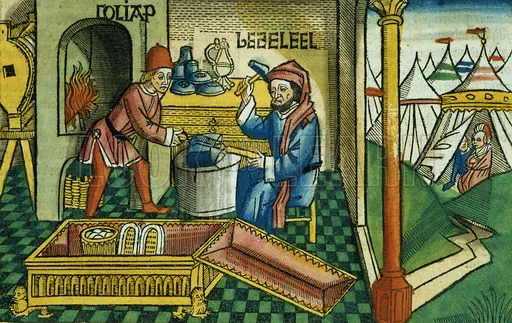
Bezalel and Oholiab build the ark of the covenant, a woodcut from the Cologne Bible, 1479

Then the Lord said to Moses, “Look, I have specifically chosen Bezalel son of Uri, grandson of Hur, of the tribe of Judah. I have filled him with the Spirit of God, giving him great wisdom, ability, and expertise in all kinds of crafts. He is a master craftsman, expert in working with gold, silver, and bronze. He is skilled in engraving and mounting gemstones and in carving wood. He is a master at every craft!

“And I have personally appointed Oholiab son of Ahisamach, of the tribe of Dan, to be his assistant. Moreover, I have given special skill to all the gifted craftsmen so they can make all the things I have commanded you to make:

the Tabernacle;
the Ark of the Covenant;
the Ark’s cover—the place of atonement;
all the furnishings of the Tabernacle;
the table and its utensils;
the pure gold lampstand with all its accessories;
the incense altar;
the altar of burnt offering with all its utensils;
the washbasin with its stand;
the beautifully stitched garments—the sacred garments for Aaron the priest, and the garments for his sons to wear as they minister as priests;
the anointing oil;
the fragrant incense for the Holy Place.

The craftsmen must make everything as I have commanded you.” (New Living Translation)

Methinks God cares about worship. After all, chapters 25-31 in Exodus are thoroughly dedicated to God communicating the specifics for the sacred spaces and symbols of worship for the Israelites.

Once the equipment for worship was described in detail, the one matter still needed was an artisan who could actually build and construct the objects. So, Yahweh also planned for the workers, as well. Bezalel was identified and designated as the person who would be divinely endowed for the task. He would be assisted by Oholiab, and together they carried out God’s instructions to the letter.

Although Bezalel and Oholiab were not priests and did not do “spiritual” work, nonetheless they were filled with the Spirit and set apart by God for their gifts to be used. In reality, all work is spiritual work, even the work of our hands. Everything we do is to be consecrated, set apart, and dedicated to the Lord for good and holy purposes.

The Spirit of God inspired and helped the two men in their very physical and mundane work. The Lord was present with them when they drew up the plans for making the objects, carved the wood, did the weaving and needlework of clothes, and the smithing of the gold. God cares about all work, not just the ethereal stuff.

A willing heart is one that follows in doing work for the Lord, and not following their own whims of how they think things ought to go. The craftsmen, Bezalel and Oholiab, were to do their work just as the Lord had commanded them to do it, just like the pattern shown to Moses on Mount Sinai. (Exodus 25:39)

God is concerned about everything, great and small alike.

When it came to the Lord’s will, the Israelites did not so much seek God’s guidance, as they waited for it. When in the desert, the pillar of cloud by day, and pillar of fire by night, determined when they moved and when they stayed put. The people simply observed, then responded. In other words, they were patient and waited for God to move, speak, command, and do whatever God was going to do.

So, when the Lord lays down some very specific instructions, those directives are meant to be followed down to the minutest detail. For the Christian, Jesus is our example. God’s will was made known to Jesus in the daily privilege and discipline of meeting with his heavenly Father and doing exactly what the Father wanted.

The Sovereign Lord has given me his words of wisdom,
    so that I know how to comfort the weary.
Morning by morning he wakens me
    and opens my understanding to his will.
The Sovereign Lord has spoken to me,
    and I have listened.
    I have not rebelled or turned away. (Isaiah 50:4-5, NLT)

All work is God’s work, and is to be done in the way God prescribes. Worship is to be directed to God, and as such, is to be done as God commands – and not any old way we think is good and needed.

No matter who we are, where we are, or what circumstances we find ourselves in, consistency in doing the will of God is imperative. Nobody has any ground for excusing themselves from their God-ordained work and worship. The ancient Israelites were in a desert without a permanent abode, yet they were still expected to follow God’s directives.

In order to embrace the will of God when it comes, and not make excuses, there are some practices we can do to help receive and do what the Lord wants:

  • Don’t fixate on past mistakes. Learn to be present and focus on what is happening in a given moment, and then you will be able to act in doing God’s will. As a result, you can stop making excuses and learn from past mistakes.
  • Take responsibility for your own words and actions. Take charge of what you have control over. If we don’t own this, then the excuses come out for why we failed to do what was needed.
  • Focus on your spiritual gifts and your strengths and skills. By actively doing what God has enables you to do, you can get the most out of each situation, without succumbing to excuses.
  • Don’t compare yourself to others. We are all unique individuals with unique journeys. That’s why it’s unhealthy to compare ourselves to others and make excuses of “not being good enough” or not measuring up to the skills of Bezalel or Oholiab or someone else. The only person you should compare yourself to is you!

By being attentive to your own walk with God, and being responsive to God’s will for your life, you will find your place in this world and discover the meaning and purpose meant for you in blessing others.

Blessed Holy Spirt of God, with God the Father and God the Son, I adore you as the Holy Trinity, the God whom I serve. I give you my heart, and offer my thanks to you for the grace given me in Jesus Christ. Continue to visit me with your grace, and enable me for work and worship in your church and your world. Amen.


Our Place in the World (Psalm 8)

Lord, our Lord,
    how majestic is your name in all the earth!

You have set your glory
    in the heavens.
Through the praise of children and infants
    you have established a stronghold against your enemies,
    to silence the foe and the avenger.
When I consider your heavens,
    the work of your fingers,
the moon and the stars,
    which you have set in place,
what is mankind that you are mindful of them,
    human beings that you care for them?

You have made them a little lower than the angels
    and crowned them with glory and honor.
You made them rulers over the works of your hands;
    you put everything under their feet:
all flocks and herds,
    and the animals of the wild,
the birds in the sky,
    and the fish in the sea,
    all that swim the paths of the seas.

Lord, our Lord,
    how majestic is your name in all the earth! (New International Version)

I adore the psalms. Many years ago, it was the biblical psalter which helped me come to faith. This little psalm for today is illustrative of why I was moved toward embracing a life with God. Psalm 8 grounds us by dealing with the ultimate questions of human existence:

  • Who am I?
  • Why do I exist?
  • What is the purpose of life?

The answers to those questions are supremely important because people throughout history, and now across the world, are asking what meaning their lives really have.

For example, depression is pervasive throughout the world, as well as the church. It’s a huge issue. Peeling back the layers of a person’s life, many have a deep sense of not truly belonging, and of being profoundly misunderstood by others. Many depressed persons are very aware of their own mortality and have a disconnected sense of their personal role in the world.

Put another way, some folks have lost their original purpose of being a person, that they belong to the human family in a way that makes a significant contribution to the world.

Living on such a big planet causes some people to feel small and wonder how they fit in. With such a large universe, which may at times seem cold and capricious, we may ask, along with psalmist, “What is humanity that you are mindful of them?”

That question forms the center of the psalm. Hebrew poetry is typically set up to have the front and the end of the poem point to the middle where the chief focus is found. So then, the psalmist purposely wrote this psalm so we would consider this great question of what God thinks of humanity within the scope of this immense universe.

And it is a staggeringly huge universe! To put it in perspective, if our galaxy, the Milky Way, were the size of the entire continent of North America, our solar system would fit in a coffee cup.

Even now, two Voyager spacecraft are hurtling toward the edge of the solar system at a rate of 100,000 miles per hour. For decades they have been speeding away from Earth, having now traveled billions of miles. When engineers beam a command to the spacecraft at the speed of light, it takes over half a day to arrive.

Yet this vast neighborhood of our sun—in truth, the size of a coffee cup—fits along with several hundred billion other stars and their planets in the Milky Way, one of perhaps 100 billion such galaxies in the universe. To send a light-speed message to the edge of that universe would take 15 billion years.

Out of the billions of galaxies in the universe, what is the planet Earth that God should care about it? 

Even on our planet there are billions of creatures. Yet, of all those bugs, animals, fish, and birds, God has a special relationship with us, humanity, and cares for us deeply. We know that God cares for us, according to this psalm, because he has entrusted us with the responsibility to care for creation.

We are the only creatures who have the charge to steward all that God has created. As people created in the image of God, we have a job that is befitting of a king. We are God’s vice-regents, in charge of tending and caring for all creation. This incredible job is both a duty and a delight.

God has us playing a crucial role in governing and caring for the world he created. Like a parent or grandparent patiently working with a child to teach them responsibility for all that is around them, God teaches us, and has entrusted to us, this large expansive world we live in. Literally everything in all creation is under our stewardship.

People alone have the self-awareness and perspective of the world that is needed to govern the world. Therefore, we can only find our true purpose and belonging in the stewardship of creation. Caregiving is at the heart of being a person.

The only glitch to all this, and why so many lose their way, is that the world is still living under a curse due to the original fall of humanity.

When we allow other dominions to supersede God’s dominion, then we have issues. Whenever the power of money or the significance of a position, job title, or the ability to do certain tasks is our basic identity and place of belonging, then we will likely succumb to anxiety. That’s because other dominions cannot help us find our true God-given majesty as people created in God’s image.

Living a way other than being a proper steward of the world is beneath us because we have inherent dignity as God’s vice-regents over creation.

Mother Teresa once said that there is no such thing as a small thing – only small things which are done with big love. Her sentiment perfectly captures the vision of the psalmist – that all people are crowned with glory and honor and rule with God to do all the small things of life with a love that comes from our Creator.

We continually have possibilities of engaging in good stewardship of all that God has given us. We have the chance to be attentive to all the little things of life, whether gardening, building a bird house, working with diligence and care at our jobs, or keeping our community clean and its citizens healthy and happy – it’s all important. It brings meaning to our existence as human beings.

People, like all creation, are meant for growth. Putting effort into developing our skills and honing our craft, whatever that may be, is what helps us tap into our God-given purpose for being in this big world.

So, may we continually improve what we do, no matter what it is, so that it befits us as God’s people crowned with honor. May we realize joy and contentment – knowing the majesty we share with God in his wondrous world. 

Almighty God, Creator of the heavens and the earth, words are not enough to express your awesome majesty. Our highest expressions of theology are but baby talk next to you.

Grant us awareness through your Spirit that you are here with us. May this awareness lead us to approach life carefully. The words we speak, the songs we sing, the thoughts we think, the joy and sadness we feel – may it all be pleasing to you, O Lord.

For, despite the inadequacy of our words and actions, our life and worship are addressed to you alone. May you make that life complete, whole, and full to overflowing through Jesus Christ, your Son, our Lord, who with you and the Holy Spirit lives and reigns forever.  Amen.

John 4:31-38 – Real Food

Meanwhile his disciples urged him, “Rabbi, eat something.”

But he said to them, “I have food to eat that you know nothing about.”

Then his disciples said to each other, “Could someone have brought him food?”

“My food,” said Jesus, “is to do the will of him who sent me and to finish his work. Don’t you have a saying, ‘It’s still four months until harvest’? I tell you, open your eyes and look at the fields! They are ripe for harvest. Even now the one who reaps draws a wage and harvests a crop for eternal life, so that the sower and the reaper may be glad together. Thus, the saying ‘One sows, and another reaps’ is true. I sent you to reap what you have not worked for. Others have done the hard work, and you have reaped the benefits of their labor.” (New International Version)

Today’s Gospel narrative reads something like the stereotypical mother concerned for her son saying, “Sit down and eat some of Mama’s pasta. You need some food!” As if preparing and serving a meal will make everything better.

Food has both the power to bring us together, as well as separate us. A meal can create the conditions for fellowship, acceptance, and enjoyment. Eating can bond people together through hospitable love. On the other hand, sitting down to eat can also be a way to avoid painful emotions. In this manner, eating becomes an obstacle to giving and receiving love.

It seems Christ’s disciples were doing the latter. They were uncomfortable and perhaps a bit stressed. Looking to fill up with food instead of with God, the disciples’ sense of unfulfillment was coming out sideways by opening the refrigerator, poking through the meager leftovers, and putting the emphasis on feeling better.

I know we can be hard on the disciples in the Gospels. Their ups and downs from faith to fear and back to faith again can be weird. Yet, through it all, I believe their hearts (excepting Judas Iscariot) were in the right place.

Jesus could see through the entire scenario and put the focus off eating. He addressed the disciples’ soul hunger through putting the spotlight on doing the will of God. Deep within they were hungering and thirsting for righteousness.

Paying attention to our vocation and discovering our humble work in the service of God, rather than a vacation to the pantry to cover our unwanted feelings, is the essence of Christ’s interaction with his disciples.

People are much more ready for the gospel of Jesus than we think. There are times we can become so insular, and lost within our own heads, that we are then unable to see the world as ripe for a harvest of people who are actually eager to be gathered into the community of the redeemed.

Jesus just had a significant interaction with the Samaritan woman. Back in that day, you just didn’t have dialogues with half-breed Samaritans – an unholy mix of Jewish and hated ancient Assyrian Gentile blood – let alone a man talking with a woman of disrepute who experienced several failed marriages.

Christ had a way of doing the will of God, despite conventional thinking of the time. And a lot of people got their undies in a bundle from it. The disciples, having a front seat to most of Christ’s shenanigans, did a few too many palms to the forehead, believing their Rabbi’s un-orthopraxis was going to make him unpopular. They feared no one would follow him.

Looks like the disciples didn’t quite get that one right.

The Samaritan woman received Jesus as Living Water, having her ultimate needs met by the penultimate Lord of all. The disciples hadn’t quite caught up to this, so fell back on their old ways of physical food and drink to assuage the weirdness happening inside them.

The woman was gushing over with Living Water, becoming a wellspring of good news to her community. Whereas the disciples (eventually becoming an incredible fountain of the gospel after Christ’s death and resurrection) are here nothing but an annoying drip from the kitchen faucet.

A non-descript ethnically suspect woman of dubious character coming to faith was meant by Jesus to open the disciples’ eyes to a new reality: The good news of Christ is meant for the world, not just Jewish men.

The disciples were given the opportunity to participate in the world’s takeover – a mission of bringing the love of God where love wasn’t present, of helping all kinds of people awaken to the deep spirituality within them, of lifting their downcast faces of guilt and shame to see the Living God wanting to bless the world with the body and blood of Jesus.

For this is real food and real drink.

Many believers in Jesus today think they are working hard for the Lord by seeking people for their churches. Yet, the real work is being done by the triune God – the heavenly Father who scans the world and seeks spiritual misfits to bless; the gracious and truthful Son who put hands and feet to that blessing; and the wild Holy Spirit who moves in unpredictable ways – are working infinitely harder for our churches, our families, our neighborhoods, and our world.

All of our work, no matter how big or small, is made possible by the pre-work of the Holy Trinity. The great Three-in-One has done all the preparations of chopping the onions, mincing the garlic, slicing the carrots, and peeling the potatoes so that we, his followers, can make a savory stew of diverse people sharing a common pot of God’s love and hospitality.

This is the food we know nothing about, and that God knows intimately.

O God, you made us in your own image, and you have redeemed us through your Son Jesus Christ: Look with compassion on the whole human family; take away the arrogance and hatred which infect our hearts; break down the walls that separate us; unite us in bonds of love; and work through our struggle and confusion to accomplish your purposes on earth; that, in your good time, all nations and races may serve you in harmony around your heavenly throne; through Jesus Christ our Lord. Amen.

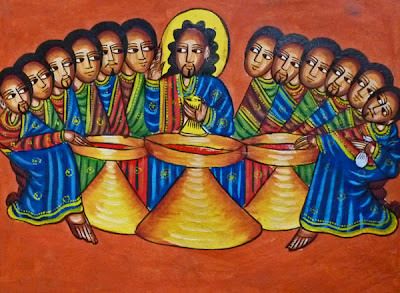
*Above painting: Ethiopian Orthodox Church depiction of the Last Supper

2 Samuel 2:1-11 – A Devout Leader

In the course of time, David inquired of the Lord. “Shall I go up to one of the towns of Judah?” he asked.

The Lord said, “Go up.”

David asked, “Where shall I go?”

“To Hebron,” the Lord answered.

So, David went up there with his two wives, Ahinoam of Jezreel and Abigail, the widow of Nabal of Carmel. David also took the men who were with him, each with his family, and they settled in Hebron and its towns. Then the men of Judah came to Hebron, and there they anointed David king over the tribe of Judah.

When David was told that it was the men from Jabesh Gilead who had buried Saul, he sent messengers to them to say to them, “The Lord bless you for showing this kindness to Saul your master by burying him. May the Lord now show you kindness and faithfulness, and I too will show you the same favor because you have done this. Now then, be strong and brave, for Saul your master is dead, and the people of Judah have anointed me king over them.”

Meanwhile, Abner son of Ner, the commander of Saul’s army, had taken Ish-Bosheth son of Saul and brought him over to Mahanaim. He made him king over Gilead, Ashuri and Jezreel, and also over Ephraim, Benjamin and all Israel.

Ish-Bosheth son of Saul was forty years old when he became king over Israel, and he reigned two years. The tribe of Judah, however, remained loyal to David. The length of time David was king in Hebron over Judah was seven years and six months. (New International Version)

Leadership today seems more complicated and compromised than ever. Narcissistic leaders appear to be everywhere. Leaders with competence and integrity struggle to maintain self-care and self-confidence in a sea of belligerent and polarized people.

And yet, there has never been a time with more resources for leaders in the form of podcasts, websites, seminars, books, education, etc. There seems to be an inconsistency, a disconnect between the availability of knowledge and the actual lived experience of leaders.

King David was a great and famous leader. We still talk about him three-thousand-years later! Three essentials made David, and can make us, godly and effective leaders.

A Devout Leader Has a Calling from G-d

David was the youngest sibling in his family. No one saw an aspiring leader, let alone one of the most famous kings in history, in David. While David was tediously tending sheep out in the backwaters of Judah, nobody was aware of his potential greatness. But G-d saw. And the Lord sent the prophet Samuel to anoint him as king.

Through a long series of events, the people of Judah recognized David’s gifts, abilities, and potential. And they affirmed those abilities and chose to place David in authority over the entire nation as king – confirming his anointing from years earlier.

Not everyone is called to a high position. Yet, we are all called to exercise leadership in our respective places and positions. Whether a parent, teacher, church deacon, factory worker – or any other role or vocation – we are in those positions through a divine call. So, we are to be daily mindful of that personal calling.

A Devout Leader Inquires of G-d

King David took his leadership cues from the Lord, and not just on what he believed was the best thing to do. David was both principled and pragmatic – rarely losing sight of principles just to get things done, nor short-sighted on the practical effects of decision-making.

David was able to hold both his biblical principles and keen pragmatism through inquiring of G-d. He was a person of prayer, constantly and consistently asking the Lord about everything. The times David failed to act on principled conviction and pragmatic practice are the events in which he simply did not look to G-d, but instead, rested on his laurels or relied on his position.

A Devout Leader Is a Servant to G-d

Perhaps one reason our world has a lack of good solid leaders is that we aren’t looking for followers who exhibit humility to the Lord through serving the common good of all persons.

David learned leadership through being a servant and a follower of G-d. Once becoming king, David used his authority and position to show steadfast love to the people in his kingdom – rather than focusing on consolidation of power or ensuring the people were serving the king.

A devout leader uses their influence to extend mercy and kindness – making the world a better place through attention to justice and systematically providing for the needs of others.

“True leadership is found in giving yourself in service to others, not in coaxing or inducing others to serve you.”

J. Oswald Sanders

Conclusion

A true leader of G-d is called by G-d, inquires of G-d, and seeks to extend grace to others with the same grace extended from G-d to them.

In other words, character is the essential element for leaders. And that principled leadership is expressed through the competence of loving G-d and neighbor.

Leadership devoid of spiritual awareness will inevitably result in short-sighted and self-serving leaders. Conversely, devout leadership which evidences an integration of mind, emotions, and spirit will surely bring life and happiness to many.

I urge, then, first of all, that petitions, prayers, intercession and thanksgiving be made for all people— for kings and all those in authority, that we may live peaceful and quiet lives in all godliness and holiness. This is good, and pleases God our Savior, who wants all people to be saved and to come to a knowledge of the truth. (1 Timothy 2:1-4, NIV)

May it be so. Soli Deo Gloria.

O Lord our Divine Leader, bless human leaders throughout our world, that we may be a people at peace among ourselves and a blessing to one another. Lord, keep the nations under your care. Give grace to your servant leaders, O Lord, and grant them wisdom and mercy in the exercise of their duties. Give courage and foresight to provide for the needs of all people. Help leaders to fulfill their obligations.

And finally, teach people everywhere to rely on your strength and to accept their responsibilities to their fellow citizens, that they may elect trustworthy leaders and make wise decisions for the well-being of our society; that we may serve you faithfully in our generation and honor your holy Name. For yours is the kingdom, O Lord, and you are exalted as head above all. Amen.

*Above painting: King David Playing the Harp by Dutch artist Gerard van Honthorst, 1622

**Above statue of King David by Italian sculptor Adamo Tadolini, 1856