Mercy and Judgment (Revelation 8:1-5)

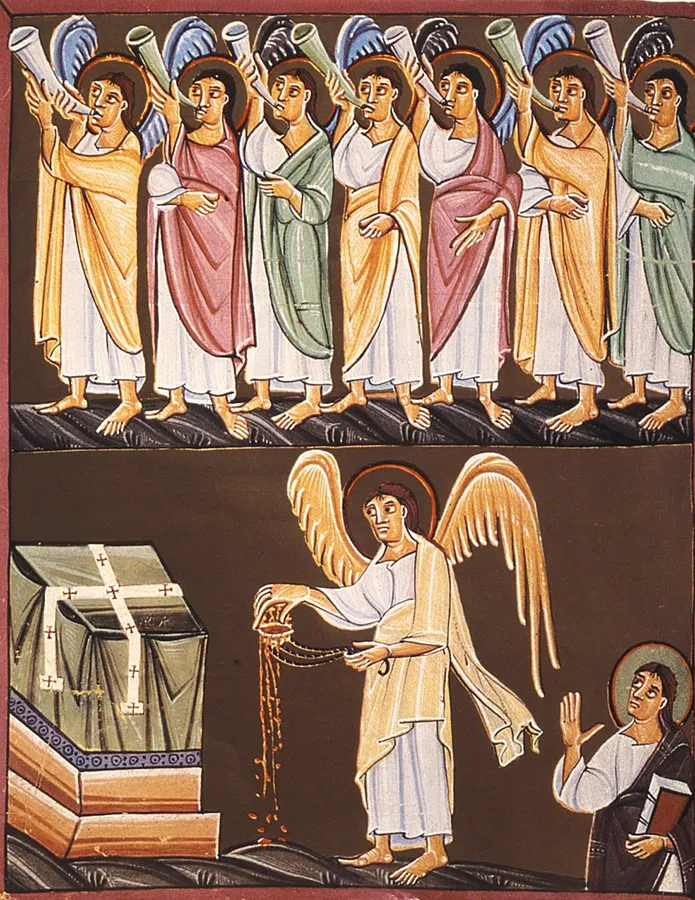
Seven angels with seven trumpets, and the angel with a censer, from the Bamberg Apocalypse, c.1020 C.E.

Then, when the Lamb opened the seventh seal, there was silence in heaven for about half an hour.

Then I saw the seven angels who stand before God, and seven trumpets were given to them. Another angel came and stood at the altar, and he held a gold bowl for burning incense. He was given a large amount of incense, in order to offer it on behalf of the prayers of all the saints on the gold altar in front of the throne. 

The smoke of the incense offered for the prayers of the saints rose up before God from the angel’s hand. Then the angel took the incense container and filled it with fire from the altar. He threw it down to the earth, and there were thunder, voices, lightning, and an earthquake. (Common English Bible)

When I was kid, growing up on a Midwest American farm, I remember times when severe weather was coming. I knew it was going to be bad whenever everything became still and there was complete silence: No wind, no birds singing, no insects chirping, nothing moving whatsoever. It was the eerie silence which precedes something big coming.

That is the way it will be in heaven when the seventh seal is opened. The silence is so quiet that you know a lot of noise and movement are about to happen. It’s not serene silence; it’s scary silent.

With the opening of the seventh seal, a climactic moment is reached. The silence is not only an anticipation of the coming drama, but is also a sign of reverence and awe.

The seventh seal initiates a series of woes: The seven trumpets. But before the trumpets begin, an angel appears. Standing before a heavenly altar, the angel mixes incense along with prayers from the people, then offers them on the altar.

These prayers of the people are for justice, and a longing for the kingdom to come, and God’s will to be done, on earth, as it is always done in heaven.

The imagery relates to us that God hears the prayers, and will act, according to the divine character and will.

The angel takes fire from the altar and hurls it down to earth, causing thunder and lightning, and an earthquake. In other words, the prayers are being answered; they are having an effect. Judgment on the earth begins with the blowing of the seven trumpets.

As we may expect, the incredible silence gives way to an equally incredible noise of weather and the earth moving. And the angel, serving as a quiet and contemplative high priest, now moves to becoming a judge upon the earth.

It turns out that mercy and judgment are not two contrasting concepts and actions; they are two sides of the very same coin. The altar of mercy becomes the source of judgment.

Whenever there is an injustice, we want (and expect) to have that act acknowledged and taken care of by a proper authority. To have a judge simply say that he/she is merciful and will acquit the guilty, does not work in every situation. Mercy only exists because of the presence of guilt and judgment.

God takes care of sin because God loves. An unloving deity would be unconcerned, random, and capricious in handling injustice. But not the God of the Bible. God shows mercy to the righteous, and will judge the wicked.

God’s mercy extends to the point of acquitting the guilty, if God so desires to do so. And everyone needs mercy, because we all have committed injustices in our lives.

Yet, by means of humble contrition and faith, we can mercifully discover gracious amnesty. This is why Jesus came, to take care of the sin issue once for all through the Cross.

We have been made holy by God’s will through the offering of Jesus Christ’s body once for all. (Hebrews 10:10, CEB)

In the time of the Apostle John’s vision, which is the Book of Revelation, Christians were facing persecution and martyrdom. The prayers of the suffering believers rose to heaven:

They cried out with a loud voice, “Holy and true Master, how long will you wait before you pass judgment? How long before you require justice for our blood, which was shed by those who live on earth?” (Revelation 6:10, CEB)

God’s response to the prayers of the saints is to send judgmental fire against the earth by the hand of the angel. In John’s apocalyptic vision, not only are the believers in Christ facing trials and tribulations for their faith, but the unbelieving persecutors who victimize the saints will be punished, as well.

If the persecutors use fiery elements against the believers, God can (and will) turn that fire back on the them. This is similar to the Book of Exodus, in which the plagues that struck and judged the Egyptians were, at the same time, a means of protecting and preserving the Israelites.

The Book of Revelation included in the Christian canon of scripture, not for the purpose of predicting the time or the season in which Jesus Christ will come back to judge the living and the dead. Rather, John’s Apocalypse is meant to encourage the followers of Christ that their suffering will not last forever; and neither will the arrogance of the wicked.

We don’t know when all of this end-of-the-age stuff is going to shake out. Which is why it is so important we learn to persevere through suffering. Because we might have to wait awhile.

Prayer for us then becomes not simply something we do if we have a bit of discretionary time; it becomes vital for us. We discern that we must speak with God. We are compelled to offer our prayers. We feel the great need to cry out and petition God for justice and righteousness.

It seems, if I don’t pray, I won’t make it. Therefore, I must pray. I will pray with all of my heart and soul, till I cannot pray anymore. And then I will pray some more, because I need God.

There is nothing easy about moving through suffering. It’s hard to persevere. It hurts to be the brunt of another’s violent tongue and/or hand. Yet, we do not experience this alone. The divine presence is with us. And that makes all the difference.

Oh God:
Give me strength to live another day;
Let me not turn coward before its difficulties, or fail in its duties;
Let me not lose faith in other people;
Keep me sweet and sound of heart, in spite of ingratitude, treachery, or meanness;
Preserve me from minding little stings, or giving them;
Help me to keep my heart clean, and to live so honestly and fearlessly that no outward failure can dishearten me, or take away the joy of conscious integrity;
Open wide the eyes of my soul that I may see good in all things;
Grant me this day some new vision of your truth;
Inspire me with the spirit of joy and gladness and make me the cup of strength to suffering souls; in the name of the strong Deliverer, our only Lord and Savior, Jesus Christ. Amen.


2 Peter 2:1-10a – Beware of Spiritual Predators

But there were also lying prophets among the people then, just as there will be lying religious teachers among you. They’ll smuggle in destructive divisions, pitting you against each other—biting the hand of the One who gave them a chance to have their lives back! They’ve put themselves on a fast downhill slide to destruction, but not before they recruit a crowd of mixed-up followers who can’t tell right from wrong.

They give the way of truth a bad name. They’re only out for themselves. They’ll say anything, anything, that sounds good to exploit you. They won’t, of course, get by with it. They’ll come to a bad end, for God has never just stood by and let that kind of thing go on.

God didn’t let the rebel angels off the hook but jailed them in hell till Judgment Day. Neither did he let the ancient ungodly world off. He wiped it out with a flood, rescuing only eight people—Noah, the sole voice of righteousness, was one of them.

God decreed destruction for the cities of Sodom and Gomorrah. A mound of ashes was all that was left—grim warning to anyone bent on an ungodly life. But that good man Lot, driven nearly out of his mind by the sexual filth and perversity, was rescued. Surrounded by moral rot day after day after day, that righteous man was in constant torment.

So, God knows how to rescue the godly from evil trials. And he knows how to hold the feet of the wicked to the fire until Judgment Day.

God is especially incensed against these “teachers” who live by lust, addicted to a filthy existence. They despise interference from true authority, preferring to indulge in self-rule. (The Message)

I wish everyone who claims the name of Christ was safe to talk to, interact with, and share life together. However, not everyone is. *Sigh*

Unfortunately, there exists spiritual predators who create chaos, keep others off-balance, and speak and act in ways that benefit their own consolidation of authority. They are like Sith Lords who come-off as well-meaning but always have a secret agenda for more power and control. *Sigh*

So-called teachers and leaders are not all trustworthy. Like mosquitoes drawn to warm blood, they seek to feast on the godly, taking advantage of their good nature – slowly, carefully, and insidiously draining the life out of them. All the while, the true believer doesn’t know what’s going on until it is too late. *Sigh*

Some are even more sinister. Like tarantulas, they immobilize their victims and slowly suck out their insides with the prey’s full awareness. Unable to scream or seek help, they lie in silent pain wishing for a miracle. *Sigh*

Yet, at the same time, none of those false teachers, emotional manipulators, and spiritual charlatans are putting anything over God. The Lord sees it all – and is incensed about it. The ungodly, masking as benevolent authorities, will not be able to carry-on with their hidden agenda of evil forever. Their time will run out. Judgment Day is coming.

The Lord knows how to deliver victims from their victimization. It rarely comes fast enough for us. Nevertheless, the destruction of all injustice is just around the corner. But how do we deal with all the unethical and immoral behavior now!?

We stay the course. Do not give-in to the temptation to play another’s Machiavellian game. The Christian life begins with humility, is sustained by a gentle spirit, embraces right ways of being with others, and typically results in trouble, even persecution. (Matthew 5:1-12)

We strive to always live into personal peace and be peacemakers. We understand that he who is within us is greater than he who is in the world. (1 John 4:4)

We choose to love and pray for our enemies, all the while being wise as serpents and gentle as doves. (Matthew 5:44, 10:16)

We embrace patience and persevere through each frustratingly mad situation, knowing that the Lord has promised to be with us, even until the very end of the age. (James 5:7-12; Matthew 28:20)

We give no one a reason to speak ill of us, blessing others and not cursing them. (Titus 3:2; James 4:11; Romans 12:14)

We trust God in all things, while being careful not to put a pearl necklace around a pig. (Proverbs 3:5-6; Matthew 7:6)

We keep encouraging and affirming others, even when we don’t get encouragement and affirmation ourselves. (Ephesians 4:29; 1 Thessalonians 5:11; Hebrews 3:13)

We stick to a community of people with like-minded values and refuse to withdraw into isolation. (Galatians 6:2; Philippians 1:27-30)

We follow Christ, our true Teacher and Lord, one day at a time, one step at a time – focusing continually on his words and ways as our polestar through the morass of confusion and iniquity. (Matthew 16:24; John 8:12, 10:27, 12:26; 1 Peter 2:21)

Jesus knew the sobering truth of spiritual predators acting as godly when he said:

Not everyone who calls me their Lord will get into the kingdom of heaven. Only the ones who obey my Father in heaven will get in. On the day of judgment many will call me their Lord. They will say, “We preached in your name, and in your name we forced out demons and worked many miracles.” But I will tell them, “I will have nothing to do with you! Get out of my sight, you evil people!” (Matthew 7:21-23, CEV)

May you remain encouraged in faith, steadfast in hope, and forever in love with the Savior who has loved you and given himself to you.

Christ, light of light, brightness indescribable, the wisdom, power and glory of God, the Word made flesh: you overcame the forces of Satan, redeemed the world, then ascended again to the Father. Grant me, I pray, in this tarnished world, the shining of your splendor. Send your holy angels to defend me, to guard my going out and coming in, and to bring me safely to your presence, where you reign in the one holy and undivided Trinity, now and forever. Amen.

Psalm 120 – Gaslighting Trouble

Ingrid Bergman and Charles Boyer in the 1944 film, “Gaslight”

I’m in trouble. I cry to God,
    desperate for an answer:
“Deliver me from the liars, God!
    They smile so sweetly but lie through their teeth.”

Do you know what’s next, can you see what’s coming,
    all you bold-faced liars?
Pointed arrows and burning coals
    will be your reward.

I’m doomed to live in Meshech,
    cursed with a home in Kedar,
My whole life lived camping
    among quarreling neighbors.
I’m all for peace, but the minute
    I tell them so, they go to war! (The Message)

I wish we lived in a world where people always speak and live the truth in love, without lying, pretense, or posturing. But we don’t. Not everyone embraces a life of encouraging others through truthful affirmation and selfless acts of service.

In reading today’s psalm, I immediately think of all the patients I’ve seen as a chaplain on my behavioral health unit who have been gaslighted.

“Gaslighting” is a recent term, yet the concept is as old as Satan’s interaction with Adam and Eve in the Garden. The word comes from the 1944 movie, “Gaslight,” starring Charles Boyer and Ingrid Bergman. In the attempt to drive his wife insane, the husband rigs the gaslights of the house so they will flicker at night. Whenever his wife comments on it, her husband flat-out lies and says the lights are not flickering at all. I’ll let you watch the film yourself to see what happens.

A person who “gaslights” uses psychological manipulation to gain and assert control over someone or some group. Gaslighters actively undermine others, using their words against them, plotting nefarious plans for them behind their backs, lying without so much of a blink of an eye, and turning family or friends against someone – all with the insidious agenda of increasing their power over that person and solidifying their dependence from the victim.

All of this gaslighting behavior is done with a smile, said with syrupy words to hook you, rather than help you. That, of course, makes it hard to spot – which is why it is so devilish. If the gaslighter can get you to doubt yourself, your abilities, or your perception of reality, then they can worm themselves into your life and plant their thoughts inside you.

Gaslighters don’t want peace. They want conflict. People at war give them an opportunity to gain more influence and power. Plus, they just plain like to watch others fight amongst themselves. It gives them a sense of control.

Today’s psalm is part of the psalms of ascent – songs used by the community as they walk their pilgrimage to Jerusalem and up the temple mount. The people collectively lament the gaslighting activity of those who oppose and hate them. And they turn to God, who abhors gaslighters, seeking solace and safety from their evil ways.

The gaslighter’s end is certain. They will have to contend with the God who will not be manipulated by anyone. Although it is not our job to punish sinners, it very much is our responsibility to see and avoid gaslighting as much as possible, as well as, God forbid, becoming a gaslighter ourselves. To that end, take note of some of the manipulative marks of gaslighters and patterns of gaslighting:

  • Pitting people against one another. This is done a variety of ways through gossip masked as trying to help, subtle slander, and carefully placed lies.
  • Avoiding responsibility. The gaslighter never owns their words and actions but are experts at blaming others for whatever goes awry.
  • Creating fights and conflicts. Gaslighters chronically avoid the dirty work. They get others riled-up at each other, then sit back and look for an opportunity to seize control over the warring parties.
  • Sucking-up to others. Flattery is a well-worn tool of gaslighters. They are masters at buttering-up people to get what they want.
  • Comparing people. This is just another way of driving a wedge between people. “Why can’t you be like ___?”
  • Mistreating the weak and powerless. The weak have no value for the gaslighter because the powerless have nothing to offer them. So, oppression becomes a means of getting the weak out of the way, like they’re some pesky insect to get rid of.
  • Bragging about accomplishments and stealing other’s. Gaslighters will always take the credit for an accomplishment and then boast about it, all the while badgering the victim.
  • Not keeping promises. Usually there’s a bait and switch where the gaslighter will promise something, then switch the rules or tell a bold-faced lie that they never promised that.

There is much more gaslighting behavior, but you get the drift. The best way to deal with a gaslighter? Get as far away from them as you can, find genuine supportive relationships, and leave them to God.

Today’s psalm can be your prayer to the Lord, offering a heartfelt plea to the Divine Being who does the opposite of gaslighting: strengthening you, giving you power, listening to your voice, and loving you with complete altruistic motives.

Eternal Father, you created us in your own image and likeness, but sin has warped the minds of humanity so that there is much injustice and much carelessness of the rights of other people in this fallen world. I pray you will right every wrong and vindicate those being treated unjustly. Keep us, your people, from trying to take matters into our own hands for vengeance. Give justice and peace to all those who have been cruelly and unfairly treated. May the injustice they have endured be the means to draw them into the saving arms of your grace, through Jesus Christ our Lord. Amen.

How to Handle a Sinner, Part 2

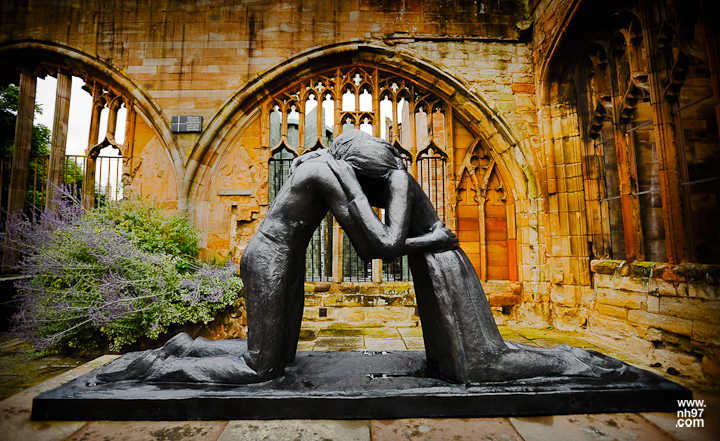
Reconciliation Statue
Reconciliation Statue, placed in the ruins of Coventry Cathedral, England, bombed by the Nazis in World War II.

Being emotionally and/or spiritually wounded by another downright hurts. So, what do we do when it happens? Gratefully, Jesus provided some clear teaching on how to handle a victimizing person. (Matthew 18:15-20)

In part one, we considered the initial step to be taken when a person has been offensive and brought damage to another and/or the community. In their straying from the law of love, we are to respond by speaking to the person privately, to attempt a one-on-one reconciliation and restoration. This effort may be repeated several times over.

These next two steps are only to be undertaken when it has become evident that the person’s intransigence about hurting others will not budge.

The Second Step – Take One or Two Others (Matthew 18:16).

Reconciliation Statue Berlin
Statue outside of the Church of Reconciliation in Berlin, Germany.

“If they will not listen, take one or two others along, so that ‘every matter may be established by the testimony of two or three witnesses.'” –Jesus

The idea here is not to get a few buddies together who agree with our assessment. Rather, we seek others who know the person and can provide loving and objective help. This upholds the ethics of the Old Testament:

A solitary witness against someone in any crime, wrongdoing, or in any sort of misdeed that might be done is not sufficient. The decision must stand by two or three witnesses. (Deuteronomy 19:15, CEB)

When a person fails to respond to reproof privately, then others need to get involved so that there is not a situation of “he said, she said.”  The witnesses are to help establish the nature of the problem. This is purposely meant to be a rather drawn out process because the goal is restoration. We are to give the person every chance to respond to correction.  People need to be given the grace of time to be effectively wooed back to the flock.

The Third Step – Tell It to the Church (Matthew 18:17-18).

Reconciliation Statue Hiroshima
Reconciliation Statue in Hiroshima, Japan

“If they still refuse to listen, tell it to the church; and if they refuse to listen even to the church, treat them as you would a pagan or a tax collector.” –Jesus

If the person ignores the group of witnesses, the group is to report the problem to the church. If the person still refuses to listen, then the person is to be treated like “a pagan or tax collector,” that is, the person is to be excommunicated and treated as though they are an unbeliever who has different needs. Jesus did not mean that we never talk to the person again. It is just the opposite: We communicate to them the need for grace just as we would to anyone.

The sixteenth-century Reformed Confession, the Heidelberg Catechism, took up this this matter (Question and Answer 85):

Q: How is the kingdom of heaven closed and opened by Christian discipline?

            A: According to the command of Christ:

Those who, though called Christians, profess unchristian teachings or live unchristian lives, and after repeated and loving counsel refuse to abandon their errors and wickedness, and after being reported to the church, that is, to its officers, fail to respond also to their admonition – such persons the officers exclude from the Christian fellowship by withholding the sacraments from them, and God himself excludes them from the kingdom of Christ.  Such persons, when promising and demonstrating genuine reform, are received again as members of Christ and of his church.

This approach is also germane with groups of people, churches, or Christian organizations. In the last century, churches around the world ostracized the South African Dutch Reformed Church for their refusal to bend concerning their racism and stance on apartheid.  Restoration did occur.  Not only that, but the Belhar Confession was eventually crafted from this church, a document which stands as a thorough biblical stand against structural racism and racist actions.

The Power of the Small Group (Matthew 18:19-20).

“Again, truly I tell you that if two of you on earth agree about anything they ask for, it will be done for them by my Father in heaven. For where two or three gather in my name, there am I with them.” –Jesus

Jesus reiterated his point about binding and loosing; opening and closing; banning and forgiving. One of the great Reformation teachings is the priesthood of all believers.  The beauty of this is that we may confess our sins to one another in a close, intimate setting so that the steps do not need be done. Small gatherings of believers coming together to confess sin and pray together is the most powerful setting there is.  If we neglect this, we are missing out on the power of God.

Conclusion

Once upon a time, there were two brothers. Their father had a large farm and when he became too old to work, he called his sons to him. “I am too old to work anymore,” he said. “I will divide my farm in half and give each of you one half. I know that you will always work together and will be good friends.”

When the brothers first started farming on their adjoining farms, they were the best of friends and would share everything together. Then, one day there was an argument between the two brothers, and they stopped speaking to one another. For many years, not a word was spoken between them.

One day, one of the brothers was at his house when a carpenter came to his door and said, “I would like to do some work. Do you have any work that I can do?” The brother thought for a moment and then replied, “I would like for you to build a fence on my property. Build it down near the stream that separates my farm from my brother’s. I do not want to see my brother and I would like for you to build a high fence there. I am going into town and I will return this evening.

Bridge over stream

When he came back that evening, he was shocked to see that the carpenter had not followed his instructions. Instead of building a high fence he built a bridge over the stream. The man walked down to look at the bridge, and as he did, his brother walked toward him from the other side. His brother said, “After all the terrible things I’ve done to you over the years, I can’t believe that you would build a bridge and welcome me back.” He reached out to his brother and gave him a big hug.

The brother then walked back up to his farmhouse to talk to the carpenter. “Can you stay?” he asked. “I have more work for you to do.” The carpenter answered, “I’m sorry but I can’t stay. I have to go, for I have many other bridges to build.”

Sometimes you and I have hurts and wounds from our brothers and sisters in Christ. When that happens, we often build a fence between ourselves and them. We stop talking to them. We do not want to see them. We do not want to be around them. However, Jesus wants something different. Instead of fences, he wants us to build a bridge of love.  He wants us to connect and work it out.