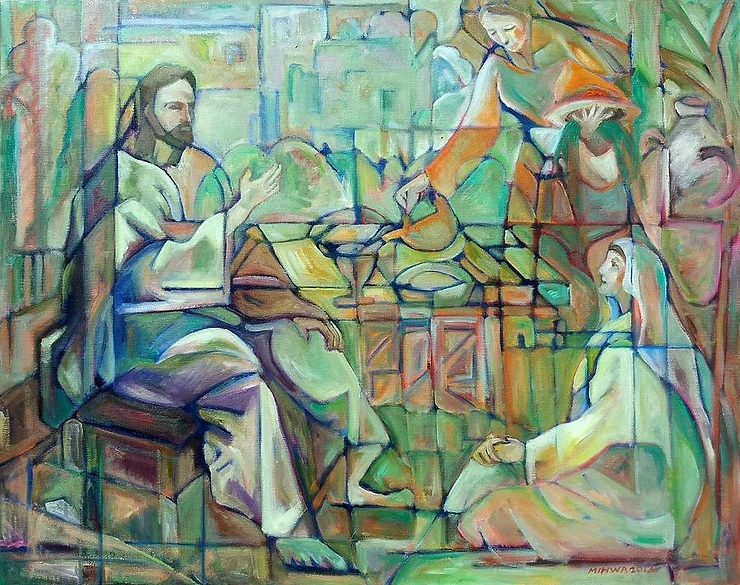
What Do You Value? (Matthew 6:1-6, 16-21)

The Sermon on the Mount, by Beryl Lewis (1939-2021)

“Be careful not to practice your righteousness in front of others to be seen by them. If you do, you will have no reward from your Father in heaven.

“So when you give to the needy, do not announce it with trumpets, as the hypocrites do in the synagogues and on the streets, to be honored by others. Truly I tell you, they have received their reward in full. But when you give to the needy, do not let your left hand know what your right hand is doing, so that your giving may be in secret. Then your Father, who sees what is done in secret, will reward you.

“And when you pray, do not be like the hypocrites, for they love to pray standing in the synagogues and on the street corners to be seen by others. Truly I tell you, they have received their reward in full. But when you pray, go into your room, close the door and pray to your Father, who is unseen. Then your Father, who sees what is done in secret, will reward you….

“When you fast, do not look somber as the hypocrites do, for they disfigure their faces to show others they are fasting. Truly I tell you, they have received their reward in full. But when you fast, put oil on your head and wash your face, so that it will not be obvious to others that you are fasting, but only to your Father, who is unseen; and your Father, who sees what is done in secret, will reward you.

“Do not store up for yourselves treasures on earth, where moths and vermin destroy, and where thieves break in and steal. But store up for yourselves treasures in heaven, where moths and vermin do not destroy, and where thieves do not break in and steal. For where your treasure is, there your heart will be also. (New International Version)

Spiritual Disciplines

In Christ’s day, there were three spiritual disciplines that were especially important: giving, prayer, and fasting. For the Jewish faithful, these three practices were meant to work together in helping them to know God and serve others. 

Yet, over time, although the disciplines were maintained, they were observed for all the wrong reasons. Jesus was concerned to communicate that not only are people to do the right thing, but that they do the right things for the right reasons.

To do any less, is to be a hypocrite who maintains an outward form of religion, but is inwardly motivated by the praise and recognition of others. Such a person is, in reality, far from God. 

Ash Wednesday is the beginning of Lent on the Christian Calendar. This season is a time devoted to spiritual disciplines, especially fasting.

Fasting

Those who truly hunger and thirst for righteousness take the time eat spiritual food in order to pursue God and seek right relationships in this world. It’s not a matter if we fast, but when.

The Bible has a great deal to say about fasting:

  • Fasting is a sign of humility and brokenness before God in recognizing both personal and corporate guilt. (1 Samuel 7:2-6)
  • Fasting is a means of preparation for ministry. Jesus used fasting in the desert as preparation for his ministry, and to face down the devil (Matthew 4:1-2). And the apostles fasted when seeking God’s direction about a new ministry. (Acts 13:2-3)
  • Fasting is meant to connect with God and serve others; and not to simply go through the motions. (Isaiah 58:3-7)

Therefore, fasting is a time to get in touch with God, to know the divine will, and then to do it. 

God doesn’t operate on a point system. If we only go through the motions of a spiritual discipline, or do it so that others will notice that I am doing my duty, then we have come under the condemnation of Jesus and are proved as hypocrites.

True fasting in an outward practice reflecting an inner attitude of heart; it’s an expression of devotion in order to connect with God and do good works of service to others.

Framing the topic another way: Why don’t we fast? Because it’s culturally okay not to? Because nobody cares whether I do, or don’t?

The spiritual disciplines of giving, praying, fasting, and other Christian practices have changed my life because they are a vital means of connecting with God and engaging the world.

A farmer disciplines himself to plow, plant, and cultivate – not because he wants to impress others (“Y’all see my big ol’ tractor and my implements!?”) but so that he will receive the reward of reaping a harvest at the proper time. 

So, we also, can engage in spiritual disciplines, like fasting, in order to see a harvest of righteousness.

Earthly vs. Heavenly Treasure

Do not store up for yourselves treasures on earth. What are earthly treasures? It’s stuff, money, possessions, as well as control, power, position, and recognition from others.

You may rightly ask, “Is this really, in and of itself, wrong?” No, it’s not. The real question is not whether we possess earthly treasure (because we all do) but rather:

Do I use my earthly treasure to build heavenly treasure? Do I hoard earthly treasure for my own purposes apart from Christ’s kingdom values?

Jesus once illustrated the difference:

Someone in the crowd said to him, “Teacher, tell my brother to divide the inheritance with me.” 

Jesus replied, “Man, who appointed me a judge or an arbiter between you?” 

Then he said to them, “Watch out! Be on your guard against all kinds of greed; life does not consist in an abundance of possessions.” 

And he told them this parable: “The ground of a certain rich man yielded an abundant harvest. He thought to himself, ‘What shall I do? I have no place to store my crops.’ “Then he said, ‘This is what I’ll do. I will tear down my barns and build bigger ones, and there I will store my surplus grain. And I’ll say to myself, “You have plenty of grain laid up for many years. Take life easy; eat, drink and be merry.”’  “But God said to him, ‘You fool! This very night your life will be demanded from you. Then who will get what you have prepared for yourself?’ 

“This is how it will be with whoever stores up things for themselves but is not rich toward God.”(Luke 12:13-21, NIV)

Again, earthly possessions are tools to be used; and not for accumulating personal wealth, esteem, and success for the sake of security in money. Rather, everything the Christian has is for the advancement of God’s kingdom values. 

Why do this? Because earthly treasure is temporary, and heavenly treasure is permanent. 

Is what you are pursuing today really going to matter in 50 billion millennia?

Heavenly treasure is righteousness as defined by Jesus: right relationships with both God and other humans.  Humility, peace, grace, mercy, purity, forgiveness are all relational values. The only thing that we will take with us when we die is relationships.

If I am genuinely committed to God’s kingdom, my most cherished values will be established by God. 

Our real values consume our thoughts and our efforts; what is in our hearts directs our work. And our ultimate values derive from how we perceive our identity. 

For a great many Americans, the primary noun that characterizes and defines us is not American Christians, not American citizens, not American workers; we are known primarily as American Consumers. 

Jesus is not necessarily advocating that we take vows of poverty, or that we ought not to enjoy the good things we have; what he is asking of us is to make a decision where your loyalty is placed.

Spiritual disciplines such as fasting help us to maintain our most cherished values, to see them clearly, and to choose wisely based upon those values.

May it be so, to the glory of God. Amen.

One Thing (Psalm 27)

And We Shall Dwell in the House of the Lord, by Dale Terbush

The Lord is my light and my salvation—
    whom shall I fear?
The Lord is the stronghold of my life—
    of whom shall I be afraid?

When the wicked advance against me
    to devour me,
it is my enemies and my foes
    who will stumble and fall.
Though an army besiege me,
    my heart will not fear;
though war break out against me,
    even then I will be confident.

One thing I ask from the Lord,
    this only do I seek:
that I may dwell in the house of the Lord
    all the days of my life,
to gaze on the beauty of the Lord
    and to seek him in his temple.
For in the day of trouble
    he will keep me safe in his dwelling;
he will hide me in the shelter of his sacred tent
    and set me high upon a rock.

Then my head will be exalted
    above the enemies who surround me;
at his sacred tent I will sacrifice with shouts of joy;
    I will sing and make music to the Lord.

Hear my voice when I call, Lord;
    be merciful to me and answer me.
My heart says of you, “Seek his face!”
    Your face, Lord, I will seek.
Do not hide your face from me,
    do not turn your servant away in anger;
    you have been my helper.
Do not reject me or forsake me,
    God my Savior.
Though my father and mother forsake me,
    the Lord will receive me.
Teach me your way, Lord;
    lead me in a straight path
    because of my oppressors.
Do not turn me over to the desire of my foes,
    for false witnesses rise up against me,
    spouting malicious accusations.

I remain confident of this:
    I will see the goodness of the Lord
    in the land of the living.
Wait for the Lord;
    be strong and take heart
    and wait for the Lord. (New International Version)

Just recently, I was reflecting on my vocational life with a friend. I realized that, for the majority of my adult life, I have worked at least two jobs at once. On top of that, for several years, I was also going to school. Even now that I have gotten older and (finally) pared my work life down to just one job, I still work in two different places, complete with different offices and staff.

For us Americans, this is like a badge of honor – that we can demonstrate what hard workers we are. Yet, there is also something quite unhealthy about all this work that leaves room for little else in life. Typically, our relationships suffer. And the relationship which suffers the most is with God.

The psalmist had a singular desire – one thing – that he wanted above all else.

It’s the same thing that the Apostle Paul wanted more than anything else in the world (Philippians 31-14); and the one thing Jesus said to the rich young ruler that he lacked (Mark 10:17-31). It’s the thing that Mary pursued, and the thing Martha neglected (Luke 10:38-42). The blind man discovered the one thing in his healing encounter with Jesus (John 9:1-34).

Perhaps we, especially in the United States, need a miraculous healing, not only from our compulsions toward work, but also from our collective spiritual attention-deficit-disorder. We need to be able to focus on the one thing that is needed above all other things – without any sort of multitasking.

Rather than adding another thing to our calendar, and just trying to work harder, let’s step back and reconnect with what is most important to us. What is your highest priority in life? That question isn’t only for me as an American; it’s for all of us everywhere.

It’s instructive that the one thing the psalmist doesn’t ask for is revenge, or judgment, or, at the least, some comeuppance and protection. Instead, he simply asks this: To dwell in the house of the Lord. That is, the psalmist, David, wants more than anything else to live fully in God’s presence – because when that happens, everything else falls into place.

The inherent nature of God is goodness and beauty. So, to be with God is to be surrounding by what is lovely and good. To be in God’s presence is to relax and know real security.

In this state, we are then able to get our bearings and remember the good deeds of deliverance the Lord has done in the past; the mighty acts of power God will show in the future; and are blanketed in the present with the reality that the world doesn’t cease spinning on it’s axis because I have only one job, or take a break, or turn off my cellphone for a day. I can do it without fear or anxiety because God is with me.

With renewed focus, I can center my schedule, my calendar, my plans, and all my decisions around the surety that God is with me; and that I can enjoy the Lord forever. After all, this is what the Christian season of Advent teaches us – that Jesus, our Immanuel, is God with us, come in the flesh for us and for our salvation. That is the one thing we need to know today.

Ever-present and ever-loving God, we plant the seeds that one day will grow. We water seeds already planted, knowing that they hold future promise. We cannot do everything; and so help us have a sense of liberation in realizing this, so that we are enabled to do one thing very well; to take joy in being part of the process; to see that taking some steps, and then rest, is enough. We see in part, yet you, O Lord, see all things in their entirety. We are open to being, not just doing, no matter that circumstances, through Jesus Christ our Lord. Amen.

Injustice Makes Everything Weird (Zechariah 11:4-17)

This is what the Lord my God says: “Shepherd the flock marked for slaughter. Their buyers slaughter them and go unpunished. Those who sell them say, ‘Praise the Lord, I am rich!’ Their own shepherds do not spare them. For I will no longer have pity on the people of the land,” declares the Lord. “I will give everyone into the hands of their neighbors and their king. They will devastate the land, and I will not rescue anyone from their hands.”

So I shepherded the flock marked for slaughter, particularly the oppressed of the flock. Then I took two staffs and called one Favor and the other Union, and I shepherded the flock. In one month I got rid of the three shepherds.

The flock detested me, and I grew weary of them and said, “I will not be your shepherd. Let the dying die, and the perishing perish. Let those who are left eat one another’s flesh.”

Then I took my staff called Favor and broke it, revoking the covenant I had made with all the nations. It was revoked on that day, and so the oppressed of the flock who were watching me knew it was the word of the Lord.

I told them, “If you think it best, give me my pay; but if not, keep it.” So they paid me thirty pieces of silver.

And the Lord said to me, “Throw it to the potter”—the handsome price at which they valued me! So I took the thirty pieces of silver and threw them to the potter at the house of the Lord.

Then I broke my second staff called Union, breaking the family bond between Judah and Israel.

Then the Lord said to me, “Take again the equipment of a foolish shepherd. For I am going to raise up a shepherd over the land who will not care for the lost, or seek the young, or heal the injured, or feed the healthy, but will eat the meat of the choice sheep, tearing off their hooves.

“Woe to the worthless shepherd,
    who deserts the flock!
May the sword strike his arm and his right eye!
    May his arm be completely withered,
    his right eye totally blinded!” (New International Version)

Injustice makes everything weird. Leaders who treat others with dishonor and disrespect are only looking to take advantage of people for their own selfish purposes. Unfortunately, such leaders try and make their leadership appear as if they care about the people they lead – even though they really don’t. This is what makes a group of people led by a charlatan feel insecure, confused, and unsure about things.

Today’s Old Testament lesson is a rather confusing allegory of ancient Israel’s history. Despite God’s desire to lead the people in righteousness and justice, many (if not most) of the leaders oppressed them.

As a sign of what was going on, and what was about to happen, the prophet himself was called to lead the people. He shepherded a flock that was marked for slaughter. The shepherds before him were only concerned about their financial bottom line and fleecing the sheep.

When the prophet took over, he used the shepherd crooks of “Favor” and “Union,” indicating that he was concerned to extend grace and form unity around what is right and just. Although the wicked shepherds were forced out from their leadership, the prophet became exasperated in caring for the sheep.

Thus, he destroyed the shepherd staffs – symbolizing God’s rejection of the flock. The owners of the flock paid the prophet thirty shekels of silver, which were then thrown into the potter’s field. New Testament readers will immediately connect this to Judas Iscariot. All of this is a demonstration of the wealthy trying to try pay off God for them not properly shepherding the sheep.

God, however, raised up another worthless and evil leader who shepherds the flock through oppression and injustice. For which the Lord then curses such leadership.

Yes, it’s all a convoluted affair – which is typically what sin does to everything and everyone it touches. Sin messes with and mucks up people to the point that they don’t know which way is up.

What makes it all even more complicated is the reality that the sheep are just as bad as their shepherds. The people got the leaders they deserved. So, the prophet had the unenviable task of watching over a group of people marked for divine judgment.

But, of course, not every single individual is guilty. Some are true victims who don’t deserve any of the injustice that was happening. And that is the very sad thing about the presence of unrighteousness, wickedness, and injustice – that good people, trying to do the right thing, have to endure such suffering of both body and soul.

And the prophet became a victim of the flock. No amount of money can make up for people who treat their leader poorly by refusing to accept the shepherd’s genuine care, clear warnings, and true counsel.

It’s a sad situation whenever people become so stubborn and self-centered that they are unable to receive good things when offered to them. The only thing people have to look forward to, in such a situation, is divine rebuke and retribution.

There are things much more valuable than money. Honor, respect, dignity, listening, obedience, wisdom, humility, righteousness, justice, and salvation are vitally important and needed – and of greater worth than any sort of financial sum.

Wolves are kept at bay by faithful shepherds who are concerned for the flock. This is how God leads and cares for people. So, evil shepherds who fleece the flock, as well as wicked sheep who oppress their shepherds, are especially heinous to God.

A flock who detests a good shepherd will end up getting a predatory tyrant for a leader, as a means of both divine judgment, and as a way of weaning people back to good leadership. Suffering at the hands of bad shepherds has its root cause in a failure to value and respond properly to the loving care and discipline of the ultimate and true Good Shepherd of the sheep.

It is impossible to be in right relation with God apart from listening to and obeying God’s Word. No matter who we are – whether leader or follower, shepherd or sheep – all must consider the worth of justice and the evil of injustice in navigating the world we live in. For injustice, indeed, makes everything and everyone a creepy sort of weird.

O God:
Give me strength to live another day;
Let me not turn coward before its difficulties or prove recreant to its duties;
Let me not lose faith in other people;
Keep me sweet and sound of heart, in spite of ingratitude, treachery, or meanness;
Preserve me from minding little stings or giving them;
Help me to keep my heart clean, and to live so honestly and fearlessly that no outward failure can dishearten me or take away the joy of conscious integrity;
Open wide the eyes of my soul that I may see good in all things;
Grant me this day some new vision of your truth;
Inspire me with the spirit of joy and gladness;
and make me the cup of strength to suffering souls;
in the name of the strong Deliverer, our Lord and Savior, Jesus Christ. Amen.

Unmasking the Hypocrite (Matthew 15:1-9)

Then some Pharisees and teachers of the law came to Jesus from Jerusalem and asked, “Why do your disciples break the tradition of the elders? They don’t wash their hands before they eat!”

Jesus replied, “And why do you break the command of God for the sake of your tradition? For God said, ‘Honor your father and mother’ and ‘Anyone who curses their father or mother is to be put to death.’But you say that if anyone declares that what might have been used to help their father or mother is ‘devoted to God,’ they are not to ‘honor their father or mother’ with it. Thus you nullify the word of God for the sake of your tradition. You hypocrites! Isaiah was right when he prophesied about you:

“‘These people honor me with their lips,
    but their hearts are far from me.
They worship me in vain;
    their teachings are merely human rules.’” (New International Version)

Reading the Gospel lesson for today, I try to imagine what emotions Jesus might have experienced when confronted by the teachers of the law about his disciples’ lack of attention to tradition concerning ritual hand washings.

Maybe Jesus felt frustration, anger, sadness, exasperation, disappointment, irritation, aggravation, or discouragement. Perhaps Christ experienced all those emotions. Whatever Jesus was feeling at the time, I can easily see him taking a deep breath and exhaling a great big *sigh* over the religious leaders’ hypocrisy.

Hypocrisy is a disconnect between the values we espouse and our behavior. When there is incongruence between what we say is important and how we really live, this is being two-faced and duplicitous.

The men who came to see Jesus were plain old insincere hacks who practiced religious quackery. And Jesus saw right through their fake pretention of righteousness.

First off, this narrative is not a dig on rituals themselves but on using ritual to leverage an appearance of religious superiority over others. This type of motivation for engaging in rituals ignores their ethical and moral intention. Sometimes folks can get so doggone wrapped up in how faith is represented that they lose sight of the faith itself.

Hypocrisy has to do with our motives – not so much what we do, but why we do it. Rituals are good. Why we do them or not, or how we go about doing them, gets at the heart of our objectives for engaging religious practices. Are they truly a worship offering to God, or are they merely mechanisms for keeping up appearances of holiness?

The hypocrite is an actor. Hypocrisy is acting a part which is not truly the person. It is to live from the false self through the attempt of providing an idealized perfect person to the public, instead of embracing the true self and realizing our common humanity with one another in genuine devotion to God and service to others.

Religious hypocrisy is particularly insidious because it uses what is sacred for selfish purposes. It damages the credibility of the religion, creates idolatry, and covers hate with a veneer of pretentious piety.

The hypocrite is one who is a bundle of disparate parts in massive need of integration to a whole and real self. The cost to facing this is letting others see the true self with all of its flaws, imperfections, and weaknesses.

A lot of people have no willingness, nor the intention, to be viewed by others in the true self; so they maintain their play-acting and continue to seek attention and accolades through being the model religious person.

We all must come to grips with the reality that God cares a whole lot about why we do what we do. When the forms of faith become tools of oppression, and big burdens upon others backs, then those forms have supplanted the faith itself. Out of the overflow of the heart the mouth speaks, and from the heart the hands and feet move.

Whenever we care more about being and appearing right – rather than getting it right and becoming better – then we have a heart problem. The heart of the issue is the heart itself. Clean up the heart, and everything else follows – not the other way around.

The probity of today’s Gospel lesson is that we might misinterpret what is important to God. We may be playing the hypocrite; and yet have the misguided belief we are genuine.

The capacity for our hearts to enlarge with love is in direct relation to an awareness of the hidden motives buried within those hearts. Evil intentions and motivations are what separate us from God – not our race, class, age, gender, religion, ethnicity, behavior, rituals, or anything else on the outside.

If we find ourselves being nit-picky of others, this is usually a clue that the unconscious self is trying to protect us from facing the pain of our own sins by projecting and focusing on another’s supposed missteps with tradition or ritual.

Fortunately, Jesus came to this earth full of grace and truth. Christ sometimes, maybe oftentimes, set aside niceness and decorum to go for the heart. In shining a light on the motives behind the deeds of people, some repented and received the good news of the kingdom of God; and, others resisted in order to maintain their illusion of control and superiority.

None could ride the fence with Jesus around. You either loved him or hated him.

The beauty of grace is that when we squarely and uncompromisingly face our sins and let go of things we consider so important, and turn to God with authenticity, we are welcome at his Table.

Most holy and merciful Father, we acknowledge and confess before you our sinful nature, prone to evil and slow to do good, and all our shortcomings, offenses, and malevolent motives. You alone know how often we have sinned in wandering from Christ’s way of grace and truth, in wasting your gifts of compassion and justice, and in forgetting your love.

O Lord have mercy on us. We are ashamed and sorry for all the ways we have displeased you. Teach us to hate our errors; cleanse us from our secret faults; and forgive us our sins; for the sake of your dear Son, our Lord. Most holy and loving God help us to live in your light and to walk in your ways according to the commandment of Jesus Christ, our Savior, in the enabling of your blessed Holy Spirit. Amen.