Integrity In All Things (Proverbs 11:3-13)

The Narrow Road, by Debbie Clark

Integrity guides the virtuous,
    but dishonesty ruins the treacherous.
Riches don’t help in the day of wrath,
    but righteousness rescues from death.
The righteousness of the innocent makes their path straight,
    but the wicked fall in their wickedness.
Those who do right are saved by their righteousness,
    but the untrustworthy are caught by their own desires.
When the wicked die, their hope perishes.
    Yes, any hope based on money perishes.
The righteous are saved from distress,
    and the wicked take their place.
The godless destroy their neighbors by their words,
    but the righteous are saved by their knowledge.
When the righteous succeed, a city rejoices;
    when the wicked perish, there are shouts of joy.
A city is honored by the blessing of the virtuous;
    it is destroyed by the words of the wicked.
Whoever despises their neighbor lacks sense;
    a sensible person keeps quiet.
A slanderer walks around revealing secrets,
    but a trustworthy person keeps a confidence. (Common English Bible)

Integrity appears to be in short supply these days. No matter whether it’s a church, a corporation, an institution, organization, or governmental administration, it only takes one person in authority who is without integrity to ruin the whole enterprise.

This is why it is so important to never normalize bad behavior and bad speech. It will do no good to simply say, “Well, that’s just the way he is.” Everyone, no matter who they are, must be held accountable for their words and actions. And if we choose to let the unvirtuous person continue in their lack of integrity, then we ourselves become complicit in their unjust activity.

What the unrighteous person fails to realize, is that watching out for number one and taking advantage of others will eventually come back to bite them. The unscrupulous rich person will lose their wealth. The unjust person will come face to face with what their injustice has done. The slanderous person shall be unmasked and seen by all for what they truly are.

The Teacher of Proverbs informs us that evildoers will suffer in their wickedness; whereas the righteous shall be rewarded. Everyone eventually receives what they deserve – whether it’s the righteous or the wicked.

This sort of karmic sense of justice happens both in this life and the life to come. Those who do and say whatever they want, without any integrity, undergo a double-suffering: They’re tormented now in the present, and likely into the future; that is, unless they undergo some Scrooge-like transformation.

The suffering of the wicked is caused by their own stupid foolish choices without any direct intervention by God. God’s law, much like the natural law of gravity, has consequences if you choose to disrespect it. In that sense, the wicked also suffer divine condemnation.

The Lord favors good people,
    but he condemns schemers. (Proverbs 12:2, CEB)

Even though the wicked prosper, by no means is it permanent. And although the righteous are deeply disturbed and troubled by the constant lies and evil machinations of wicked persons, they shall realize a world that is just, right, and good. Injustice and unrighteousness are temporary.

The evil person will surely not go unpunished,
    but the children of the righteous will escape. (Proverbs 11:21, CEB)

It may drive us batty to see that evil is having its way, and that the wicked are doing quite nicely for themselves, but the Teacher seeks to comfort the righteous with the reality that it will not always be this way.

Stolen bread is sweet,
    but afterward the mouth is full of gravel. (Proverbs 20:17, CEB)

We know we’re living in an upside-down messed-up world because the righteous too often suffer and the wicked too often prosper. But it won’t last.

It’s important we remain honest and above board – no matter the circumstances. Whether its in business dealings, leadership, family relations, community involvement, or political activity, its imperative to be a person of integrity without any hint of duplicity.

Dishonesty may get the wicked person where they want to go in the short term, but it has a devastating price to pay. Deals with the devil always do.

Better a little with righteousness
    than great profits without justice. (Proverbs 16:8, CEB)

The Lord is a just God. That means God does more than show justice in all things; justice is a part of God’s very character and makeup. God cannot be unjust because God is Justice with a capital “J.”

Its way above our pay-grade to seek retribution and revenge on another. Exacting judgment belongs to God, and not you nor me.

Don’t say, “I’ll repay the evildoer!”
    Wait for the Lord, and he will save you. (Proverbs 20:22, CEB)

In the past several months, I have largely abandoned social media and electronic conversations with others. There is too much of the godless (cloaked in godly language) destroying their neighbor with their angry words and ignorant misinformation. I don’t want to get sucked into that vortex of ridiculousness. I’ll let the Lord deal with them. I have bigger fish to fry than to get involved in unhelpful and often harmful communication.

I rather choose to focus my time, effort, and words on reminding myself and others of the need for integrity in all things; always remaining prudent; and practicing self-awareness. When Christ returns, I’d like him to find me patiently waiting in quiet trust – instead of spewing a bunch of nasty vitriol that is consistent with Satan, not God.

For me, Proverbs isn’t simply a nice book of the Bible to read. Rather, it is vital knowledge to internalize and learn from. Without the wisdom of Proverbs, I’m undone and adrift. I need these short pity statements of experiential truth to help me understand how to talk and act in this fallen world.

This is why its important to read Proverbs slowly, carefully, prayerfully; to meditate upon these wise statements; and to reflect on putting them into practice. Integrity in everything – both speech and action – will serve us well, now and forever.

Wise God, may divine wisdom shape my thoughts, decisions, and actions each day as I seek to live by the Spirit. Lead me into all truth as I submit wise teaching; and to You as my Counselor and Guide; through Christ my Lord. Amen.

A Psalm of Lament For the Government of the United States of America

Many, if not most, people fail to acknowledge their grief, and therefore fail to lament their significant changes and losses in life.

What’s more, many, if not most, Christians do the same thing because they focus too much upon triumphalism to the exclusion of dealing with suffering. “Just get over it!” is the mantra to themselves and others.

But that is not a biblical approach to change and loss. 62 out of the 150 Psalms in the Old Testament are laments; some are communal, and others are individual expressions of grief.

Even God laments. We must never forget that a major role of God in our own loss is that the Lord grieves and laments along with us.

Keep in mind that grief can attach itself to any significant change or loss; it is the normal emotional, spiritual, physical, and relational reaction to that loss.

Lament is an intentional process of letting go of relationships and dreams, and living into a new identity after the loss or change.

Please know that everyone’s grief is personal; there is no one-size-fits-all. Thus, the following psalm of lament is my own. It is not meant to be a dig on someone else who rejoices in what I happen to lament. It’s just simply my own sadness over the state of affairs in my beloved nation…

O Lord, I’ll get right down to it: Help!

          I have always taken my refuge in You.

Rescue us, the American people;

          free us from the injustice and unrighteousness rampant in our government.

Be a strong rock to which the oppressed may rely upon;

be a place where I may always go.

You, O God, have saved us many times in the past,

          and Your divine providence has guided us, despite our past and many sins.

My God, free the innocent and the poor from the hands of wicked persons,
         from the grasp of the cruel and unjust President of the United States.

For decades, members of both political parties agreed to safely regulate business;

they’ve decided to provide a social safety net, promote infrastructure, and protect civil rights.

Ideally, the U.S. government has sought to protect every American,

by access to education, healthcare, transportation, communication, employment, and resources.

And elected officials thought primarily of the common good,

so that every American could work hard and prosper.

But what is happening today in the United States,

is the same thing which occurred so long ago in ancient times.

We are in similar situations when the Old Testament prophets called out greed,

          injustice, and abuse in Israel and Judah.

Hear this word that I take up over you in lamentation, O house of Israel…  

They [the rich and powerful] hate the one who reproves in the gate,
    and they abhor the one who speaks the truth.
Therefore because you trample on the poor
    and take from them levies of grain,
you have built houses of hewn stone,
    but you shall not live in them;
you have planted pleasant vineyards,
    but you shall not drink their wine.
For I know how many are your transgressions
    and how great are your sins—
you who afflict the righteous, who take a bribe
    and push aside the needy in the gate.

Hate evil and love good,
    and establish justice in the gate. (Amos 5:1, 10-12, 15a, NRSV)

Perhaps because so few persons even read the prophetic books anymore,

our ignorance has allowed evil means and ways to take over the government.

We are in a nation and in a world full of oligarchs,

who care only for their exorbitant wealth, abuse of power, and self-interest.

As for me, I will not amble down the path of injustice,

          but walk the path of light and life.

I will embrace truth and harmony,

          unlike so many Republican politicians and their lackeys.

They say one thing and then do another;

          lies and corruption are on their lips.

If we say we are in harmony with him [God] yet walk a path of darkness,
we are living a lie and not following the truth…
If we say that we have no broken ways,
we are lying to ourselves,
and the truth is not alive in us.

(1 John 1:6, 8, First Nations Version)

I must, I will, view our problems differently,

because You are my hope, O Almighty Lord.

You have been my confidence ever since I was young;
          I depended on You through many hard times.

My songs of praise constantly speak about You,

for You are my strong refuge,

the Rock I have built my life upon.

Therefore, my mouth is filled with your praise,

and with your glory all day long.

I make my appeal to You, merciful God;

          I ask for divine intervention and deliverance,

          from the ignorant and sinister machinations of the U.S. President.

Do not reject us forever, O Lord,

or abandon us whenever we are too weak to carry on.

My political (and spiritual) enemies talk about me behind my back,

and plot their evil schemes to silence the truth.

They say, “God is not with him and his nonsense;

          put him in his place because no one will help him.”

O God, be close to me, and to all who love the truth;

          O Lord, come quickly to my aid.

Let those who traffic in lies come to a shameful end;

          let them be covered with disgrace and humiliation.

As for me, I will always have hope,

          because You are the God of all hope.

I vow to testify when Your righteousness wins the Day;

          I will never cease to praise Your sacred way of life.

Even when I am old and my mind is no longer clear,

          do not abandon me, O God.

Let me continue to tell the people of this age

what Your divine strength has accomplished,

to someday tell about how Your power delivered us from evil leadership.

Your righteousness and justice reaches to the heavens, O God;

You have done great things.

O Lord, who is like You?

          saving the poor from injustice,

          and delivering the oppressed from evil.

We, indeed, are enduring many terrible troubles;

          yet You, God, are expert at restoration, right relations, and harmonious ways.

You are the One who comforts the afflicted,

and the One who afflicts the comfortable.

Because of your faithful and steadfast love, O God,

          I will give thanks to You as long as I live.

As long as I have a mouth to speak,

          I will tell about your righteousness all day long.

Evil will not prevail;

          ungodly leadership shall not endure.

May Your divine and loving ways come to this country, O God,

          and may your moral will be done,

          on this earth, as it is always done in Your heaven. Amen.

A Plan That Backfired (1 Samuel 4:1-22)

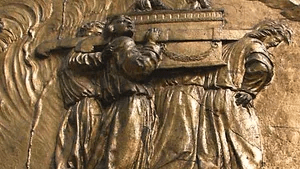
Transporting the Ark of the Covenant, Cathedral of Sainte-Marie, Auch, France

Now the Israelites went out to fight against the Philistines. The Israelites camped at Ebenezer, and the Philistines at Aphek. The Philistines deployed their forces to meet Israel, and as the battle spread, Israel was defeated by the Philistines, who killed about four thousand of them on the battlefield. When the soldiers returned to camp, the elders of Israel asked, “Why did the Lord bring defeat on us today before the Philistines? Let us bring the ark of the Lord’s covenant from Shiloh, so that he may go with us and save us from the hand of our enemies.”

So the people sent men to Shiloh, and they brought back the ark of the covenant of the Lord Almighty, who is enthroned between the cherubim. And Eli’s two sons, Hophni and Phinehas, were there with the ark of the covenant of God.

When the ark of the Lord’s covenant came into the camp, all Israel raised such a great shout that the ground shook. Hearing the uproar, the Philistines asked, “What’s all this shouting in the Hebrew camp?”

When they learned that the ark of the Lord had come into the camp, the Philistines were afraid. “A god has come into the camp,” they said. “Oh no! Nothing like this has happened before. We’re doomed! Who will deliver us from the hand of these mighty gods? They are the gods who struck the Egyptians with all kinds of plagues in the wilderness. Be strong, Philistines! Be men, or you will be subject to the Hebrews, as they have been to you. Be men, and fight!”

So the Philistines fought, and the Israelites were defeated and every man fled to his tent. The slaughter was very great; Israel lost thirty thousand foot soldiers. The ark of God was captured, and Eli’s two sons, Hophni and Phinehas, died.

That same day a Benjamite ran from the battle line and went to Shiloh with his clothes torn and dust on his head. When he arrived, there was Eli sitting on his chair by the side of the road, watching, because his heart feared for the ark of God. When the man entered the town and told what had happened, the whole town sent up a cry.

Eli heard the outcry and asked, “What is the meaning of this uproar?”

The man hurried over to Eli,who was ninety-eight years old and whose eyes had failed so that he could not see. He told Eli, “I have just come from the battle line; I fled from it this very day.”

Eli asked, “What happened, my son?”

The man who brought the news replied, “Israel fled before the Philistines, and the army has suffered heavy losses. Also your two sons, Hophni and Phinehas, are dead, and the ark of God has been captured.”

When he mentioned the ark of God, Eli fell backward off his chair by the side of the gate. His neck was broken and he died, for he was an old man, and he was heavy. He had led Israel forty years.

His daughter-in-law, the wife of Phinehas, was pregnant and near the time of delivery. When she heard the news that the ark of God had been captured and that her father-in-law and her husband were dead, she went into labor and gave birth, but was overcome by her labor pains. As she was dying, the women attending her said, “Don’t despair; you have given birth to a son.” But she did not respond or pay any attention.

She named the boy Ichabod, saying, “The Glory has departed from Israel”—because of the capture of the ark of God and the deaths of her father-in-law and her husband. She said, “The Glory has departed from Israel, for the ark of God has been captured.” (New International Version)

It was a really bad day. Yet, it wasn’t a day disconnected from other days. This particular day had been coming for quite some time.

The Philistines and the Israelites were continually going at each other. They had been enemies for a long time. But the Philistines were only the surface problem. The real issue had been building ever since Eli and his sons Hophni and Phineas were the priests in Israel.

They were tasked with the sacred responsibility of caring for the Tabernacle – the tent which housed the Ark of the Covenant – and attending to the people’s worship and sacrifices. But they had been terribly irresponsible in their work. As biblical readers, we are meant to feel the building tension of inevitable divine intervention of judgment against the injustice that was happening.

In one of the many military battles which took place against the Philistines, the Israelites suffered loss. So, someone had the bright idea of perhaps getting God involved. No one perceived, however, the involvement the Lord was planning. God was ready to deal with the wickedness in Israel.

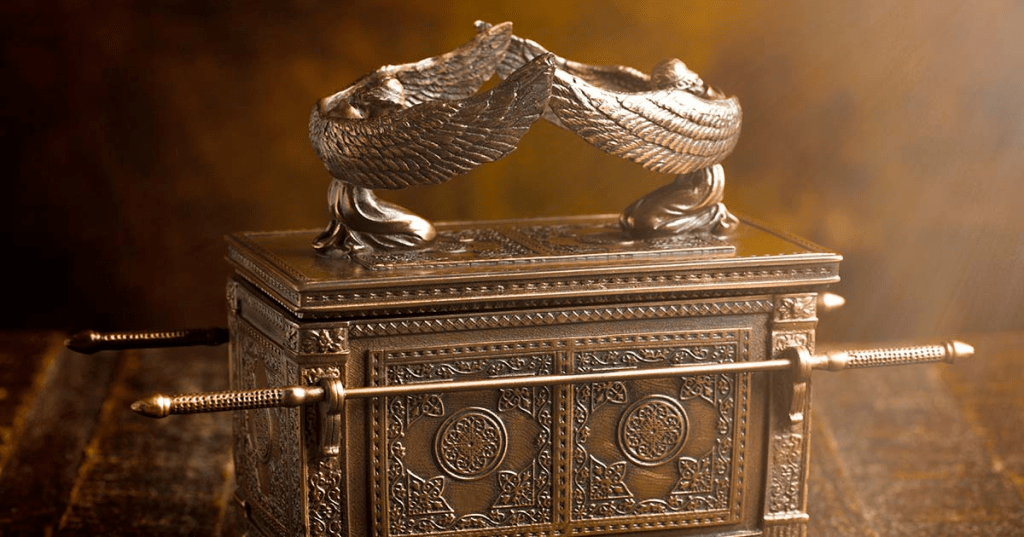
The Ark of the Covenant was brought from Shiloh to the front lines. This, of course, meant that the persons who handled sacred objects, Hophni and Phineas, would have to be the ones who bring it. We sense as readers that in spite of the Ark’s symbolism of God’s presence with the Israelites, this move isn’t going to end well for Israel.

The story is leading us to an important point: Faithfulness to the invisible God is much more important and powerful than a visible sacred object. The Ark of the Covenant is a symbol of what is right and just; it is not a supernatural talisman to ward off a bad and stressful situation.

Many in Israel were faithful to the Lord. Israel’s leaders, however, were not. In an age old story that has kept repeating itself up to the present time, the people keep supporting a bad government which does not serve the common good of all persons; it only serves itself.

What is interesting here is that God neither fights against the Philistines, nor the Israelites. The Lord simply didn’t show up. God was absent and did not help Israel. The divine intervention turned out to be no intervention at all.

The entire Ark of the Covenant plan completely backfired. The Philistines, understanding the brevity of the situation, were emboldened to fight like never before – thus bringing devastation on the battlefield to Israel. The narrator takes note to let us know the impact this has on the old priest Eli, his two sons, and the rest of that family.

Superstition will get us nowhere – especially when we are looking for solutions to problems we created for ourselves by ignoring righteousness and justice. The hard work of doing what is right cannot be substituted with magic.

There is big difference between believing in God and becoming superstitious and wanting easy solutions to complex problems. God is not, cannot, and will not be contained in a box – even if it’s the Ark of the Covenant.

Eternal God, in whose perfect kingdom no sword is drawn but the sword of righteousness, no strength known but the strength of love: So mightily spread abroad your Spirit, that all people may be gathered under the banner of the Prince of Peace, as children of one Father; to whom be dominion and glory, now and forever. Amen.

Mercy Is Coming (Micah 7:8-20)

“Justice Tempered with Mercy,” an oil painting by Emil Bisttram, 1936

Do not rejoice over me, my enemy,
        because when I fall, I will rise;
            if I sit in darkness, the Lord is my light.
I must bear the raging of the Lord,
    for I have sinned against him,
        until he decides my case and provides justice for me.
    He will bring me out into the light;
        I will see by means of his righteousness.
    Then my enemy will see;
        shame will cover her who said to me:
            “Where is the Lord your God?”
    My eyes will see her ruin;
        now she will become something to be trampled,
            like mud in the streets.

A day for the building of your walls!
        On that day, the boundary will be distant.
        On that day, they will come to you from Assyria and the cities of Egypt,
            from Egypt to the River,
            from sea to sea,
            and from mountain to mountain.
And the earth will become desolate because of her inhabitants,
        because of the fruit of their actions.

Shepherd your people with your staff,
        the sheep of your inheritance,
        those dwelling alone in a forest in the midst of Carmel.
    Let them graze in Bashan and Gilead, as a long time ago.

As in the days when you came out of the land of Egypt,
        I will show Israel wonderful things.

Nations will see and be ashamed of all their strength;
        they will cover their mouths;
        their ears will be deaf.

They will lick dust like the snake,
        like things that crawl on the ground.
They will come trembling from their strongholds to the Lord our God;
        they will dread and fear you!
Who is a God like you, pardoning iniquity,
        overlooking the sin of the few remaining for his inheritance?
    He doesn’t hold on to his anger forever;
        he delights in faithful love.
He will once again have compassion on us;
        he will tread down our iniquities.
You will hurl all our sins into the depths of the sea.
You will provide faithfulness to Jacob, faithful love to Abraham,
        as you swore to our ancestors a long time ago. (Common English Bible)

The prophecy of Micah was directed to the people because of the nation’s messed up social and political relations. Unrighteousness had thoroughly drenched the land. In this situation, the nation groaned; Micah responded to them and interceded for the people; God agreed with it all; and Micah concluded with a theological reminder of who God is and what God is like.

The nation of Israel was in a bad way during the eighth century B.C.E. because of their injustice toward one another. The leaders only thought of themselves, and not the people as a whole. Unfaithfulness ran so deep that not even one’s closest friends or relatives could be trusted.

To be a faithful and righteous person during that time required a resolve to wait for God’s deliverance – because there was no way any one person or group of people could fix any of it.

And this is the nature of hope – it can only be understood and realized by knowing, sensing, and feeling hopelessness in all of its despair. We do not hope for something we already possess.

The prophet Micah recognized the situation of the nation for what it was, as well as the consequences to having injustice throughout the land. Yet, he also looked forward to a time when God’s wrath will move from God’s people to the people’s enemies.

It may seem as if the Lord is either slow, not paying attention, or doesn’t care; but God’s timing is not the same as ours. Divine deliverance will come when divine deliverance will come.

The circumstances of Israel’s national sins were ripe not only for God’s judgment, but also for Micah’s prayers on behalf of the people. He called on the Lord to shepherd Israel, while at the same time, to put Israel’s enemies in their place.

And God, out of the storehouse of divine mercy, granted an assurance of pardon.

But if we confess our sins, he is faithful and just to forgive us our sins and cleanse us from everything we’ve done wrong. (1 John 1:9, CEB)

Micah affirmed the grace and mercy of God. He had the confident expectation that the Lord would cast all of Israel’s sins into the depths of the sea. Guilt, shame, and despair will not have the last word; the final word belongs to mercy.

Into a world full of cynicism and sarcasm, hopelessness and despair, it is vitally important that we have faithful and godly individuals who have a settled hope. This is what it means to be a remnant, a small minority of people who hold onto that which is just, right, and good.

We are to quietly go about our business of bringing justice, mercy, and love to this world with a quiet and confident expectation that God’s grace will overcome and overwhelm everything in its path.

Most merciful God, we confess that we have sinned against you in thought, word, and deed, by what we have done, and by what we have left undone. We have not loved you with our whole heart; we have not loved our neighbors as ourselves. We are truly sorry and we humbly repent. For the sake of your Son Jesus Christ, have mercy on us and forgive us; that we may delight in your will, and walk in your ways, to the glory of your Name. Amen.