
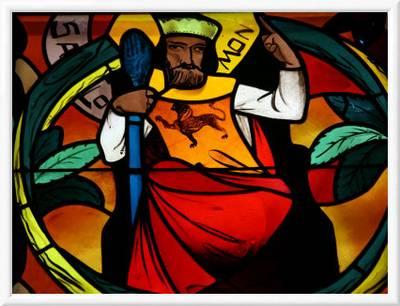
1 Kings 3:5-14 – A Prayer for Discernment

Stained glass window of King Solomon in Saint-Joseph Des Fins Church, France

The Lord appeared to Solomon at Gibeon in a dream at night. God said, “Ask whatever you wish, and I’ll give it to you.”

Solomon responded, “You showed so much kindness to your servant my father David when he walked before you in truth, righteousness, and with a heart true to you. You’ve kept this great loyalty and kindness for him and have now given him a son to sit on his throne. And now, Lord my God, you have made me, your servant, king in my father David’s place. But I’m young and inexperienced. I know next to nothing. But I’m here, your servant, in the middle of the people you have chosen, a large population that can’t be numbered or counted due to its vast size. Please give your servant a discerning mind in order to govern your people and to distinguish good from evil, because no one is able to govern this important people of yours without your help.”

It pleased the Lord that Solomon had made this request. God said to him, “Because you have asked for this instead of requesting long life, wealth, or victory over your enemies—asking for discernment so as to acquire good judgment— I will now do just what you said. Look, I hereby give you a wise and understanding mind. There has been no one like you before now, nor will there be anyone like you afterward. I now also give you what you didn’t ask for: wealth and fame. There won’t be a king like you as long as you live. And if you walk in my ways and obey my laws and commands, just as your father David did, then I will give you a very long life.” (Common English Bible)

You will recognize today’s Old Testament lesson as being the same as yesterday – just in a different book of the Bible. The books of 1 and 2 Chronicles are a restatement and edited version of 1 and 2 Kings. That’s because each was written in a different time for a particular context. Kings was compiled at the time of the Jewish exile when the Babylonians captured Jerusalem. Chronicles was put together for the exiles returning to Jerusalem.

Both accounts were meant to be lessons in how to live rightly as God’s people. For the people going into exile, the Kings narrative was to serve as a remembrance of how far the people had strayed from their roots in basic life wisdom.

“It is said that wisdom lies not in seeing things, but seeing through things.”

Manly P. Hall

Solomon was a very wise king. And today’s lesson makes it clear why. At the outset of his reign, Solomon could have asked for anything from God. A typical request might be for power in subduing enemies, popularity for appealing to the masses, or perks for maintaining political stability. 

Instead, Solomon asked for understanding and wisdom to govern God’s people so that he could discern between good and evil. It was the kind of asking which the Lord was pleased to hear and to give. All these millennia later, Solomon still has the reputation of being the wisest king that ever lived.

Solomon’s prayer resonates with me. As a church pastor, rather than focusing prayers on a bigger budget, more people reached, or adding programs, I can make the choice to pray for wisdom so that I will have my ministerial ladder on the right wall. 

As a hospital chaplain, instead of praying for greater visibility of the spiritual in healthcare, increased impact within the system, or more healing of patients, I can pray for understanding so that I will be able to make sound ethical, practical, and ministerial decisions in each context and case I encounter.

Solomon’s request was borne of a clear realization of who God is (the One who shows steadfast love) and who he himself is (like a little child with a big responsibility). God’s greatness and Solomon’s humility collided in a wonderful prayer for discernment to carry out God’s will on earth and to bless God’s people.

In this time of year, in which it is vogue to make New Year’s resolutions based upon the individual’s willpower, let’s take a different approach. Let’s pray and invite God to do the kind of deep change needed in our lives so that we can accomplish the will of God on this earth for this time. 

May we pray for discernment to serve well, ask for wisdom to be good stewards of our callings, and seek understanding from the God who delights in answering altruistic requests from humble people.

May you walk in the way of wisdom so that you will make good decisions and act in all good understanding.

Lord God, give me a mind and heart of wisdom so that I might rightly discern good and evil, right and wrong, and the best decisions to made in every situation. I choose to seek your ways and follow the narrow way of Jesus Christ through the enablement of your Holy Spirit. Amen.

Job 39:1-30 – Questions without Answers

God responds to Job out of the whirlwind by William Blake (1757-1827)

When do mountain goats
    and deer give birth?
Have you been there
    when their young are born?
How long are they pregnant
    before they deliver?
Soon their young grow strong
and then leave
    to be on their own.

Who set wild donkeys free?
I alone help them survive
    in salty desert sand.
They stay far from crowded cities
    and refuse to be tamed.
Instead, they roam the hills,
    searching for pastureland.

Would a wild ox agree
to live in your barn
    and labor for you?
Could you force him to plow
or to drag a heavy log
    to smooth out the soil?
Can you depend on him
to use his great strength
    and do your heavy work?
Can you trust him
    to harvest your grain
or take it to your barn
    from the threshing place?

An ostrich proudly
    flaps her wings,
but not because
    she loves her young.
She abandons her eggs
and lets the dusty ground
    keep them warm.
And she doesn’t seem to worry
that the feet of an animal
    could crush them all.
She treats her eggs as though
    they were not her own,
unconcerned that her work
    might be for nothing.
I myself made her foolish
    and without common sense.
But once she starts running,
she laughs at a rider
    on the fastest horse.

Did you give horses their strength
and the flowing hair
    along their necks?
Did you make them able
    to jump like grasshoppers
or to frighten people
    with their snorting?

Before horses are ridden
    into battle,
they paw at the ground,
    proud of their strength.
Laughing at fear, they rush
    toward the fighting,
while the weapons of their riders
    rattle and flash in the sun.
Unable to stand still,
they gallop eagerly into battle
    when trumpets blast.
Stirred by the distant smells
and sounds of war,
they snort
    in reply to the trumpet.

Did you teach hawks to fly south
    for the winter?
Did you train eagles to build
    their nests on rocky cliffs,
where they can look down
    to spot their next meal?
Then their young gather to feast
    wherever the victim lies. (Contemporary English Version)

God has a way of asking questions for which he already has answers to.

The older I get, and the more understanding I gain, the more I realize how little knowledge I truly possess. When I was eighteen years old, I thought I had the world pretty much figured out. Since then, it has all been downhill. With each passing year, my ignorance seems to grow exponentially.

I suppose this all really makes some sense when talking about God’s upside-down kingdom. So much more of life is a mystery to us than we realize. Turns out that those with understanding need to become stupid before they can truly be wise. Seems like the biblical character of Job found this out the hard way.

If there is any person in Holy Scripture that would be wise and understanding, its him. God speaks highly of Job in the Bible. Regarding the upcoming destruction of Jerusalem, God said, “even if these three men—Noah, Daniel and Job—were in it, they could save only themselves by their righteousness, declares the Sovereign Lord” (Ezekiel 14:14). Job is held up the model of patience under suffering: “As you know, we count as blessed those who have persevered. You have heard of Job’s perseverance and have seen what the Lord finally brought about. The Lord is full of compassion and mercy” (James 5:11).

Yet, with all of Job’s integrity, patience, and righteousness his understanding can barely get a movement on the Richter Scale of God’s expansive knowledge. Being a conscientious follower of God, Job is careful to live uprightly. He acknowledges God in all things and worships him alone. Yet, suffering befell him – for no other reason than that God allowed it. Job knew fully well that there was no personal sin behind his awful ordeal of grief and grinding pain.

So, Job contended with God. For an agonizing thirty-five chapters (Job 3:1-37:24) Job questions God and respectfully takes him to task – as Job’s supposed friends questioned him and assume his guilt. Through it all God is there… silent, saying nothing….

Then, just when we think God is paying no attention, he suddenly speaks. And what is so remarkable about God’s speech is that for four chapters God gives no answers (Job 38:1-41:34). It is all questions. God said, “Brace yourself like a man; I will question you and you shall answer me” (Job 38:3).

It becomes abundantly clear after just a few questions that it would be impossible for any human being to even come close to having the understanding to answer anything God asks. And that was the whole point. God is God, and we are not. Our questions, however legitimate, real, and raw they are, come from a very puny perspective.

We just don’t know as much as we think we do.

To Job’s great credit, he keeps his mouth shut and listens. At the end of the questioning, Job responds in the only wise way one could after such an encounter: “Surely I spoke of things I did not understand, things too wonderful for me to know” (Job 42:3).

None of this means that, for us, we need to face our hardships and our sufferings with a stoic keep-a-stiff-upper-lip approach. Trapped grief will inevitably come out sideways and only cause more hurt.

I believe God allowed Job to express his terrible physical, emotional, and spiritual pain for chapter after chapter because he needed to. Only when God sensed it was the proper timing did he jump in and bring the perspective Job then needed. And even after being challenged by God about his vantage point, Job still did not receive answers as to why he had to endure the awfulness of loss beyond what most of us could comprehend.

It just might be that, even if God directly answered all our questions, we still would not understand what the heck is happening to us.

Most likely, God protects us from knowing things that might bring irreparable damage to our human psyches. Yet, this is all pure conjecture. Which leaves us with perhaps one of our greatest challenges as human beings: We must eventually come to the place of being comfortable with mystery – and even embracing it. We simply will not have all things revealed to us that we want to know. And that’s okay.

Anytime we try to pin God down to nice, neat, understandable categories, he typically colors outside our human contrived lines and demonstrates he cannot be contained in our ramshackle box.

God is unbound by any human knowledge, understanding, ideas, or plans. God will do what God will do. God will be who God will be. “I Am who I Am,” he once said. Now that’s a God I can put my trust in.

O Lamb of God that takes away the sins of the world, have mercy upon me.

O Lamb of God that takes away the sins of the world, have mercy upon me.

O Lamb of God that takes away the sins of the world, grant me your peace. Amen.

Proverbs 9:1-6 – Lady Wisdom’s Invitation

Divine Wisdom by Shiloh Sophia McCloud

Wisdom has built her house
    with its seven columns.
She has prepared the meat
and set out the wine.
    Her feast is ready.

She has sent her servant women
    to announce her invitation
    from the highest hills:
“Everyone who is ignorant
    or foolish is invited!
    All of you are welcome
    to my meat and wine.
If you want to live,
    give up your foolishness
    and let understanding
    guide your steps.” (CEV)

Wisdom is personified as a wise woman calling out to us. Her message is a passionate appeal to take the path of insight through God’s revealed will. She encourages us to leave our simple ways and walk in the way of insight. 

The word “wisdom” in Scripture is the careful application of God’s Word to concrete situations in our lives. During our daily life, paying attention to wisdom and following her instructions is vital to experiencing success in the Christian walk, and in all of life.

Obstructing the ability to listen for wisdom’s call is the fact that too many people are downright impatient. The deliberate ways of wisdom take far too much time for them. They want the bottom-line, the skinny on wisdom. However, to let wisdom teach us her ways, we need to slow down enough to hear, accept, and engraft wise practices of living. Working and living harder and faster when we encounter difficulties only betrays our great need for Lady Wisdom’s instruction.

It is the immature simpleton who refuses to wait on the lessons that wisdom wants to impart. Wisdom cannot be gained quickly. Her teachings are learned slowly with careful application over time. Wisdom is something of a marinade, and if we don’t allow the proper time, we are unable to live well. We will then, at best, be bland and dull, and at worst, be an unsavory presence in the world.

Another foolish obstacle to receiving wisdom is the search for simple solutions to complex problems. Wisdom calls us to leave such ineffective and short-sighted ways and take the high road of consultation, collaboration, and humble learning.

Rather than always rush to Google for answers to our questions; instead of allowing another person to make decisions for us; in place of implementing sheer pragmatic plans, please allow wisdom to penetrate the mind and heart so that what comes out is thoroughly godly and biblical. 

Where is the place to start? Reverence of the Lord is the beginning of wisdom, and knowledge of the Holy One is insight. There is no substitute to committing oneself to the regular and daily regimen of reading God’s Holy Word and seeking to put it into practice.

All-Wise God, the One who is never in a hurry, create in me a wise mind and heart.  Help me to sit still long enough for wisdom to bring biblical and spiritual maturity to my life, through Jesus Christ in the power of the Holy Spirit.  Amen.
