2 Chronicles 1:7-13 – Ask for Wisdom

“Dream of Solomon” by Luca Giordano, 1693

God appeared to Solomon that night in a dream and said, “Solomon, ask for anything you want, and I will give it to you.”

Solomon answered:

Lord God, you were always loyal to my father David, and now you have made me king of Israel. I am supposed to rule these people, but there are as many of them as there are specks of dust on the ground. So, keep the promise you made to my father and make me wise. Give me the knowledge I’ll need to be the king of this great nation of yours.

God replied:

Solomon, you could have asked me to make you rich or famous or to let you live a long time. Or you could have asked for your enemies to be destroyed. Instead, you asked for wisdom and knowledge to rule my people. So, I will make you wise and intelligent. But I will also make you richer and more famous than any king before or after you.

Solomon then left Gibeon and returned to Jerusalem, the capital city of Israel. (Contemporary English Version)

Maybe it’s just me but I don’t often hear the word “wisdom” used in normal conversation.

I certainly don’t hear wisdom mentioned in talking about politicians, corporate executives, or even church leaders. “Oh, the Congressman is so wise!” “Isn’t that CEO a wonderfully sage person?” “My Pastor is full of wisdom!” You might even be laughing at this point because those kinds of statements just aren’t part of our daily interactions with others. 

We are more likely to say that somebody is full of something else other than wisdom. Yet, all the aforementioned statements could be said about King Solomon. The guy was wise, in fact, the wisest person that ever lived.

“Wise men talk because they have something to say; Fools , because they have to say something.”

Plato (424-348 B.C.E.)

Wisdom is the ability to put truth into practice. It is to see everything and everyone from God’s perspective. Wisdom is to have a solid base of knowledge, along with the skill set to use it for godly and constructive purposes. 

Solomon had a load of it. The really important thing to note from today’s Old Testament lesson is how Solomon obtained such wisdom. It came from God. Solomon asked for it, and he got it.

Anyone who needs wisdom should ask God, whose very nature is to give to everyone without a second thought, without keeping score. Wisdom will certainly be given to those who ask. (James 1:5, CEB)

Maybe the reason why so many people today are not characterized as wise is because they rely on their own ingenuity and hard work. Asking for wisdom may not even on their mind. Their radical independence prevents them from obtaining the wisdom needed.

In a world of dire straits, where significant problems often overshadow effective solutions, wisdom is needed more than ever. So, like Solomon of old, ask for wisdom and knowledge from God. 

We all are in some position of governing or overseeing others, whether it is being a parent, a faith community leader, or in charge of something at work. Everyone needs wisdom. 

Just ask. Be free to seek. Go ahead and knock on the door. Jesus said:

“Keep on asking, and you will receive what you ask for. Keep on seeking, and you will find. Keep on knocking, and the door will be opened to you. For everyone who asks, receives. Everyone who seeks, finds. And to everyone who knocks, the door will be opened.” (Matthew 7:7-8, NLT)

For all people everywhere, and in every circumstance, ask God for the ability to know the truth and put it into practice. Wisdom isn’t optional; it’s absolutely necessary to living a good life.

Get wisdom, get understanding;
    do not forget my words or turn away from them.
Do not forsake wisdom, and she will protect you;
    love her, and she will watch over you.
The beginning of wisdom is this: Get wisdom.
    Though it cost all you have, get understanding. (Proverbs 4:5-7, NIV)

Wise God, you know all things and how everything works. Give me wisdom and knowledge so that your purposes and plans might be accomplished in and through me for every situation to the glory of Jesus Christ in the power of your Holy Spirit. Amen.


Isaiah 59:9-19 – (Un)Truth in the Public Square

Because of all this, justice is far from us,
    and righteousness beyond our reach.
We expect light, and there is darkness;
    we await a gleam of light, but walk about in gloom.
We grope along the wall like the blind;
    like those without eyes we grope.
We stumble at noonday as if it were twilight,
    and among the strong as if we were dying.
All of us growl like bears,
    and like doves we moan.
We expect justice, but there is none;
    we await salvation, but it is far from us.
Our rebellions are numerous in your presence;
    our sins testify against us.
Our rebellions are with us;
    we’re aware of our guilt:
    defying and denying the Lord,
    turning away from our God,
    planning oppression and revolt,
    muttering lying words conceived in our minds.
Justice is pushed aside;
    righteousness stands far off,
    because truth has stumbled in the public square,
    and honesty can’t enter.
Truth is missing;
    anyone turning from evil is plundered.

The Lord looked and was upset at the absence of justice.
Seeing that there was no one,
    and astonished that no one would intervene,
    God’s arm brought victory,
    upheld by righteousness,
    putting on righteousness as armor
    and a helmet of salvation on his head,
    putting on garments of vengeance,
    and wrapping himself in a cloak of zeal.
God will repay according to their actions:
    wrath to his foes, retribution to enemies,
    retribution to the coastlands,
    so those in the west will fear the Lord’s name,
    and those in the east will fear God’s glory.
It will come like a rushing river
    that the Lord’s wind drives on. (Common English Bible)

It is telling that when the word “politics” is used today, we immediately think of other words like, “polarized” “rancorous” and “corrupt.” The word “statecraft,” that is, the positive use of politics as a vocation in serving the common good of all persons, seems now like some anachronistic concept of the past.

Isaiah the prophet may have spoken over two millennia ago, yet his words are eerily relevant today, when he said, “Truth has stumbled in the public square.”

Politics, today as in Isaiah’s day, has become less about unselfish public servants promoting the welfare of citizens, and more about winning elections and possessing power. 

A party spirit rules the day, where, in the Unites States, Republicans and Democrats are more divided than ever with less and less ability to truly listen to one another in order to advance genuine justice, ethical righteousness, and social peace within both the nation and the world.

We, as citizens of both our local regions and of the world, must avoid getting sucked into the vortex of acrimonious speech and hate-filled rhetoric. 

Christians, especially those who desire to live and love like Jesus, need to be at the forefront of forsaking the hypocrisy of saying one thing and doing another; of envying power in order to satisfy personal agendas; and, of believing that malicious talk is justified if it accomplishes my wants and needs. 

We are not to keep looking for politicians, and everyone else whom we disagree with, to change. Rather, we ourselves are to practice repentance and allow the grace of God to transform and renew us. 

If what we speak in the public square is selfish and deceitful, we have no further to look than within, when it comes to turning from evil. A slow, careful, and serious reading of the prophet Isaiah is quite necessary. If it does not lead to repentance, we only have God’s displeasure to anticipate.

So, instead of continually insisting that others change or move over, let’s focus on us and seek the following:

  • Seek our better angels of humility, tolerance, and patience to guide our public discourse.
  • Open our eyes to see the image of God in others who are different from us and who see the world differently than we do.
  • Embrace civility and basic human respect for all persons, no matter who they are, as our presuppositions to all conversations.
  • Develop good listening skills so that we aren’t misinterpreting and misrepresenting another’s viewpoint.
  • Be willing, within our own communities of faith, to participate and worship together as the one people of God, without assigning other identities to each other which are not helpful.
  • Enlarge our hearts so that we are big enough people to hold the differing perspectives and politics of others without demonizing them.
  • Default to grace when we aren’t sure what to do say or do.

The Lord will not contend forever with injustice and unrighteousness in the world’s politics, including the extremely local politics of church, family, and neighborhood. Divine intervention cuts both ways, bringing deliverance and freedom, as well as judgment and retribution.

Let us, then, be found to be truthful and honest in all our words and ways; encouraging and helpful in all our public service; and seeking the peace of everyone in our own relational orbits.

Great God of truth and justice, you have every right to judge the world. Yet, instead of destroying the earth, you sent your Son to redeem lost humanity to yourself. May I, along with every creature you have made, come to our senses and speak truth with grace and act with integrity so that there is again righteousness throughout the land. Amen.

Luke 16:19-31 – Does God Know Your Name?

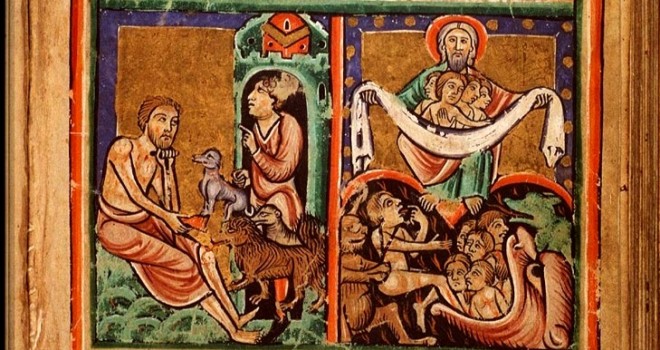
The Rich Man and Lazarus, from a French pictorial Bible, c.1200 C.E.

“There was a rich man who was dressed in purple and fine linen and lived in luxury every day. At his gate was laid a beggar named Lazarus, covered with sores and longing to eat what fell from the rich man’s table. Even the dogs came and licked his sores.

“The time came when the beggar died, and the angels carried him to Abraham’s side. The rich man also died and was buried. In Hades, where he was in torment, he looked up and saw Abraham far away, with Lazarus by his side. So, he called to him, ‘Father Abraham, have pity on me and send Lazarus to dip the tip of his finger in water and cool my tongue, because I am in agony in this fire.’

“But Abraham replied, ‘Son, remember that in your lifetime you received your good things, while Lazarus received bad things, but now he is comforted here, and you are in agony. And besides all this, between us and you a great chasm has been set in place, so that those who want to go from here to you cannot, nor can anyone cross over from there to us.’

“He answered, ‘Then I beg you, father, send Lazarus to my family, or I have five brothers. Let him warn them, so that they will not also come to this place of torment.’

“Abraham replied, ‘They have Moses and the Prophets; let them listen to them.’

“‘No, Father Abraham,’ he said, ‘but if someone from the dead goes to them, they will repent.’

“He said to him, ‘If they do not listen to Moses and the Prophets, they will not be convinced even if someone rises from the dead.’”  (New International Version)

Everyone looks for a miracle at some point in life, especially for family. Whenever we see relatives walking far from God or siblings living without much thought to the words and ways of Jesus, it can be disconcerting. We may reason that if they could just experience or see some great miracle, then they will surely believe and embrace Christ. 

Yet, Jesus’ parable to us of the rich man and Lazarus graphically depicts an important message: God has already revealed divinity to humanity through Moses and the Prophets (the Old Testament). If people are not convinced by what already exists and is, they will not respond when the miraculous slaps them in the face.

Maybe we too often look for the dramatic because the mundane typically rules the day. Perhaps what we are looking for is already present in God’s revelation to us. It could be that the greatest task we have is not to beg for a miracle (even though there is nothing wrong with that!) but first to be quiet and listen to the Spirit of God speak through the Word of God so that our prayers to God arise in God’s way and God’s time.

Today’s Gospel story gets at the heart of where we immediately and reflexively turn when in dire straits. There is nothing wrong with turning to others, consulting trusted resources, or even Google. Yet, Holy Scripture is timeless. It contains everything we need for life and godliness in this present age. And I believe it has the answers to life’s most pressing questions.

Everyone has their trusted sources, as well as sources we don’t trust. If a person has had a pattern of not consulting or trusting the source material of Scripture, then it doesn’t matter who encourages them, even if it is a trusted person who shows up from the grave, to look into the Bible’s contents and believe it’s message.

If we look closely at the story, we are told the poor man’s name: Lazarus. And we are not told the rich man’s name. You see, the poor man, Lazarus, had his name written in the Book of Life. The rich man’s name cannot be spoken because it is not found there.

There are two opposite choices in life. One is to choose pleasure and overlook the great needs of the earth. Like old Jacob Marley in the Christmas Carol, it is to forge a chain, link by link, day after day, which will eventually leave one in bondage and regret.

The other choice is hope. To look ahead by faith and see the eternal things which are coming, then shaping our existence to act in sync with permanent values, is to choose life. Although this may bring deprivation, even suffering, in this present existence, the decision to forego temporary pleasure for eternal glory shall be rewarded. It is to live for future prosperity through present affliction.

So, how shall we then live?

Will we anchor our souls in the good bosom of bettering our fellow humanity?

Is there an acknowledgment that the measure we give to others shall eventually be given to us?

Do we seek to hold faith with a neighbor in his poverty?

Are we trusting so much in our five senses – sight, smell, taste, hearing, touch – that we either cannot or will not trust in the sixth sense of the spirit which tells us to believe Moses and the prophets?

Christ has risen. Christ is coming again. If we align our lives with spiritual truth, we shall find our names written in the Book of Life. Let us actively look for Lazarus in our lives, so that we don’t carelessly step over him day after day while selfishly indulging in the good things of this life.

Mighty God, you have done miraculous things. Help me see what you have already done and teach me to listen so that your revelation becomes alive to me. Holy Spirit, impress the redemptive event of Christ’s resurrection on the hearts of all who do not know you so that they might know your amazing grace. Amen.

1 John 2:18-25 – Who Is the Antichrist?

Dear children, this is the last hour; and as you have heard that the antichrist is coming, even now many antichrists have come. This is how we know it is the last hour. They went out from us, but they did not really belong to us. For if they had belonged to us, they would have remained with us; but their going showed that none of them belonged to us.

But you have an anointing from the Holy One, and all of you know the truth. I do not write to you because you do not know the truth, but because you do know it and because no lie comes from the truth. Who is the liar? It is whoever denies that Jesus is the Christ. Such a person is the antichrist—denying the Father and the Son. No one who denies the Son has the Father; whoever acknowledges the Son has the Father also.

As for you, see that what you have heard from the beginning remains in you. If it does, you also will remain in the Son and in the Father. And this is what he promised us—eternal life. (New International Version)

Throughout Christian history there have been churches, ministers, and individuals who have advanced certain persons as being the “antichrist,” enemies of Christ and his followers.  

Attempting to identify a particular enemy comes from a theological disposition that believes an antichrist is the first link in a chain of end-times events. Typically, a ruthless or dictatorial ruler, like Mussolini, Hitler, or Stalin received the label of “antichrist.” 

For some Protestants, the papacy continually gets set apart as being the antichrist. Seems like, ever since the Reformation, the Pope has received the dubious title from anti-Catholics. Today, it is standard fare for some evangelical end-times watchers to bemoan the state of the world and lay the blame in a particular person who is outside their own little group. 

Yet, the term “antichrist” has not typically been used as a title for one enemy setting-off a bomb of world-ending trauma. The earliest church, following the teaching of the Apostle John, understood antichrist not as an individual, but as a class of people who deny Jesus is the Christ. 

Indeed, John plainly said the antichrist is anyone who forsakes the Father and the Son. What is so disturbing about John’s talk of antichrist is that these persons arise from within the church, not outside of it.   

It has become too vogue in some circles of Christian evangelicalism to identify and label enemies outside their small groups, leading to a xenophobic attitude of distrust and finger-pointing toward all kinds of people.  

The fingers, however, must first be directed within our own house. It behooves us all to take up the instruction of John to internalize and remember sound teaching. If what you heard from the beginning abides in you, then you too will abide in the Son and in the Father.   

We are to embrace basic core cardinal truth given us. Then we will not be deceived by some supposed enlightened teacher who detracts from Trinitarian theology.   

It is the last hour – but not because of some politician, tyrant, or even religious figure. It is the end-times because Jesus has accomplished redemption for us, and the only event left is the return of Christ to judge the living and the dead.   

Therefore, we must all live with the possibility and tension that it could be today. We are to be prepared. That preparation comes through proclaiming Jesus in all we say and do – not by obnoxiously foaming at the mouth, fearmongering, or pointing fingers at those we don’t like. Rather, we emulate our Lord in the way of loving God and neighbor. 

When a person or group gets labeled by us as “enemy” or “antichrist” then our hate for them seems divinely justified and sanctioned. God, however, is the judge; not us. We are to follow the ethical instruction of Jesus to love our enemies, not curse them through slapping a moniker of “monster,” “devil,” “animal,” or some other non-human label on them. 

Weaponizing words in a verbal war which supposedly defends Christianity only shifts the focus off Jesus and onto how horrible another is. One of the great problems of our world, including many corners of Christianity, is the assumption we already know what another believes. So, we fail to listen. We do not care as we ought because we’ve already formed our judgments. 

“The moment someone attaches you to a philosophy or a movement, then they assign all the baggage and all the rest of the philosophy that goes with it to you. And when you want to have a conversation, they will assert that they already know everything important there is to know about you because of that association. And that’s not the way to have a conversation.”

Neil deGrasse Tyson

Within Christianity, there is much more we have in common with one another across the various traditions than that which is different. Yes, spiritual charlatans exist. Let’s just make sure we have done our due diligence in listening to another and being curious before we form our opinions. 

Despite our differences, the exchange of ideas and debate among various Christian groups in the early centuries of the church helped to clarify and form orthodox Christology. While it may be difficult to avoid labeling individuals in an increasingly complex society, we must act in good faith. 

Mighty God, you sent the Son to this earth to fulfill all your good promises. Let me embrace Jesus so fully and completely that the truth of his reality comes pouring out of me in every area of my life.  In his name I pray. Amen.