Pride Comes Before the Fall (Luke 22:31-33, 54-62)

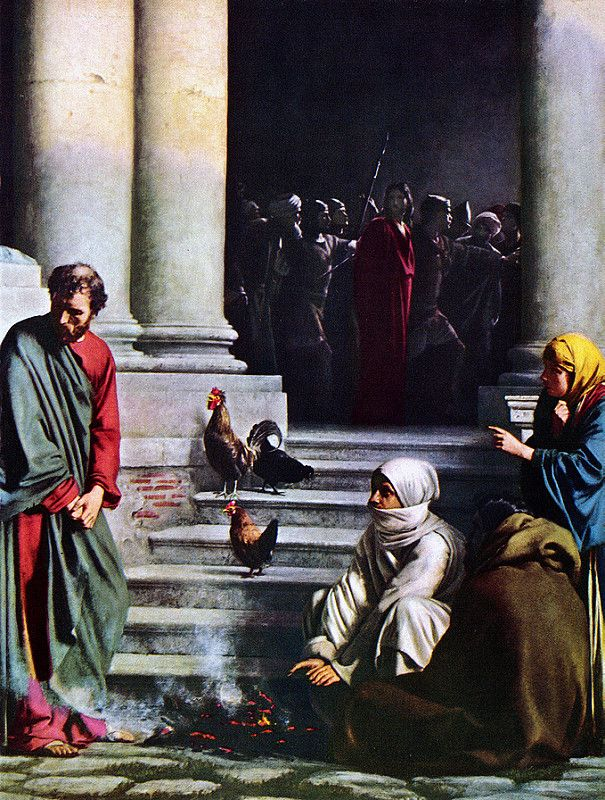
The Denial of Peter by Carl Bloch (1834-1890)

“Simon, Simon, Satan has asked to sift all of you as wheat. But I have prayed for you, Simon, that your faith may not fail. And when you have turned back, strengthen your brothers.”

But he replied, “Lord, I am ready to go with you to prison and to death….”

Then seizing Jesus, they led him away and took him into the house of the high priest. Peter followed at a distance. And when some there had kindled a fire in the middle of the courtyard and had sat down together, Peter sat down with them. A servant girl saw him seated there in the firelight. She looked closely at him and said, “This man was with him.”

But he denied it. “Woman, I don’t know him,” he said.

A little later someone else saw him and said, “You also are one of them.”

“Man, I am not!” Peter replied.

About an hour later another asserted, “Certainly this fellow was with him, for he is a Galilean.”

Peter replied, “Man, I don’t know what you’re talking about!” Just as he was speaking, the rooster crowed. The Lord turned and looked straight at Peter. Then Peter remembered the word the Lord had spoken to him: “Before the rooster crows today, you will disown me three times.”And he went outside and wept bitterly. (New International Version)

A Lesson In Trust

One day I watched a lifeguard handle a group of kids for their first time in the pool. She went to each one and told them to put their ears in the water and their belly buttons in the air while she was holding them up. “When I count to three, you won’t feel my hands underneath you, but they’re there,” she said. 

Most of the kids frantically jerked their knees toward their chins and flailed their arms.

Even though nearly all people float when they assume a posture of rest, many believe they’ll sink, and don’t keep their posture for long. 

The disciples had a hard time trusting Jesus. They couldn’t seem to rest and relax because Jesus said and did things that they were not expecting him to say and do. 

Jesus preached the necessity of humility and loving one’s enemies; and he focused on ministry to the least persons around them. The disciples had not yet really bought into Christ’s kingdom agenda because they kept pulling their knees up by thinking Jesus was going to lead a rebellion against the Romans and put Israel back on the map – believing it would be just like the old days of Jewish domination of the land.

But Jesus is all about a different agenda: transformation of the inner person that leads to greater submission to God’s will so that the least persons among us will be reached.

Bad News Before Good News

Many already believe they know what God wants and how to follow Jesus, and so, aren’t much open to the Spirit. They acknowledge they’re sinners, yet don’t believe their sin is as bad as others. “O, sure, we sin, but not like murderers and child molesters. Our sins are ‘respectable’– a little resentment, a little prejudice, and a little gossip is even necessary to make sure people submit to the unwritten rules.”

We must first hear the bad news before we can hear the good news. Once we hear the bad news and accept it, we must receive God’s remedy for it. In order to do this, let’s compare and contrast two disciples: Peter and Judas.

Peter’s Denial, 17th Century Ethiopian

Peter and Judas

Peter and Judas shared a similar vision about seeing Israel restored to its previous glorious prominence. Judas was a Zealot, ready to take military action, if necessary; and Peter had no problem taking up the sword when it seemed the time was ripe for a political rebellion and takeover.

Even though Peter insisted he would never turn on Jesus, Jesus knew better. And, sure enough, Peter did a full-fledged moral belly flop in the pool of denial by disowning Jesus three times.

Judas actually caught on, quicker than Peter, that Jesus wasn’t going to lead a military coup. Judas had enough of wasting time on poor marginalized people; they weren’t going to make good soldiers. After Judas clearly saw that Jesus had no intention of forcing an earthly political kingdom, he actively sought an opportunity to betray him.

Neither Judas or Peter, nor any of the disciples wanted to take a step into the world of suffering as the means of reaching others and embracing the kingdom of God. They wanted glory not suffering. But Jesus chose the cup of suffering.

Both Judas and Peter realized after denying Jesus that they had made a terrible mistake. But that is where the similarities end. 

Judas realized what he had done, and so, went out and died by suicide. Rather than throw himself upon the mercy of God, Judas tried to atone for his own sin. He tried to fix something that could not be undone. It was a refusal of grace.

Peter responded by weeping bitterly, consistent with someone experiencing repentance. He realized he was poor in spirit and mourned over his sin. Peter later becomes a genuinely meek person with God’s righteousness taking root within him as he, in the book of Acts, demonstrated mercy and became a preacher of truth and grace.

The Need for Transformation

There cannot be systemic and structural renewal without personal transformation. And there cannot be personal transformation without a brutally honest assessment of myself. “I will never fall,” comes from a heart of pride that believes “I’m not so bad.”

Our sins and failures stem ultimately from a lack of trust. We keep pulling our knees up because we are too anxious to let the agenda of Jesus control our lives. 

Proud people don’t pray much because they are self-sufficient. But humble people pray a lot because they don’t want to fall into temptation. They pray because they discern they’re prone to being like a cockeye little dog who thinks he is a big dog. 

Even Jesus felt the need to watch and pray so that he could face his hour of pain and suffering on behalf of all mankind.

Following Either Close or From a Distance

Jesus was arrested and Peter followed him at a distance. If we are brutally honest with ourselves, this too, describes much of our own following of Jesus. We want to see how everything will shake-out before we commit. 

Christ is asking us to trust him, to make and keep promises before we even know what it all means. We need to acknowledge and admit that we have commitment-it is; we have made a mess of our lives by our stubbornness and holding on to our own ideas for how we think things ought to go.

If you find yourself in a mess, whether it is of your own making or of somebody else, the only thing that can handle it is a close following of grace. We are to approach God with brutal honesty, humility, and a willingness to rest and relax when he is telling you to. 

The Lord will give you his righteousness; you need not try to obtain it on your own. So, let the knees go down and stick the belly button out – rest in Jesus.

Psalm 11 – Fight, Flight, Freeze, or Faith?

I have taken refuge in the Lord.
How can you say to me:
“Flee to your mountain like a bird?
Wicked people bend their bows.
They set their arrows against the strings
to shoot in the dark at people whose motives are decent.
When the foundations of life
are undermined,
what can a righteous person do?”

The Lord is in his holy temple.
The Lord’s throne is in heaven.
His eyes see.
They examine Adam’s descendants.
The Lord tests righteous people,
but he hates wicked people and the ones who love violence.
He rains down fire and burning sulfur upon wicked people.
He makes them drink from a cup filled with scorching wind.
The Lord is righteous.
He loves a righteous way of life.
Decent people will see his face. (God’s Word Translation)

We all know what it feels like to take the brunt of someone’s poison verbal darts. And it’s scary. What do you do? In a state of fear, shock, or panic, we will likely either fight, flight, freeze, or faith.

If you have ever received a nasty email based on half-truths and accusations; stood dumbfounded as someone hurled misinformation and criticism at you; and/or experienced the victimization that comes from slanderous and gossiping tongues, then the psalmist knows exactly how you feel. 

Cobbling together a hasty email response, full of anger and vitriol, only sucks us into the person’s evil ways. Metaphorically punching someone in the face for their slap to your face is how the demonic realm handles offenses. Fighting back with an equal or greater force is diametrically opposed to the way of Jesus in loving our enemies and praying for those who persecute us.

Then, there is the response of taking flight from the nastiness. Indeed, it sometimes seems as if good people are always getting swallowed whole by unjust words and behaviors directed squarely at them. And it doesn’t help when the downers among us stroll along and give us their unhelpful fatalism about how there is nothing we can do and how nothing will ever change.

For others, they are just plain dumbfounded that another person can be so mean or controlling, so they freeze, unable to speak or do anything. They end up suffering in silence, without their victimization having a voice.

To be the target of evil speech or malevolent actions is, at the least, unsettling, and, at worst, can bring years of struggle, depression, and inability to serve. Yet, there is someone who sees it all, and that someone will address the wrong. We have an option beyond fighting back in anger or fleeing altogether in fear. We can trust God.

The Lord sits aloft, overseeing all, and knows everything humanity does and says. God always does right and wants justice done. Everyone who shares a divine sense of what is right and just will see God’s face. God will act because the Lord abhors and despises those who are cruel and enjoy violence.

It’s not a good idea to get on God’s bad side. The way to flare God’s anger is by possessing an acerbic tongue; relishing in verbal violence; and, having no remorse about any of it. Because God loves people, God hates evil. The righteous are to take solace in the truth that God really does see the harm done and is in a position to do something about it. Like the psalmist, we seek the Lord. The Lord fights our battles.

Whenever we are harassed and the ungodly give us a hard time, the psalmist isn’t offering some nice religious platitudes such as, “Just let go and let God,” “Everything works for the good of those who love God,” or “It’s okay, you’ll be in heaven someday.”

In another context, maybe those statements are helpful. But being in the teeth of the wicked, all is not okay. As much as some folks try to sanitize an evil situation with rainbows and butterflies, the evil is real, and it’s there. The truth is that everything is not okay. The earth is filled with violence, malevolence, oppression, injustice, and systemic evil. The psalmist knows this, all too well.

Humble yourselves under God’s power so that he may raise you up in the last day. Throw all your anxiety onto him because he cares about you. (1 Peter 5:6-7, CEB)

Today’s psalm is reminding and reassuring us that the Lord is aware of what’s going on and will most certainly do something about it. God will act to punish the wicked and deliver the Lord’s people. There may not be peace this present moment, yet it will not always be this way. We shall behold the face of the Lord.

The Lord is a righteous judge. Justice is the foundation of God’s throne. God sees the entire spectrum of humanity and can make a right assessment of people’s thoughts, intents, words, and actions. We, however, cannot. Therefore, it is most necessary for us to put our trust in a Divine Being who cares about right and wrong and has the power to act with justice.

Whenever we are hemmed-in through the schemes of diabolical persons and are powerless, there is always the choice to trust in the Lord. The outcome of every life on earth rests in the hands of God. And it will be a just and right rendering.

Trust in the Lord and do good. Seek peace and pursue it. We might struggle mightily on both the inside and outside – our hard circumstance might not change immediately – yet God is the One who will vindicate the just person when the time is right.

You are not alone. The Lord is with you always.

God of justice, look at the state of your servant and act on my behalf. Do not let evil prevail. Thwart the ungodly so that they can no longer do any harm. Amen.

Psalm 52 – Deliver Us From Evil

The world’s oldest olive tree, 3,000 years, on the island of Crete

Hey, powerful person!
    Why do you brag about evil?
    God’s faithful love lasts all day long.
Your tongue devises destruction:
    it’s like a sharpened razor, causing deception.
You love evil more than good;
    you love lying more than speaking what is right.
You love all destructive words;
    you love the deceiving tongue.

But God will take you down permanently;
    he will snatch you up,
    tear you out of your tent,
    and uproot you from the land of the living!
The righteous will see and be in awe;
    they will laugh at those people:
“Look at them! They didn’t make God their refuge.
    Instead, they trusted in their own great wealth.
        They sought refuge in it—to their own destruction!”

But I am like a green olive tree in God’s house;
    I trust in God’s faithful love forever and always.
I will give thanks to you, God, forever,
    because you have acted.
In the presence of your faithful people,
    I will hope in your name because it’s so good. (Common English Bible)

Ideally, every person on planet earth would be safe to talk to and work with. But we know this is not true. That’s because we have our own experiences of persons in authority who used their power and influence for malevolent purposes – knowing exactly what kind of harm they’re doing.

This is precisely what once happened with David. Before he was king over all Israel and Judah, David was on the run from King Saul.

David had done nothing wrong. In fact, he had done everything right from a good heart. And yet, because of Saul’s jealousy and lust for power, he saw David as a threat and not an asset. So, he hunted him like an animal.

King Saul’s abuse of power was bad enough. But that abuse reached it’s evil height with Doeg the Edomite. (1 Samuel 22:6-23)

Doeg was a nasty guy. He wasn’t just bad; he enjoyed being bad. Saul was so obsessed with getting rid of his perceived rival, that he sought to kill anyone who aided and abetted David. And Doeg had such a lust for murder that he was willing to kill anyone.

And that’s what he did. When Saul found out that the priests in the village of Nob had helped David when he was on the run, the jealous king tried to use his authority to command the army to slaughter them all. However, being reasonable men, they could not do it.

Yet, Doeg stepped in and stepped up to single-handedly wipe out the priests. Sadly, he didn’t stop there…

Doeg the Edomite turned and attacked the priests; on that day he killed eighty-five who wore the linen ephod. Nob, the city of the priests, he put to the sword; men and women, children and infants, oxen, donkeys, and sheep, he put to the sword. (1 Samuel 22:18-19, NRSV)

It was after this horrific event that David crafted the psalm for today.

There is abuse, trauma, and oppression – and then there is the continual harming from another which goes unabated. The abuser, the oppressor, the murderer keeps going, unchecked. And we are powerless to stop it.

There is only One who can right such terrible wrongs.

Today’s psalm speaks of God’s constancy, the continual love which persists all day long. David lifted his grief and anger to the Lord concerning the misuse of power and authority by Saul and Doeg. In light of God’s justice and faithful love, David affirms and believes that the Lord will bring ruin on those who despise divine commands and ethical instruction.

We don’t know always know why evil continues, or how it will end. Those enduring questions out of our own human condition and experience of evil may persist. Yet, the believer knows with certainty, as follower of a righteous, just, and holy God, that the downfall of the wicked will be total, and it will be permanent.

There is a day coming when evil shall be finished forever. And it’s hard not knowing exactly when that’s going to happen.

Perhaps this sort of talk seems like a cop out. It may appear that if God is so loving and powerful that evil ought to be stopped this very second.

Yet, consider this: There is so much evil and injustice in this world that to forcefully and immediately pull up those nasty wicked weeds will end up taking out the good plants next to them. The cure ends up being the harm.

The Lord is presently, patiently, and meticulously moving all things toward an inexorable ending – and it must be done carefully so that the godly are preserved from annihilation.

Fortunately, most people on earth aren’t like Doeg the Edomite or King Saul. Unfortunately, having one of them in your life is likely to happen because of the world’s great evil. One wicked person is bad enough to foment hate, spread lies, create havoc, and outright murder people – both verbally and actually.

The biblical psalms exist to serve us well whenever we experience the wrath of a person like Doeg. The psalms let us know we aren’t alone and help give us a voice. This is highly important, especially when the wicked seek to silence us and squelch our voice.

Trusting in the Lord, day after day… week after week… month after month… year after year… decade after decade… with the same slow and deliberate plod of God, strengthens us like a big old thick olive tree. And the psalms are here to help that happen.

May the Lord Jesus Christ guard and deliver you from the snares of the devil, the assaults of evil spirits, the wrath of the wicked, all base passions, and the fear of the known and unknown. Amen.

Matthew 9:27-34 – How To Use Your Faith

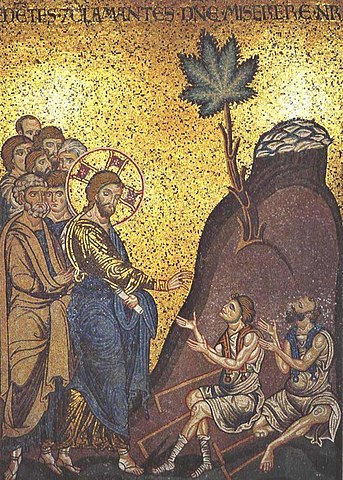
Jesus healing two blind men, 11th century mosaic, Sicily

As Jesus went on from there, two blind men followed him, calling out, “Have mercy on us, Son of David!”

When he had gone indoors, the blind men came to him, and he asked them, “Do you believe that I am able to do this?”

“Yes, Lord,” they replied.

Then he touched their eyes and said, “According to your faith let it be done to you”; and their sight was restored. Jesus warned them sternly, “See that no one knows about this.” But they went out and spread the news about him all over that region.

While they were going out, a man who was demon-possessed and could not talk was brought to Jesus. And when the demon was driven out, the man who had been mute spoke. The crowd was amazed and said, “Nothing like this has ever been seen in Israel.”

But the Pharisees said, “It is by the prince of demons that he drives out demons.” (New International Version)

Every day the news is a steady stream of disease, death, war, and outright human suffering. It’s as if the phrase, “slow news cycle,” is a thing of the past.

As we stare into the face of trouble, I find myself uttering the ancient prayer of the Church: “Lord have mercy.  Christ, have mercy.  Lord have mercy and grant us your peace.” 

We collectively feel the weight of the world’s suffering, experience the heaviness of concern for family and friends, and perhaps wonder how much more people can take.

It’s in the topsy-turvy times that I come back again and again to the deep spiritual convictions which inform what I do each day. One of those underlying creeds and affirmations is this:

Jesus is trustworthy, no matter whether my faith or the faith of others is small or great.

In our Gospel lesson for today, two blind men were healed according to their faith in Jesus. The diverse healing accounts of Jesus in the New Testament, whether the faith was large or small in those healed, leads me to the conclusion that:

It isn’t faith itself that heals, saves, or transforms – it is Jesus.

All the healing accounts in the New Testament Gospels have something in common: They all directly point to Jesus as the object of faith. 

It isn’t about the level or amount of faith, but about where the faith is placed. 

For the Christian, faith itself doesn’t mean much if it isn’t in Jesus.

If I place a large and sincere faith in an inanimate object such as money; in a position of power; or, even in my own independence, my faith isn’t worth much. 

If I have a huge faith in a doctor or a psychiatrist to heal my body or my mind, I will quickly discover there are limits to their abilities. 

If I have a confident faith that my family will meet all my needs, my faith will eventually run into failure when they let me down. That’s because the ultimate object of faith is Jesus. 

If all my faith eggs are in the church basket, my faith will eventually face a crisis because it is a misplaced faith.  Furthermore, the answer I provide for others is not simply getting them to attend church or to adopt my moral code.

There should be a consistency that runs through us all. For Jesus doesn’t change—yesterday, today, tomorrow, he’s always totally himself.

Hebrews 13:8, MSG

We know with certainty that circumstances change, as everyday seems to bring new levels and permutations of unprecedented alterations to our lives – and through it all, Jesus remains as the ever-present Savior, seated at the right hand of God ceaselessly interceding on behalf of those who offer even the slightest mustard seed of faith.

“For truly I tell you, if you have faith the size of a mustard seed, you will say to this mountain, ‘Move from here to there,’ and it will move, and nothing will be impossible for you.”

Jesus (Matthew 17:20-21, NRSV)

It says something about our modern Western society that whenever we hear the words of Jesus on faith that we interpret the mountain moving as an immediate event that happens almost instantaneous, like a snap of the finger. Yet, there is nothing in those words that says that. There is also nothing that says an individual necessarily does it.

The fact of the matter is this: Jesus heals, transforms, and delivers people from sickness, sin, trouble, and overwhelming circumstances in his own good time, not ours.

Just because we pray without ceasing for days, weeks, months, and even years for something doesn’t mean we lack faith if the prayer isn’t answered immediately. It could be that God wants others involved, maybe even across generations, for the impossible mountain to be moved.

It is misplaced faith which expects microwave results. Faith placed appropriately in Jesus as the object of belief discerns that faithful prayer is consistently prayed until there is an answer.

Healing and restoration will happen – just maybe not always how or when we think it will.

Almighty God, you know that we have no power in ourselves to help ourselves: Keep me both outwardly in my body and inwardly in my soul, that I may be defended from all adversities which may happen to the body, and from all evil thoughts which may assault and hurt the soul; through Jesus Christ our Lord, who lives and reigns with you and the Holy Spirit, one God, forever and ever. Amen.