When the people of Israel left Egypt, when Jacob’s descendants left that foreign land, Judah became the Lord’s holy people, Israel became his own possession.
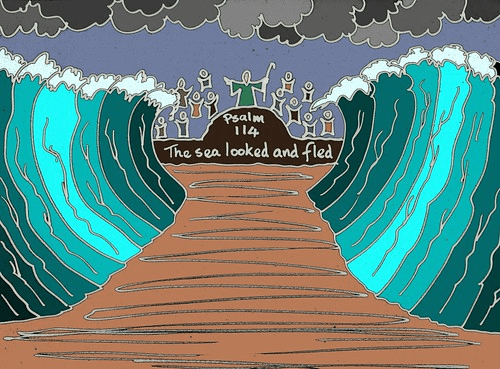
The Red Sea looked and ran away; the Jordan River stopped flowing. The mountains skipped like goats; the hills jumped around like lambs.
What happened, Sea, to make you run away? And you, O Jordan, why did you stop flowing? You mountains, why did you skip like goats? You hills, why did you jump around like lambs?
Tremble, earth, at the Lord’s coming, at the presence of the God of Jacob, who changes rocks into pools of water and solid cliffs into flowing springs. (Good News Translation)
I tend to use a lot of metaphors in my conversations with others. I like word pictures, analogies, and illustrations. Maybe that’s one reason I resonate with the Old Testament. The Hebrew mind revels in story, symbol, similitude, and even the occasional sarcasm.
The turn-of-phrase is something which connects well with me – which is why I like today’s psalm. The language is freighted with metonymy (using the name of one object or concept for that of another) and personification (using an animate characteristic for an inanimate object).
This psalm is a poetic response to the Jewish Passover and exodus out of slavery to freedom. It is a brief song of thanksgiving which nicely recounts the Israelite experience from Egypt to the Promised Land. At the behest of a mighty God, the Red Sea parted when the people left Egypt, and the Jordan River stopped its flowing when the people entered the Promised Land.
It’s a whole lot more powerful to say, “When the sea looked at God, it ran away,” than it is to say, “The Red Sea parted.” God is so mighty, so powerful, so large and sovereign that we must use the full extent of language to even begin to describe the wonderful works of the Lord. A big God with awesome capability needs some wordsmithing worthy of divine greatness.
Not only does the sea flee from its place, but the river also turns back, the mountains and hills shake and skip. To try and somehow capture the immensity of God, the psalmist used language which communicates that even inanimate objects come alive and fulfill the Lord’s bidding.
It is one thing to make a flat statement such as, “Put your trust in God,” and it is quite another matter to open up the tool of language and allow it to picture a divine Being so amazing that nothing nor anyone can possibly stand in such a Sovereign’s way. And this very same God works for us, and not against us.
The Lord God almighty, Creator of heaven and earth, has taken this formidable divine power and granted us a pinch of it – because that’s all we really need. Jesus, intimately familiar with his mighty heavenly Father, commented:
If your faith is as big as a mustard seed, you can say to this mulberry tree, “Dig yourself up and plant yourself in the ocean!” And the tree will obey you. (Luke 17:6, ERV)
For assuredly, I say to you, whoever says to this mountain, “Be removed and be cast into the sea,” and does not doubt in his heart, but believes that those things he says will be done, he will have whatever he says. (Mark 11:23, NKJV)
All of creation conspires together to participate in the great liberating and saving acts of God for God’s people. And if that wasn’t enough, we have been given the Holy Spirit to be with us forever – uprooting trees and moving mountains to accomplish the good and loving plan of God here on earth as it is always done in heaven.
Mighty God you invite us to be with you, to have a place near you. Your presence is joy, light, and comfort. Your nearness is holy, awesome, and wonderful. In the play of sunlight through rainbows, in the sounds of music and laughter, in the beauty of creation and the taste of bread and wine, your presence is known. Your saving presence surrounds us, whether we are fearful or joyful, laughing or crying.
You invite us, welcome us, forgive us and renew us with fresh hope and new life. You love us into your presence. We bless and thank you. We praise and adore you. We enjoy being with you, in the name, the spirit, and the presence of Jesus. Amen.
When Pharaoh let the people go, God did not lead them on the road through the Philistine country, though that was shorter. For God said, “If they face war, they might change their minds and return to Egypt.” So God led the people around by the desert road toward the Red Sea. The Israelites went up out of Egypt ready for battle.
Moses took the bones of Joseph with him because Joseph had made the Israelites swear an oath. He had said, “God will surely come to your aid, and then you must carry my bones up with you from this place.”
After leaving Sukkoth they camped at Etham on the edge of the desert. By day the Lord went ahead of them in a pillar of cloud to guide them on their way and by night in a pillar of fire to give them light, so that they could travel by day or night. Neither the pillar of cloud by day nor the pillar of fire by night left its place in front of the people. (New International Version)
From a human perspective, God makes some nonsensical decisions in the Bible such as telling Noah to build a big boat in a place with no water; Abraham to leave everything, and later, to sacrifice his son; Moses to stroll into Egypt and tell Pharaoh to let the people go; and, the people to walk through a body of water without getting wet. Indeed, it’s as if God has an odd predilection for making weird requests of people.
Although today’s Old Testament story gives us a glimpse into God’s thinking, the people were not privy to that information. Yes, God’s people were experiencing an unbelievable exodus out of Egypt. Their wildest dreams could not have imagined such a reality as strolling out of slavery having seen not one but a string of miraculous wonders. Yet, God was not done with the miracle thing.
Although many people would really like to see a miracle happen in their lives, rarely do we think about the circumstances we might need to face for that miracle to occur. God typically asks folks to do some outrageous-sounding things to set up the miracle.
An entire nation left Egypt with celebration only to be told to go in a misdirection toward the Promised Land, as if God were somehow geographically challenged. I can imagine that this decision had Moses raising a Spock-like eyebrow and the Israelites wondering if God was off his celestial rocker.
There is, however, a reason why folks like Noah, Abraham, and Moses obeyed instructions that didn’t make sense to them at the time: The Presence of God.
Pillar of Fire, Pillar of Cloud in the Desert, Congregation Beth Emeth, Herndon, VA
It is the personal Presence and power of God which makes all the difference. For God has not promised to create an existence with a zero factor of hardship. God, instead, has created a world that is full, vibrant, and alive with Presence – and a zero tolerance for bullies like Egypt. The uncertainty, doubt, and mystery of the future is thoroughly mitigated with the effusive Presence.
When sitting with patients in the hospital who struggle with the unknown of why they are there and what will become of them (and their families) the last thing I do is try to fabricate reasons so that it makes sense – because it doesn’t, and I’m not going pretend that it does.
Rather, I remind them of what I know: The Presence of God is here. Although God does not go out of the way to give us an easy life, God does, however, go far out of the way to communicate the glorious divine Presence with us.
God kept constant vigil over the ancient Israelites, powerfully seen with the pillar of cloud by day and pillar of fire by night. Nothing was going to happen to the Jewish people without first passing through the mighty hands of God.
Not only do I know God is with us, but I also know the Lord neither slumbers nor sleeps (Psalm 121). When God keeps vigil, God keeps vigil! No smoke or bathroom breaks with God. God’s vigilance is relentless and wondrous, giving assurance to the godly, and terrifying the ungodly.
Once we are out in the wilderness of uncertainty, there is no turning back. And that’s okay – because the Presence of God patrols the area and divinely guards our every move.
For the Christian, the Presence has found its fulfillment in the person of Jesus. Although Christians everywhere serve a risen and ascended Christ, the Divine Presence remains with glorious constancy through the Holy Spirit, the Paraclete, the One who is consistently alongside us, empowering us and advocating on our behalf.
The beautiful theological truth here is that God is both transcendent (far above us) and immanent (intimately close to us) at the same time, all the time. Armed with such a robust theological understanding, trust and confidence come to us without having to resort to ginning up positive thoughts.
Instructions and commands which seem like nonsense? No problem. The Transcendent and Immanent One has the Presence all around it. In between a rock-and-hard-place (or an Egyptian army and a Red Sea)? Not an issue. I willingly place myself there knowing that with the Presence, the miraculous is about to happen.
We need not buck the difficult circumstances. The Presence has got this.
So, then, let us pray for the Church and for the world, and let us thank God for the great Presence: In the power of the Spirit and in union with Christ, we pray to you, Almighty God, and Father. From the rising of the sun to its setting, we pray to you, ever-vigilant Lord, on behalf of those in despair and darkness, that they may find the hope and light of Christ; those in fear of death, that they may find faith through the resurrection of Jesus; prisoners and captives, widows and orphans, and all those who today need a blessed assurance of the Presence; through Jesus Christ, your Son, our Lord, who with you and the Holy Spirit are one God, now and forever. Amen.
Jesus Walks on Water, by Konstantin Alexejewitsch Korowin, 1890
Immediately Jesus made the disciples get into the boat and go on ahead of him to the other side, while he dismissed the crowd. After he had dismissed them, he went up on a mountainside by himself to pray. Later that night, he was there alone,and the boat was already a considerable distance from land, buffeted by the waves because the wind was against it.
Shortly before dawn Jesus went out to them, walking on the lake. When the disciples saw him walking on the lake, they were terrified. “It’s a ghost,” they said, and cried out in fear.
But Jesus immediately said to them: “Take courage! It is I. Don’t be afraid.”
“Lord, if it’s you,” Peter replied, “tell me to come to you on the water.”
“Come,” he said.
Then Peter got down out of the boat, walked on the water and came toward Jesus. But when he saw the wind, he was afraid and, beginning to sink, cried out, “Lord, save me!”
Immediately Jesus reached out his hand and caught him. “You of little faith,” he said, “why did you doubt?”
And when they climbed into the boat, the wind died down. Then those who were in the boat worshiped him, saying, “Truly you are the Son of God.” (New International Version)
In the New Testament Gospels, we see Jesus for who he is – Son of God and true Sovereign of the universe – seeking to reconcile people to God through his life, miracles, and teaching. In the Gospels we also see Christ’s disciples for who they are – a rag-tag bunch who express both belief and doubt, and experience both faith and failure.
The reality of the Christian life is that it is a sort of three-steps-forward and two-steps-backward kind of experience. The expectation that we will “succeed” and have everything go hunky-dory each time we step out in faith, is far from how things actually work in both the world and in God’s kingdom. Doubt and failure are important experiences for the believer in Jesus.
Without failure, there is no Christian life. Why? Because it means we are still in the boat.
It’s evidence that we never left the safety of established routines and responded to God’s command to step out of our comfort zone, and boldly go where we’ve never gone before.
Our failures may, like Peter, be colossal bellyflops. Yet, Jesus is there – extending grace to Peter and helping him, even in his failure of faith. Failure does not define us; it isn’t our identity. Jesus is Lord over everything, including storms, hardship, and trouble.
Yes, there are a lot of scary things in life. Learning to ride a bike was scary. Driving for the first time on an icy road was scary. Getting married and having kids was scary. Admitting a fault, mistake, or weakness is scary. Being vulnerable with another person is scary.
It can even be scary to be at church. Why? Because we might fail, and it may crush us.
The fear of failure, however, need not control our lives. Why? Because grace overcomes everything.
We all find ourselves, at times, caught midway between faith and doubt. But to know this situation is to experience grace. If the worst scenario you worry about in your head would actually come to pass, it will still never change the reality that God loves you! And it will not stop Jesus from extending his hand to you in a life-saving grip of grace.
Fear melts away when we keep our eyes on Jesus. So, we must focus on Christ, instead of fixating on the waves around us. The truth sets us free. Therefore, let’s notice five truths about Jesus that help us overcome the fear of failure and embrace a life of faith.
1. Jesus is a person of prayer
Jesus was deeply dependent on his heavenly Father. His life exhibited the necessities of simple prayer and obedience. If Jesus found the need for solitude and prayer for his life and ministry, how much more to we need it!?
The Lord had his disciples get into the boat and go out on the lake. Jesus knew they were about to face a storm. The boat ended up getting thrown around by the waves. Even though the disciples were doing God’s will by going out on the lake, they were not spared from adversity.
Jesus wanted his disciples to experience the storm. Why? Because it is through the storm that we learn faith.
Faith is developed through experience and adversity. Faith that never endures distress, never grows and matures. Faith must be exercised – and if it isn’t, it atrophies and becomes useless.
Show me a person with great faith, and I’ll show you a person that has gone through a boatload of adversity and hurt, having allowed Jesus to grace them with healing.
2. Jesus is present with us, and this presence brings an end to fear
Being in the middle of a lake during a storm did not prevent Jesus from being present with the disciples – he just walked on the water to be with them. Even though the disciples had just participated in the miracle of Jesus feeding the five thousand, another miracle was not on their radar – which is why they did not recognize Jesus and were afraid when they saw him.
While afraid, we don’t see Jesus, even when he’s right in front of our faces. Why? Because we don’t expect him to be there and mistake him for a ghost.
When the disciples cried out in fear, Jesus responded. I used to have a factory job, training workers. When the training was completed, I had the trainees evaluate our time together. The top response I received is that my presence helped them to learn their job – the freedom to fail time and time again without judgment. Having me there to rescue them, when things got too much, built confidence that they could do it on their own.
3. Jesus desires those who follow him to imitate him
Jesus walked on water. Jesus invited Peter to walk on water. Peter was not chided by Jesus for getting out of the boat, but for doubting that he could continue in the miracle that was happening.
Jesus isn’t merely interested in disciples being able to regurgitate his teaching. Why? Because he wants us to exercise our learning through actual deeds of faith.
Once the command of Jesus was given to Peter, “Come”, then walking on water became only a matter of trust.
“Christianity has not been tried and found wanting. It has been found difficult and left untried.”
G.K. Chesterton
We understandably get nervous when a crazy Jesus and an unpredictable Holy Spirit call us to change by getting out of the friendly confines of the boat. Why? After all, we might fail.
However, it is at those times that we bank on God’s Word and promises. The Apostle James said that if we find ourselves lacking wisdom to deal with the unpredictable and unknowable, we are to ask God who gives generously to all without finding fault and will be given to us. (James 1:5)
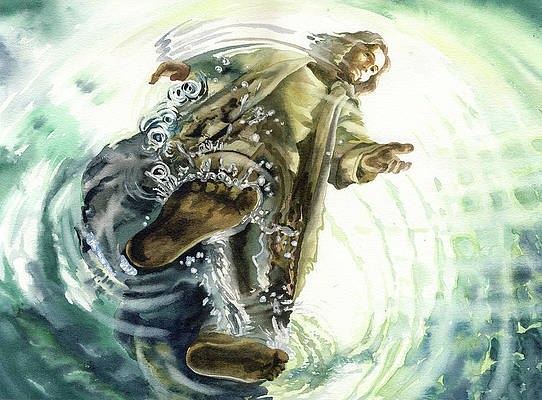
Christ Walking on the Sea, by Natali Fedorova
Peter responded to his predicament by crying out to Jesus, “Lord, save me!” Jesus immediately reached out and saved Peter from his own doubt and lack of faith. Jesus called Peter a “little-faith.”
Many people have lived too long with the notion that God is some stern angry deity who is constantly displeased with sinful people, and that only through perfection will God ever be happy with us. The truth is that Jesus wants us to imitate him; and, when we fail, he is there to pick us up.
4. Jesus has the authority to settle the storm when he is ready to do it
Jesus is King. Christ is Sovereign of the world. He will bring the crisis to an end according to his own good pleasure and good timing. Rather than spending all our emotional capital by worrying or conniving to get out of a situation, we can trust God and keep our eyes on Jesus. Our job is to believe; God’s job is everything else.
5. Jesus’ power led the disciples to acknowledge who he is
Worship happens when we see Jesus as he really is, the Son of God. Flat, dull, boring worship comes from flat, dull, boring Christians who are unable to see the power of Jesus in their lives. We discover the power of God when we are in a situation which requires God’s strength to deliver us. Grasping Jesus as the Son of God is more than a verbal confession of faith; it is being able to trust him, like getting out of a boat in the middle of a lake.
We are to live by faith in the Son of God who loved us and gave himself for us (Galatians 2:20). It doesn’t require much faith to pray that Aunt Mable’s bunions will feel better. It only requires a little faith to give a dollar when you have ten dollars. It takes no faith to discuss the weather and steer clear of hard conversations.
But it does require faith:
to pray for a miraculous healing every day without giving up for a little boy who is racked by epilepsy, and trust God to spare his life
to write a check for $100 to someone in need when you have exactly $100 in your checking account, and trust God to provide for you own necessities.
to go off the grid of the routine schedule to have a difficult discussion about social justice, and trust God to act on Christ’s teachings.
to live as though the mission of God in this world is the most important thing we could ever do, and trust God to step out and do it.
It would be great if we could pray and act without ever doubting or failing, yet the only way to do that is to never step out of the boat. Instead, live life. Trust God. And see what happens.
Holy God, help us, your people, to embrace the life that is truly life by stepping out of the boat. May Jesus define our lives instead of letting failure define us. May we accept the grace that is ours in Jesus Christ our Lord, in whose name we are bold to pray. Amen.
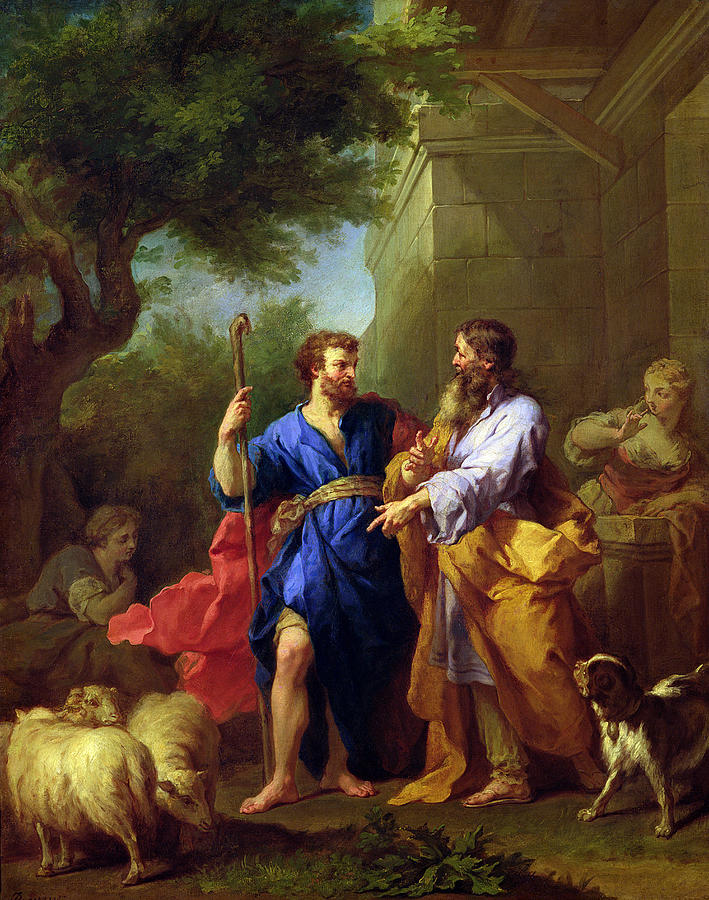
After Joseph was born, Jacob said to Laban, “Release me from our agreement and let me return to my own country. You know how hard I’ve worked for you, so let me take my wives and children and leave.”
But Laban told him, “If you really are my friend, stay on, and I’ll pay whatever you ask. I’m sure the Lord has blessed me because of you.”
Jacob answered:
You’ve seen how hard I’ve worked for you, and you know how your flocks and herds have grown under my care. You didn’t have much before I came, but the Lord has blessed everything I have ever done for you. Now it’s time for me to start looking out for my own family.
“How much do you want me to pay you?” Laban asked.
Then Jacob told him:
I don’t want you to pay me anything. Just do one thing, and I’ll take care of your sheep and goats. Let me go through your flocks and herds and take the sheep and goats that are either spotted or speckled and the black lambs. That’s all you need to give me. In the future you can easily find out if I’ve been honest. Just look and see if my animals are either spotted or speckled, or if the lambs are black. If they aren’t, they’ve been stolen from you.
“I agree to that,” was Laban’s response. Before the end of the day, Laban had separated his spotted and speckled animals and the black lambs from the others and had put his sons in charge of them. Then Laban made Jacob keep the rest of the sheep and goats at a distance of three days’ journey. (Contemporary English Version)
Jacob left home by himself and went to his mother’s family. After twenty years away, he had two wives and twelve sons by four different women. He had worked for his father-in-law Laban for all that time – all to Laban’s advantage. During those twenty years, there was plenty of complicated and awkward family drama.
Now Jacob was ready to be done with all that. He wanted to move on and go back to the place of his family origin. But, of course, Laban had a good thing going and did not want Jacob to leave. So, he did his best to convince him to stay. Jacob was able to set his own terms. And there was some space put between his burgeoning family and his in-law’s.
But returning is a lot more difficult than leaving. When I left home as a young man I had all my worldly possessions in a ’74 Chevy Vega. And when I returned to the land of my origins, it was in a large rental truck with a wife a three kids. There was a lot of logistics involved, not to mention all the relationships we left.
For twenty years, Jacob and Laban did a weird relational dance. They were both tricky dudes, and were continually attempting to maneuver and outmaneuver the other. Yet, Jacob mostly got the brunt of unfairness.
In reality, Jacob owed Laban nothing. He had agreed to work for him fourteen years in total. But he could take nothing with him except his family – which would leave him with no means of support. And Laban was not about to give his son-in-law any support outside of his fatherly-in-law control.
Jacob came up with a strange set of terms concerning the flocks of sheep. Laban logically calculates that Jacob is unlikely to gain much profit from the plan, and can still keep the status quo going. So it becomes a done deal.
In a typical relational dynamic which they have become accustomed to, Laban himself sorts the flock, removes all the spotted and speckled sheep to a safe distance, and leaves Jacob with the rest.
So, if Jacob is to acquire any flock of his own, he needs to discover a way of breeding multicolored sheep from monochrome ones – a task which seems to be improbable if not impossible. But that’s exactly what Jacob does in the end, and that is yet the subject of another Old Testament lesson….
So, exactly what is today’s lesson? Life is anything but a nice, neat trajectory upwards toward achieving goals. Rather, life is a series of twists and turns, leading us to often take three steps forward and two steps backward in a herky-jerky sort of journey. Yet, behind it all, the Lord’s promises are still there, still in effect, still being worked out, in order to be fully realized. Nothing and no one is going to derail the plans and purposes of God.
Sometimes we need to be reminded that God is the giver of prosperity, and not anyone or anything else.
When you become successful, don’t say, “I’m rich, and I’ve earned it all myself.” Instead, remember that the Lord your God gives you the strength to make a living. That’s how he keeps the promise he made to your ancestors. (Deuteronomy 8:17-18, CEV)
To the person who pleases him, God gives wisdom, knowledge and happiness, but to the sinner he gives the task of gathering and storing up wealth to hand it over to the one who pleases God. (Ecclesiastes 2:26, NIV)
If any of you lacks wisdom, you should ask God, who gives generously to all without finding fault, and it will be given to you. (James 1:5, NIV)
We may, at times, feel the need to acquire what we want through trickery or manipulation. However, there is a God in heaven who sees and who cares. The Lord delights is being generous and giving to us, that is, if we are aware and attentive enough to ask. We might not get what we want immediately, and it likely won’t be easy, but we shall nonetheless receive it. We only need to trust.
Heavenly Father, source of all life, we thank you for the many ways in which you have blessed and enriched our lives: Keep us from possessiveness and greed, and lead us into the greater joy of sharing your gifts with others, through Jesus Christ, in whom is perfect peace. Amen.









 Rev. Tim Ehrhardt