Trust vs. Anxiety (Isaiah 30:15-18)

The holy Lord God of Israel
    had told all of you,
“I will keep you safe
if you turn back to me
    and calm down.
I will make you strong
    if you quietly trust me.”

Then you stubbornly said,
“No! We will safely escape
    on speedy horses.”

But those who chase you
    will be even faster.
As few as five of them,
or even one, will be enough
    to chase a thousand of you.
Finally, all that will be left
    will be a few survivors
as lonely as a flag pole
    on a barren hill.

The Lord God is waiting
to show how kind he is
    and to have pity on you.
The Lord always does right;
he blesses those who trust him. (Contemporary English Version)

God’s plan for our lives calls for times of retreat and renewal, of quiet patience and perseverance, for restraint and waiting.

Ancient Judah was experiencing one of their many periods of rebellion toward God’s commands. One of the things that happens – whether in ancient times or today – is that whenever we go off the road of God’s ways, our lives become characterized by a grand self-help program.

Those in the Judean royal court could not wait on God. They had to do something about Assyria. The Assyrian Empire was waning, and Judah wanted to take advantage of it, seeing an opportunity for some relative autonomy.

So, many of the activists in the royal court rushed to Egypt for help – not at all considering to turn toward God and wait on the Lord. God blesses those who trust and wait on divine promises and initiative. But, in their anxiety, the people of Judah would not exercise faith and patience.

As a result, the enemy would overtake them. The people’s refusal to take the quiet course would not end well for them.

On many days, as I attend to the hospitals for which I work, I visit many hurting people, including patients, their families, and teammates. In my time there, I deal with a vast array of emotional problems, spiritual struggles, and mental disorders. One of things I have discovered through this work is that people’s internal issues absolutely need to be expressed, out loud, to someone who cares and knows what to do with those expressions.

And this is not only a modern problem; the need to deal with our internal stuff has been there throughout all of human history. Every culture and society who does not attend well to personal and communal spiritual health is literally killing their bodies – because body and soul are inextricably connected in a union as one.

It continually amazes me that people who think nothing of going to a medical doctor, an emergency room, or having a surgery, would never think of getting help when their minds are mixed up, emotions are frayed, and spirits are downcast.

Stubbornly holding onto self-help to handle a spiritual crisis, refusing help from others, and ignoring God, is just as sure to kill you as believing that chest pains, shortness of breath, and inability to walk across the room will simply get better on its own.

Conversely, isolating oneself and calling it “waiting on God” and remaining passive – when the Lord has clearly told us to be active – will accomplish the same ends as the committed self-help person. Faith and action are not mutually exclusive terms. It takes some wisdom to know when to retreat, pray, and be patient; and when to take initiatives of faith, and trust God to work through action.

Rebellion gets us nowhere. It’s what puts us in the awkwardness of making bad decisions and discernments. The Lord had told the people of Judah to stay put and not rely on Egypt to help them. There were clear instructions through the prophets about what to do. But the people were too anxious, too impatient, wondering too much about whether God would show up or not.

The Spirit God gave us does not make us afraid. His Spirit is a source of power and love and self-control.

2 Timothy 1:7, ERV

No matter where we have been or what we have done, the Lord is continually waiting on us – and will consistently respond with grace and mercy to our petitions and overtures to live for God. It’s never too late to flee to God in quiet trust.

Running to God is not escaping our problems. Rather, the Lord enables us to face both our outward situations, as well as our inward thinking and feeling. It’s easy to engage in busywork and keep active when we are anxious; yet it is very difficult to sit still before God and be alone. Silence and solitude put us face to face with ourselves. And doing that is what many people would rather avoid.

“I’ll do it myself!” is the cry of many a person who is mentally, emotionally, and spiritually overwhelmed. That approach, however, is a highway to the grave. And, in fact, it is a stubborn rebellion that puts a stiff arm to God.

I’m not saying that opening-up is easy; I am stating that it is necessary to our spiritual and emotional health. It might be helpful to begin communicating with some vulnerability and authenticity to God. The following are some appropriate ways that might help:

  1. Be congruent between the outer self and inner self. Make sure your outside affect and behavior is congruent with your inside feelings and thoughts. If you are discouraged on the inside, but wear a smile and pretend to be spiritually with it, you’re not fooling God. You cannot receive grace apart from humble authenticity.
  2. Focus on feelings. You won’t get struck by lightning if you express your anger, or other emotions, to God. Be aware of how you are feeling. In fact, ask the Lord to help you understand your feelings. Share them openly as much as you can.
  3. Change questions into statements. Sometimes, when we have an attitude or a feeling, we’re afraid to say it and be open. So instead, we ask a question. Try changing questions such as “Do you love me?” into “I love you.” And, “Do you want me to do this?” to “I want to do your will.”
  4. Speak in the first person. Begin sentences with “I” instead of “you,” For example, ” I am happy that you are with me,” instead of asking, “Are you there?”
  5. Say out loud what you really want and need. It’s okay to do that. This is when it is appropriate to ask questions. The Lord’s ear is ready to listen.

Patient and confident trust in God is always a better option than anxious and nervous striving by yourself.

O God, the source of all health: So fill my heart with faith in your love, that with calm expectancy I may make room for your power to possess me, and gracefully accept your healing; through Jesus Christ our Lord. Amen.

God Is Bigger (Psalm 46)

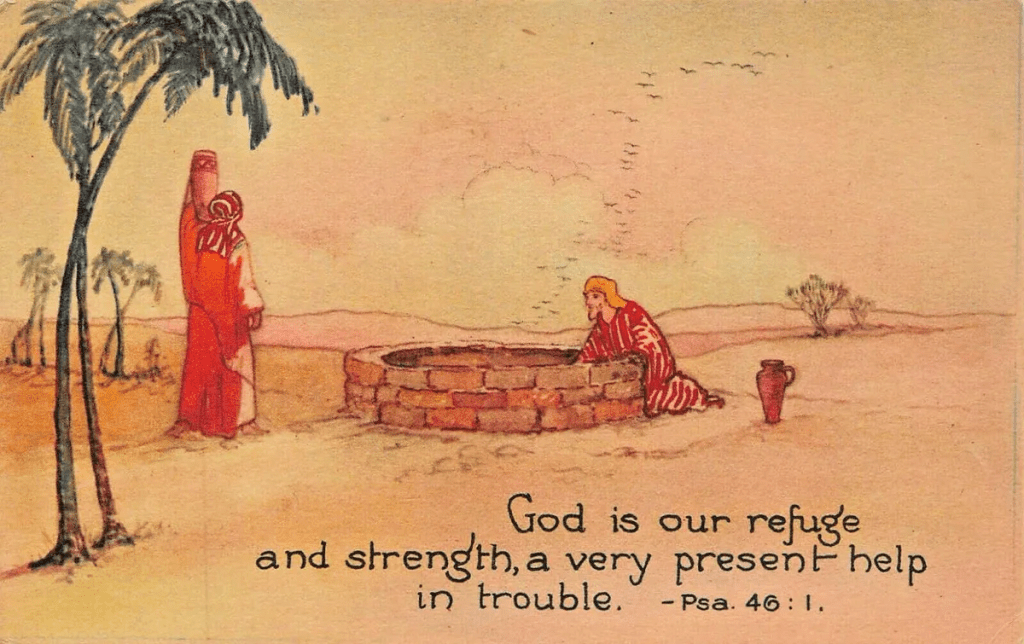
God is our refuge and strength,
    a very present help in trouble.
Therefore we will not fear, though the earth should change,
    though the mountains shake in the heart of the sea,
though its waters roar and foam,
    though the mountains tremble with its tumult.

There is a river whose streams make glad the city of God,
    the holy habitation of the Most High.
God is in the midst of the city; it shall not be moved;
    God will help it when the morning dawns.
The nations are in an uproar; the kingdoms totter;
    he utters his voice; the earth melts.
The Lord of hosts is with us;
    the God of Jacob is our refuge.

Come, behold the works of the Lord;
    see what desolations he has brought on the earth.
He makes wars cease to the end of the earth;
    he breaks the bow and shatters the spear;
    he burns the shields with fire.
“Be still, and know that I am God!
    I am exalted among the nations;
    I am exalted in the earth.”
The Lord of hosts is with us;
    the God of Jacob is our refuge. (New Revised Standard Version)

Fear is one of those things that we don’t get over simply by telling ourselves to not be afraid. In fact, that approach typically makes us even more fearful – namely, because we focus on the fear itself. But to cope and deal with fear, it requires a focus on something bigger than the fear.

God is bigger than the boogie man.
He’s bigger than Godzilla,
or the monsters on TV.
Oh, God is bigger than the boogie man.
And He’s watching out for you and me.

So, when I’m lying in my bed,
and the furniture starts creeping,
I’ll just laugh and say,
“Hey, cut that out!”
And get back to my sleeping.
‘Cause I know that God’s the biggest,
and He’s watching all the while.
So, when I get scared I’ll think of Him,
and close my eyes and smile.

God is bigger than the boogie man.
He’s bigger than Godzilla,
or the monsters on TV.
Oh, God is bigger than the boogie man.
And He’s watching out for you and me. – VeggieTales

Psalms and songs of trust in God help us focus on divine hugeness instead of human puniness.

Changing Circumstances

Even though people may find themselves in the dire straits of natural disasters, they can have confidence smack in the middle of all the crazy chaos. Whereas those who focus on their fear become ever more anxious and feel as if the world is out of control, the believer isn’t threatened when overwhelming circumstances occur.

We will not fear, because God – who created the world and its vast natural systems – stands above it all and is therefore able to establish order out of chaos. Just as we are certain that the sun will again rise in the morning, so too, we have full confidence that God shall rise over the darkness and bring light and warmth to all that is shadowy and cold.

Shaky Politics

The nations and their governments who rule with injustice and care nothing for religion, breathe-out their threats and posture themselves as supreme leaders. They, too, are chaotic forces. But God is far above them, as well as above the flood and the famine. The leader’s bellicose blustering sounds merely like a chattering chipmunk to God.

And like natural disasters, the uproar of the nations does damage; but national leaders cannot topple God. Instead, God will shake up the unjust nations, like a protein shake in a blender. When delusional leaders encounter the voice of God, they cower in fear – but God’s people don’t. The spiritual person’s foundation will not be shaken, whereas the would-be dictator will find himself without anyone to lead.

A Working God

God is always working, albeit most of the time behind the scenes. God’s dominion extends over everything and everyone. God can obliterate any and all threats because God is everywhere present.

Based on this view of God, all we as people need do is be still and know that the Lord is God. Like Jesus rebuking the waves and the sea, resulting in immediate stillness, so God’s word brings us stillness, calmness, and freedom from fear and anxiety.

God is with us. God is in control. God cares for us. There are a lot of things we don’t know – such as why we have to personally endure the natural disasters and the unnatural dictators – but we can know without a shadow of a doubt that the presence of God surrounds us, and the love of God squeezes us.

With a transcendent Being who commands the angelic hosts of heaven, our source of security comes not from within but from without. The Lord is a trustworthy God who is vigilant in watching over us.

Trusting the Lord

Armies, security systems, and protective coverings all have their needed purpose in human life. Yet, when we look to our ultimate protection – the kind that provides security of both body and soul – it is God’s presence that sustains our highest and greatest needs.

Perhaps you understand the psalm’s message, yet still find it difficult or untenable to place faith in such an ancient writing and an even older God. Maybe you much prefer to trust in something that isn’t so ethereal, something you can engage with your five senses.

It could be that you prefer a strong political leader, more and bigger weapons, higher and thicker walls of protection. You work hard to have as much money as possible to keep you safe from harm. You seek to gain as much influence in the form of earthly power and authority as you can.

The problem is, however, that none of this earthly posturing is going to protect you from what you fear the most. All that work is going to prove unreliable in the end.

God is the only sure defense. Ultimate power belongs to the Lord God almighty, creator of heaven and earth. Deliverance of body and soul does not ultimately come through the strength of the military, the economy, or any human ingenuity or hard work; for the Christian, it comes through the suffering, death, and resurrection of Jesus Christ.

Any inclination to place saving trust in personal resources, human institutions, or world might, will result in sure failure. They cannot remedy our fear, for nothing is able to match the power of God. Indeed, God is bigger than anyone and anything. We need the mighty fortress which is our God.

A mighty Fortress is our God
A Bulwark never failing
Our Helper He amid the flood
Of mortal ills prevailing

For still our ancient foe
Doth seek to work us woe
His craft and power are great
And armed with cruel and hate
On earth is not his equal

Did we in our own strength confide
Our striving would be losing
We’re not the right Man on our side
The Man of God’s own choosing
Dost ask who that may be?
Christ Jesus, it is He
Lord Sabaoth His Name
From age to age, the same
And He must win the battle

That word above all earthly powers
No, thanks to them, abideth
The Spirit and the gifts are ours
Through Him who with us sideth
Let goods and kindred go
This mortal life also
The body they may kill
God’s truth abideth still
His Kingdom is forever

Amen

“Follow Me” (John 1:43-51)

The next day Jesus decided to go to Galilee. He found Philip and said to him, “Come, follow me.” Philip was from Bethsaida, Andrew and Peter’s hometown.

Philip went to look for Nathanael and told him, “We have found the very person Moses and the prophets wrote about! His name is Jesus, the son of Joseph from Nazareth.”

“Nazareth!” exclaimed Nathanael. “Can anything good come from Nazareth?”

“Come and see for yourself,” Philip replied.

As they approached, Jesus said, “Now here is a genuine son of Israel—a man of complete integrity.”

“How do you know about me?” Nathanael asked.

Jesus replied, “I could see you under the fig tree before Philip found you.”

Then Nathanael exclaimed, “Rabbi, you are the Son of God—the King of Israel!”

Jesus asked him, “Do you believe this just because I told you I had seen you under the fig tree? You will see greater things than this.” Then he said, “I tell you the truth, you will all see heaven open and the angels of God going up and down on the Son of Man, the one who is the stairway between heaven and earth.” (New Living Translation)

I describe myself as a follower of Jesus. I have been for decades. I found, and continue to find, in Jesus Christ a compelling person full of grace, truth, and love.

But my early life was not characterized with knowing Christ. I certainly learned about Jesus, that this ancient guy lived an altruistic life, got tortured and killed on a cross, and that Christians believe in his resurrection from death. However, back then it was more like some strange history lesson. The information made no difference to me.

That is, until I heard a voice – not an audible one that others could hear. Yet, it was just a real as any daily conversation with another person. I heard the call of Jesus. The Ancient of Days showed up.

I know with every epistemic fiber in my being that it wasn’t an undigested bit of beef, a blot of mustard, a crumb of cheese, a fragment of an underdone potato. I am sure beyond certainty that there was more of an empty grave than gravy about my experience of the risen Christ.

I experienced the call of Jesus to “follow me.” And that is really, at its simplest, the call which continually goes out to all humanity. It is a gracious and merciful call. It isn’t a summons to experience a cataclysmic event of total belief in one fell swoop. Rather, it’s a call to believe that is much more an unfolding awareness of the deep spirituality and connection with the divine within.

Important to that faith process is another call to “come and see.” Whereas there are some Christian traditions which focus solely on a singular one-time experience of saving faith in Christ, the Gospel of John displays a drama of faith with multiple layers which people move through.

There is no egalitarian zap in which God grants total and immediate understanding. Instead, faith is an ever-increasing process. It is appropriate and biblical to say that our salvation has happened, is happening, and will happen. We follow, we come and see, and we keep following, keep coming, keep seeing more and more.

Like a muscle, our faith grows, develops, stretches, and strengthens over time. To use another metaphor, we ascend a stairway to heaven, one step at a time, day after day, following Jesus and ascending to spiritual maturity.

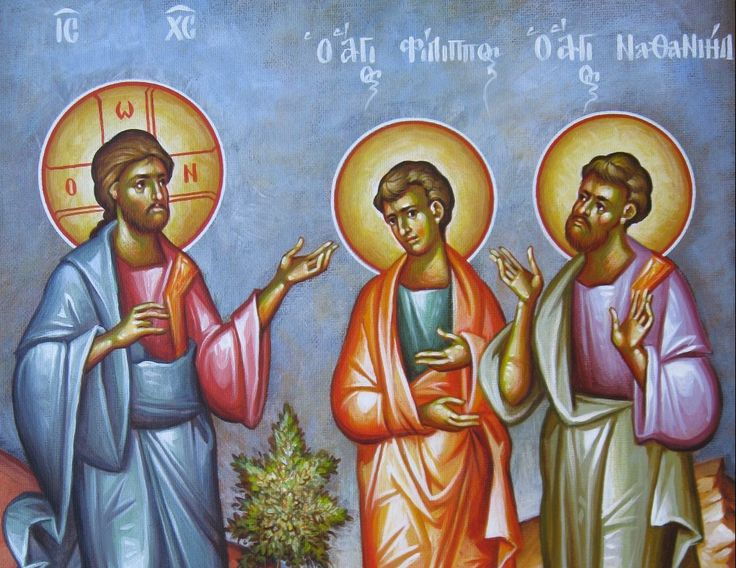
Orthodox icon of Christ calling Philip and Nathanael

Methinks this is likely part of what Jesus was getting at with Nathaniel in today’s Gospel lesson. Nathaniel would have quickly picked up on the reference Jesus was making, way back to the first book of Genesis. The Jewish patriarch, Jacob, had an experience of seeing the angels of God on some celestial stairway, ascending and descending. It was an encounter of God’s presence with Jacob, assuring him of divine intervention into the muck of humanity. (Genesis 28:10-17)

Jesus connected that ancient portrait to himself so that Nathaniel would understand, would believe, that God has again broken into this world with a special divine presence. To look at Jesus and follow him, is to see and follow God.

Christ Jesus is the ultimate example and embodiment of God with us. Throughout John’s Gospel, Jesus presents himself as:

  • Living water – connecting to Jacob’s well (John 4:5-14)
  • The Temple of God – the place where the Lord dwells in all divine fullness (John 2:18-22)
  • Bread from heaven – linking the giving of manna to the Israelites in the desert (Exodus 16:4-7; John 6:1-59)
  • The good shepherd – fulfilling divine Old Testament imperatives of caring for people (Ezekiel 34:11-16; John 10:1-30)

In all these ways, and more, Jesus intentionally connects himself as fulfilling God’s ancient promises to people.

In whichever way we need to hear the call to follow, Jesus accommodates to us. For some, Christ comes knocking on the front door. For others, he enters the side door, or slips into the backdoor of our lives.

And, if we will come and see, Jesus will also accommodate us by being the authority over us, the teacher to us, or the friend beside us. The Lord Jesus shall shepherd us and woo us to the flock for guidance and protection.

However it may be that Jesus comes to you, it most likely will be in ways you aren’t expecting. Surely, nothing good can come from Nazareth! Yet, it did. Can anything good come from Calcutta, India, or Juarez, Mexico, or Hoboken, New Jersey, or Milwaukee, Wisconsin, or even from a small rural area that doesn’t show up on a map? Yes, it can. Because with Jesus, God has entered this world, and, as it turns out, the Lord’s presence is everywhere.

Follow me. Come and see. Two of the simplest exhortations ever uttered. Yet, two of the most gracious phrases ever said, with profound implications for us beyond what we can fathom or imagine.

Guide us waking O Lord, and guard us sleeping; that awake we may watch with Christ and asleep we may rest in peace. May the shape of each day be formed by the pedantic following of my Lord; and may I come and see the wonders you have done, are doing, and will do. Almighty and merciful God – Father, Son and Holy Spirit – bless us and keep us. Amen.

Parable of the Three Servants (Matthew 25:14-30)

Parable of the Three Servants, a woodcut by Jan Luiken, 1712

Jesus said, “The Kingdom of Heaven can be illustrated by the story of a man going on a long trip. He called together his servants and entrusted his money to them while he was gone. He gave five bags of silver to one servant, two bags of silver to another servant, and one bag of silver to the last servant—dividing it in proportion to their abilities. He then left on his trip.

“The servant who received the five bags of silver began to invest the money and earned five more. The servant with two bags of silver also went to work and earned two more. But the servant who received the one bag of silver dug a hole in the ground and hid the master’s money.

“After a long time their master returned from his trip and called them to give an account of how they had used his money. The servant to whom he had entrusted the five bags of silver came forward with five more and said, ‘Master, you gave me five bags of silver to invest, and I have earned five more.’

“The master was full of praise. ‘Well done, my good and faithful servant. You have been faithful in handling this small amount, so now I will give you many more responsibilities. Let’s celebrate together!’

“The servant who had received the two bags of silver came forward and said, ‘Master, you gave me two bags of silver to invest, and I have earned two more.’

“The master said, ‘Well done, my good and faithful servant. You have been faithful in handling this small amount, so now I will give you many more responsibilities. Let’s celebrate together!’

“Then the servant with the one bag of silver came and said, ‘Master, I knew you were a harsh man, harvesting crops you didn’t plant and gathering crops you didn’t cultivate. I was afraid I would lose your money, so I hid it in the earth. Look, here is your money back.’

“But the master replied, ‘You wicked and lazy servant! If you knew I harvested crops I didn’t plant and gathered crops I didn’t cultivate, why didn’t you deposit my money in the bank? At least I could have gotten some interest on it.’

“Then he ordered, ‘Take the money from this servant, and give it to the one with the ten bags of silver. To those who use well what they are given, even more will be given, and they will have an abundance. But from those who do nothing, even what little they have will be taken away. Now throw this useless servant into outer darkness, where there will be weeping and gnashing of teeth.’ (New Living Translation)

What would you do with a million dollars?…  Maybe you would pay off some debts, finish some work on your house, or quit your job and take a vacation. Perhaps you might invest a good portion of it. Whatever you do with it, your investment of money is only as good as your level of trust. 

When I worked at a senior citizen healthcare facility, there was a resident living in an independent living apartment, but he still owned his house. During one conversation, the old man admitted to me that over the past sixty years, he had secretly bored holes in every door jamb of his house and had stuffed away $100,000 dollars in cash! This dear resident had personally experienced the run on banks which began the Great Depression in 1929. He had zero trust for investment banking.

The three servants responded their master’s generosity according to their view of him. Two of the servants regarded the master as gracious and generous, and so, freely took their hefty bags of money and confidently invested them to create even more money. They took risks, invested, worked, and acted with the idea that they were secure in their relationship with their master. 

The third servant, however, perceived his master as stern, serious, and angry. So therefore, he did nothing with his bag of money because he was afraid.

If we consider God as primarily an angry Being, then we will almost certainly not use the gifts he has given us, for fear of messing up and experiencing God’s wrath. 

Yet, the truth is, God is gracious and generous. The Lord has generously give to everyone; and God expects us to use what was given and not hide it away in a door jamb! If we want to hear the Lord Jesus say, “Well done, good and faithful servant,” then taking faithful initiative is necessary.

Fear is perhaps the devil’s greatest tool in preventing God’s people from being productive Christians in serving the church and the world. Beneath the fear can be powerful feelings of inferiority, inadequacy, and an inner conviction of not being enough. Oftentimes, a low view of self can come from a low view of God.

Being continually afraid, wastes whatever impact we could have for God in the world, and diminishes our resolve to act so that our lives are ineffective.

We are meant to enjoy the gracious and generous God, and in our enjoyment of the Lord, godly dreams will be placed within us that God is pleased to fulfill:

Our enjoyment of God gives us the security and confidence to act upon godly desires and produces a generous harvest of righteousness and peace. We then can share the bounty with others, as a way of giving back to God. 

Yet, if fear gets thrown into the mix, it dilutes and destroys everything. Fear paralyzes us, and we do nothing, like the third servant in the parable who did nothing. What’s more, fear leads us into hiding, just like the servant hid and buried his big bag of money. 

We might wrap a lot of our fears in morbidly sanctified self-belittling, that is, of feeling good about feeling bad. Those self-deprecating feelings stop us from exploring God’s dream and vision for us. Yet, we really can speak and act in the world with confidence because we serve a God who is gracious and generous.

Some of the greatest fears that hold back people from exploring their faith is:

  • Fear of criticism – being afraid of what others may think or say 
  • Fear of taking a risk – being afraid of going outside the comfort zone of how something has always been done
  • Fear of ourselves – being afraid to explore our vast inner world with its guilt, shame, insecurity, and mixed motives

If you once had a dream and you think that dream is dead because of your sins and bad habits, you are wrong.  Dreams are destroyed by fear, by being duped into believing that we are not enough, and never will be. So, we end up doing nothing.

Living in a way that is always looking over your shoulder to see if God is going to rap your knuckles with a ruler is no way to live.

The hardest people to get along with are those who have a low view themselves. Because they do not like themselves, they do not like others. They continually wonder if God is upset with them about something. The man in the parable blamed God for his lack of investment. Blaming others is really our own fear and insecurity seeping through – it helps no one, especially ourselves. 

“I can’t!” is the cry of the person locked in fear. I cannot stand up in front of people, meet strangers, serve like others, or love like Jesus did. I cannot because I am afraid, and I only have one measly bag of money! 

Yet, God typically uses tongue-tied people like Moses; worriers like Abraham; lowly tax-collectors like Matthew, and prostitutes with sordid pasts like Mary Magdalene – and not superstars. The less talented a person is, the more God gets to show up and show off with generous power and gracious ability through that person.

Conclusion

God loves you, and really does have wonderful plans for you. God created you with your unique personality, gave you unparalleled experiences, and gifted you with uncommon abilities. God wants you to tap into that passion and dream placed down deep in your heart to serve the world. 

What would you do with a million dollars? You already have it. Now, go and invest it.

Soli Deo Gloria