Living Bread from Heaven (John 6:51-58)

Art by Nigel Wynter (1957-2024)

I am the living bread that came down from heaven. Whoever eats of this bread will live forever, and the bread that I will give for the life of the world is my flesh.”

The Jews then disputed among themselves, saying, “How can this man give us his flesh to eat?” 

So Jesus said to them, “Very truly, I tell you, unless you eat the flesh of the Son of Man and drink his blood, you have no life in you. Those who eat my flesh and drink my blood have eternal life, and I will raise them up on the last day, for my flesh is true food, and my blood is true drink. Those who eat my flesh and drink my blood abide in me and I in them. Just as the living Father sent me and I live because of the Father, so whoever eats me will live because of me. This is the bread that came down from heaven, not like that which the ancestors ate, and they died. But the one who eats this bread will live forever.” (New Revised Standard Version)

To the religious leaders of Christ’s day, Jesus was making more noise than a couple of skeletons dancing on a tin roof. And they neither liked it, nor appreciated him drawing so much attention to himself.

Tensions had been escalating between Jesus and the religious establishment. The atmosphere was thick with grumbling leaders, as they tried to make some sense of Christ’s words to them.

Jesus offering his body for people to eat was causing far too much noise for the Jewish leaders. What in the world is this guy talking about?

Rather than making the meaning clear for them, Jesus added drinking his blood to the discussion. What’s more, Christ got up in their grill and confronted them with a choice, instead of a straightforward explanation.

Using some good old double negative language, Jesus flatly stated that there’s no life without any eating of his flesh and drinking of his blood. Then conversely, stated positively, Jesus affirmed that eternal life is found in those who eat his flesh and drink his blood.

This was next level communication of Jesus to the religious leaders. Earlier, Christ let them know that they needed to make the choice of coming to himself, of engaging in a life-giving relationship with him.

Yet now, it’s a matter of outright participation in Jesus, of eating and drinking the body and blood of Christ. Both the choice of relationship and of participation are radical decisions, which requires ditching some old traditions, and beginning some new ones.

Christ’s words are difficult, because they demand a change in thinking and behavior. Indeed, his words demand a change in our very way of being.

Christian discipleship requires that we stop the false ways of being in this world, and start a different way of being, according to the true self. In other words, Jesus was insisting on repentance and faith.

We are all on the hook to not just talk some theology and take some communion elements. It’s a lot more involved than that. Jesus demands our very lives, and not simply to sign off on some doctrinal statement about him. It’s about life itself, the power of life and death.

By eating and drinking Christ, there is meaningful relational connection, and ongoing participation in his life and ministry.

None of this is about literal cannibalism, and not even about actual bread and wine. This is deep metaphorical stuff which is meant to convey to us who Jesus is and how we can be related to him.

When we ingest food and drink, it goes into us and throughout our entire body. You cannot get much closer to something than by eating it and having it inside you. Just as eating bread goes to our very core and helps sustain life, so ingestingJesus is about allowing him to be as close to us as possible, into the very depths of our soul.

And by taking Christ into us, we will truly live and connect; and not be separated and die.
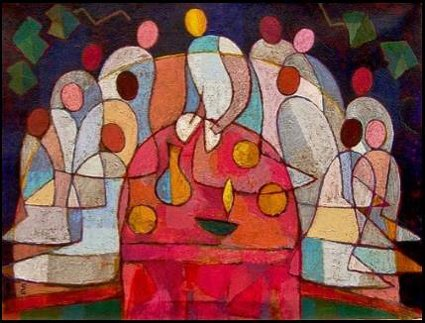
Art by Soiche Watanabe

We can no more spiritually live without taking Jesus into us, as we could live without eating on a regular basis. Christ is our breakfast, lunch, and dinner; our midnight snack and our birthday cake. Jesus is all that, and more.

Perhaps you are wondering why Jesus didn’t just state plainly who he is, why he came, and what will happen. Because it’s too much to handle.

We don’t simply accept Jesus into our heart, and then go on our merry way. Jesus Christ is someone to search for and discover, as if we were looking for fresh water or for the best baguette in the world.

Anyone can affirm a few belief statements, or do some good deeds. But it takes real courage to go hard after the spiritual life and find out what it’s all about:

It requires some solid bravery to explore the depths of your own true self and face the internal crud that’s been hiding in the shadows of your soul.

It demands identifying the bogus ways we prop up a false self for others to see – wanting to control how people view us and treat us.

It takes some real chutzpah to pursue the God life without worrying about where it will take you or who it will upset.

Jesus is a force to contend with. He is the Son of God, sent from above, to provide the world with real spiritual food and drink. Christ is the one who sustains life, and makes abundance possible. He is the Lord who speaks, calls out, and draws us to himself.

Jesus Christ helps us fit, even though we come from the island of misfit toys.

Even more pertinent than the question of “Who is Jesus?” is the probing question, “And what will you do with him?”

Christ cannot fit into your neat theological system, your tidy doctrinal statements, and on your nicely cleaned coffee table within the attractive Bible. Sooner or later, we all must contend with the divine force which gives life to everything. We cannot get away from him.

So, go after Jesus. Find out who he is. Determine how to deal with a mercy so powerful that it melts away guilt and shame as if it were in a 500 degree oven. After all, it’s better to have a tasty loaf of bread than to become a hard slice of burnt toast.

But let’s not worry about how hot it is in here, but how noisy it’s getting.

Gracious Lord, move us, your people, to experience your love more deeply. Fill us with the energy that comes from a desire for service. Connect us with creation to care for your world. Engage us in the scriptures and increase our knowledge of you. Raise up your power and come among us. May your bountiful grace and mercy equip us. Amen.

Wear the Right Clothes (1 Samuel 2:18-21)

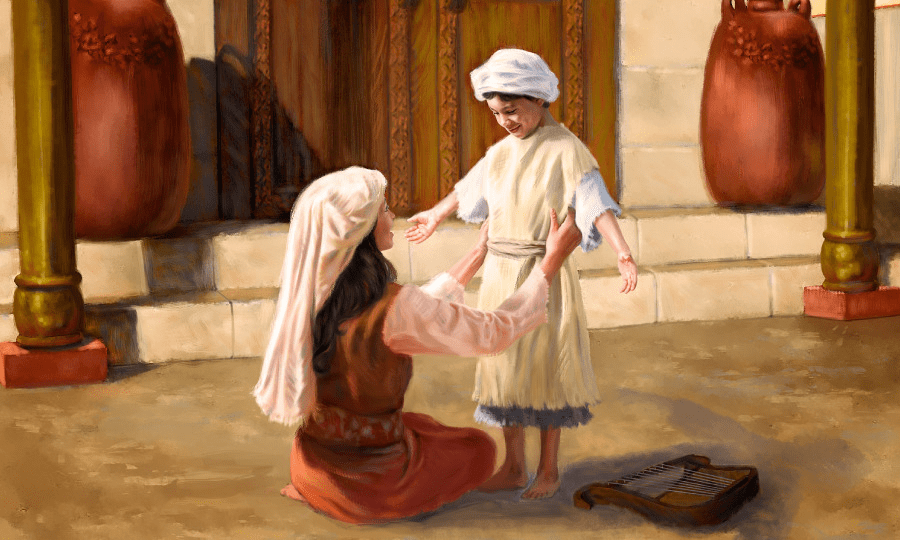
Hannah fits Samuel with a priestly robe, by Unknown artist

But Samuel was ministering before the Lord—a boy wearing a linen ephod. Each year his mother made him a little robe and took it to him when she went up with her husband to offer the annual sacrifice. Eli would bless Elkanah and his wife, saying, “May the Lord give you children by this woman to take the place of the one she prayed for and gave to the Lord.” Then they would go home. And the Lord was gracious to Hannah; she gave birth to three sons and two daughters. Meanwhile, the boy Samuel grew up in the presence of the Lord. (New International Version)

Hannah had to deal with infertility, a rival who taunted her mercilessly, and the societal shame of it all. But the God who is rich in mercy heard Hannah’s prayer at the Tabernacle in Shiloh. She was given a son, Samuel.

And when he was old enough – about 3 or 4 years of age – Hannah and her husband Elkanah presented Samuel to Eli the priest at the Tabernacle. She had vowed to do so if the Lord granted her a son. Hannah made good on that promise.

It turns out that the small boy Samuel was head-and-shoulders above the adult priests. Eli and his two sons, Hophni and Phineas, were no good, too small for the office of priest they occupied. Their service to God was anything but that. They served themselves, especially the two sons.

Eli’s adult children blatantly engaged in sacrilege, aggressively grabbing whatever they wanted from the sacred space of the Tabernacle. They made a mockery of the Lord’s instructions regarding sacrifices and worship in that holy place. The two of them cursed others (which would come back on them soon enough).

In contrast, the boy Samuel was a blessed child. His dear mother Hannah would make him a new priestly robe year after year as he served faithfully. His growing stature, and the need for clothing which suited him, were a light shining in the darkness of two sons who were outfitted in priestly garb that didn’t spiritually fit them at all.

The thing about our clothes is that they can either be an expression of who we truly are; or they can be a covering which hides the true identity. The story makes it plain that Samuel had a beautifully handcrafted robe which suited him perfectly. But Hophni and Phineas inherited priestly threads that seemed like ill-fitting hand-me-downs.

All of us are either revealing who we really are for all to see with unabashed authenticity, or we are concealing ourselves behind a disingenuous false façade, so that our true self is obscured and hidden in the shadows.

We are embodied people living on a physical earth. Our clothes aren’t just mere coverings of the body; they are a material means of communicating important immaterial aspects of ourselves and the world. The elaborate garb of the priest has significance, and ought not to be taken lightly.

In the case of Eli’s sons, they used their clothing to fleece incoming worshipers who were making genuine animal sacrifices to God. The priestly outfits themselves were not the problem; at issue was two people committing sacrilege against the Lord, and injustice toward the Lord’s people.

Material things neither contaminate nor purify a person; the heart does that. We just need to ensure that material objects like clothing are set apart for specific and good purposes. Those clothes ought to be congruent with the person and the task at hand. And clothing ought never to demean or deceive ourselves or others.

Although we aren’t told what sort of clothing Hannah wore, I’m sure that everything she wore spoke to her humility before others, devotion to God, and spirit of doing what is right and just. The Lord gave her clothes fitted for a mother by blessing Hannah with even more children. I can imagine that the biblical writers had women like her in mind when they wrote some of their words:

I want women to enhance their appearance with clothing that is modest and sensible, not with elaborate hairstyles, gold, pearls, or expensive clothes. They should make themselves attractive by doing good, which is appropriate for women who claim to honor God. (1 Timothy 2:9-10, CEB)

It is not fancy hair, gold jewelry, or fine clothes that should make you beautiful. No, your beauty should come from inside you—the beauty of a gentle and quiet spirit. That beauty will never disappear. It is worth very much to God. (1 Peter 3:3-4, ERV)

For all of us, we are encouraged to wear actual and metaphorical clothing that is consistent with what is good:

Right living was my clothing. Fairness was my robe and turban. (Job 29:14, ERV)

Because we belong to the day, we must live decent lives for all to see. Don’t participate in the darkness of wild parties and drunkenness, or in sexual promiscuity and immoral living, or in quarreling and jealousy. Instead, clothe yourself with the presence of the Lord Jesus Christ. And don’t let yourself think about ways to indulge your evil desires. (Romans 13:13-14, NLT)

Therefore, as God’s chosen people, holy and dearly loved, clothe yourselves with compassion, kindness, humility, gentleness and patience. (Galatians 3:12, NIV)

The boy Samuel lived up to the priestly clothes he was wearing; they fit him like a hand in a glove. But the adults who should have known better, Eli and his sons, dressed down their priestly garments and demeaned the office of priest for the people they should have been serving.

It is high time to dress appropriately and clothe ourselves with Christ, so that the very life of Jesus may flow powerfully in us and through us, to the glory of God. Amen.

Unmasking the Hypocrite (Matthew 15:1-9)

Then some Pharisees and teachers of the law came to Jesus from Jerusalem and asked, “Why do your disciples break the tradition of the elders? They don’t wash their hands before they eat!”

Jesus replied, “And why do you break the command of God for the sake of your tradition? For God said, ‘Honor your father and mother’ and ‘Anyone who curses their father or mother is to be put to death.’But you say that if anyone declares that what might have been used to help their father or mother is ‘devoted to God,’ they are not to ‘honor their father or mother’ with it. Thus you nullify the word of God for the sake of your tradition. You hypocrites! Isaiah was right when he prophesied about you:

“‘These people honor me with their lips,
    but their hearts are far from me.
They worship me in vain;
    their teachings are merely human rules.’” (New International Version)

Reading the Gospel lesson for today, I try to imagine what emotions Jesus might have experienced when confronted by the teachers of the law about his disciples’ lack of attention to tradition concerning ritual hand washings.

Maybe Jesus felt frustration, anger, sadness, exasperation, disappointment, irritation, aggravation, or discouragement. Perhaps Christ experienced all those emotions. Whatever Jesus was feeling at the time, I can easily see him taking a deep breath and exhaling a great big *sigh* over the religious leaders’ hypocrisy.

Hypocrisy is a disconnect between the values we espouse and our behavior. When there is incongruence between what we say is important and how we really live, this is being two-faced and duplicitous.

The men who came to see Jesus were plain old insincere hacks who practiced religious quackery. And Jesus saw right through their fake pretention of righteousness.

First off, this narrative is not a dig on rituals themselves but on using ritual to leverage an appearance of religious superiority over others. This type of motivation for engaging in rituals ignores their ethical and moral intention. Sometimes folks can get so doggone wrapped up in how faith is represented that they lose sight of the faith itself.

Hypocrisy has to do with our motives – not so much what we do, but why we do it. Rituals are good. Why we do them or not, or how we go about doing them, gets at the heart of our objectives for engaging religious practices. Are they truly a worship offering to God, or are they merely mechanisms for keeping up appearances of holiness?

The hypocrite is an actor. Hypocrisy is acting a part which is not truly the person. It is to live from the false self through the attempt of providing an idealized perfect person to the public, instead of embracing the true self and realizing our common humanity with one another in genuine devotion to God and service to others.

Religious hypocrisy is particularly insidious because it uses what is sacred for selfish purposes. It damages the credibility of the religion, creates idolatry, and covers hate with a veneer of pretentious piety.

The hypocrite is one who is a bundle of disparate parts in massive need of integration to a whole and real self. The cost to facing this is letting others see the true self with all of its flaws, imperfections, and weaknesses.

A lot of people have no willingness, nor the intention, to be viewed by others in the true self; so they maintain their play-acting and continue to seek attention and accolades through being the model religious person.

We all must come to grips with the reality that God cares a whole lot about why we do what we do. When the forms of faith become tools of oppression, and big burdens upon others backs, then those forms have supplanted the faith itself. Out of the overflow of the heart the mouth speaks, and from the heart the hands and feet move.

Whenever we care more about being and appearing right – rather than getting it right and becoming better – then we have a heart problem. The heart of the issue is the heart itself. Clean up the heart, and everything else follows – not the other way around.

The probity of today’s Gospel lesson is that we might misinterpret what is important to God. We may be playing the hypocrite; and yet have the misguided belief we are genuine.

The capacity for our hearts to enlarge with love is in direct relation to an awareness of the hidden motives buried within those hearts. Evil intentions and motivations are what separate us from God – not our race, class, age, gender, religion, ethnicity, behavior, rituals, or anything else on the outside.

If we find ourselves being nit-picky of others, this is usually a clue that the unconscious self is trying to protect us from facing the pain of our own sins by projecting and focusing on another’s supposed missteps with tradition or ritual.

Fortunately, Jesus came to this earth full of grace and truth. Christ sometimes, maybe oftentimes, set aside niceness and decorum to go for the heart. In shining a light on the motives behind the deeds of people, some repented and received the good news of the kingdom of God; and, others resisted in order to maintain their illusion of control and superiority.

None could ride the fence with Jesus around. You either loved him or hated him.

The beauty of grace is that when we squarely and uncompromisingly face our sins and let go of things we consider so important, and turn to God with authenticity, we are welcome at his Table.

Most holy and merciful Father, we acknowledge and confess before you our sinful nature, prone to evil and slow to do good, and all our shortcomings, offenses, and malevolent motives. You alone know how often we have sinned in wandering from Christ’s way of grace and truth, in wasting your gifts of compassion and justice, and in forgetting your love.

O Lord have mercy on us. We are ashamed and sorry for all the ways we have displeased you. Teach us to hate our errors; cleanse us from our secret faults; and forgive us our sins; for the sake of your dear Son, our Lord. Most holy and loving God help us to live in your light and to walk in your ways according to the commandment of Jesus Christ, our Savior, in the enabling of your blessed Holy Spirit. Amen.

Be Real, Not Fake (Titus 1:5-16)

The reason I left you in Crete was that you might put in order what was left unfinished and appoint elders in every town, as I directed you. 

An elder must be blameless, faithful to his wife, a man whose children believe and are not open to the charge of being wild and disobedient.Since an overseer manages God’s household, he must be blameless—not overbearing, not quick-tempered, not given to drunkenness, not violent, not pursuing dishonest gain. 

Rather, he must be hospitable, one who loves what is good, who is self-controlled, upright, holy and disciplined. He must hold firmly to the trustworthy message as it has been taught, so that he can encourage others by sound doctrine and refute those who oppose it.

For there are many rebellious people, full of meaningless talk and deception, especially those of the circumcision group. They must be silenced, because they are disrupting whole households by teaching things they ought not to teach—and that for the sake of dishonest gain. One of Crete’s own prophets has said it: “Cretans are always liars, evil brutes, lazy gluttons.” This saying is true.

Therefore rebuke them sharply, so that they will be sound in the faith and will pay no attention to Jewish myths or to the merely human commands of those who reject the truth. To the pure, all things are pure, but to those who are corrupted and do not believe, nothing is pure. In fact, both their minds and consciences are corrupted. They claim to know God, but by their actions they deny him. They are detestable, disobedient and unfit for doing anything good. (New International Version)

Everything in life needs some decency and order – including the church. The bulk of the Apostle Paul’s letter to Titus gives needed instructions about structuring the life of the church, along with some warnings about those who would attempt to disrupt that good order.

One of the most important aspects of church life and organization is to appoint competent persons with good character and sound doctrine to oversee and serve the congregation. The leaders of the church are to be mature, unselfish, concerned for the common good of all the parishioners, and able to handle Holy Scripture by strengthening the faithful and rebuking the faithless.

It takes solidly worthy leaders to counter people who are opposed to doing and believing things that are inconsistent with apostolic teaching. Paul had neither the tolerance nor the patience for rebellious folk who sought to deceive the faithful. So, he told Titus to silence, rebuke, and put a stop to such persons.

Orthodox icon of St. Titus the Apostle, the first Bishop of Crete

The rebellious persons, however, were not so easy to spot for many in the church – which is why Paul instructed Titus to deal with false teachers forcefully. They were not the real article, but came across as genuine.

Sometimes, you cannot tell a fake by the external appearance. In Christianity, and within the church, a person might give a good outward performance, but actually not be the real deal because they are full of bitterness and death on the inside with a heart far from God.

A sobering reality for devoted believers in God is that the church and Christianity can have people who are religious on the outside but not really Christ followers on the inside. Claiming to know God isn’t the same as actually knowing the Lord. It’s like putting perfume in a vase – it might smell like flowers but the flowers aren’t really there.  

The Apostle was pointed about how to handle those of the “circumcision group” because they were legalists who put heavy spiritual loads on people and were unwilling to help them carry those burdens. Paul, following the example of the Lord Jesus, was always laboring and challenging people into a genuine, real righteousness from the heart that would submit to God’s kingdom. 

And, much like Jesus before him, Paul kept having the Judaizers in the church undermining him, talking behind his back, and stirring up resentment against him. 

The rebellious people of the circumcision group were not helping believers know God better through active service, but only tried to talk a good line. Paul pointed them out to Titus because such persons were not strengthening the faith of others and enabling them to live a sound spiritual life.

The Judaizers did not practice what they preached – and even what they taught was neither gentle, nor had any grace. People need one another in the church to truly live for God; but if there are double standards, then heavy loads aren’t getting carried because some individuals think they are above helping, or think too little of themselves and believe God could not use them. 

In both cases the person declares, “Someone should do something!” Someone should give, someone should pray, someone should visit, someone should tell that person about Christ, someone should help. To which Paul (and Jesus) would say that someone is you.

We may believe we are genuine and think we are being helpful when we really are not. Whenever we plaster on fake smiles, only obey and serve when others are looking, and/or pretend like everything is just peachy keen when we are dying inside, then we are in the same category as the Judaizers. We have become in need of putting aside how we look to others and ask the God of grace to have mercy on us. 

It’s possible to be so obsessed about the right thing to say that we never say what is really on the inside because we think it isn’t spiritual enough and we fear looking bad. We then put up a spiritual façade, live into a false self, thereby and eventually becoming a false teacher.

The rebellious in the church are those who seek power, status, authority, and prestige. Respect and honor from others is everything to them, so they want the positions of prominence and insist on being recognized for whatever they say or do in the church.

But facades will not work for Christianity. The church is about integrity, mission, worship, and service – and not about acting with the spectator in mind, and seeking to elicit praise and respect from others. For such persons, it does not matter what’s on the inside as long as the outside looks good. 

Instead of being a liar (one whose outward actions and inner dispositions don’t match) and an evil brute (not acting with anyone else’s needs in mind or at heart) and a lazy glutton (always receiving but never giving) instead be a servant of others with a good character, a basic understanding of Holy Scripture, and a heart to know and love God. 

If there is a job that no one wants to do, I’ll do that job.

If there’s a lonely person, I’ll be with them.

If there’s a parking space up close, I’ll park in the back of the lot.

If there’s a need is someone’s life, I’ll meet that need.

If there’s a hardship someone has to endure, I’ll help carry that hardship.

If there’s a sacrifice to be made, I’ll make that sacrifice. Amen.