Trinity Sunday (John 16:12-15)

Holy Trinity, by Andrei Rubley

“I still have many things to say to you, but you cannot bear them now. When the Spirit of truth comes, he will guide you into all the truth, for he will not speak on his own but will speak whatever he hears, and he will declare to you the things that are to come. He will glorify me because he will take what is mine and declare it to you. All that the Father has is mine. For this reason I said that he will take what is mine and declare it to you.” (New Revised Standard Version)

Trinity Sunday is an annual celebration on the Christian Calendar which focuses intentionally on the mystery, power, and beauty of the triune God – Father, Son, and Spirit. All three persons of the Holy Trinity exist together in eternal love, harmony, and unity with each other as one God.

This day is much more than a doctrinal and theological affirmation. It is a reminder that our theological impulses are to have movement toward union with this triune God, to participate in the Divine dance of the Trinity.

The Christian life is oriented toward the Trinity. Christianity is a path, a road, a journey with God. It is a pilgrimage of the soul that demands our time, effort, and courage.

In other words, we are meant to experience God as Father, Son, and Spirit, rather than merely acknowledging the Trinity. Not only are we to know God; we are designed to feel at the core of our being the existential presence of God. What’s more, the Holy Trinity participates within the Godhead to help make that happen within us.

The Trinity we see in the Gospel of John is a presentation of God’s love for us. A gracious window is opened to the mystery of the one God in three persons. This allows us to see and feel that this trinitarian love holds us in a Divine embrace.

In Christ’s Farewell Discourse (John chapters 13-17) love is the dominant theme. Love is what Jesus wanted to leave with his disciples, and to remind them that all things are to be said and done with love. Christ promised the giving of the Spirit as a gift of love, so that we will learn to love ourselves and others.

There is eternal love, unity, and harmony continually flowing from the Father who sent the Son for us and for our deliverance, and from the Spirit who dwells with us in an abiding presence of love. Together the Father, Son, and Spirit develops us as lovers, loving the world just as God does.

The heavenly Father holds us in love so that we will hold the world in love.

Jesus the Son comes among us and reassures us of Divine love so that we will bring love to the world.

The Spirit guides us into the truth of love so that we will display love for one another in front of the world.

As Christians bravely, patiently, and calmly walk the road of the Christian life, they grow more and more in love with God, and therefore, more in love with the world that God loves so much.

There is an interaction between the Father and the Son marked by truth and love. Jesus graciously invites the believer into this conversation. In addition, the Spirit instructs us so that our speech and behavior will emulate the love which always takes place within the Trinity.

The reality of the Holy Trinity helps us experience and feel that God is for us; God is with us; and God is in us.

Sometimes we get hung up on the timing of things. We want what we want now. We don’t understand why God isn’t coming to our rescue. We wonder if God is even around because of this crud-encrusted planet we live on with all of its natural disasters and human destruction.

Yet, let’s keep in mind that the triune God has forever existed. God is constant. Father, Son, and Spirit are continually working in the immediacy of the now. We have been offered Living Water, but the water pouring forth now is not the same as what came before and what is to come – just as the water in a river flows by us, having come from somewhere downstream, and going somewhere else.

Time is irrelevant. All we have is the now. When we hold on to the past and/or have anxiety about the future, we are failing to live in the present. And in this very moment, the triune God is present with you, is in you, and is for you. Live in the now, and not so much in the has been and the not yet.

God only becomes real to us when I am. Then, the great “I AM” is able to dwell with the little “I am” of me in the present tense of now.

Because God is God, there will always be a mystery, because trying to understand the Holy Trinity – the great Three in One – shall forever elude us. We have not been called to understand God; we are called right now to submit to the unfolding of what God wants to reveal to us.

The triune God has shown us that within the Trinity there exists perfect love, harmonious unity, infinite beauty, and great goodness. As people created in the image of this God, we have the capacity to pursue these very same qualities. With God’s enablement, we can be a source of light and hope to a world which needs an experience of Divine love and truth.

God of heaven and earth, before the foundation of the universe and the beginning of time you are the triune God: the Author of creation; the eternal Word of salvation; and the life-giving Spirit of wisdom.

Guide us, O God, to all truth by your Spirit, so that we may proclaim all that Christ revealed and rejoice in the glory he shared with us. Glory and praise to you – Father, Son, and Spirit – now and forever. Amen.

Romans 5:1-5 – Maybe There Can Be Peace…

Therefore, since we have been justified through faith, we have peace with God through our Lord Jesus Christ, through whom we have gained access by faith into this grace in which we now stand. And we boast in the hope of the glory of God. Not only so, but we also glory in our sufferings, because we know that suffering produces perseverance; perseverance, character; and character, hope. And hope does not put us to shame, because God’s love has been poured out into our hearts through the Holy Spirit, who has been given to us. (New International Version)

Today, there are millions, perhaps billions, of people without peace in this world.

Maybe…

Maybe there isn’t much peace in your life. Because of that unsettled icky sense of agitation, your mind is somewhere else. It could be that you are upset about something that has happened or are worried about something that is going to happen. 

Maybe the lack of peace has to do with another person. They did or said something, and it’s been grinding on you. So, you are having conversations with that person in your head for which you will probably never say aloud. 

Maybe you have to deal with someone else who doesn’t have peace, and it’s creating stress for you. And you are wondering when things will settle down.

Maybe the lack of peace runs much deeper than your immediate circumstances and plans. 

Maybe every day, day-in-and-day-out, you are not quite sure about where you stand with a person or a group of people.

Maybe you aren’t sure about how you stand with God. You wonder whether God is really pleased with you, or not. 

Maybe you aren’t even in touch with your lack of peace because you are an expert at pushing whatever feelings you have so far down that you think you’re fine. But you really aren’t.

Maybe you are a perfectionist…

Perfectionists are never at peace. The specter of perfectionism always hangs in the air. There’s a steady stream of “should have’s,” and “could have’s” making noise in your head. Your work, no matter how good, is never good enough. “I should have done better.”  “I ought to do better.”  “I must be better.” 

Instead of viewing life’s opportunities as challenges to be welcomed, the perfectionist sees life as one unending mountain to climb, never quite reaching the top. 

The constant companions of perfectionistic people are disappointment, condemnation, frustration, and perceived failure. There is, for them, an internal world of self-loathing based on the lie that I am not enough – I have to be perfect. Peace, for the perfectionist, is a pipe dream.

Maybe we could focus a bit on God…

The Christian God is a triune God, existing in three persons – Father, Son, and Spirit – the great Three-in-One. The Trinity is the basis for all we are and all we do.

All of life is grounded in the triune God. God exists in perfect unity and harmony. God is God’s own community of glorious love. God’s glory is primarily seen on this earth through creation, through us, God’s creatures.

Glory is revealed as we reflect the image of God stamped on us in creation. Since God is love, God’s people are to be characterized by love – loving God, loving one another, and loving neighbor. God’s people are meant to exist together in unity and harmony, reflecting the very nature of the Holy Trinity. 

Yet, after the creation of the world and humanity, man and woman fell into guilt and shame through bucking God’s design for people. Ever since, God has been on a mission to reclaim the lost glory.

Maybe we need to focus on the Son… 

The ultimate expression of God’s mission was the sending of the Son to this earth. It is through Christ’s life, death, resurrection, and ascension that the way has been opened to a renewed relationship with our triune God.

The way is now clear for us to experience real practical peace. It has been achieved through the cross of Jesus Christ.

Therefore, since God has initiated a rescue mission for us by sending the Son, since we have been justified through faith, we have peace with God. 

To be justified means God made us righteous – has made things right between us. God has also provided access for us to be right with each other and the rest of creation. To put this in a contemporary vernacular, we ask God, “Are we good?” and God responds, “We’re good.”

Since then, we’re good with God, we have peace with God. 

Since then, that is true, we cannot try and get peace by another way.

Peace does not come through doing the right things, and by being a good person. 

Peace does not come through trying to obtain feelings of peace.

Peace is not merely the absence of conflict – of just keeping people from strangling each other and harming one another. 

Peace cannot be achieved by trying to relieve anxiety through better effort. 

Maybe grace is the answer…

The antidote to perfectionism, the resolution to feeling a lack of peace is unconditional approval from God. 

Grace is the elixir of life. 

Grace is the thing a perfectionist cannot work to obtain, and the thing that truly helps. 

Grace is freely given; it is a gift.   

Grace (God’s loving unconditional acceptance of us) is the true way of peace.

Some folks have so tied themselves to impossible performances and conditional love that the gift of grace is hard to accept. 

Change won’t happen overnight, and that’s okay – because God deals with us according to grace, not by earning spiritual merit badges. 

The renewal that brings transformation is a process, not an event. In Scripture it’s called “sanctification.” So, it’s important to enjoy the process. 

When you’ve caught yourself going back to the pigsty of perfectionism, instead of beating yourself up, go ahead and laugh at yourself and your own fallibility. Perfectionists take themselves way too serious. Anytime they can lighten up, it lights up the face of God (in a non-performance sort of way!).

Maybe peace is possible…

Peace delivers us from our brokenness.  Again, let’s return to the triune God. There is perfect peace within Father, Son, and Spirit. God is perfect unity, harmony, and love.

Peace means living, working, and playing together. 

Peace means experiencing wholeness, integrity, and contentment, even in the midst of hard circumstances. 

Peace means being a peacemaker.

The late Fred Rogers, from Mister Rogers’ Neighborhood, got into television because he didn’t like TV. During spring break of his senior year in seminary he encountered television for the first time. What he saw repulsed him because he saw people demeaning each other and not having peace.  

Fred Rogers worried that TV programming would create a generation of emotionally-bankrupt children. Faced with the decision to either sour on television itself or work to restore the medium, he chose the latter. He dropped out of seminary and began pursuing a career in broadcasting. Fourteen years later, he created a television show that shaped entire generations of children, running on PBS from 1968-2001.

Mr. Rogers was a devout Christian who rarely talked about his faith on the air. Yet, his show infused our society with beauty and grace. “You’ve made this day a special day by just your being you,” he’d famously sign off. “There is no person in the whole world like you, and I like you just the way you are.” 

In many ways, the lasting legacy of Mr. Rogers will not only be the greater emotional stability of generations of children, but also his wonderful example of peace and how to restore the world through basic human kindness.

Maybe the path of peace is different than I believed…

Having all our circumstances like we want them is not the basis of experiencing peace. That’s being delusional. Peace doesn’t happen whenever everything goes our way.

Instead, we are to rejoice in all our circumstances, even the ones which cause suffering – because they the Holy Spirit’s means of teaching us to experience the peace we long for.

Suffering is our triune God’s way of weaning us off all that divides and antagonizes so that we can attach ourselves to God’s peace. 

One of the most read Christian books of all time was written in the 1500’s by a French woman known as Madame Guyon. She saw the disunity of the world and the lack of peace in our individual lives as stemming from our lack of practicing God’s ways. 

Much of the world doesn’t know what to do with suffering, and does not accept it, because people want their own way with everything.

War and Peace by U.S. Air Force Staff Sgt. Jamal D. Sutter

To know God’s peace, we must practice just the opposite – by refusing all personal desires we have, whether good or bad. Why? Because the practice of refusing our own will breaks it free so it can attach to God’s will.  

We need our brains to be rewired in saying “no” to ourselves.

The other part of Madame Guyon’s practice is to accept every circumstance, even difficulty and suffering, with joy and thanksgiving. 

We can learn to say “yes, thank you” for each hard circumstance, whether good or bad. As in the case of Mr. Rogers, the evil we observe can spur us toward making peace in this world. We detach from personal desires so we can attach to what God wants to do.

Peace, on the practical level, comes from persevering under suffering and rejoicing in it. Why rejoice? Because suffering produces character and character hope. There cannot be hope without suffering. 

God the Father called God the Son to suffer; and God the Spirit leads us into suffering so that we might know peace and hope on a daily basis.

Conclusion

Abandon everything to God. Let it go – every dream, every personal desire, everything you have so that you are free to know God’s will for your life. 

Accept each circumstance you face with joy and thanksgiving. The Trinitarian love of God is poured into our hearts through every circumstance of life, even if it is difficult and hard. 

When we practice abandonment of our wills and acceptance of our circumstances, the result gives us hope, the confident expectation that nothing in our lives happens in vain. 

Every situation can lead us to know God and experience peace. This is very different from simply believing in the Trinity; it is to daily experience the Trinity. 

Glorious God, make your presence known through our worship, our prayer, and our reading of your Word. Father, Son, and Holy Spirit, within you lies unity, love, justice, peace, and power.

Fill our outstretched hearts with your Spirit and encircle us with your love. Make yourself known to us in new and challenging ways. Empower us to forsake every will but your own.  Inspire us toward your peace. Do with us what you will, through Christ our Lord in the power of the Holy Spirit. Amen.

A Big Glorious Vision of Worship

In the year that King Uzziah died, I saw the Lord, high and exalted, seated on a throne; and the train of his robe filled the temple. Above him were seraphim, each with six wings: With two wings they covered their faces, with two they covered their feet, and with two they were flying. And they were calling to one another:

“Holy, holy, holy is the Lord Almighty;
    the whole earth is full of his glory.”

At the sound of their voices the doorposts and thresholds shook, and the temple was filled with smoke.

“Woe to me!” I cried. “I am ruined! For I am a man of unclean lips, and I live among a people of unclean lips, and my eyes have seen the King, the Lord Almighty.”

Then one of the seraphim flew to me with a live coal in his hand, which he had taken with tongs from the altar. With it he touched my mouth and said, “See, this has touched your lips; your guilt is taken away and your sin atoned for.”

Then I heard the voice of the Lord saying, “Whom shall I send? And who will go for us?”

And I said, “Here am I. Send me!” (Isaiah 6:1-8, NIV)

Uzziah was a king of Judah who reigned for fifty-two years. For most of his rule, he followed God faithfully. Under Uzziah the Jews had enjoyed the best political stability, economic security, and consistent worship of God since the days of King Solomon, hundreds of years before. 

Yet, if one were to look below the surface of Judah, it was also a time of spiritual complacency, apathy in worship, taking prosperity for granted, and self-centered – often oppressing others. The nation needed a fresh experience of God, and it came through the prophet Isaiah.

The essence of worship is a recognition and celebration of the triune God. Worship is a relational rhythm between God and humanity in which God self-reveals and people respond.

Worship is an experience of seeing and hearing divine revelation; repenting from wayward actions; and renewing missional service.

Worshiping the triune God ideally happens every day. It’s a lifestyle – not the result of one cleverly planned hour on Sunday. The people of Isaiah’s day were going through the ritual motions of worship without having their hearts in it. Worship was a kind of rabbit’s foot for them in which, if they had regular attendance within the temple, they believed they could do whatever they wanted with their lives outside the temple. 

As a result, the people did not see or hear God in their worship. Authentic worship of God does not have to do with the environment, the fellowship, or the music. True worship of the triune God is a heart desire to see and hear God. 

If worship does not happen in the sanctuary, that is because worship fails to occur daily life. Real worship is a life-changing encounter with Father, Son, and Holy Spirit. It experiences God’s revelation and changes our view of him. Bona fide worship leads to repentance and changes our view of self. True worship brings spiritual renewal and changes our view of mission and service.

Revelation: Worship Changes Our View of God

Isaiah saw a vision of God in the majestic divine throne room. It was a grand and transcendent vision of a God who dominates the entire setting. The train of God’s robe filled the temple. This is Isaiah’s way of saying the vision was incredibly large. If the train of his robe fills up the temple, then God is an immense Being. Gaining a vision of God’s hugeness is what causes our human problems to be seen as small. 

One time the Assyrian King Sennacherib invaded the land and approached Jerusalem during the reign of Uzziah’s great grandson, Hezekiah. The Assyrians were the dreaded horde of the ancient world, and it seemed no one could withstand them. So, the people prayed:

King Hezekiah and the prophet Isaiah son of Amoz cried out in prayer to heaven about this. And the Lord sent an angel, who annihilated all the fighting men and the commanders and officers in the camp of the Assyrian king… So, the Lord saved Hezekiah and the people of Jerusalem from the hand of Sennacherib king of Assyria and from the hand of all others. God took care of them on every side. (2 Chronicles 32:20-22, NIV)

Isaiah’s vision included seraphs – angels with the job description to glorify God with ceaseless praise. Their physical description symbolizes their function: covering their face symbolizes humility in God’s presence; covering their feet identifies it as holy ground; and flying symbolizes their work to do God’s will.

The seraphs have two-thirds wing power for worship, and one-third wing power for work. If this is any indication how God’s creatures are to conduct their lives, we as humans have a great deal of adjusting to do to accommodate the worship of God.

The sound of worship that came from the seraphs was proclaiming God’s holiness. Isaiah’s view of God changed as a result. As he saw God’s glory, Isaiah saw God as much bigger than he had before. For example, European visitors who come to the United States sometimes have no frame of reference as to how spacious the geography of our country is.

Some have a notion they can make day trips to places like San Francisco, Houston, or New York City because where they live is much more geographically compact. But once they get here, they experience the land in all its glory, and they gain an appreciation for the bigness of America. We all need to experience God’s glory and see God’s holiness because it will cause us to repent of old ways of seeing.

Repentance: Worship Changes Our View of Self

Isaiah was reduced to nothing after seeing a vision of the holy God. Humans cannot see God’s glory without also seeing their sinful selves. Isaiah’s response to God was not praise, but confession. Show me a proud, self-centered, and arrogant person and I will show you a person who has not seen God. Isaiah was unable to cleanse his own sin. Isaiah needed God to purge and purify his uncleanness. The New Testament says:

If we live in the light in the same way as he is in the light, we have fellowship with each other, and the blood of Jesus, his Son, cleanses us from every sin… If we confess our sins, he is faithful and just to forgive us our sins and cleanse us from everything we’ve done wrong. (1 John 1:7, 9, CEB)

Seeing God completely unravels us, for we see our depravity for what it truly is:

  • When the Apostle Peter saw the Lord’s immensity and power through a miraculous catch of fish he fell at Jesus’ knees and said, “Go away from me, Lord; I am a sinful man.” (Luke 5:8) 
  • When the Apostle John had a vision of Christ’s glory, and heard his voice, he fell at the Lord’s feet as though dead. (Revelation 1:12-17)
  • When the prophet Ezekiel had a vision of God and saw the appearance of God’s glory, he fell facedown. (Ezekiel 1:25-28)
  • Even Daniel, perhaps the most righteous prophet of all time, when seeing a vision of God’s glory, fell prostrate with his face to the ground, totally overwhelmed with God’s holiness and his own human sinfulness. (Daniel 8:15-18)

There is wickedness and indifference in the world. People do not see God’s glory and holiness. Because, if they did, they would be totally undone and see the foulness and degradation of hate and injustice. They would turn from apathetic and complacent ways of living. The world and the church need a vision of a holy God that comes from meeting with God. Isaiah saw the Lord. And because he repented, he was then able to hear the voice of God.

Renewal: Worship Changes Our View of Service

God is calling us. God’s voice has gone out. If we do not hear it, it’s because we have not experienced God’s self-revealing and have not responded with repentance. Apart from worship, we are unable to hear God. While Isaiah was worshiping God, he saw, responded, and heard the Lord. The early church heard the voice of God to service and mission:

The church at Antioch had several prophets and teachers…. While they were worshiping the Lord and fasting, the Holy Spirit told them, “Appoint Barnabas and Saul to do the work for which I have chosen them.” Everyone prayed and fasted for a while longer. Next, they placed their hands on Barnabas and Saul to show that they had been appointed to do this work. Then everyone sent them on their way. (Acts 13:1-3, CEV)

Isaiah was willing. He didn’t ask any clarifying questions. He neither inquired what the mission would be nor questioned God as to the plan. Isaiah plainly said, “Here I am, send me.”  It was an unconditional response to hearing God. Isaiah made no deals with God, did not try and negotiate terms of service. Isaiah simply told God he was willing to be sent. 

Many people fill their lives with stuff and activity. And they are unable to hear the voice of God. There’s just too much noise drowning out God. We have uncritically, without any discernment through prayer and worship, filled our lives to overflowing with never-ending things to do. And we have even sanctified it and called it holy, as if God’s will for us is to be constantly on the go.

Someday, we must give an account of our lives. God will ask why we did not take a risk, get involved, and go out into the world with a deep sense of mission. Too many people will say, “I never heard the call!” Yet, God was calling. “Whom shall I send? And who will go for us?” says the triune God.

Conclusion

God’s glory was revealed to Isaiah. Isaiah responded to that vision with confession and repentance. This brought a renewed sense of mission to his life. Isaiah was then able to hear God’s voice calling him to service. It is not our ability God cares about. Because God can equip anybody for any type of work. Instead, it is our availability God cares about.

We need to put ourselves in a position to see and hear God. The obstacles to visioning God’s glory and hearing God’s voice are legion: inattention to God’s Word and God’s creation; no mindfulness to the Holy Spirit; intense, constant, and prolonged preoccupations; lack of availability to the ways of Jesus; little sleep; unhealthy habits; a dull spiritual sense; lack of personal and divine awareness; a paucity of spiritual practices and disciplines; and a failure to be able to experience a vision of God.

God has graciously revealed himself to us as Father, Son, and Spirit. The Trinity is not so much a doctrine to believe as it is a powerful reality to live into. If we see and hear God today it will cause us to repent and be renewed in mission and service.

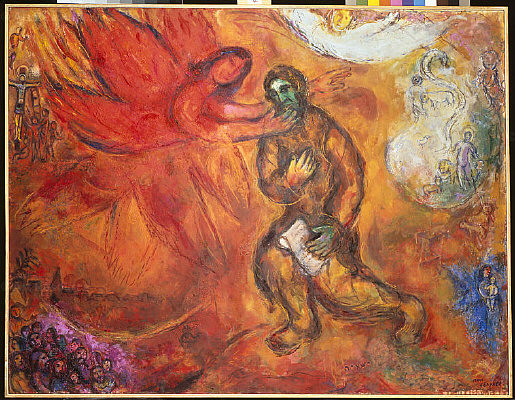
*Above painting of the prophet Isaiah by Marc Chagall, 1968

Trinity Sunday – The God of Wholeness

oak tree 2

We live in a fundamentally broken world. Systemic racism, political gridlock, social stratification, hate crimes, alcohol and domestic abuse, ageism, disease, malpractice, terrorism, and xenophobia barely scratch the surface of sad societal ills and we face living in this old fallen world. Indeed, it is all quite distressing. To realize wholeness and integrity will require operating the mechanism of blessing.

“May the grace of the Lord Jesus Christ, the love of God, and the fellowship of the Holy Spirit be with you all.” (2 Corinthians 13:14)

This is the blessing I leave with my congregation each Sunday. A divine blessing involves the wholeness and integrity of the triune God given to us through grace, love, and fellowship. Holding each facet of that blessing together can sometimes be a challenge.

There was a time in my life when I golfed every day. Even though I played a lot of golf, it was rare for me to have an entire round where my driving, approach shots, chipping, and putting all worked nicely together. My typical experience was that when my driving was superb, my chipping and putting was awful; or, that when my putting was amazing, my approach shots were atrocious. Rarely did I have the whole package of a solid golf game put together in one seamless round. Instead, my game, along with most amateur golfers, is typically disjointed with a combination of brilliant shots and ugly shanks.

The Christian life can seem the same way – with the ability to show love and grace, be open and caring on some days, and not so much on other days. We need God – the triune God. Within God there is complete wholeness, a total well-rounded divine Being.  As we connect with this Being, then we can experience God’s wholeness and integrity, which leads to our own consistent daily wholeness, with no divided herky-jerky self.

The Trinity – Father, Son, and Spirit – provides us with a model of wholeness and displays how it all comes together in a solid consistent life of blessing. There is a beautiful connection between the Trinity and our lives.  It is a path to wholeness that involves healing, hope, and spiritual health based in the triune God.

Healing

The grace of Jesus enables us to pull ourselves together. Jesus is the one who has brought reconciliation and restoration – he has made the bridge and connection to God. In response to this grace we aim for perfection (not perfectionism) pull ourselves together” and restore and heal ourselves. Since Jesus is the Reconciler, the one who restores and heals, we are to allow that grace to wash over us and seep deep into our souls so that we experience reconciliation, restoration, and healing.  When we are broken and disjointed, the grace of Jesus sets us back in place again.

Tim Hansel

The late Tim Hansel was a teacher and mountain climber. He wrote a book many years ago entitled, You Gotta Keep Dancin’: In the Midst of Life’s Hurts, You Can Choose Joy! Hansel lived with chronic debilitating pain for thirty-five years after a climbing accident where he literally fell off a mountain and shattered most of the vertebrae in his back. In his long journey of coming to grips with his painful existence, Tim Hansel discovered that wholeness can certainly come through brokenness. Healing can happen with pain still present. Maturity can occur through painful growth of the human spirit. He constantly said to people, “Pain is inevitable; but misery is optional.” He explained to others, “Character is developed through adversity and pain. That adversity can either destroy us or build us up, but it will not leave us the same, depending upon our chosen response to it.  Pain can either make us better or bitter.”

Even if you do not experience the kind of healing and restoration of body or soul you are looking for, maybe, like Tim Hansel, you will receive grace and freedom that the loving triune God gives. God himself lives with observing the terrible pain of humanity’s hurts every day. The more we participate in the life of God, the greater is our ability to deal with pain – our own as well as the pain of others.

Hope

The fellowship of the Holy Spirit enables us to receive comfort. The Spirit is the Paraclete, the one who encourages by coming alongside and helping. The Spirit works with us, intimately participating in our lived everyday experiences. The Spirit is God’s means of experiencing wholeness. The Holy Spirit lovingly appeals to us in ways we can understand and act – speaking words of comfort and exhortation with the commitment to a faithful presence. Since the Spirit is committed to helping us, thus, we are to help others through living in fellowship with them.

John-Wesley

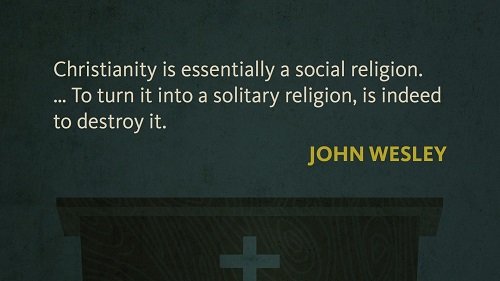
When John Wesley was a young Christian, a seasoned saint advised him, “Do you wish to serve God and go to heaven? Remember you cannot serve him alone. You must therefore find companions or make them. The Bible knows nothing of solitary religion.” Wesley took that advice to heart. Convinced that the pursuit of personal holiness was impossible apart from Christian community, he carefully organized the Methodist movement (a reaction against solitary religion) into societies (congregations), classes (small groups of eight to twelve), and bands (accountability groups of three to five).

We are meant to receive the encouragement of the Spirit. The Holy Spirit does not hold back in providing us with the help we need to live the Christian life in the form of other believers. We are all important. If we are not healed, we hurt and then hurt others. However, with healing comes hope, and hope encourages us that it will not always be this way – there are better days ahead.

Hope helps us to see beyond the immediate pain, hard circumstance, or adversity to what God can do through the help and power of the Holy Spirit. Just as there is complete and whole fellowship within the triune God, so there can be wholeness of fellowship with us. Christianity is not a solitary religion; it involves companions and fellow disciples for the journey.

Health

The love of God the Father is our peace. God’s unconditional love brings spiritual health to the Body of Christ and to the world. Within God there is complete and total love – a wholeness in which everything God does expresses loving-kindness.

Unity and peace happen when there is health in the church and the world. It is the fruit of love. Love for one another brings unity of prayer and purpose. It is love that brings about peace and harmony. It is love which solidifies compassion in circumstances of adversity.

We are meant to receive the Father’s love. Love brings people together and enables them to become conduits of the loving nature of God to others. There is no other path to spiritual health and sanity than the journey of love.  And love most often gets messy because we get into the muck of people’s lives with all their needs and hurts. Sometimes it takes a tragedy before some folks show love. So, live each day with no regrets as if it were your last and Jesus was coming today.

The Trinity

God the Son, Jesus Christ, brings healing because of his grace.

God the Holy Spirit brings hope because of his encouragement.

God the Father brings health because of his love.

Because of the Trinity, our work is clear:

The Body of Christ brings healing to the world because it bestows grace.

The Body of Christ brings hope to the world because of its encouragement.

The Body of Christ brings health to the world because of its love.

May the grace of the Lord Jesus Christ, and the love of God, and the fellowship of the Holy Spirit be with you all, now and forever. Amen.