1 John 2:18-28 – Who Is the Real Enemy?

Dear children, this is the last hour; and as you have heard that the antichrist is coming, even now many antichrists have come. This is how we know it is the last hour. They went out from us, but they did not really belong to us. For if they had belonged to us, they would have remained with us; but their going showed that none of them belonged to us.

But you have an anointing from the Holy One, and all of you know the truth.I do not write to you because you do not know the truth, but because you do know it and because no lie comes from the truth. Who is the liar? It is whoever denies that Jesus is the Christ. Such a person is the antichrist—denying the Father and the Son. No one who denies the Son has the Father; whoever acknowledges the Son has the Father also.

As for you, see that what you have heard from the beginning remains in you. If it does, you also will remain in the Son and in the Father. And this is what he promised us—eternal life.

I am writing these things to you about those who are trying to lead you astray. As for you, the anointing you received from him remains in you, and you do not need anyone to teach you. But as his anointing teaches you about all things and as that anointing is real, not counterfeit—just as it has taught you, remain in him. (New International Version)

Identifying the Antichrist is almost a spectator sport amongst some Christians. They seem to enjoy advancing particular persons as the archenemy of Christ and the Church.

Throughout Christian history, bloodthirsty kings and ruthless dictators have typically received the moniker of Antichrist. When the Protestant Reformation came along, five-hundred years ago, the Catholic Church often got labeled as the great enemy of Christianity.

The mudslinging that has gone on between different Christian traditions throughout the centuries can make any contemporary political war look like a powder puff football game.

Although some Christian groups tend to view the antichrist as a single enemy, setting-off a bomb of world-ending trauma, the earliest Church, following the teaching of the Apostle John, understood antichrist not as an individual, but as a class of people who deny Jesus is the Christ. 

It has become much too vogue in some circles of Christianity to identify and label enemies outside their small groups, leading to a xenophobic attitude of distrust and finger-pointing toward all kinds of people.

 

The fingers, however, must first be directed within our own house. It behooves us all to take up the instruction of John to let what we have heard from the beginning abide in us. If what you heard from the beginning abides in you, then you too will abide in the Son and in the Father. 

We are to embrace basic core cardinal truth given us. Then we will not be deceived by some supposed enlightened teacher who detracts from Trinitarian theology.

It is the last hour – but not because of some politician, tyrant, or religious figure. It is the end-times because Jesus has accomplished redemption for us, and the only event left is the return of Jesus to judge the living and the dead. 

Therefore, we must all live with the possibility and tension that it could be today. We are to be prepared. Proper preparation comes through proclaiming Jesus in all we say and do – not by obnoxiously ginning up fearmongering through pointing fingers at those we don’t like. Rather, we emulate our Lord in the way of loving God and neighbor.

When a person or group gets labeled by us as “enemy” or “antichrist” then our hate for them seems divinely justified and sanctioned. God, however, is the judge; not us. We are to follow the ethical instruction of Jesus to love our enemies, not curse them through declaring certain persons a “monster,” “devil,” “animal,” or some other non-human label.

Weaponizing words in a verbal war, which supposedly defends Christianity, only shifts the focus off Jesus and onto how horrible another is.

One of the great problems in our world, including many corners of Christianity, is that we assume we already know what another believes. So, we fail to listen. We cannot care as we ought because we’ve already formed our judgment.

“The moment someone attaches you to a philosophy or a movement, then they assign all the baggage and all the rest of the philosophy that goes with it to you. And when you want to have a conversation, they will assert that they already know everything important there is to know about you because of that association. And that’s not the way to have a conversation.”

Neil deGrasse Tyson

Within Christianity, there is more we have in common across the various traditions, than that which is different. Yes, spiritual charlatans exist. Let’s just make sure we have done our due diligence in listening to another and being curious before we form our opinions.

Despite the differences, the exchange of ideas and debate among various Christian groups in the early centuries of the church helped to clarify and form a sound Christology. While it may be difficult to avoid labeling individuals in an increasingly complex society, we must act in good faith and make the effort.

Perhaps we have already met the real enemy… us.

Gracious God, you are the Divine Gardener who cares for us with love. You call us to see the beauty of each branch united to the vine, the beauty of each person united to you in Christ through the Holy Spirit.

And yet, too often the differences in others make us afraid. We withdraw into ourselves. Our trust in you is forsaken. Enmity develops between us. Come and direct our hearts. Help us to live from your forgiveness so that we may be together and praise your name.

Lord Jesus, Prince of Peace, light the fire of your love in us so that suspicions, contempt and misunderstanding cease in the church. May the walls that separate us fall. Amen.

Luke 4:38-44 – Every One of Them

“Healing” by Ivan Filichev, 2014

After leaving the synagogue he entered Simon’s house. Now Simon’s mother-in-law was suffering from a high fever, and they asked him about her. Then he stood over her and rebuked the fever, and it left her. Immediately she got up and began to serve them.

As the sun was setting, all those who had any who were sick with various kinds of diseases brought them to him; and he laid his hands on each of them and cured them. Demons also came out of many, shouting, “You are the Son of God!” But he rebuked them and would not allow them to speak, because they knew that he was the Messiah.

At daybreak he departed and went into a deserted place. And the crowds were looking for him; and when they reached him, they wanted to prevent him from leaving them. But he said to them, “I must proclaim the good news of the kingdom of God to the other cities also; for I was sent for this purpose.” So, he continued proclaiming the message in the synagogues of Judea. (New Revised Standard Version)

One of the most fundamental truths about the person of Jesus is that he heals all kinds of people. 

Even people who know very little about the historical Jesus know that he was a guy who brought healing to people while he was here on this earth.  For many Christians, the fact that Christ healed people is almost a “ho-hum” moment because we are so familiar with the Gospel stories about him doing the supernatural. 

Observation: Christ Healed Every One of Them

Yet, as with most Scripture stories we encounter, we really need to slow down a bit and let the story sink in. Then, we are likely to make simple but profound observations of the text. One of those observations is this: When people brought the sick and infirmed to Jesus, he healed every one of them. Christ laid his hands on each and every one of them and cured them.

Every one of them, Jesus healed. There is apparently no disease, no infirmity, no sickness, no malady, and no situation too much for Jesus to heal. Without exception, no matter the problem, every individual who came to Jesus was healed by Jesus. 

Observation: Every One of Them Were Healed Through Others

Here’s another simple but profound observation of the story: All those who had any who were sick brought them to Jesus. In other words, those needy folks didn’t come to Jesus on their own. It was their family, friends, and neighbors of the sick persons who brought them to Jesus for healing.

It is good to care for the sick. It is also good to encourage them to look to Jesus for their help and healing. Yet, it is also very good when we bring them to Jesus ourselves. 

Perhaps one of the main reasons we are not seeing more healing and new life in the Western church is because we are not bringing the needy to Jesus. Maybe it is our lack of faith and action, and not the sick person’s, that prevents healing from being realized. 

Methinks that a profound dearth and lack of prayer for others might be at the core of all the physical, mental, and spiritual sickness that abounds in this world. So, let us bring people to Jesus so that he will heal and cure every one of them.

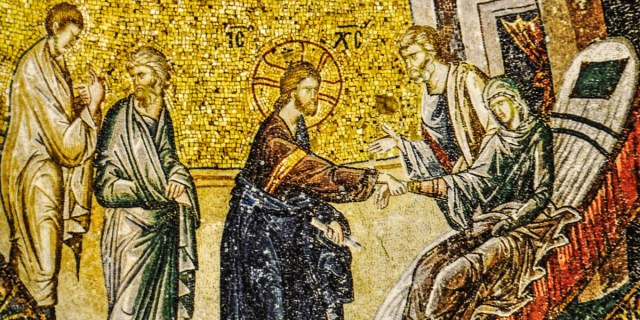
A mosaic of Jesus healing Peter’s mother-in-law, from a Byzantine Church, c.1100 C.E.

Observation: Christ Cares about Every One of Them

Jesus accepts, heals, and cures those at the margins of society. The sick, infirmed, and demon-possessed were the most marginalized people in the ancient world. They were at the mercy of a caring relative, that is, if they had one. If not, the only way of making it was to beg and rely on public charity. Yet, that was difficult because, in many cases, depending upon the illness, they were considered impure. No one would get near them. They couldn’t participate in the community.

But Jesus welcomed them. He took the time and attention to place his hands on each one of them. Their divine healing was much more than physical; being cured meant they no longer needed to be at the margins, unaccepted and unwanted. Jesus was giving them full inclusion to society.

The good news of Jesus Christ consists of meeting the holistic needs of people for health and community. Our Lord desires to integrate excluded people into society. If that takes the miraculous healing of sickness to do it, then Jesus will make it happen.

Observation: Christ Looks to Heal and Care for Every One of Them, Besides Just Us

It can be a real temptation to believe that our little group has the corner on Jesus. We don’t. Jesus was given for the life of the world – not just a few people who look, think, and act like you and me. In today’s story, the people didn’t want Jesus to go. That’s understandable. Yet, Christ left them because there were others in need of healing of both body and soul.

Christ’s mission is so much broader than we sometimes see or expect. Evangelical Christians camp on saving the soul. Progressive Christians hang their hat on social justice and the real physical needs of people. In reality, the gospel involves both body and soul. To only focus on one aspect is to truncate the gospel as only okay news, not good news.

I would argue there is far too much proclaiming of okay news today. Christianity needs a full-orbed gospel that addresses the holistic needs of people, just like Jesus did. It needs a robust Trinitarian theology with the love of God the Father, the grace of Jesus Christ, and the empowerment of the Holy Spirit delivering souls from spiritual death and saving bodies from worldly injustice.

Anything less is simply picking and choosing what we want and trying to keep Jesus to ourselves. Let’s not do that. Instead, let’s preach the gospel, a kingdom message in which the power of God comes upon people – transforming them from the inside-out and bringing them from the outside-in.

Healing God, we bring to you all those who are discouraged, depressed, diseased, disordered, and damaged in some way by the sin of this world. Cure them by your mighty power so that they will be included into our communities, as well as your heavenly kingdom. Amen.

Hebrews 5:1-10 – Our Great High Priest

Mosaic of Jesus Christ in the Hagia Sophia, Istanbul, Turkey

Every high priest is selected from among the people and is appointed to represent the people in matters related to God, to offer gifts and sacrifices for sins. He is able to deal gently with those who are ignorant and are going astray, since he himself is subject to weakness. This is why he has to offer sacrifices for his own sins, as well as for the sins of the people. And no one takes this honor on himself, but he receives it when called by God, just as Aaron was.

In the same way, Christ did not take on himself the glory of becoming a high priest. But God said to him,

“You are my Son;
    today I have become your Father.”

And he says in another place,

“You are a priest forever,
    in the order of Melchizedek.”

During the days of Jesus’ life on earth, he offered up prayers and petitions with fervent cries and tears to the one who could save him from death, and he was heard because of his reverent submission. Son though he was, he learned obedience from what he suffered and once made perfect, he became the source of eternal salvation for all who obey him and was designated by God to be high priest in the order of Melchizedek. (New International Version)

The New Testament letter of Hebrews is perhaps the most Christ-centered book in all the Bible. If you like Jesus, or are at all intrigued by him, this is the best place to go, outside the four Gospels.

Hebrews deliberately points out and exalts the supremacy of Jesus Christ over the Old Testament prophets, the angelic realm, and even Moses and the Law. And, as today’s New Testament lesson insists, Jesus is superior to the old Levitical priesthood because Christ is our salvation. His priesthood is from a different and better order.

With all this talk in Hebrews about Christ’s superiority over everything, some might expect a focus on his deity. Yet, it is the humanity of Jesus which gets the most attention. The actual lived experience of Jesus on this earth is the highest qualification there is to intercede between God and us.

Jesus, as a true bona fide human person, had to learn obedience just like the rest of us. He went through all the hardships and sufferings of life, too. Jesus was dependent on prayer, just as we are. And he was heard by God the Father because of his reverent submission.

One of the great deceptions which can befall Christians is that Christianity is all about strength, victory, and glory. That, however, is only part of the story. If Jesus needed to learn and grow by means of suffering, then how much more do we need to be spiritually formed through the adversities, challenges, and heartaches of life?

Jesus Christ proved himself through his obedience to God. Even though he himself was God, he submitted himself to being human with all of it’s limitations, weaknesses, and pains. Through it all, Christ maintained perfect submission and obedience to the will of God.

All of this means that Jesus, the pioneer and perfecter of our faith, is eminently qualified to be our great high priest. Jesus can relate to us. Jesus knows us. Jesus understands what it’s like for us. And Jesus has dealt with the endemic issue of guilt and shame once for all through the cross.

So, what does this mean for you and me? Without a realization of who Jesus is, what he did for us, and continues to do for us, we easily take Christ for granted and slip into spiritual lethargy – and perhaps even spiritual self-loathing – and needlessly suffer in loneliness and despair.

The truth is: Jesus Christ loves us. He has become our high priest, the one who is able to intercede for us – constantly taking our prayers and advocating for us to God the Father.

Let Christians everywhere be reminded that we serve a Trinitarian God – Father, Son, and Spirit – who conspires to do what is best for us, at all times. There is a divine community of three persons, the Holy Trinity, who work seamlessly and with perfect unity to provide deliverance from sin, death, and hell. The God whom we serve is both willing and capable to meet our most pressing needs.

Here are 17 ways we can live into being mature Christian believers who are spiritually growing in the grace of God:

  1. Realize God has called you to be holy and righteous and has given you everything you need to do so. (2 Peter 1:3-4)
  2. Be an integral part of a Christian faith community so that you can be encouraged and encourage others. (Hebrews 10:24-25)
  3. Listen to the counsel of others and discern what is good and what is not. (Philippians 1:9-11)
  4. Stick to a consistent regimen of Bible reading and Scripture study. (Hebrews 4:12-13)
  5. Find good books to read and go through them carefully. (2 Timothy 2:15)
  6. Seek to obey Holy Scripture with all your heart. (Psalm 119:89-96)
  7. Persevere and keep growing spiritually. (Hebrews 10:35-36)
  8. Pray continually, realizing your utter dependence on Christ. (1 Thessalonians 5:16-18)
  9. Always look for ways to praise God and serve Christ. (2 Corinthians 1:1-7)
  10. Consider the consequences of your words and actions before you say and do them. (Galatians 6:7-10)
  11. Enjoy God and God’s people. (Philippians 4:4-9)
  12. Understand that the Christian life is not always easy. (Philippians 1:27-30)
  13. Be patient: Spiritual growth and maturity take time. (Hebrews 6:1-3)
  14. Use the spiritual gifts given to you for the benefit of others. (Romans 12:3-8)
  15. Make plans with other like-minded persons to become spiritually self-disciplined. (Proverbs 27:17)
  16. Pursue genuine and intimate spiritual friendships. (2 Corinthians 7:1-4)
  17. Engage in spiritual conversation and prayer around the Bible’s contents and message. (Colossians 4:2-6)

Gracious Father, we pray for Christ’s Church. Fill it with all truth and peace. Where it is corrupt, purify it; where it is in error, direct it; where in anything it is amiss, reform it. Where it is right, strengthen it; where it is in want, provide for it; where it is divided, reunite it; for the sake of Jesus Christ, your Son, our Savior. Amen.

Galatians 3:23-29 – A Ministry of Equals

Until the time when we were mature enough to respond freely in faith to the living God, we were carefully surrounded and protected by the Mosaic law. The law was like those Greek tutors, with which you are familiar, who escort children to school and protect them from danger or distraction, making sure the children will really get to the place they set out for.

But now you have arrived at your destination: By faith in Christ, you are in direct relationship with God. Your baptism in Christ was not just washing you up for a fresh start. It also involved dressing you in an adult faith wardrobe—Christ’s life, the fulfillment of God’s original promise.

In Christ’s family there can be no division into Jew and non-Jew, slave and free, male and female. Among us you are all equal. That is, we are all in a common relationship with Jesus Christ. Also, since you are Christ’s family, then you are Abraham’s famous “descendant,” heirs according to the covenant promises. (The Message)

Ever since the fall of humanity, people have had the predilection to organize themselves in groups that keep them distinct from other groups. Whether it is high school peer groups or office politics; whether class warfare or church cliques; there has always existed a tendency to think better about the groups we identify with, and to look down and believe the worst about those we don’t understand or just don’t plain like.

Jesus is the person who changes it all. Faith in Christ Jesus is what makes each of us equal with each other, whether Jew or a Greek, in bondage or in freedom, a man or a woman. The cross of Christ not only brought deliverance from sin, death, and hell; the work of Jesus Christ ushered-in a new egalitarian society.

I’m not sure the English translations of the Apostle Paul’s phrasing to the Galatian Church can truly capture his emphatic pathos about this issue. For Paul, Christ’s cross has done so much more than bring personal salvation; it has completely eradicated prejudice, discrimination, and division. 

Therefore, the Church is to be the one place on earth where divisions no longer exist. It is to be a foretaste of heaven. The Church is to be a new society, a community of the redeemed, based in equity, diversity, and inclusion, from every people group, race, ethnicity, and gender. Together as one, just as God is One, the Church lives the kingdom values of Christ’s words and ways in a fragmented world.

Since the ground is level at the cross, we are to live into Christian unity with a humble attitude and loving actions. To do otherwise is to be immature. We (hopefully) expect kids to be kids and not be like adults. They need teaching, training, and tutoring to learn. When kids grow up and get into adulthood, we then expect them to be like an adult. If they continue in childish behavior, they are immature.

Many adult Christians are still stuck in spiritual childhood. The evidence of this is seen in trying to stratify church society into insiders and outsiders, those who have always been in the church and newcomers who haven’t, the committed servants and the lax pew sitters.

Rather than all of that dividing of people, energy is to be placed with living into the egalitarian society inaugurated by Jesus (and Paul). Not taking women’s leadership seriously, avoiding relationships with the poor, and being xenophobic all come from a place of immaturity. It is childish behavior. Jesus expects better.

Embracing an egalitarian society neither means we are all the same nor should act alike. The diverse backgrounds and experiences of people help make a rich mosaic of support for one another in the Body of Christ.

Being egalitarian means all people are created in the image and likeness of God – no exceptions. All persons, therefore, deserve morally equal treatment, respect, and justice. A just and good Christian ethic ensures all believers are handled with love, given sound instruction, and are free to explore their gifts and abilities within the church.

Church, at its heart, is a community of equals. Thus, the church, as an egalitarian community, must actively reject racism, sexism, and all forms of discrimination while purposefully seeking ways to create and maintain a unified community without divisions.

Jesus reached out to the misfits and marginalized in society who were suffering from political, cultural, gender, and religious oppression and discrimination. The community of persons Christ formed included people of all ages and backgrounds. Children were welcome. Women sat down with men to learn and became active participants alongside one another.

Christ’s conversation with the Samaritan woman at the well, the parable of the good Samaritan, and the healing of the daughter of the Canaanite woman, all illustrate that ministry is to reach beyond our own familiar group. In short, Jesus practiced a radical hospitality.

Christians would do well to emulate their Lord, as well as take their cues on ministry from Paul, who grounded both his theory and practice in a Trinitarian theology of equals.

Gracious God, you have abolished barriers through the redemption of Christ.  Prevent me from erecting walls that would divide and use me to be a bridge so that others may experience equality in Jesus.  Amen.