Psalm 52 – Deliver Us From Evil

The world’s oldest olive tree, 3,000 years, on the island of Crete

Hey, powerful person!
    Why do you brag about evil?
    God’s faithful love lasts all day long.
Your tongue devises destruction:
    it’s like a sharpened razor, causing deception.
You love evil more than good;
    you love lying more than speaking what is right.
You love all destructive words;
    you love the deceiving tongue.

But God will take you down permanently;
    he will snatch you up,
    tear you out of your tent,
    and uproot you from the land of the living!
The righteous will see and be in awe;
    they will laugh at those people:
“Look at them! They didn’t make God their refuge.
    Instead, they trusted in their own great wealth.
        They sought refuge in it—to their own destruction!”

But I am like a green olive tree in God’s house;
    I trust in God’s faithful love forever and always.
I will give thanks to you, God, forever,
    because you have acted.
In the presence of your faithful people,
    I will hope in your name because it’s so good. (Common English Bible)

Ideally, every person on planet earth would be safe to talk to and work with. But we know this is not true. That’s because we have our own experiences of persons in authority who used their power and influence for malevolent purposes – knowing exactly what kind of harm they’re doing.

This is precisely what once happened with David. Before he was king over all Israel and Judah, David was on the run from King Saul.

David had done nothing wrong. In fact, he had done everything right from a good heart. And yet, because of Saul’s jealousy and lust for power, he saw David as a threat and not an asset. So, he hunted him like an animal.

King Saul’s abuse of power was bad enough. But that abuse reached it’s evil height with Doeg the Edomite. (1 Samuel 22:6-23)

Doeg was a nasty guy. He wasn’t just bad; he enjoyed being bad. Saul was so obsessed with getting rid of his perceived rival, that he sought to kill anyone who aided and abetted David. And Doeg had such a lust for murder that he was willing to kill anyone.

And that’s what he did. When Saul found out that the priests in the village of Nob had helped David when he was on the run, the jealous king tried to use his authority to command the army to slaughter them all. However, being reasonable men, they could not do it.

Yet, Doeg stepped in and stepped up to single-handedly wipe out the priests. Sadly, he didn’t stop there…

Doeg the Edomite turned and attacked the priests; on that day he killed eighty-five who wore the linen ephod. Nob, the city of the priests, he put to the sword; men and women, children and infants, oxen, donkeys, and sheep, he put to the sword. (1 Samuel 22:18-19, NRSV)

It was after this horrific event that David crafted the psalm for today.

There is abuse, trauma, and oppression – and then there is the continual harming from another which goes unabated. The abuser, the oppressor, the murderer keeps going, unchecked. And we are powerless to stop it.

There is only One who can right such terrible wrongs.

Today’s psalm speaks of God’s constancy, the continual love which persists all day long. David lifted his grief and anger to the Lord concerning the misuse of power and authority by Saul and Doeg. In light of God’s justice and faithful love, David affirms and believes that the Lord will bring ruin on those who despise divine commands and ethical instruction.

We don’t know always know why evil continues, or how it will end. Those enduring questions out of our own human condition and experience of evil may persist. Yet, the believer knows with certainty, as follower of a righteous, just, and holy God, that the downfall of the wicked will be total, and it will be permanent.

There is a day coming when evil shall be finished forever. And it’s hard not knowing exactly when that’s going to happen.

Perhaps this sort of talk seems like a cop out. It may appear that if God is so loving and powerful that evil ought to be stopped this very second.

Yet, consider this: There is so much evil and injustice in this world that to forcefully and immediately pull up those nasty wicked weeds will end up taking out the good plants next to them. The cure ends up being the harm.

The Lord is presently, patiently, and meticulously moving all things toward an inexorable ending – and it must be done carefully so that the godly are preserved from annihilation.

Fortunately, most people on earth aren’t like Doeg the Edomite or King Saul. Unfortunately, having one of them in your life is likely to happen because of the world’s great evil. One wicked person is bad enough to foment hate, spread lies, create havoc, and outright murder people – both verbally and actually.

The biblical psalms exist to serve us well whenever we experience the wrath of a person like Doeg. The psalms let us know we aren’t alone and help give us a voice. This is highly important, especially when the wicked seek to silence us and squelch our voice.

Trusting in the Lord, day after day… week after week… month after month… year after year… decade after decade… with the same slow and deliberate plod of God, strengthens us like a big old thick olive tree. And the psalms are here to help that happen.

May the Lord Jesus Christ guard and deliver you from the snares of the devil, the assaults of evil spirits, the wrath of the wicked, all base passions, and the fear of the known and unknown. Amen.

Acts 5:12-16 – Healing For All

The apostles performed many signs and wonders among the people. And all the believers used to meet together in Solomon’s Colonnade. No one else dared join them, even though they were highly regarded by the people. Nevertheless, more and more men and women believed in the Lord and were added to their number. 

As a result, people brought the sick into the streets and laid them on beds and mats so that at least Peter’s shadow might fall on some of them as he passed by. Crowds gathered also from the towns around Jerusalem, bringing their sick and those tormented by impure spirits, and all of them were healed. (New International Version)

Healing is a universal longing.

To long for healing, of course, presupposes that something or someone is broken.

Those with bodily ills and infirmities; the ones carrying diseased and disordered minds; those with deep emotional wounds; and tortured souls with broken hearts and damaged spirits are all intimately familiar with pain – not to mention their friends and loved ones who observe their suffering day after day.

How will the healing ever come? When will it ever be realized? Dare I hope for a miracle?

There is a reason the ancient apostles were able to be agents of healing. There was something happening privately which worked itself out in miraculous public healing. Within the believing community, earnest prayers were being offered:

Stretch out your hand to heal and perform signs and wonders through the name of your holy servant Jesus. (Acts 4:30, NIV)

Just as all were healed when brought to Jesus, so the same happened with his followers.

The natural world, along with the most modern medical practices and interventions, has its limitations. Yet, the supernatural realm is unlimited in its power and scope to bring thorough and complete healing.

Prayer discerns and understands that humanity is limited in its abilities to transform and heal. There is no magical incantation to access such power. There isn’t any specific formula to achieve results. There is only the simple prayers and faithful ministry of believing persons who know that healing can come in many forms and in various ways.

In many cases, I have witnessed my hospital patients improve without any specific medical interventions – decades of intestinal issues gone; heart and brain function restored (which, biologically, doesn’t return when lost); and even the paralyzed walking again.

A miracle isn’t finding an open spot in a busy parking lot. Miracles don’t occur by sending in $19.95 to a “faith healer” who will pray and rid you of your gout.

Bona fide miracles have no natural, medical, or biological explanation. They aren’t tied to money. They only have divine explanations.

Prayers offered daily, and for years, are still effective prayers. That’s because the miraculous occurs irrespective of time.

There shall be healing. It just might not be today. We may have to wait.

Whenever God heals, there is complete healing. The physical trauma of an accident or disease isn’t confined to the body. It also traumatizes the person mentally, emotionally, and even spiritually. This is why faithful believers who come out of a major surgery may feel estranged from God. It’s not that God is absent, or that the individual did something wrong. The spirit just needs to heal along with the body.

The Lord wants to heal the whole person. Whenever a person has been emotionally abused, that abuse is experienced throughout the entirety of personhood. It is common for such persons to have a bevy of physical health issues in their lives. As the individual is healed from their damaged emotions, the body follows.

In this era of religious, church, and clergy abuse, the broken spirits left in its wake need healing. Victims may find themselves with chronic depression, anxiety, or other mental and emotional disorders. The spiritual healing which the Lord carefully provides will also effect the mind and the feelings.

The deepest need of healing is holistic – to impact the breadth and depth of a person’s life. The myriad diseases, disorders, and depressions of humanity are devastating enough, in and of themselves. Yet, they also create social separation, economic challenges, emotional distress, spiritual wondering, relational disconnection, terrible grief, and grinding loneliness.

God seeks to restore a life, and not just a malady.

Restoration to a family, a community, a workplace, a position of respect and responsibility, and to God is the Lord’s goal for all humanity.

The Lord your God will restore your fortunes and have compassion on you and gather you again from all the nations where he scattered you. Even if you have been banished to the most distant land under the heavens, from there the Lord your God will gather you and bring you back. (Deuteronomy 30:3-4, NIV)

Your righteousness, God, reaches to the heavens,
    you who have done great things.
    Who is like you, God?
Though you have made me see troubles,
    many and bitter,
    you will restore my life again;
from the depths of the earth
    you will again bring me up.
You will increase my honor
    and comfort me once more. (Psalm 71:19-21, NIV)

After you have suffered for a little while, the God of all grace, who has called you to his eternal glory in Christ, will himself restore, support, strengthen, and establish you. To him be the power forever and ever. Amen. (1 Peter 5:10-11, NRSV)

Our simple prayers focused on the restorative healing of a person, are what God has chosen to use to mend the broken. Prayer is not a last resort; it is always the believer’s first order of business.

O God, you made us in your own image and redeemed us through Jesus your Son: Look with compassion on the whole human family; take away the arrogance and hatred which infect our hearts; break down the walls that separate us; unite us in bonds of love; and work through our struggle and confusion to accomplish your purposes on earth; that, in your good time, all nations and races may serve you in harmony around your heavenly throne; through Jesus Christ our Lord. Amen.

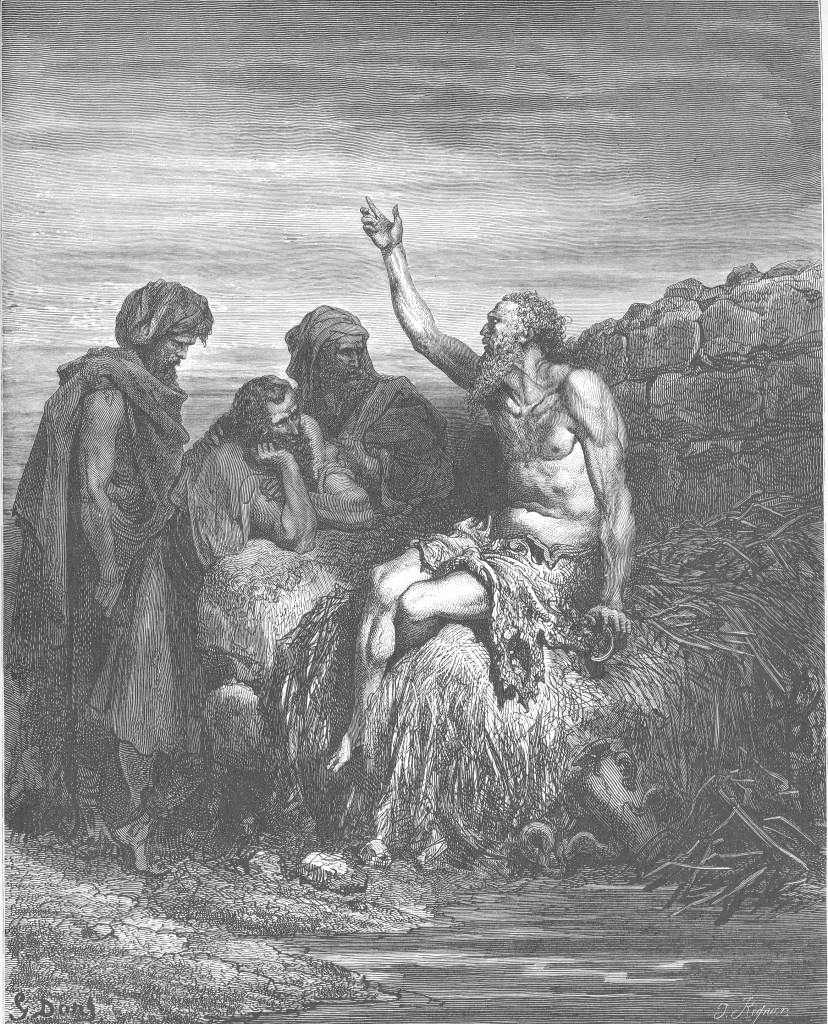
Job 8:1-22 – Face the Pain

Job Speaks with His Friends by Gustave Doré (1832-1883)

Are you finally through with your windy speech?
God never twists justice;
    he never fails to do what is right.
Your children must have sinned against God,
    and so he punished them as they deserved.
But turn now and plead with Almighty God;
    if you are so honest and pure,
    then God will come and help you
    and restore your household as your reward.
All the wealth you lost will be nothing
    compared with what God will give you then.

Look for a moment at ancient wisdom;
    consider the truths our ancestors learned.
Our life is short; we know nothing at all;
    we pass like shadows across the earth.
But let the ancient wise people teach you;
    listen to what they had to say:

“Reeds can’t grow where there is no water;
    they are never found outside a swamp.
If the water dries up, they are the first to wither,
    while still too small to be cut and used.
Godless people are like those reeds;
    their hope is gone, once God is forgotten.
They trust a thread—a spider’s web.
    If they lean on a web, will it hold them up?
    If they grab for a thread, will it help them stand?”

Evil people sprout like weeds in the sun,
    like weeds that spread all through the garden.
Their roots wrap around the stones
    and hold fast to every rock.
But then pull them up—
    no one will ever know they were there.
Yes, that’s all the joy evil people have;
    others now come and take their places.

But God will never abandon the faithful
    or ever give help to evil people.
He will let you laugh and shout again,
    but he will bring disgrace on those who hate you,
    and the homes of the wicked will vanish. (Good News Translation)

These are the words of Bildad, a “friend” of Job. The guy just couldn’t take it anymore. As Job expressed his deep grief, Bildad grew perturbed. Whereas Job needed to be heard, to tell his story with others who would offer listening ears of empathy, Bildad was uncomfortable with all this grief junk and felt he needed to rebuke Job…. Oy vey.

There are various kinds of suffering, and the biblical character of Job experienced them all. One of the most severe kinds of hurt, and the one that gets far more attention than any other in the book of Job, are the short-sighted rebukes from Job’s “friends.” 

God had a severe mercy for Job. The friends, however, lived in a black and white world of either/or – either you confess your sin, or you don’t – as if all suffering is connected to personal sin. Bildad’s left-brained linear explanation was expressed this way: God will not reject a blameless man.

For Bildad, personal suffering equals personal sin and God’s disfavor. Bildad could only see a sequential connection, a direct line from sin to calamity. It was simply out of his equation to think otherwise. Since Bildad saw suffering as the direct result of sin, his remedy was to exhort toward confession of sin. 

The problem with this view is that we, as the readers, already know this to be a patently false understanding of Job’s suffering. Although Bildad saw the suffering, he did not discern the unseen dimension of good and evil contending behind-the-scenes between God and Satan.

It is only normal to wonder if we have sinned against God whenever finding ourselves in the crucible of suffering. But if we have done patient work to determine there is no personal reason for the pain, perhaps there is something going on that is much bigger than us. 

Our task, like Job’s, is to entrust ourselves to God. We might chafe at such counsel because we like to fix things that hurt. Suffering, however, will not last forever; it will eventually pass. And God’s way will always prevail, in the end. So, we must continually keep in mind that permanent faith transcends temporary pain.

There are four types of pain we experience in this life:

  1. Spiritual pain that arises from within us in our connection, or lack thereof, with the divine.
  2. Emotional pain that arises from our relationship with others.
  3. Physical pain that arises from our bodies and from natural forces on this earth.
  4. Mental pain that arises from cognitive disorders, childhood trauma, and all forms of abuse or neglect.

In all pain, the story we tell ourselves about the reason for the hurt is significant. We have a relationship with our pain. If the story we are telling ourselves is that the pain is all in my head, or that others have it worse than me, we are ignoring or stuffing our pain. If the story is that pain is bad and I must rid myself of it, then we will completely miss what our pain is trying to tell us.

Job was trying to come to grips with his pain. He was facing it, talking about it, expressing his wonderings concerning it, and allowing himself to completely feel all of it.

Conversely, Bildad so tightly held onto his own story about what pain and suffering is that he was unable to be the friend Job needed. And, I might add, at the end of the story, God didn’t look with favor on Bildad’s approach.

So, what will you do with your pain?

What is the story you are telling yourself about your pain?

Who do you trust so that you can talk about your pain?

Where is God in your pain?

How is your current relationship to the pain helping or hindering you?

Where will you turn, in the future, when pain comes upon you?

Loving God, take pity on my life as I seek to embrace you in both good times and bad. I belong to you; therefore, I will not forsake you, no matter how much I do not understand the suffering. Amen.

Psalm 79 – Facing Trauma

Raise Up by Hank Willis Johnson in the Nova Southeastern University Art Museum, Fort Lauderdale, Florida

Our God, foreign nations
    have taken your land,
    disgraced your temple,
    and left Jerusalem in ruins.
They have fed the bodies
of your servants
    to flesh-eating birds;
    your loyal people are food
    for savage animals.
All Jerusalem is covered
    with their blood,
    and there is no one left
    to bury them.
Every nation around us
    sneers and makes fun.

Our Lord, will you keep on
    being angry?
    Will your angry feelings
    keep flaming up like fire?
Get angry with those nations
that don’t know you
    and won’t worship you!
They have gobbled down
Jacob’s descendants
    and left the land in ruins.

Don’t make us pay for the sins
    of our ancestors.
    Have pity and come quickly!
    We are completely helpless.
Our God, you keep us safe.
    Now help us! Rescue us.
    Forgive our sins
    and bring honor to yourself.

Why should nations ask us,
    “Where is your God?”
Let us and the other nations
    see you take revenge
    for your servants who died
    a violent death.

Listen to the prisoners groan!
Let your mighty power save all
    who are sentenced to die.
    Each of those nations sneered
    at you, our Lord.
Now let others sneer at them,
    seven times as much.
    Then we, your people,
    will always thank you.
We are like sheep
    with you as our shepherd,
    and all generations
    will hear us praise you. (CEV)

Yes, you are in the right place. No, this is not yesterday’s post. The Revised Common Lectionary Daily Scripture readings include a psalm reading every day. What is more, the same psalm is read three days in a row. This is because psalms are designed to be repeatedly used. So, today, I continue reflecting on this psalm….

The psalmist was full of emotion as he crafted his words. Reflecting on the tragic and horrific takeover of Jerusalem and its destruction, he cried out in spiritual and emotional pain concerning the trashing of God’s temple and Name, and the physical and verbal violence executed on the people. The psalmist wanted the victimization to stop and the victimizers to feel God’s wrath.

This psalm is raw and real, an expression of the true self. Here there is no pie-in-the-sky positive thinking with singing about always looking on the bright side of life. It is agonizing grief in all its misery and disgrace. Thus, therein lies the path to healing: To connect with the true self, refusing the pretensions of the false self, expressing the real lived feelings and thoughts of honest wounds.

Illumination by American sculptor Paige Bradley

The alternative only presses further pain into the soul. The false self, seeking to takeover and make one feel better, engages in a devil’s pact by ignoring the aching spiritual doubt and emotional injury within to have temporary reprieve from the troubled spirit. The road to renewed and lasting happiness comes not through the false self but the true self’s recognition of the event(s) in all their foulness and degradation. It is a hard road to walk, yet we must travel it if we are to live in the light of truth, joy, and peace.

You and I will not find God in the false self. One of the great tragedies of the human condition is that, when having experienced trauma, we hustle to obtain something we already possess. We might believe God is not there, or simply does not care. As one becomes alienated from the Lord, there increasingly becomes self-distancing. Disconnected from life-giving divinity, self-loathing gradually replaces self-awareness, and thus, self-compassion.

If at any point, we begin to associate and then fuse self with our traumatic experience(s) then the inner person weakens and becomes detached from the spiritual resources needed to heal. We are not our events. We are people created in God’s image and inherently worthy of love, compassion, kindness, goodness, and healing. We were not made for death and destruction but for life and connection.

The demonic termites of contempt might eat away at our humanity, yet there is always a way to exterminate them – through telling our story, as the psalmist did, with emotional flavor and full honesty. The true self is there; we just might need to dig a little deeper to find her.

So, if you notice that you tend to avoid planning for self-care; engage regularly in self-pity; or, swear at yourself under your breath with self-hatred; then it is high time for the false self to quit calling the shots and to bring up the true self. Internal conflict is not resolved through avoidance; it comes through external voicing of one’s story to another who listens with care.

The psalmist spoke to both God and God’s people. His story came from the gut, the place where both deep loathing and deep compassion come from. If one has already been tortured by a traumatic experience, the torture will continue from the false self unless the true self asserts herself and seeks awareness, mercy, and healing.

Stories are meant to be told. And they need to be uttered when the storyteller is ready and not when the listener is. Through the voicing of their ordeal, victims of human-inflicted suffering need to hear that God is just and will right the wrong things in this world. They need some hope of healing and some assurance that their injury will not go unanswered.

This can be tricky business because the act of proclaiming one’s story and the reception of that message by another might easily become a vengeful justification for intolerance and malicious retribution. Therefore, the psalmist appealed to God, not fellow humans, for justice. We are to leave room for God’s wrath without taking matters into our own hands. (Romans 12:17-21)

So, avoid isolation from God, others, even yourself. Seek help, both divine and human. Tell your story when you are ready. Face the terrible pain. These are the things the psalmist did to deal with his own trauma. The true self acknowledges this and, with full awareness, steps into the future with faith.

Lord Christ, you came into the world as one of us, and suffered as we do. As I go through the trials of life, help me to realize that you are with me at all times and in all things; that I have no secrets from you; and that your loving grace enfolds me for eternity. In the security of your embrace I pray. Amen.