Matthew 21:18-22 – Faith and Prayer

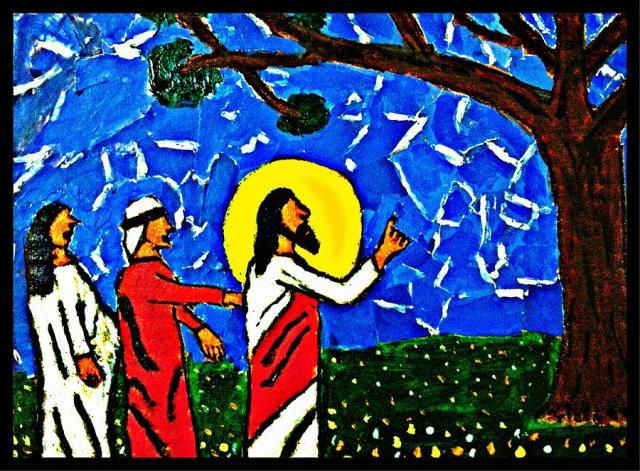
Jesus Cursing the Fig Tree
Jesus Cursing the Fig Tree by Ganosh Kelagina Beedu Shenay, 2016

Early in the morning, as Jesus was on his way back to the city, he was hungry. Seeing a fig tree by the road, he went up to it but found nothing on it except leaves. Then he said to it, “May you never bear fruit again!” Immediately the tree withered.

When the disciples saw this, they were amazed. “How did the fig tree wither so quickly?” they asked.

Jesus replied, “Truly I tell you, if you have faith and do not doubt, not only can you do what was done to the fig tree, but also you can say to this mountain, ‘Go, throw yourself into the sea,’ and it will be done. If you believe, you will receive whatever you ask for in prayer.” (NIV)

God wants us to pray! Prayer happens from a place of faith because to pray, one must believe that God is good and answers prayer. Conversely, prayerlessness is faithlessness.  A person of little faith prays only a little. A person full of faith cannot stop praying.

God’s world revolves more around promise than command – which means that Jesus merely exhorting the disciples to pray would fall flat; they needed a deep change of heart. God calls us all to transformation. Lasting change takes place at the roots of our lives. When there is a drought, pouring lots of water on our backyard trees at the first sign of withering leaves is too late. The tree may look fine on the outside, but on the inside, it is dying from lack of water. Real change comes from the inside-out.  It is the root of a person’s life, below the surface where others do not see, that needs change, and not merely the outward behavior.  Prayer must be directed to the root, to the heart of the issue.

In today’s Gospel story, Jesus was up early and going to Jerusalem. He was hungry and wanted some breakfast, so he approached a fig tree. Figs were known back in Christ’s day as the poor man’s food. Fig trees were everywhere. Approaching a certain fig tree, Jesus found one that looked fine, but no figs. He chose to use the tree as a teachable moment for his disciples. Christ cursed the tree and immediately the entire tree withered.  So, why did Jesus curse the tree?

Jesus cursed the fig tree because it looked good on the outside, but it was already dead on the inside. The tree had everything a tree needed: branches, leaves, and a trunk – except fruit.  The tree served as an illustration for the disciples of believing prayer. The tree looked fine, and had the promise of fruit, yet, none was found.  The point of the tree illustration is this: Jesus is looking for faith in his followers.

In the prophet Jeremiah’s day, the nation of Judah had enjoyed a long stretch of prosperity and good circumstances. By all outward appearances they were doing fine. Temple attendance was at its peak and everyone was offering their sacrifices. But something was wrong….

I will put an end to them,
declares the Lord;
there are no grapes on the vine,
no figs on the tree,
only withered leaves.
They have squandered what I have given them!
(Jeremiah 8:13, CEB)

Although fine on the outside, the people of Judah trusted in themselves, their ability to produce a harvest, and their outward show of how many cattle and sheep they brought to the temple. But what God was looking for was fruit, not nice leaves. He was watching for offerings of believing prayer, born of a faith that is confident in the goodness of God. And the Lord is still looking for people’s faith in God alone – rather than in religiously outward forms of success.

Jesus wants his followers to understand and believe that our words and prayers can have the immediate effect of changing the world.  We can even speak to a mountain and it will have to move if we tell it to. We probably do not go around talking to mountains, but all of us go around talking to ourselves about mountain-like problems. The power that levels mountains is prayer that speaks confidence and boldness.  If you believe, you will receive whatever you ask for in prayer.

Doubt sometimes stands in the way of prayer – not doubt in ourselves because we do not answer our own prayers. The Apostle James said:

“If any of you needs wisdom, you should ask God for it. He is generous to everyone and will give you wisdom without criticizing you. But when you ask God, you must believe and not doubt. Anyone who doubts is like a wave in the sea, blown up and down by the wind. Such doubters are thinking two different things at the same time, and they cannot decide about anything they do. They should not think they will receive anything from the Lord.” (James 1:5-8, NCV)

Both James and his brother Jesus refer to an unshakable faith in the goodness of God. This is faith in the person of God, and not faith in faith itself. If we are honest, every one of us who has made a difficult prayer request, mustering-up all the faith we can, and then being disappointed when it did not happen, has been hurt. The unstable person vacillates when this happens, doubting whether God is good (playing the he-loves-me, he-loves-me-not game). The person of faith believes God answers prayers according to his will, and that if the prayer is not answered, God knows what he is doing and will answer it in his own good timing and purposes.

Maybe you have even indulged your inner-critic, a Job-like friend, telling you that you have a failure of faith, or not enough faith, and that is why your prayer was not answered. Yet, positive thinking is not the same as Christian faith.  It is neither a matter of being optimistic, nor of sending $19.95 to some hack preacher who promises to give you the secret of answered prayer, along with a free gold cross.

God’s will for our lives is sometimes, maybe even oftentimes, a mystery. However, we do know what God’s will is for a lot of things. For example, God is not willing that any should perish but all be brought to eternal life.  So, we can pray with confidence for a person’s deliverance from sin.  We can be bold about trusting in God’s promises – he will do what he says he will do.  Boldness is only as good as the truth it is based upon.

Imposing Mountain View and Lake Glacier National Park
Imposing Mountain View and Lake Glacier National Park. Many Glacier Area. Swiftcurrent Lake.

We have every right, based in our union with Jesus Christ and our redemption in him, to ask God confidently and boldly for the removal of mountains.  We have the authority in Christ to do so.  Therefore, we do not need to offer tepid, milquetoast, mumbling prayers with sighs and hunched shoulders (i.e. “Well, God, if it is your will, could you help me?”).

It is time for men to step out and give God some healthy hairy-chested prayers.  And, this is not the time for women to be worried about what the men do, or not do. Everyone is to be bold in prayer.

“God desires of us nothing more ardently than that we ask many and great things of him, and he is displeased if we do not confidently ask and entreat.” –Martin Luther

Jesus wants faithful and fruitful prayer. He still scans the horizon of our spiritual lives looking for believing prayer. Christ desires from those who follow him bold prayers which curse and wither fruitless and feckless places. When my children were small there was an adult store in our neighborhood. It disturbed my spirit. Each time I passed it I confidently prayed that the pornography and exploitation of women would dry up and cease in Jesus’ name, and that those who worked in that establishment would find more gainful and ethical employment. And that is exactly what happened.

Aggressive prayer against the enemy of our souls is needed, prayer that claims the authority which has been given us in Christ, prayer that is based in solid biblical truth and robust theology. So, let us pray in faith and confidence….

Heavenly Father, we praise you for the grace we possess through the Lord Jesus Christ.  We rejoice in Christ’s teaching and the victory you have provided for us to live above sin and failure.  We come before you in confession and to plead your mercy over our sins, the sins of other believers, and the sins of our world.  We confess the sin of prayerlessness, faithlessness, apathy, complacency, and indifference to those who are lost.  We also acknowledge before you the wickedness of our world through the evil machinations of injustice, oppression, and exploitation of others.

We praise your holy name, O God, that there is plenty of grace through the person and work of the Lord Jesus.  We plead the blood of the cross and the power of the resurrection against the sins and rebellion of people against you.  We pray and wait for you, Holy Spirit, to bring us all to new life in Jesus Christ. 

We recognize that Satan and the kingdom of darkness have plotted and laid strategies against new spiritual life, keeping your people from believing prayer.  So, in the name of the Lord Jesus Christ, we claim our place as children of God. We smash and pull down all the strongholds which Satan has erected against humanity – and pray that the power of Christ’s resurrection would hinder and frustrate the plans formed against us. 

We pull down demonic strongholds of prayerlessness and carelessness with the Word of God. We claim back for the Lord Jesus Christ the ground Satan is claiming as a means of hindering faith, hope, and love; and, we affirm that Satan’s plans were fully defeated through the cross and resurrection of Jesus. We pull down all of Satan’s plans to divert fresh faith when it comes. Blessed Holy Spirit, may you send a renewal to the hearts and souls of all people. May it bring a wondrous season of peace and joy.

We, your people, accept the role of standing in the gap for others in prayer.  You yourself, God, said that we, in Christ, are mighty through God to the pulling down of strongholds.  So, we bring all the work of the Lord Jesus Christ to focus directly against the powers of darkness that blind people and keep them in bondage.  We pray the victory of Christ’s incarnation, crucifixion, resurrection, ascension, and glorification directly against all of Satan’s power in their lives.  We now bind all powers of darkness set to destroying them, and we unbind those demonic bonds and blinders from them in the mighty name of Jesus. 

By faith we claim humanity for fruitful lives of spiritual abundance, social justice, and sanctified relationships in the name of Jesus Christ our Lord, who defeated all powers and principalities of this world.  Amen.


Matthew 8:14-17 – A Changed Life

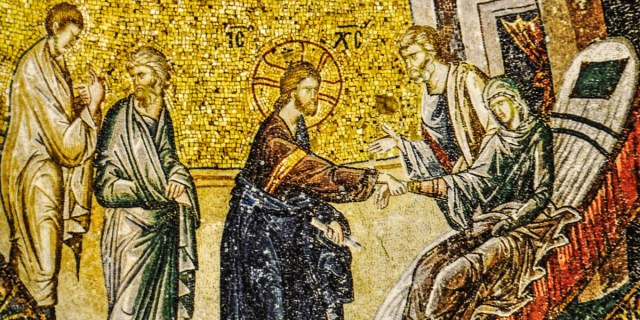
Jesus Heals Peters Mother In Law
A mosaic of Jesus healing Peter’s mother-in-law, from a Byzantine Church, c.1100 C.E.

When Jesus came into Peter’s house, he saw Peter’s mother-in-law lying in bed with a fever. He touched her hand and the fever left her, and she got up and began to wait on him.

When evening came, many who were demon-possessed were brought to him, and he drove out the spirits with a word and healed all the sick. This was to fulfill what was spoken through the prophet Isaiah:

“He took up our infirmities
    and bore our diseases.” (NIV)

One of the great realities we run headlong into with the New Testament Gospels is that Jesus has the authority to heal and transform the world… and me. Forty-one years ago, today, I experienced the reviving and revolutionizing work of Jesus Christ. I realize not everyone has a specific time they can point to when God does something miraculous, and I also do not expect that everyone’s experience of the divine must conform or be like my own. No, my encounter with God was just that, mine alone. Yet, I hope you find some encouragement and solace in my brief story.

I was probably the least likely person to become a follower of Jesus, let alone to have shown any promise toward the pastoral and religious life. I had serious reservations about the veracity of faith, the relevance of church, and the importance of religion. Although, outwardly, my family made attending our local church mandatory, inwardly, I felt the entire Christianity thing to be boring, irrelevant, and contrived. I was much more likely to behave passive-aggressively than piously.

But I began to rethink and revisit my doubts and epistemic assumptions about all things God and Christianity. The love of Christians around me stirred the internal upheaval. I had come to view the world as a cruel place and saw other people through jaded lenses. Relationships were for me a necessary evil. So, when love and grace entered my orbit, it threw me into sort of an existential angst. Having come to settled-thinking in my understanding of a dark world and having learned to navigate it with the tools of sarcasm and skepticism, genuineness and authenticity were a complete monkey wrench in my cosmology.

To put the whole matter succinctly, Jesus touched me. My small sin-sick heart was healed and enlarged. I walked away completely changed. I cannot accurately say what happened any more than I could tell you how a transplant doctor puts a new heart into the chest of a person. I can only speak to the results: newfound joy instead of nihilism; new desires to bless others and the world instead of looking for ways to disengage from people; new speech and wanting to edify and encourage people instead of sly words of putting others down; and, perhaps most surprising of all (to me) a thoroughly new desire to glorify God and enjoy him forever.

Pastor Tim

The love of God in Christ made all the difference for me – and still does, all these years later. I stand in a long Christian tradition of outsiders and misfits entering the kingdom of God through spiritual metamorphosis – going all the way back to today’s story of Jesus healing and transforming.

In the first century, Jewish women were not allowed as far inside the temple as Jewish men.  Lepers could not go in, at all.  Centurions and Gentiles could only get into the outer court, emphasizing that they were outsiders.  In the synagogue service, women sat in the back, under the balcony. There were pious men who would pray, not in a spirit of humility, but thanking God they were not women.  In this healing account of a woman, no one asks Jesus for healing; he just walks into a house and heals Peter’s mother-in-law just because he wants to!

Christ’s authority, concern, and healing power even extended to the demonic realm. It perhaps goes without saying that most people would not want to hang-out with demonized people who carry a load of problems and sickness with them; they are yet another example of the classic outsiders.  If we take seriously that Jesus is our model for ministry, then we need to take passages like this seriously and connect with outsiders and bring them to Jesus.

The Old Testament quote comes from Isaiah 53:4. Sickness relates to sin – not always personal sin, but from living in a fallen and fundamentally broken world.  In other words, when the biblical text says that Jesus took up our infirmities and carried our diseases, it is saying that Christ takes our sin upon himself. His healing acts are tied to the cross.  There is new life and spiritual health in the cross of Jesus Christ.  We come to the foot of the cross as spiritual beggars, looking for grace and mercy in our time of need because Jesus has the authority to extend healing and deliverance from every sin and every sickness and every problem known to people.

Through Jesus Christ there is and can be healing for damaged emotions, broken hearts, pain-ridden bodies, and sin-sick souls. There shall be joy through mourning. There is life through death. A new day will dawn, carrying fresh grace and unique mercies for the journey ahead. Behind it all is the God who is still in the business of renewing minds and hearts, and reforming attitudes and actions through extravagant and inexhaustible love.

God of all creation forgive my foolish thoughts and errant ways; clothe me in my right mind; and, calm my troubled heart. My soul is off, and I cannot seem to find my balance, so I stumble and worry constantly. Give me the strength and clarity of mind to find my purpose and walk the path you have laid out for me. I trust your love, God, and know that you will heal this stress, and mend my spirit. Just as the sun rises each day against the dark of night, bring me clarity with the light of God, through Jesus Christ, Savior and Lord, in the power of your Holy Spirit. Amen.

Genesis 32:22-31 – A Crippling Grace

Welcome, friends! Simply click on the video below and let us gather around God’s Word.

You can also view this video at TimEhrhardtYouTube

For today’s Old Testament story set to song, click Wrestle with God from the Church in Ireland; and, Jacob’s Song sung by Gabrielle Ariana.

May the Lord bless you
    and protect you.
May the Lord smile on you
    and be gracious to you.
May the Lord show you his favor
    and give you his peace.  Amen.

A Crippling Grace

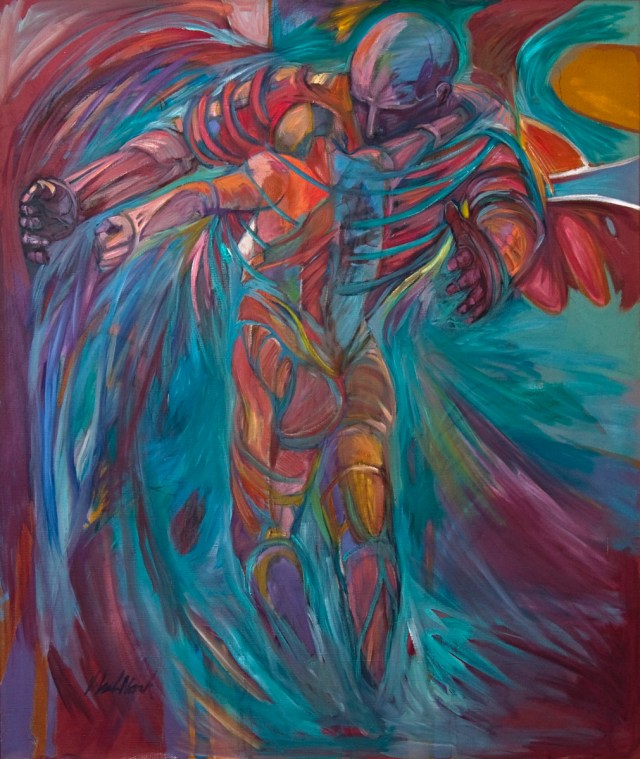
Jacob Wrestling the Angel by Karen Laub-Novak
Jacob Wrestling the Angel by Karen Laub-Novak (1937-2009)

Confrontation and struggle were a way of life for me in my first solo pastorate.  In the first six weeks of being in the church I faced every kind of sin imaginable, to the point that my mentor in the faith recommended I take some time off. I had not even been there for two months!  Although that was a difficult time, the greatest struggle was with God himself and feeling like my prayers were doing nothing but bouncing off the ceiling.  In fact, I spent several years of my life in an extended wrestling match with God.  He touched me and crippled me by his grace, reminding me how much he is in control.  Since that time, I walk with a limp that is not visible – an invisible limp which reminds me I am a different person – one who knows Jesus better and is much more at peace with life.

If we do not wrestle with God in the stressful times of our lives, we will have difficulty discovering what genuine humility is, how much we need the Holy Spirit, and the grace that can be ours to face the rest of our lives.  Five hundred years ago Thomas à Kempis wrote to new priests entering ministry with this advice:

“We should so firmly establish ourselves in God that we have no need to seek much human encouragement.  It is when a man of good will is distressed or tempted, or afflicted with evil thoughts, that he best understands the overwhelming need he has for God, without whom he can do nothing.  While enduring these afflictions he takes himself to prayer with sighs and groans; he grows tired of this life and wishes to die so that he could be undone to live with Christ.  It is in such times of trial that he realizes that perfect security and full peace are not to be found in this world.”

The Old Testament patriarch, Jacob, was worried and stressed.  He knew he had deceived his brother Esau many years earlier to gain their father’s blessing.  Now Jacob is about to meet Esau after all these years, and he is downright afraid for himself and his large family.  So, he divided them up into two groups, thinking that if Esau were to attack, the other group could escape. The night before the big stressful meeting, Jacob sent his wives and family across a tributary of the Jordan River, the Jabbok, and spent the night alone wrestling with God. (Genesis 32:22-31)

God will put us in life-compromising positions to create divine encounters so that we will walk away changed.  Those events usually come in the form of engaging God with all the questions and difficulties of an incredibly stressful situation.  The inner change that occurs comes in the form of a new identity, a new limp, and a renewed understanding of God’s grace. A new confidence arises, convinced that through disability and weakness we are strong and able.

Jacob Wrestling with the Angel by Lippy Lipshitz
Jacob Wrestling with the Angel by Israel Isaac Lipshitz (1903-1980)

There is a good deal of symbolism happening in the story of Jacob wrestling with the angel of God.  First, take note that this Scripture story raises more questions than it answers, such as: Who was the man Jacob wrestled? Was he God, an angel, or someone else? Why have a wrestling match? What in the world is going on here?  The unanswered questions are symbolic of the reality that we do not and probably will not get the clarity we are looking for in our struggles with God.  Sometimes we might not even know it is God whom we are wrestling with.  It is quite possible where we see God estranged from us, he really has us in the grip of grace and will not let go.

Second, Jacob got up during the night, representing his dark night of the soul and struggle with the circumstance he must face.  Jacob was left alone with no one to deceive (his typical modus operandi) which is symbolic of his great need – he had no “tricks up his sleeve” and had nowhere to turn but to God.  Jacob was asked by his wrestling opponent what his name is. Jacob’s answer is a humble one, confessing who he really is (Jacob means “schemer” or “deceiver”).  Jacob asked for a blessing, which in itself is an act of humility because it is an honest profession that he lacks something necessary for life that he cannot provide on his own through any kind of ingenuity on his part.

Third, Jacob asked for God’s name – and got no answer to his question, no clarity, and no satisfaction.  This is deeply symbolic of the fact that God is mysterious, and we will not always get the answers to our questions we want.  God will not kowtow to our puny attempts at controlling him.  Jacob would not let the wrestling match end and held on, just like he grasped the heel of his brother Esau at their birth.  This is a symbolic reference to Jacob’s stubbornness which was redeemed and transformed into tenacity, rather than a manipulation of people to get what he wanted.

Fourth, God renamed Jacob, “Israel.”  Jacob is now distinguished from the old deceiver with a new identity.  Israel literally means “God fights” which is a reference of hope for Jacob’s descendants.  That Jacob struggled with God and was able to walk away from it is not really a statement of physical victory so much as a reference to Jacob’s having overcome his constant fear and need for control which prompted his continual trickery.

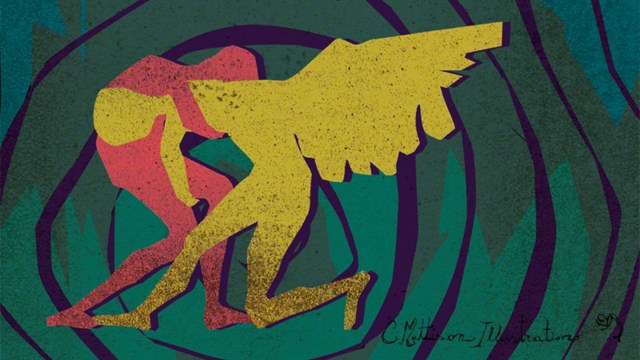
Jacob Wrestles the Angel by Christina Mattison Ebert

Fifth, Jacob’s limp is a permanent sign of God’s grace to Jacob. God is with him and his descendants.  Jacob is a different person having encountered God, and the limp is a continual reminder God changed his life forever – Jacob will never be the same after this.  Ironically, the limp made Jacob stronger, not weaker.  From this point forward in Jacob’s life, he is mindful of his limitations and that God is the One who will arise to fight, protect, and carry on the covenant promises.  There is no longer any need or even desire to scheme to accomplish anything.

It will be difficult to find grace apart from wrestling with God in the painful situations of life.  It is in such times we must be crippled by grace.  We need to be willing to fight with God. It is necessary to get in the match and struggle with God rather than worry within ourselves or just pretend everything is okay so that we will avoid the hard contest in front of us.

Has God left a permanent mark on you?  Do you carry a limp from him?  What is your name?  How does God identify you?  Our great need is not in being clever, smart, or working harder; it is God’s grace that we all need.  As a kid, when my parents left the house, my brother and I would rearrange the furniture so that we could have a good-solid-knock-down-drag-out wrestling match.  Since my brother was older, it usually ended badly for me with a pile-driver that left me incapacitated.  It is seriously a miracle that I am still alive after being dropped on my head so many times.

Whenever Christians approach the Lord’s Table, we are reminded of the Son who wrestled with the Father in prayer in the garden of Gethsemane and came away confident of facing a cruel cross so that we might have life.  The Lord Jesus carries with him even now the reminders of his suffering – the marks on his hands and his feet from a crucifixion that accomplished deliverance from sin on our behalf.  The elements of bread and cup are deeply symbolic reminders of what Jesus did as the cost for our salvation.  And they are further reminders that just as we eat this bread and drink this cup we will drink again with Jesus at the end of the age.  It is faith in Jesus alone that creates and secures for us a transformed life so that we can share in a crippling grace from him forever.