Longing For God (Psalm 63)

O God, you are my God; I seek you;
    my soul thirsts for you;
my flesh faints for you,
    as in a dry and weary land where there is no water.
So I have looked upon you in the sanctuary,
    beholding your power and glory.
Because your steadfast love is better than life,
    my lips will praise you.
So I will bless you as long as I live;
    I will lift up my hands and call on your name.

My soul is satisfied as with a rich feast,
    and my mouth praises you with joyful lips
when I think of you on my bed
    and meditate on you in the watches of the night,
for you have been my help,
    and in the shadow of your wings I sing for joy.
My soul clings to you;
    your right hand upholds me.

But those who seek to destroy my life
    shall go down into the depths of the earth;
they shall be given over to the power of the sword;
    they shall be prey for jackals.
But the king shall rejoice in God;
    all who swear by him shall exult,
    for the mouths of liars will be stopped. (New Revised Standard Version)

David, the psalmist, had a great longing for God.

This sort of longing has nothing to do with lustful desires which want something specific under the Christmas tree. To long for God is to have a deep inner wish for fulfillment and connection.

People have all sorts of longings in their lives, because they miss someone or are missing something important.

A parent longs for an estranged child to return, or at least to talk to them.

A spouse wishes to be with their loved one without the ravages of dementia.

A teacher has a deep longing to impact her students in a positive and profound way that will change their lives.

A person longs to see their friend realize the dream they have been seeking.

An individual has been living with chronic pain for years, and longs to be at least pain-free enough to enjoy the simple pleasures of taking a walk, visiting family, or going to a restaurant for a nice meal.

These longings, and thousands more, make up the future hope which keeps us going day after day. And they are all, in one way or another, related to the ultimate longing for divine connection.

Many types of longing come from a place of relationship, of love and support for another. It is this kind of longing that the psalmist had for God. The deep longing to experience a divine/human contact, to commune with the living God, is what motivated and fueled David throughout much of his life.

Like a person looking to satiate their thirst in a hot dry desert, is the one who actively seeks and goes after the longing they have. I believe that every person on planet earth has a deep abiding desire and need for something transcendent in this life, to encounter a power which is higher and greater than us – knowing that the basic nature of this power is loving and good.

My need for communion with God is on the same level as my daily need for water. I cannot survive without either of them.

Spiritual survival requires being watered and fed by an intimate relationship with our Creator. The presence of God is just as necessary and life-sustaining as food. Along with the psalmist David, God’s words are the spiritual food I need to live and survive.

Longing involves memory. Our various longings are often a remembrance of special events, seasons, or people. Deep hope activates those memories, and drives us to prayer, because God has the strength and the ability to honor those honest longings.

The greatness of God, and the divine purposes for this world, are heavy laden with longing. God’s heart longs for humanity to realize a renewed and revitalized relationship with God.

So, the Lord serves humanity in a myriad of ways, bringing deliverance from all that hinders us in a relationship with God, so that we might associate meaningfully and purposefully with what is good, right, and just.

We are invited by God to unpack the gift of faith, and the various spiritual gifts given to us, for the benefit of the church and the world.

God’s steadfast love is indeed better than life itself, because it is beyond what we humans can even conceive of as to what a good life truly is.

God is Love, and Love is God. Love transcends life and brings us to a place of connection beyond what our minds can imagine, and our hearts can only long for.

Since God is always gracious, loving, and good within God’s basic character, God always does what is good and loving. And that makes praise and adoration of God always open season.

Praising God reminds us of what God has done. The Lord is personally invested and involved in God’s big world. Thus, praise is quite appropriate whenever one is going through difficult times; because it accesses memories of God’s help in times past, enabling divine help in the present.

God’s gracious actions are both communal and personal. God not only helps others; God helps me. The Lord’s faithfulness endures throughout all generations. And God is big enough to notice me, and to help me in my own time of need.

Therefore, any occasion is appropriate in coming to God.

Are you in need of rest? Do you need encouragement? Are you in need of some help?

Then, come to God. Praise the Lord. Remember God. Consider the works God has done throughout history for God’s people. Do it during the day while working. Do it at night with your head on the pillow. Do it anytime, anywhere. Because God is there.

The Lord will provide – perhaps not on your timetable, yet God will nonetheless help, often in a way you may not expect.

Faith in God isn’t about trying to avoid God’s anger or wrath; faith is about syncing my wishes and my longings with the heart of God. That is called “repentance.” And it’s the way of finding our great inner longings satisfied.

We must tend to our relationship with the Lord; for God has made it possible to do so.

Receive this blessing from author John O’Donohue in his book, To Bless the Space Between Us: A Book of Blessings…

Blessed be the longing that brought you here
And quickens your soul with wonder.

May you have the courage to listen to the voice of desire
That disturbs you when you have settled for something safe.

May you have the wisdom to enter generously into your own unease
To discover the new direction your longing wants you to take.

May the forms of your belonging—in love, creativity, and friendship—
Be equal to the grandeur and the call of your soul.

May the one you long for long for you.

May your dreams gradually reveal the destination of your desire.

May a secret Providence guide your thought and nurture your feeling.

May your mind inhabit life with the sureness with which your body inhabits the world.

May your heart never be haunted by ghost-structures of old damage.

May you come to accept your longing as divine urgency.

May you know the urgency with which God longs for you.

Amen.

The Most High Shall Lift Up the Needy (Psalm 113)

By Unknown Artist

Praise the Lord!
Praise, O servants of the Lord;
    praise the name of the Lord.

Blessed be the name of the Lord
    from this time on and forevermore.
From the rising of the sun to its setting,
    the name of the Lord is to be praised.
The Lord is high above all nations
    and his glory above the heavens.

Who is like the Lord our God,
    who is seated on high,
who looks far down
    on the heavens and the earth?
He raises the poor from the dust
    and lifts the needy from the ash heap,
to make them sit with princes,
    with the princes of his people.
He gives the barren woman a home,
    making her the joyous mother of children.
Praise the Lord! (New Revised Standard Version)

The psalmist calls for praise to God, because the Lord is the God both far and near, both transcendent (high above and over) and immanent (close by enough to respond quickly).

God is a dynamic force and presence in this world.

It is God who sees the poor and needy from on high, and comes near to lift them and give them a place alongside those in power and with authority.

It is the Lord God almighty who observes the childless woman from afar and draws near to ensure that she becomes a joyful mother.

Today’s psalm is the first of six psalms (Psalms 113-118) which make up the Jewish Hallel – prayers of thanksgiving added to the morning service of worship on the days of festive Jewish holidays. 

This collection of psalms tells a story of God’s merciful acts in history for the people of Israel. The Israelites express joy and thanksgiving, because the Lord noticed them, and actively worked on their behalf.

Christians, too, make use of Psalm 113 for praise and worship. In the stories of both Hannah in the First Testament, and Mary in the Second Testament, the transcendent God listened to them, and was immanently present in helping them to conceive children.

This is a concerned and engaged God, who hears the humble, and lifts them beyond what they can even ask or imagine. (1 Samuel 2:1-10; Luke 1:39-57)

Yet, some may wonder why their prayers have not been answered.

Some are confused as to why God seems aloof in the midst of their needy circumstance.

There are yet many more who are discouraged by all of the terrible natural disasters which devastate people’s lives, and the existence of war and hatred and injustice around the globe.

And there are plenty of women who want children, but are unable to conceive; while there are women with children who treat them poorly.

Where is this good God when there is so much bad going on?

The psalmist exclaimed that God raises the poor, lifts the needy, and gives the barren woman a home. There is, however, no timetable set on precisely when this will happen.

Many a barren woman in the biblical stories was in that position for year after year. Sarah in the Old Testament, and Elizabeth in the New, were two elderly women who had a child in their old age. Beyond what was biologically possible, God nevertheless gave.

There was also many a person in the Bible who died, while never having had a change in their circumstance. Even in such cases, the humble and godly poor person shall be rich in heaven; and the needy person will experience plenty for eternity.

This isn’t meant to be a pat answer now in the present; rather, it points to the need for hope, the confident expectation that the unwanted and awful circumstance I am experiencing today will not always be true of me.

Just one implication of this is that even the destitute can praise God. Even the needy can give thanks, while they are simultaneously crying out for help.

The Christian will someday have a seat with Christ in the heavenlies. This is a hope built into one’s faith commitment. It is a sure thing in the future, just as much as the present reality I currently face.

No matter whether one is rich or poor, in plenty or in want, in a full house of children or none at all – every person has a reason to praise God and express gratitude for the One who sees from on high, and draws near with what is truly helpful for this present time – whether that help is in the form of tangible resources and assistance, or intangible comfort and encouragement.

Unfortunately, there are people in this old fallen world of ours who create the conditions of poverty for others; manipulate circumstances that opens a large gap of need for the underprivileged; and exclude people who are not in power and have no earthly authority.

God does not want injustice for people; oppression and exclusion is inconsistent with the Lord’s sense of justice and mercy. The psalmist affirms those who languish on the ash heap of life that they will be lifted up. Their present experience of despair will not last forever.

A day is coming when those in need will have their justice, where the malevolent forces of this world will be leveled, and the needy will sit with princes.

Discouragement does not have the last word. The day of praise will break through and overcome the day of despair.

Praise be to God!

Almighty and most merciful God, we remember before you all the poor and neglected persons whom it would be easy for us to forget: the homeless and the destitute, the old and the sick, and all who have none to care for them. Help us to heal those who are broken in body or spirit, and to turn their sorrow into joy. Grant this, O God, for the love of your Son, who for our sake became poor, Jesus Christ our Lord. Amen.

God Is Bigger (Psalm 46)

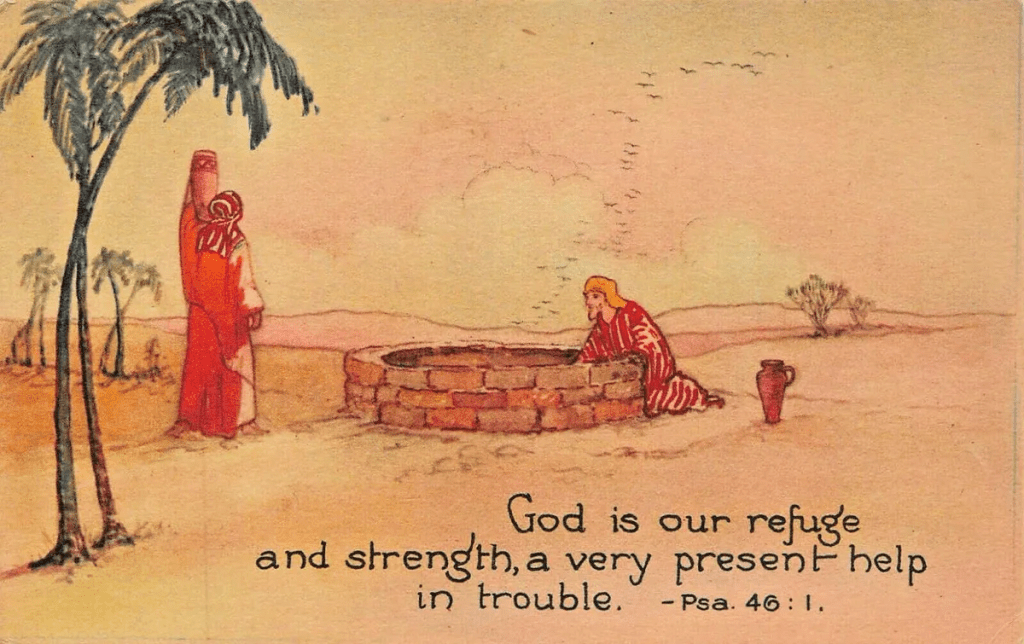
God is our refuge and strength,
    a very present help in trouble.
Therefore we will not fear, though the earth should change,
    though the mountains shake in the heart of the sea,
though its waters roar and foam,
    though the mountains tremble with its tumult.

There is a river whose streams make glad the city of God,
    the holy habitation of the Most High.
God is in the midst of the city; it shall not be moved;
    God will help it when the morning dawns.
The nations are in an uproar; the kingdoms totter;
    he utters his voice; the earth melts.
The Lord of hosts is with us;
    the God of Jacob is our refuge.

Come, behold the works of the Lord;
    see what desolations he has brought on the earth.
He makes wars cease to the end of the earth;
    he breaks the bow and shatters the spear;
    he burns the shields with fire.
“Be still, and know that I am God!
    I am exalted among the nations;
    I am exalted in the earth.”
The Lord of hosts is with us;
    the God of Jacob is our refuge. (New Revised Standard Version)

Fear is one of those things that we don’t get over simply by telling ourselves to not be afraid. In fact, that approach typically makes us even more fearful – namely, because we focus on the fear itself. But to cope and deal with fear, it requires a focus on something bigger than the fear.

God is bigger than the boogie man.
He’s bigger than Godzilla,
or the monsters on TV.
Oh, God is bigger than the boogie man.
And He’s watching out for you and me.

So, when I’m lying in my bed,
and the furniture starts creeping,
I’ll just laugh and say,
“Hey, cut that out!”
And get back to my sleeping.
‘Cause I know that God’s the biggest,
and He’s watching all the while.
So, when I get scared I’ll think of Him,
and close my eyes and smile.

God is bigger than the boogie man.
He’s bigger than Godzilla,
or the monsters on TV.
Oh, God is bigger than the boogie man.
And He’s watching out for you and me. – VeggieTales

Psalms and songs of trust in God help us focus on divine hugeness instead of human puniness.

Changing Circumstances

Even though people may find themselves in the dire straits of natural disasters, they can have confidence smack in the middle of all the crazy chaos. Whereas those who focus on their fear become ever more anxious and feel as if the world is out of control, the believer isn’t threatened when overwhelming circumstances occur.

We will not fear, because God – who created the world and its vast natural systems – stands above it all and is therefore able to establish order out of chaos. Just as we are certain that the sun will again rise in the morning, so too, we have full confidence that God shall rise over the darkness and bring light and warmth to all that is shadowy and cold.

Shaky Politics

The nations and their governments who rule with injustice and care nothing for religion, breathe-out their threats and posture themselves as supreme leaders. They, too, are chaotic forces. But God is far above them, as well as above the flood and the famine. The leader’s bellicose blustering sounds merely like a chattering chipmunk to God.

And like natural disasters, the uproar of the nations does damage; but national leaders cannot topple God. Instead, God will shake up the unjust nations, like a protein shake in a blender. When delusional leaders encounter the voice of God, they cower in fear – but God’s people don’t. The spiritual person’s foundation will not be shaken, whereas the would-be dictator will find himself without anyone to lead.

A Working God

God is always working, albeit most of the time behind the scenes. God’s dominion extends over everything and everyone. God can obliterate any and all threats because God is everywhere present.

Based on this view of God, all we as people need do is be still and know that the Lord is God. Like Jesus rebuking the waves and the sea, resulting in immediate stillness, so God’s word brings us stillness, calmness, and freedom from fear and anxiety.

God is with us. God is in control. God cares for us. There are a lot of things we don’t know – such as why we have to personally endure the natural disasters and the unnatural dictators – but we can know without a shadow of a doubt that the presence of God surrounds us, and the love of God squeezes us.

With a transcendent Being who commands the angelic hosts of heaven, our source of security comes not from within but from without. The Lord is a trustworthy God who is vigilant in watching over us.

Trusting the Lord

Armies, security systems, and protective coverings all have their needed purpose in human life. Yet, when we look to our ultimate protection – the kind that provides security of both body and soul – it is God’s presence that sustains our highest and greatest needs.

Perhaps you understand the psalm’s message, yet still find it difficult or untenable to place faith in such an ancient writing and an even older God. Maybe you much prefer to trust in something that isn’t so ethereal, something you can engage with your five senses.

It could be that you prefer a strong political leader, more and bigger weapons, higher and thicker walls of protection. You work hard to have as much money as possible to keep you safe from harm. You seek to gain as much influence in the form of earthly power and authority as you can.

The problem is, however, that none of this earthly posturing is going to protect you from what you fear the most. All that work is going to prove unreliable in the end.

God is the only sure defense. Ultimate power belongs to the Lord God almighty, creator of heaven and earth. Deliverance of body and soul does not ultimately come through the strength of the military, the economy, or any human ingenuity or hard work; for the Christian, it comes through the suffering, death, and resurrection of Jesus Christ.

Any inclination to place saving trust in personal resources, human institutions, or world might, will result in sure failure. They cannot remedy our fear, for nothing is able to match the power of God. Indeed, God is bigger than anyone and anything. We need the mighty fortress which is our God.

A mighty Fortress is our God
A Bulwark never failing
Our Helper He amid the flood
Of mortal ills prevailing

For still our ancient foe
Doth seek to work us woe
His craft and power are great
And armed with cruel and hate
On earth is not his equal

Did we in our own strength confide
Our striving would be losing
We’re not the right Man on our side
The Man of God’s own choosing
Dost ask who that may be?
Christ Jesus, it is He
Lord Sabaoth His Name
From age to age, the same
And He must win the battle

That word above all earthly powers
No, thanks to them, abideth
The Spirit and the gifts are ours
Through Him who with us sideth
Let goods and kindred go
This mortal life also
The body they may kill
God’s truth abideth still
His Kingdom is forever

Amen

1 Corinthians 1:18-31 – The Sixth Sense of Spirituality

For the message of the cross is foolishness to those who are perishing, but to us who are being saved it is the power of God. For it is written:

“I will destroy the wisdom of the wise;
    the intelligence of the intelligent I will frustrate.”

Where is the wise person? Where is the teacher of the law? Where is the philosopher of this age? Has not God made foolish the wisdom of the world? For since in the wisdom of God the world through its wisdom did not know him, God was pleased through the foolishness of what was preached to save those who believe. Jews demand signs and Greeks look for wisdom, but we preach Christ crucified: a stumbling block to Jews and foolishness to Gentiles, but to those whom God has called, both Jews and Greeks, Christ the power of God and the wisdom of God. For the foolishness of God is wiser than human wisdom, and the weakness of God is stronger than human strength.

Brothers and sisters, think of what you were when you were called. Not many of you were wise by human standards; not many were influential; not many were of noble birth. But God chose the foolish things of the world to shame the wise; God chose the weak things of the world to shame the strong. God chose the lowly things of this world and the despised things—and the things that are not—to nullify the things that are, so that no one may boast before him. It is because of him that you are in Christ Jesus, who has become for us wisdom from God—that is, our righteousness, holiness and redemption. Therefore, as it is written: “Let the one who boasts boast in the Lord.” (New International Version)

Although a lot of people are not religious, I believe every person on planet earth is spiritual. By that I mean we all intuitively know deep in our gut that there are bigger things going on in this world beyond our own existence – that there is a transcendent Someone who is higher than us whom we can connect to and helps us connect with one another as humans.

If our epistemology (the study of how we as humans know things) doesn’t allow for transcendent reality, then it is a deficient and truncated philosophy (the study of truth, knowledge, and conduct); it will not be able to accommodate spiritual realities.

There are times you have no explanation for what is happening – no words to describe the experience you went through. That’s because your five senses (taste, sight, touch, smell, and sound), although alert and reliable with taking-in all kinds of sensory data, are simply inadequate to explain the transcendent situation.

I was once talking with an agnostic (a person who denies that ultimate knowledge can be found, or that knowledge can be located ultimately with a god). This particular guy became a father for the first time. He was fresh off the incredible experience of being in the room with his wife when she gave birth to their son. 

Bill (not his real name) was flush with enthusiasm. He took in the sight of his newborn baby boy, held him and touched him for the first time, and joyfully listened to his very first screams of new life in this great big world.  Bill described it all to me with such awe and reverence. 

Then, Bill said something to me that I haven’t forgotten: “I don’t know how to explain it, Tim. Something spiritual happened when my son was born, something I can’t put into words. All I can say is that I experienced something that was not of this world.”

Something not of this world. That was Bill’s way of saying that he had no mental categories from which to draw from to give him any kind of sensory explanation to the awesome reality of being there at childbirth. 

Our five senses are vital, critical, and significant; yet they do not tell the whole story. As important as our ability to taste, see, touch, smell, and hear is, there are other ways of knowing and experiencing life.

Faith and spirituality are the sixth sense which enable us to discern and know things about ourselves, this world, and God – things that we would not know with only our five senses. 

There is a spiritual reality which transcends the physical. The soul, whether we acknowledge we have one or not, is the place of communion with this unseen reality. The inner person is where we meet-up with God and find a vast world of spiritual resources which boggle the five senses. Somehow, we know this is true, even if we have no language to explain it.

Jesus once said that it is the Spirit who gives life; human strength isn’t even a factor (John 6:63). In other words, God is Spirit, and the One who gives meaning, connection, relationship, and even physical life. Human abilities cannot ultimately do this. Yes, we do have biological explanations for human attraction, marriage, and where babies come from; yet this is not the whole story. 

There is a transcendent reality behind it all that gives life meaning and purpose. There are times, once-in-awhile, when the unique, the astonishing, and the beautiful grab us.

Our souls spring to life. We “see” the transcendent and get an awesome glimpse of this place where the physical and the spiritual “touch.”

We “taste” that the Lord is good, and “hear” the call to a deeper experience of recognizing the care and compassion of Christ. 

We take in a deep breath and “smell” the aroma of him who created us in his image and likeness.

Let your senses draw in all the wonderful information it can. And don’t stop there. Allow your soul to drink in the spiritual dimension of wisdom, and feed your inner person with Jesus Christ, who saves us from the sinful and the mundane, and lifts us to the world of the Spirit where there is life, hope, and infinite love.

Holy God, your knowledge of me exceeds what I grasp or see in any moment; you know me better than I know myself. Now, help me to trust in your mercy, to see myself in the light of your holiness, and grant me the grace that I may have true contrition, make an honest confession, and find in you forgiveness and perfect remission. Amen. – A prayer of St. Augustine