
Joshua 4:14-24 – The Importance of Visual Reminders

That day the Lord brought honor to Joshua before all Israel. They respected him all his life, just as they had respected Moses.

The Lord told Joshua, “Instruct the priests carrying the ark of the covenantal laws to come up from the Jordan.” So, Joshua instructed the priests, “Come up from the Jordan!” The priests carrying the ark of the covenant of the Lord came up from the middle of the Jordan, and as soon as they set foot on dry land, the water of the Jordan flowed again and returned to flood stage.

The people went up from the Jordan on the tenth day of the first month and camped in Gilgal on the eastern border of Jericho. Now Joshua set up in Gilgal the twelve stones they had taken from the Jordan. He told the Israelites, “When your children someday ask their fathers, ‘What do these stones represent?’explain to your children, ‘Israel crossed the Jordan River on dry ground.’ For the Lord your God dried up the water of the Jordan before you while you crossed over. It was just like when the Lord your God dried up the Red Sea before us while we crossed it.He has done this so all the nations of the earth might recognize the Lord’s power and so you might always obey the Lord your God.” (New English Translation)

On my hospital office desk, where I can see it every day, is a scapular. “Scapular” is the Latin word for “shoulders.” A scapular typically consists of two small pieces of cloth, a few inches in size, which has a religious image on one, and a message on the other. There are two bands of cloth connecting the message or image.

The wearer places one square on the chest, rests the bands on each shoulder and lets the second square drop down the back. Worn by some Catholic faithful, the scapular serves to remind the believer of their commitment to live a Christian life.

The particular scapular I have in my possession was given to me by a patient when I was first starting out as a hospital chaplain. I was called to the room of a dying patient. He was afraid of death. So, we conversed together for an hour about his life, his fears, and his devotion to faith. At the end of the conversation, the patient took off the scapular he was wearing, which states, “Whosoever dies wearing this Scapular shall not suffer eternal fire.”
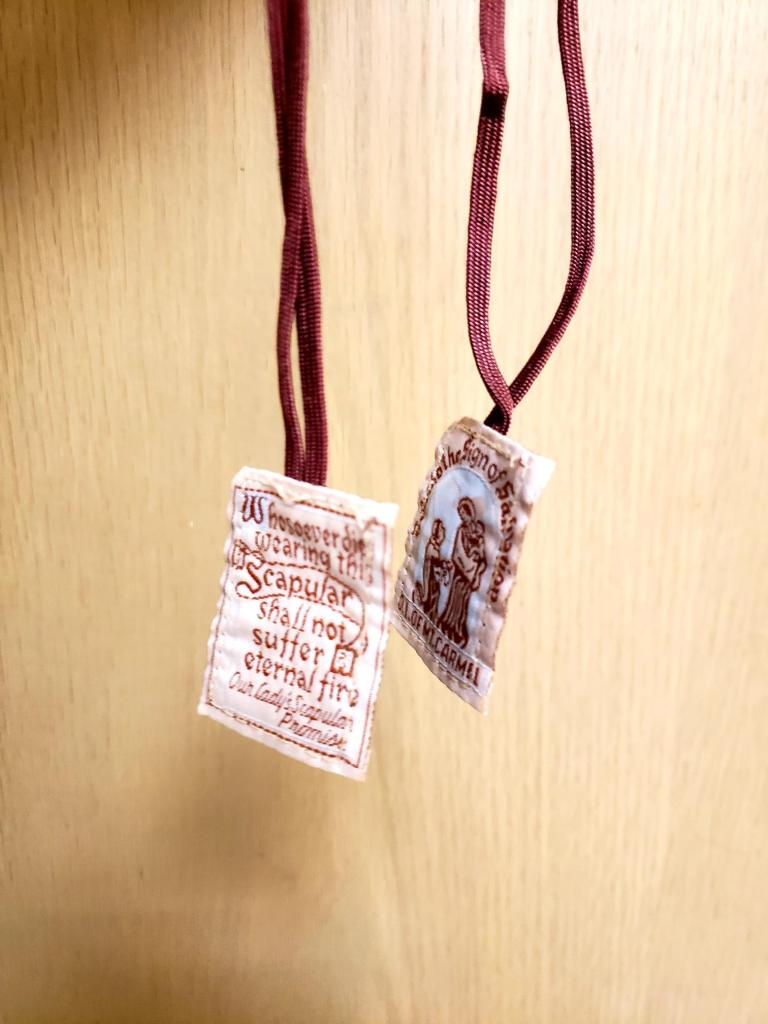
Regardless of what you think about scapulars and the particular message on this one, most important to me is what the patient said next with tears in his eyes: “I’ve worn this scapular every day for the past forty years. Here, I want you to have it. I don’t need it anymore. I am no longer afraid of death.”

The patient died. But he died at peace with God and without fear. I keep his scapular on my desk as a constant reminder of why I am a hospital chaplain, and how important the work I do is. Anytime I get discouraged or have a hard day, when I return to my office, the scapular reminds and reorients me that the spiritual care of patients is a privileged and sacred responsibility.

The ancient Israelites were finally ready to enter the Promised Land. The twelve tribes miraculously crossed the Jordan River on dry ground. God had stopped the water from flowing. After everyone crossed over, the river went back to flowing again.

Joshua, their leader, instructed people from each tribe to take a large stone from the river and place them in a heap for two didactic reasons:

1) To educate future generations inside Israel that God kept the promise to bring them into a land of abundance; and

2) To educate those outside Israel that God is mighty.

It’s important that we all have a continual awareness of why we are here on this earth and what our purpose is. Our history is significant and needs to be remembered.

Yet, there are many families and faith communities in which the children know little about how God worked in their parents’ lives, not to mention the many previous generations. Having tangible reminders of God’s past actions helps everyone remember. 

Just as people ask me about why I have a scapular on my desk, so having reminders of God’s grace in prominent visible places serves to aid all ages of folks to ask why those mementos are there.

It is good to have visual reminders of faith and the faithful people who influenced us around our homes, places of work, and communities so that others may discover and know the redemptive acts of God, that the Lord keeps promises.

Almighty God, we praise and magnify your holy Name for all your servants who have finished their course in faith and patience. May we remember them and their service well. We humbly pray that, at the day of resurrection, we and all who are members of the mystical body of your Son may be set on his right hand, and hear his most joyful voice: “Come, you who are blessed by my Father, inherit the kingdom prepared for you from the foundation of the world.” Grant this, O merciful Father, for the sake of Jesus Christ, our only Mediator and Advocate. Amen

Romans 2:12-16 – Doing, Not Just Hearing, Makes the Difference

If you sin without knowing what you’re doing, God takes that into account. But if you sin knowing full well what you’re doing, that’s a different story entirely. Merely hearing God’s law is a waste of your time if you don’t do what he commands. Doing, not hearing, is what makes the difference with God.

When outsiders who have never heard of God’s law follow it more or less by instinct, they confirm its truth by their obedience. They show that God’s law is not something alien, imposed on us from without, but woven into the very fabric of our creation. There is something deep within them that echoes God’s yes and no, right and wrong. Their response to God’s yes and no will become public knowledge on the day God makes his final decision about every man and woman. The Message from God that I proclaim through Jesus Christ considers all these differences. (The Message)

Every single person on planet earth has been created by a good Creator in the image and likeness of God, without exception.

Because we are all stamped with the Lord’s divine image deep within us, there is a universally inherent sense of justice, rightness, fairness, integrity, morality, and love. Particulars of ethics may differ from culture to culture, yet all persons and societies have a broadly similar innate understanding of right and wrong.

Within the ancient Roman Church were a mix of Jews (the historical people of God who were given the law and the covenant through Moses) and Gentiles (non-Jewish persons). The Apostle Paul wrote his lengthy and probing letter to them because the two groups of Jew and Gentile were at odds with one another.

The Gentile Christians could not understand the Jewish Christian fondness and insistence on ancient rules and particular commands, and so, they looked down on their brothers and sisters in the faith as being hopelessly locked into outdated traditions and practices.

Conversely, the Jewish Christians could not understand the Gentile Christian affinity for a freedom that seemed to not care about the religious importance of food and eating, seasons and holy days, and outward signs of Christianity, and so, they tended to look down on their brothers and sisters in the faith as ignorant, immature, and in need of ritual practices.

We are made right with God by placing our faith in Jesus Christ. And this is true for everyone who believes, no matter who we are.

Romans 3:22, NLT

The Church back then was almost like putting a group of people with O.C.D. (Obsessive-Compulsive Disorder) with a group of people with A.D.D. (Attention-Deficit Disorder). At the least, it’s going to very interesting to watch them try to live and worship together; at the worst, it’s going to spark an all-out battle for supremacy.

Paul was intervening somewhere in the middle between the interesting situation and the pitched battles so that the Church would not turn into total war. The last thing he wanted was two churches: one Jewish and one Gentile. No, there is one church, just as there is one God. Paul was determined that these knuckleheads are going to have to learn to get along.

Since Paul himself was a Jewish Christian, he tended to get pretty testy with his fellow Jews. Although Paul often went back-and-forth throughout his letter to the Romans, addressing Jews, then Gentiles, he most often had more to say to the Jewish brothers and sisters.

And that is what’s happening in today’s New Testament lesson. The Apostle Paul is directing his words chiefly toward the Jewish believers. He is lifting the Gentile believers and placing them on the same level as the Jews. Although the Gentiles weren’t the ones who received the law, they’ve always had that law deep inside them.

God is not only the God of the Jews. He is also the God of those who are not Jews. There is only one God. He will make Jews right with him by their faith, and he will also make non-Jews right with him through their faith.

Romans 3:29-30, ERV

Not only ought the Gentile Christians to be respected because of their inherent sense of God’s law, but this also makes them accountable for their own words and actions. In other words, there’s no excuse for any sinful talk or behavior.

What’s more, the real issue isn’t whether one group has the law, or not. The rub is whether one actually obeys and does the will of God. It doesn’t matter whether one hears the law read aloud in a Jewish synagogue or whether one hears the law spoken in the individual conscience. All are responsible for acting on that voice and engaging in deeds of justice, peace, and love. All must connect with the stamped image of God within us.

I’m not sure what is worse: committing overt sins or observing the sin and doing nothing about it. Indifference is at the core of most sin – both for the perpetrator and the passive spectator seeing it. Each one is living against both their conscience and by what they’ve heard and been taught.

The Word of God has not been truly received until it is put into practice. This is a consistent theme in the New Testament: 

Jesus said, “The people who are really blessed are the ones who hear and obey God’s message!”

Luke 11:28, CEV

Obey God’s message! Don’t fool yourselves by just listening to it. If you hear the message and don’t obey it, you are like people who stare at themselves in a mirrorand forget what they look like as soon as they leave. But you must never stop looking at the perfect law that sets you free. God will bless you in everything you do, if you listen and obey, and don’t just hear and forget. (James 1:22-25, CEV)

Listening to the Word without obedience is just that – it is mere hearing.

Profession of faith in Jesus means nothing without a practice of that faith.

Learning the Bible is useless without living it.

Acceptance of the Word is nothing more than a mental exercise without action to back it up.

Profession, knowledge, and acceptance alone does not satisfy God’s plan for our lives. 

The danger is that we have the potential to deceive ourselves into thinking we are okay just because we know the right things and believe the right things. Christianity is a vital love relationship with Jesus, and, so, is not merely a matter of hearing and affirming orthodox truth; it also involves orthopraxy, that is, having right practice, the doing of truth.

Whenever the Gentile Christians in Rome refused to love the Jewish Christians, they were not hearing God and doing his will.

Whenever the Jewish Christians listened to law and gospel, but then had no intention of changing to accommodate the Gentile Christians, they were being disobedient.

And whenever we hear about how God forgives us in Jesus’ name, but then we insist on not forgiving another person, we are not being doers of the Word.

So, let’s take a lesson from the ancient Roman Church: Live by faith. Be attentive to all persons in the Body of Christ. Include them and care for them. Pay attention to God’s Word. Include it and engraft into your life. Because care of the Body and care of the Word go hand-in-hand together.

May the God who created a world of diversity and vibrancy,
Go with us as we embrace life in all its fullness.

May the Son who teaches us to care for stranger and foreigners,
Go with us as we try to be good neighbors in our communities.

May the Spirit who breaks down our barriers and celebrates community,
Go with us as we find the courage to create a place of welcome for all. Amen.

Numbers 27:12-23 – Humble Leadership

Moses Blesses Joshua by Marc Chagall, 1966

One day the Lord said to Moses, “Climb one of the mountains east of the river and look out over the land I have given the people of Israel. After you have seen it, you will die like your brother, Aaron, for you both rebelled against my instructions in the wilderness of Zin. When the people of Israel rebelled, you failed to demonstrate my holiness to them at the waters.” (These are the waters of Meribah at Kadesh in the wilderness of Zin.)

Then Moses said to the Lord, “O Lord, you are the God who gives breath to all creatures. Please appoint a new man as leader for the community. Give them someone who will guide them wherever they go and will lead them into battle, so the community of the Lord will not be like sheep without a shepherd.”

The Lord replied, “Take Joshua son of Nun, who has the Spirit in him, and lay your hands on him. Present him to Eleazar the priest before the whole community, and publicly commission him to lead the people. Transfer some of your authority to him so the whole community of Israel will obey him. When direction from the Lord is needed, Joshua will stand before Eleazar the priest, who will use the Urim—one of the sacred lots cast before the Lord—to determine his will. This is how Joshua and the rest of the community of Israel will determine everything they should do.”

So, Moses did as the Lord commanded. He presented Joshua to Eleazar the priest and the whole community. Moses laid his hands on him and commissioned him to lead the people, just as the Lord had commanded through Moses. (New Living Translation)

Moses was one of the most humble persons who ever lived on this earth (Numbers 12:3). Whereas many people are concerned for their legacy at end of life, Moses, instead, had a deep pastoral concern for his fellow Israelites. He didn’t want them without a capable and godly leader. So, in his humility, Moses was willing to obey God, let go of power, and share his authority so that the people would be well-cared for.

“All streams flow to the ocean because it is lower than they are. Humility gives it its power.”

Lao Tzu (Chinese philosopher, 6th century B.C.E.)

I believe humility is the queen of all virtue, especially that of leadership. Yet, humility is one of the hardest virtues to practice because it requires that we willingly put aside pride, ego, and personal agendas in order to embrace God’s agenda.

Rather than having large statues erected to honor us and our proud accomplishments, or having our names plastered on buildings (and churches!) to recognize our wonderful charity, we really need to orient our energies toward passing the baton to trustworthy people who are capable of faithfully fulfilling the role of servant leader. (2 Timothy 2:2)

Being poor in spirit (Matthew 5:3), becoming like a little child (Matthew 18:3), and thinking of others as better than ourselves (Philippians 2:3) are the cornerstones to becoming open to what God has for us. To be a humble leader means to steadfastly seek God’s will and way in everything. Then, to have the courage in leading others toward God’s direction, despite resistance and opposition from those who want to follow a different path.

Therefore, a leader’s task is to be consumed with seeking God’s direction rather than living purely according to instinct, pragmatic desire, or personal views. We continually need a radical openness to God. So, we must work to develop an ever-deepening awareness of where God is leading us. 

God, in divine mercy, is always up to something good. The Lord has plans for us and for the people we lead.  It’s humility that allows us to listen well to God’s Spirit and gain the direction needed for leadership.

Yet, being open to God is not quite as easy as it sounds. We must recognize that not everyone is open to God.  There are those, maybe even including us, who may be closed to God. 

If our focus is more on creating safety and security or trying to do enough good deeds to be recognized by God and others, or having our institution be what we want it to be, then we have become closed to what God wants.  This comes out in a couple of different ways….

  1. Maintaining tradition, at all costs. Whenever we do everything the way we have always done it, to make us feel safe and secure, then anything that threatens that security angers us. This is where folks practice either fight or flight – they wage either a holy war or just leave. Living with uncertainty and ambiguity is too much for them. But faith is what it takes if we are going to follow God. Like Abraham in the Old Testament, we are called to move and change without always knowing the destination.
  • Getting rid of traditions, at all costs. Sometimes folks who want new or different, desire to create a place of their own making to serve them and their needs. They aren’t really focused on what God is calling them to do. Rather, like Timothy in the New Testament, we are to hold onto the great deposit of doctrine and heritage given to us and not always be looking for the next new thing to turn things around.

So, what to do? Have the humility to ask the question continually and constantly: “What is God’s will?”  We need leadership that is incredibly open to God, allowing decision-making to come from a position of faith, and not fear. This enables us….

  • To let God, flow in and through us, rather than willfully insisting it should be our way or the highway.
  • To practice hope and love, rather than relying on our own strength and desires.
  • To make prayer and discernment the foundation of what we do, always seeking what God wants and then leading others in that direction by inviting them to the same kind of prayerful process.
  • To read our Bibles as if our lives depended on it and pray like there is no tomorrow.

If we have humility and a deep openness to God; a conviction that we are primarily called to follow Jesus Christ; a willingness to let God’s power flow through us; and, a determined readiness to move people lovingly and graciously in God’s direction, then amazing things can happen. 

Let our prayer together be this: I am yours, God, no matter where you call me to go, what you call me to do, and how you call me to be. I will seek your will and way as I lead others to do the same. Amen.