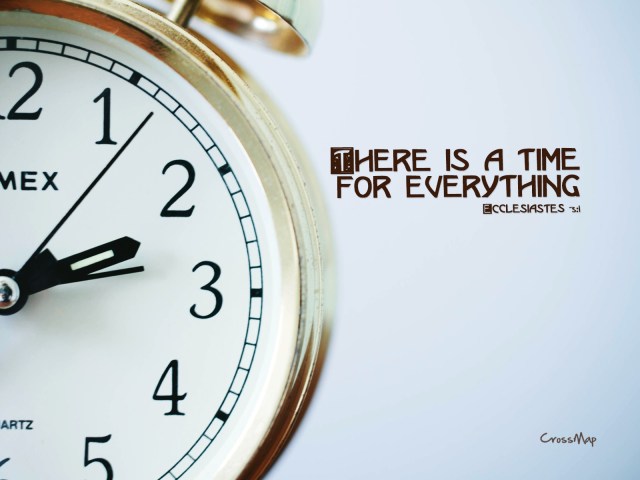
Ecclesiastes 3:1-13 – What Time Is It?

There is a right time for everything, and everything on earth will happen at the right time.

There is a time to be born
    and a time to die.
There is a time to plant
    and a time to pull up plants.
There is a time to kill
    and a time to heal.
There is a time to destroy
    and a time to build.
There is a time to cry
    and a time to laugh.
There is a time to be sad
    and a time to dance with joy.
There is a time to throw weapons down
    and a time to pick them up.
There is a time to hug someone
    and a time to stop holding so tightly.
There is a time to look for something
    and a time to consider it lost.
There is a time to keep things
    and a time to throw things away.
There is a time to tear cloth
    and a time to sew it.
There is a time to be silent
    and a time to speak.
There is a time to love
    and a time to hate.
There is a time for war
    and a time for peace.

Do people really gain anything from their hard work? I saw all the hard work God gave us to do. God gave us the ability to think about his world, but we can never completely understand everything he does. And yet, he does everything at just the right time.

I learned that the best thing for people to do is to be happy and enjoy themselves, as long as they live. God wants everyone to eat, drink, and enjoy their work. These are gifts from God. (ERV)

Time is finite. We cannot get it back once we lose it. So, it is important to use our time in ways that reflect our most cherished values and commitments. For that, we need wisdom to know what to do, what not to do, and when to do it.

We can often use our time in strange ways. For example, Rafael Antonio Lozano of Plano, Texas has been on a quest to visit every company-owned Starbucks on the planet. He began his mission in 1997, when there were 1,304 Starbucks stores worldwide. Currently, there are 31,256 stores. As of September 2019, Lozano reported having visited over 15,000 global locations. 

Despite his impressive pace, Lozano is realistic about the nature of his quest, saying, “As long as they keep building Starbucks, I’ll never be finished.” He is also realistic about the importance of his mission. “Every time I reach a Starbucks, I feel like I’ve accomplished something,” he said, “when actually I’ve accomplished nothing.”

The book of Ecclesiastes would say, “There is a time to drink coffee, and a time to stay home.” Certainly, Lozano’s personal mission is extreme. But before we get too hard on Rafael, do we have a personal mission?  Does it reflect the stewardship of time God has given us?  When we get to the end of our lives, will we feel like we have accomplished something only to discover that we have accomplished nothing?

Time is a gift from God, and a temporary commodity to be used for God before the end of time comes.

One of the realities of time is that our lives are full of seasonal rhythms and change over time. These are built into the life God has given us. The book of Ecclesiastes is one that, throughout its contents, explains that nothing we pursue has any permanence to it. We throw ourselves into some work or activity, but what does that activity really do for us in the end?

Time is our master, and we must respect it.

When I was twenty years old, I thought nothing of playing a round of golf in the morning and three sets of tennis in the afternoon, then staying up late at night with friends. If I did that same thing today, I would have a team of doctors attending me in the hospital. We all, at some point, try to defy time and act like we can do the things we once did in the past. Sometimes it takes a lot for us to accept our limitations, whether it is our play or our work. Ecclesiastes teaches us that forces from the outside seem to always dictate what we can do and not do.

Time can be a harsh taskmaster.

The clock relentlessly and inexorably moves forward with the cycles and rhythms of life offering only meaninglessness, as we discover we are prisoners of time. But for the believer, time can be redeemed with godly purpose and meaning, no matter what the season of life is. Because there is time, and all things will someday come to an end – all activity, or the lack of it, will be judged according to how we denied or accepted our limitations due to time. 

Ecclesiastes also offers to us what seems a subversive perspective that is counter-cultural to our society. Whereas many Americans believe that if we work hard and do the right thing we can shape our own lives and our own prosperity, the Teacher of Ecclesiastes insists on submitting and moving with the events, rhythms, and seasons of God.  

Apart from God, time is futile and meaningless. In our denial, it is no wonder so many persons are so unhappy with their lives.

In the seasons of life and experiences we have from birth to death, the conclusion of Ecclesiastes is that everything is out of our control. Too many of us try to exert control over events, people, and circumstances when, in truth, any control we have is an illusion. I call this the “c-clamp syndrome,” trying to clamp down on others to get them to submit to our agenda.

Instead, Holy Scripture directs us to practice self-control – to focus on myself and my own actions:

Moderation is better than muscle, self-control better than political power. (Proverbs 16:32, MSG)

Prepare your minds for action and exercise self-control. Put all your hope in the gracious salvation that will come to you when Jesus Christ is revealed to the world. (1 Peter 1:13, NLT)

The end of everything has come. Therefore, be self-controlled and clearheaded so you can pray. (1 Peter 4:7, CEB)

Do your best to improve your faith. You can do this by adding goodness, understanding, self-control, patience, devotion to God, concern for others, and love. If you keep growing in this way, it will show that what you know about our Lord Jesus Christ has made your lives useful and meaningful. (2 Peter 1:5-7, CEV)

We cannot make time stand still. So, we must focus on how we spend our time now. It is time for us to lay aside lesser pursuits and diligently pursue God. We each must give ourselves to the unforced rhythms of grace and let God redeem the time. What time is it?  It is time to live in harmony with God in all we say and do.

God of all time help us to know ourselves. Teach us to recognize our weaknesses and work to walk in holiness. Let us follow you in all things, submitting to the times you have for us. Thank you for your unending grace and mercy toward us when we need it most. Help us to trust you with our lives through Jesus Christ our Lord in the power of the Holy Spirit. Amen.

2 Peter 3:8-13 – It’s Time

But do not forget this one thing, dear friends: With the Lord a day is like a thousand years, and a thousand years are like a day. The Lord is not slow in keeping his promise, as some understand slowness. Instead he is patient with you, not wanting anyone to perish, but everyone to come to repentance.

But the day of the Lord will come like a thief. The heavens will disappear with a roar; the elements will be destroyed by fire, and the earth and everything done in it will be laid bare.

Since everything will be destroyed in this way, what kind of people ought you to be? You ought to live holy and godly lives as you look forward to the day of God and speed its coming. That day will bring about the destruction of the heavens by fire, and the elements will melt in the heat. But in keeping with his promise we are looking forward to a new heaven and a new earth, where righteousness dwells. NIV)

The Apostle Peter invites us to see the moving of history as God sees it. Peter addressed two questions and concerns the people had about the Lord’s coming: Will this coming be worth the wait? And what should I be doing in the meantime now while I wait?

The people in Peter’s time were impatient. They saw time from a mere human perspective and needed a bigger understanding of God’s purposes. The fact of the matter is that God’s timing is different than ours. There are two words for “time” in the New Testament: chronos and kairos

Chronos is where we get our English word “chronological.” This is time measured by the clock and is the way much of our lives are governed. The other term for time, kairos, is seasonal time. Kairos is not determined by the clock but is event oriented. 

God is not time-oriented in the sense that we are, that is, God is not ruled and controlled by the clock. God is event-oriented, which is why the Lord’s understanding of time is that a thousand years are like a day, and a day like a thousand years. In other words, God measures time differently than most Westerners do. When the Bible says Christ is coming soon, it means there are no events left in the course of history except the Day of the Lord, the return of Jesus, to judge the living and the dead.

I admit I am a clock-oriented guy. I also confess that my wife and girls are not. They are much more event oriented than me, so I suppose when it comes to time, they are the godly ones. After all, the seasons will continue to come and go but a clock will eventually die, that is, when its time is up.

I cannot begin to count how many hours of my life have been spent waiting on my wife and girls. I used to get frustrated and impatient because I thought they should be clock-oriented, like me. Yet, over the years, I have learned to accept this reality. Now I take the time of waiting and read. I have read a lot of books over the years through my waiting. I used to want to time travel because of wasted time, but that is all in the past now.

A clock-oriented guy like me needs to grasp that God has all the time in the world. God serves no clock. Clocks are merely playthings for the Lord. When God wants a hot time, he just puts a clock in the oven. I, however, tend to get antsy, impatient, and frustrated, believing that God must operate on my time schedule. However, what looks like divine tardiness to me is really something else.

God seems slow in keeping divine promises. But the truth is, the Lord takes all the time in the world because of divine mercy. While I am beating my chest trying to get everyone on my time deadlines, God beats up the clock, just to kill time.

In the face of so much that is not right with the world, we might wonder why God is not just stepping in and taking care of all the evil and unjust situations on this earth. What we view as a lack of mercy is, in fact, sheer grace on God’s part – patiently waiting for all kinds of people to confess their guilt and shame and come to Jesus. God is waiting for that lost soul to make their way to forgiveness. You cannot bear your secrets with a clock around because time will tell.

Whereas I tend to think I am waiting on God, God is waiting for me, too. What should I be doing in the meantime while I wait? We ought to be living holy and godly lives as we look forward to Christ’s coming and speed its coming. Yes, God is the One who is waiting on us. Do you know the time of the Second Coming? No, me neither; we have not met yet.

The holiness and peace of God’s people will influence the timing of the Christ’s return. When God upends our current situations, it is time to get a new set of circumstances. In other words, since God is an event-oriented God, the Lord has all the time in the world to wait on us to be the kind of people we need to be.

The fact that we are two-thousand years removed from the first Advent of Christ probably does not speak very well to the church in general. It will do no good to sit on our watches so that we can be on time. God is still waiting for a lot of folks to come to repentance, as well as the church to take up her mandate of making disciples.

God is gracious and does not bully us or strike us with lightning when we disobey. Rather, God is patient, wanting us to approach and receive mercy. The Lord is waiting for us to avail ourselves of divine help to live holy and godly lives. Holiness simply means to be separated from evil and attached to God. Godliness means to live a worshipful and spiritually disciplined life.  Our Lord’s patience means deliverance from all that disconnects us from Jesus so that we might rightly attach ourselves to Christ.

Robby Robins was an Air Force pilot during the first Iraq war. After his 300th mission, he was given permission to immediately pull his crew together and fly his plane home. They flew across the ocean to Massachusetts and then had a long drive to western Pennsylvania. They drove all night, and when his buddies dropped him off at his driveway just after sun-up, there was a big banner across the garage—”Welcome Home!”  How did his wife know? No one had called her, and the crew themselves had not expected to leave so quickly.

Robins relates, “When I walked into the house, my wife came running down the hall—she looked terrific—hair fixed, make-up on, and a crisp yellow dress. ‘How did you know?’ I asked.  ‘I didn’t,’ she answered through tears of joy. ‘Once I knew the war was over, I knew you’d be home one of these days. I knew you would try to surprise me, so I was ready every day.'”

In the history of redemption, the war has been won. There is only one event left on God’s calendar: The return of Jesus. When a clock stops ticking, it just hangs around. That is not what the Lord wants. Throwing the watch across the room will not make time fly; Jesus will come when he comes. Meanwhile, our focus is on living holy and godly lives as we wait….

Even so, come Lord Jesus.

James 4:11-16 – On Planning Well

Brothers and sisters do not slander one another. Anyone who speaks against a brother or sister or judges them speaks against the law and judges it. When you judge the law, you are not keeping it, but sitting in judgment on it. There is only one Lawgiver and Judge, the one who can save and destroy. But you—who are you to judge your neighbor?

Now listen, you who say, “Today or tomorrow we will go to this or that city, spend a year there, carry on business and make money.” Why, you do not even know what will happen tomorrow. What is your life? You are a mist that appears for a little while and then vanishes. Instead, you ought to say, “If it is the Lord’s will, we will live and do this or that.” As it is, you boast in your arrogant schemes. All such boasting is evil. (NIV)

Listening is both art and hard work. A few years back I spent a week at a prayer retreat. It was time intentionally set aside to hear God. It was hard work. I stayed in a little one room hermitage in the woods surrounding by God’s creation. On the first morning, I was in bed and at dawn I heard this loud thud on one of the windows. I woke up and heard it again, and then again. Outside there was a big male robin going at the window like there was no tomorrow. He did it about a dozen times before finally flying away. I laid there a bit frustrated with this stupid bird waking me up, and yet also wondered about that robin. Since I was there to connect with God, I started asking the question: “God, what are you trying to teach me through that stupid robin?”

I did not get an answer to my question. Then, the next day it happened again. Mr. Robin came by and took about a dozen hard tries at my window before flying away. However, this time I finally realized what was going on. Mr. Robin was perching just outside the window and looking at his own reflection. All he could see was a big rival robin staring back at him, on his turf, and he was going to tear into that interloper. Little did the birdbrain know that he was fighting a losing battle, against himself. 

“God, what are you trying to teach me through this robin?” Now, I had my answer. I was a Pastor tackling the issues and problems of others in the church and the world. Yet, I came to understand that I was only tackling myself, seeing my own reflection and struggling in a losing battle. I investigated the face of the enemy, and the enemy was me.

We are our own worst enemies. Much of life is determined by whether we plan for and with God. The natural temptation of us all is to view the landscape of human problems, assign enemies, and then fail to see that our greatest enemy is staring at us in the window’s reflection. Another temptation is to believe that when things are going well, it is because of our own doing – as if somehow, we can live and move and have our being independent of God in the equation. So, I ask, is God in our plans?

That is a big question. Here is just a smattering of what Jesus said about living for him: 

“Any of you who does not give up everything he has cannot be my disciple.” (Luke 14:33)

“Anyone who does not carry his cross and follow me cannot be my disciple.” (Luke 14:27)

“If you hold to my teaching, you are really my disciples.” (John 8:31)

“No one who puts his hand to the plow and looks back is fit for service in the kingdom of God.” (Luke 10:62) 

We are not called by God to control other people or events; we are called to practice self-control and listen to God as we determine the course of our lives in both the big and small things of life.

The Apostle James had to deal with some birdbrain robins. They were only looking at themselves and not doing the good they knew they ought to do.

The Actual Situation

Some of the people James addressed were planning and mapping out their lives without consideration of what God wanted. They neither looked to God before beginning their planning process nor intended on including him in their dealings. These certain businesspersons were independent minded. They viewed their time and money as their own. In their minds, they give God an hour on Sunday, and the rest of the time is their own; they make their own money and no one can tell them what to do with it; they make their own plans, and maybe ask God afterward to bless it all.

The actual situation was that people were holding back on God, only giving him a certain portion of their effort.  And this can happen to any of us, with anything we have.  We may not all have money and power, yet we all have time, and how we use our time says a lot about our faith.

One of the many things God taught me at my prayer retreat was through all my business and busy-ness that I was holding back in some ways. Yes, I could compassionately connect with people but was guarded with it. Having my armor up was coming from a fear of not doing something perfect, or at least not doing it really well; and, if I would give myself completely to compassionately connecting with others, I might get hurt (because I’ve been hurt before). I wonder if you can resonate with this.

God just wants us to show up, be present, and not be perfect. We are to do the best with the gifts and abilities given us and leave it all on the playing field so that it cannot be said of us that we did not do the good we knew we should have done.  Furthermore, there is nothing wrong with being afraid.  In fact, true courage involves fear because real bravery is doing what is right when it is scary to do it, no matter what the consequences might be.

The Analysis of the Situation

Life is truly short – like a mist that appears for a little while in the morning, and then vanishes. Thus, the scheming we might do to make money and guard our investments; the posturing to make ourselves look good; the power-plays we engage to get our way; and, the anxiety which prevents us from the things we know we ought to do amounts to nothing at the end of our lives.

I have talked with far too many people over the years who crucify themselves between the two thieves of regret over yesterday’s missed opportunities, and fear of what will happen tomorrow. I have observed far too many people who made lots of money, patented inventions, and won awards, yet had no one at the end of their lives to be with them. They were not there for others, and so others were not there for them. 

Jesus said we cannot serve both God and money (Matthew 6:24). In God’s economy, money is simply a tool to be used to meet needs and bless others. Yet, we tend to make audacious plans with money through accumulating debt and presuming we can pay it off; encouraging our kids to get high paying jobs as their highest objective; and, putting faith in the market economy to provide for us in the end. 

James was not saying money is bad and making plans is wrong; he was saying that the almighty dollar is not to be the motivating factor in our lives, and that God needs to be squarely in the middle of all that we do.

The Alternative to the Situation

The alternative to making plans independent of God is to plan carefully for God to be in everything – to find and do his will without trying to impose our will upon the divine.

This requires listening well. It is easy to rush and keep busy and then are unable to hear what God might be saying. When things are rough, we may work so we do not have to stop long enough to feel what is really going on inside of us. James encourages us to say, “If it is the Lord’s will, we will live and do this or that.”  Listening well enables living well.

The Audacity of the Situation

Some people in James’ day were boasting over their accomplishments.  Like Kings Nebuchadnezzar and Herod of old, they made plans and did what they wanted with delusions of grandeur. They believed they were the ultimate sovereigns of what could and should go on in the world of which they controlled. They had to learn the hard way that they were only masters of small worlds.

Boasting merely sets us up for a higher fall. We need God, and we need each other, and whenever we lose sight of that truth, we are on a one-way road to implosion. Whereas some might call it independence, God calls it evil.

The Awfulness of the Situation

The tragedy of independent planning and acting is that God is left out due to purposeful ignorance. Like the deceitful husband and wife duo, Ananias and Sapphira, there were certain persons who withheld their money and their resources so that they could look good to the rest of the community and influence happenings within the church (Acts 5:1-11).  It did not end so well for them.

Conclusion

Doing more with greater efficiency may help, yet it misses the point. We are to take the time and effort to relate meaningfully with God so that we can plan with confidence and make faith-based decisions on what we believe the Lord wants us to do.

Let us not find ourselves repeatedly flying into a window. Instead, let the Lord shape life in such a way that conforms to his purposes, so that we will then know genuine lasting joy and peace.

One mark of the mature person is that he/she has the same benevolence and character whether they are rich or poor. Since we are all rich in faith, let us continually demonstrate it by living for Jesus Christ, loving one another, and planning to reach a lost and unjust world with the good news of God’s grace.

Exodus 2:11-15 – Time Out

A Time for Everything

In the course of time Moses grew up. Then he went to see his own people and watched them suffering under forced labor. He saw a Hebrew, one of his own people, being beaten by an Egyptian. He looked all around, and when he didn’t see anyone, he beat the Egyptian to death and hid the body in the sand.

When Moses went there the next day, he saw two Hebrew men fighting. He asked the one who started the fight, “Why are you beating another Hebrew?”

The man asked, “Who made you our ruler and judge? Are you going to kill me as you killed the Egyptian?” Then Moses was afraid and thought that everyone knew what he had done.

When Pharaoh heard what Moses had done, he tried to have him killed. But Moses fled from Pharaoh and settled in the land of Midian. (GW)

Faith is not a static phenomenon that one possesses, or not. Rather, faith is a dynamic movement which is continually either being strengthened or weakened through our life choices.  Moses needed to learn how to make healthy decisions of faith, just as much or more than the rest of us.  The fact that he was eighty years old before he became the human agent of God’s deliverance of the Israelites from the Egyptians, after a forty year stint in the backside of the desert, tells us that it took him awhile to mature.  Even though Moses may have had a sense that the Israelites needed freedom from slavery and acted on that sense by killing a ruthless Egyptian, his method and sense of timing were off.

There is a time for everything, said the writer of Ecclesiastes.  Wisdom, which is the ability to apply faith to concrete situations with appropriate forms, is often in the timing of things.  To know when to speak and when to listen, when to act and when to wait, is an important facet of faith.  The ancient Israelites were slaves in Egypt for a long time.  Moses knew they were suffering, and he acted in “good faith.” Yet, it was not yet time and it was a rash movement.  Eventually, the Jewish cry of suffering arose to God, and God heard them, remembering his covenant with them.  Why God did not act sooner, or use Moses earlier, is information that is only privy within God himself.

If we are to develop a strong and wise faith with an opportune sense of timing, we will need to rely on God.  Trusting in ourselves, our own efforts, and our own gauge of how things ought to proceed will usually not end well.  We may, like Moses, find ourselves taking a “time out” from God in obscurity until we learn to wait on him.

In the fullness of time, Paul said to the Galatians, Jesus came, born of a woman, born under law, to redeem those under the law (Galatians 4:4-5).  God knows what he is doing, even though it might seem like he is sometimes slow to act.  God sees.  God delivers.  And he does it in his timing – not ours.

Redeeming God, you control all things, including the clock.  Give me wisdom so that my sense of timing might reflect your will and your way, through Jesus Christ, your Son, who with you and the Holy Spirit reign supremely as one God, now and forever.  Amen.