Build It Now! (Haggai 1:1-15a)

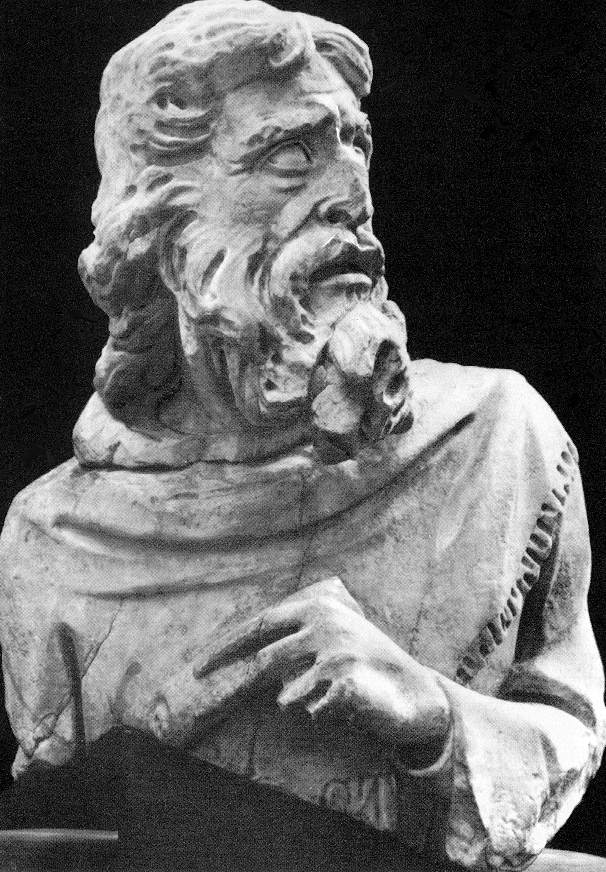
Statue of the prophet Haggai, by Giovanni Pisano, c.1290 C.E., Siena, Italy

In the second year of King Darius, on the first day of the sixth month, the word of the Lord came through the prophet Haggai to Zerubbabel son of Shealtiel, governor of Judah, and to Joshua son of Jozadak, the high priest:

This is what the Lord Almighty says: “These people say, ‘The time has not yet come to rebuild the Lord’s house.’”

Then the word of the Lord came through the prophet Haggai: “Is it a time for you yourselves to be living in your paneled houses, while this house remains a ruin?”

Now this is what the Lord Almighty says: “Give careful thought to your ways. You have planted much but harvested little. You eat, but never have enough. You drink, but never have your fill. You put on clothes but are not warm. You earn wages, only to put them in a purse with holes in it.”

This is what the Lord Almighty says: “Give careful thought to your ways. Go up into the mountains and bring down timber and build my house, so that I may take pleasure in it and be honored,” says the Lord. 

“You expected much, but see, it turned out to be little. What you brought home, I blew away. Why?” declares the Lord Almighty. “Because of my house, which remains a ruin, while each of you is busy with your own house. 

Therefore, because of you the heavens have withheld their dew and the earth its crops. I called for a drought on the fields and the mountains, on the grain, the new wine, the olive oil and everything else the ground produces, on people and livestock, and on all the labor of your hands.”

Then Zerubbabel son of Shealtiel, Joshua son of Jozadak, the high priest, and the whole remnant of the people obeyed the voice of the Lord their God and the message of the prophet Haggai, because the Lord their God had sent him. And the people feared the Lord.

Then Haggai, the Lord’s messenger, gave this message of the Lord to the people: “I am with you,” declares the Lord. So the Lord stirred up the spirit of Zerubbabel son of Shealtiel, governor of Judah, and the spirit of Joshua son of Jozadak, the high priest, and the spirit of the whole remnant of the people. They came and began to work on the house of the Lord Almighty, their God, on the twenty-fourth day of the sixth month. (New International Version)

Timing is everything.

There is a time to ponder and plan and there’s a time to move and act. If the time is ripe for action, then the lack of initiative is plain old procrastination. But how do you know when to act?

If the Lord says it’s time, well then, it’s time!

God’s people wouldn’t have described their inaction in rebuilding God’s house as dragging their feet. They perceived their inertia as a sensible delay.

Yet, the Lord saw the people’s approach as inexcusable enough to send a prophet with a specific message and call to action: Build the house now!

Let’s get a feel for why God’s call for immediacy comes when it does. In the ancient world, it had always been the practice of armies to assimilate conquered peoples into the culture of the conquering king. 

In the eighth century B.C.E., the Assyrian Empire conquered the northern kingdom of Israel. The Assyrians took most of the people into captivity, left the poorest of the people alone, and resettled the land with some of their own Assyrian people. The inevitable intermarriages resulted in their progeny being known as the Samaritans in the New Testament Gospels, as the Samaritans.

Two-hundred years after Assyria conquered Israel, Nebuchadnezzar besieged the southern kingdom of Judah and took over Jerusalem. He carried Daniel and all the other educated and professional people to Babylon. In the course of taking the city, Nebuchadnezzar tore down the wall and destroyed the temple that Solomon had made.

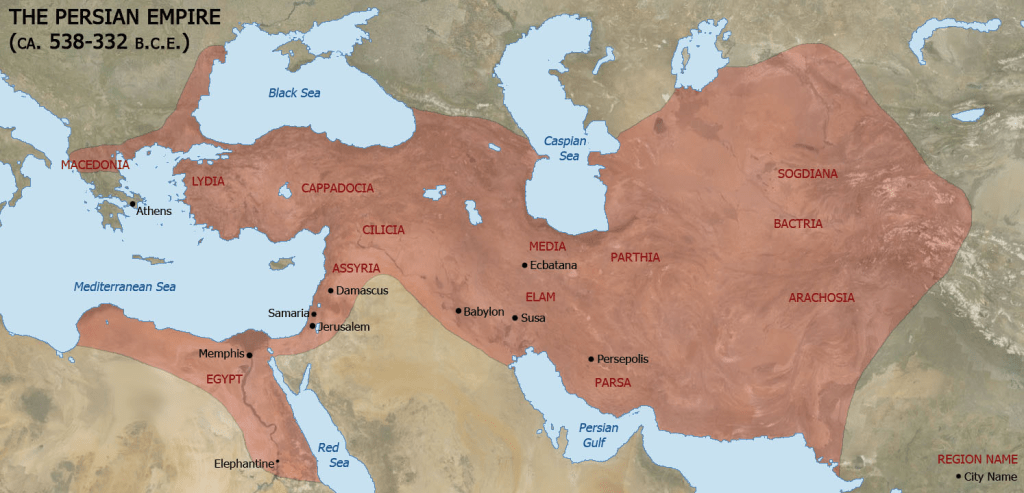
During the Babylonian exile, the Persians conquered Babylon and became rulers of a large geographical empire. Because the massive Persian Empire was in control of so many different kinds of people across such a vast territory, they were not able to operate as previous empires did by assimilation and resettlement. 

Instead, the Persians did something new and different: They encouraged and enabled their conquered peoples to keep their religion and their culture. The only caveat was that they had to give tribute and allegiance to the empire and pray for the king. This is why Nehemiah, Ezra, and Haggai were able to return to Jerusalem and given royal authority to rebuild the wall and the temple. 
But, from the git go, there was opposition to the rebuilding from the old Canaanite inhabitants of the land. After many years, the wall was rebuilt but the temple restoration bogged down. The people slowly became discouraged and lost enthusiasm to do the work. 

Understandably, the people got caught up in taking care of their own homes and just plain neglected working on the temple. Over time, they just forgot about the entire project. But God didn’t.

The prophet Haggai made it clear that the people’s mental distraction and physical neglect was taken as disrespect by the Lord. Haggai insisted that the reason the people were not experiencing blessing on their land was because they simply did not have their priorities straight. 

Thus, God sent the prophet Haggai to preach a sermon entitled: Build the house now! 

To the people’s credit, they responded to the call of God and started rebuilding God’s house. The work was completed. However, there seemed to be a problem. 
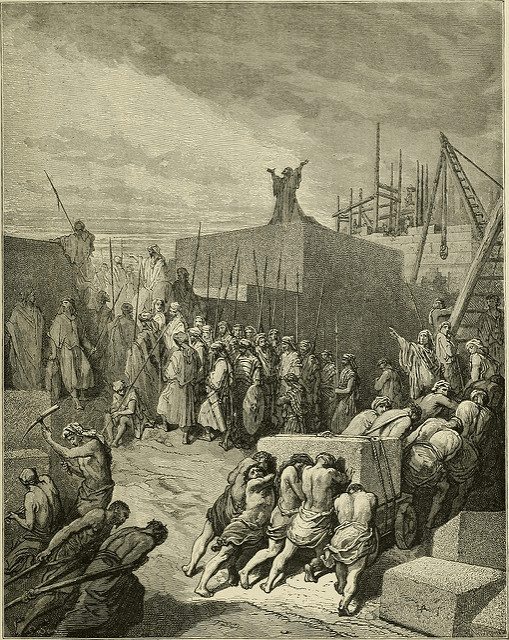
Rebuilding the Temple, by Gustave Doré, 1866

Moving into the rest of Haggai’s prophecy, the newly restored temple didn’t look anything like Solomon’s grand and glorious temple. Many of the older worshipers could still remember Solomon’s temple; to them, the rebuilt temple seemed like a bologna sandwich compared to the T-bone steak of the past. 

So, God sent Haggai again to encourage the people. The Lord will be with them. The restored temple may not look the same, but what makes the temple great is God’s glory.

An important takeaway from the prophecy of Haggai is that the Lord is a jealous God; God’s people are to worship the Lord with all of their heart, soul, mind, and strength. 

We also learn that the Lord is sovereign and supreme over all creation. God owns everything and will use it all to accomplish divine purposes on this earth. 

In addition, we see that God calls people to new work and fresh ministry. The Lord was behind the destruction of the old temple; and when the time was right, God called the people to build a new ministry.

And we learn something about ourselves, as well. God’s people need to hear and respond to God’s call. Haggai put a God-sized vision before the people; he helped them imagine what the new temple would be like – full of God’s glory.

God is doing a new thing. The Lord continues calling people to:

  • Seek first the kingdom of God. (Deuteronomy 4:29; Psalm 63:1; Matthew 6:33; Hebrews 11:6)
  • Love God with whole hearts. (Deuteronomy 6:5, 11:1-22, 19:9, 30:16-20; Matthew 22:37)
  • Love neighbor as we love ourselves. (Leviticus 19:18; Matthew 22:38; Romans 13:9; Galatians 5:14)
  • Make disciples of Christ from all nationalities. (Matthew 28:18-20)
  • Be witnesses to God’s glory in Christ. (Psalm 66:16; Acts 1:8; 2 Timothy 2:2)
  • Obey the Holy Spirit. (Acts 5:31-33; Romans 6:17; Hebrews 5:8-9)

It is good to remember and celebrate past ministries; and it is also good to throw ourselves into the new ministries which God calls us and to build them for God’s glory.

My friends, build it now.

Glory to you, O God, the One who is able to do far beyond all that we could ask or imagine by your divine power at work within us; glory to you, blessed God, in the church and in Christ Jesus for all generations, through the empowering Holy Spirit, forever and always. Amen.

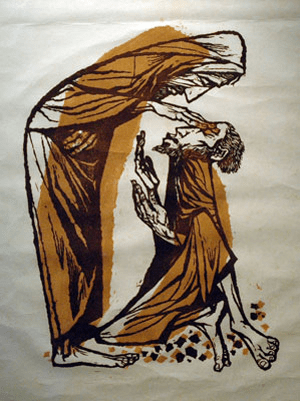
Lord, Have Mercy (Mark 10:46-52)

“Christ Healing the Blind Man” by Robert Hodgell

Then they came to Jericho. As Jesus, his disciples, and many people were leaving Jericho, a blind beggar named Bartimaeus, son of Timaeus, was sitting by the road. When he heard that Jesus from Nazareth was passing by, he began to shout, “Jesus, Son of David, have mercy on me!”

The people told him to be quiet. But he shouted even louder, “Son of David, have mercy on me!”

Jesus stopped and said, “Call him!” They called the blind man and told him, “Cheer up! Get up! He’s calling you.” The blind man threw off his coat, jumped up, and went to Jesus.

Jesus asked him, “What do you want me to do for you?”

The blind man said, “Teacher, I want to see again.”

Jesus told him, “Go, your faith has made you well.”

At once he could see again, and he followed Jesus on the road. (God’s Word Translation)

“I’d like to live my life so close to the bottom that when the system collapses I don’t have far to fall.” Dorothy Day

This is one of my very favorite stories in the entirety of Holy Scripture. And I will tell you why….

Because Jesus listens with ears of mercy

Jesus was headed to Jerusalem and had a lot on his mind and his heart. He knew what was coming, that his passion and death awaited him. No one would fault Jesus for not hearing a blind man shouting. But Jesus was listening so that he might hear someone just like the needy blind man. Rather than being distracted and lost in his head, Jesus was just the opposite – being attentive and aware of the humble folk right in front of him.

The Lord is always and continually listening for honesty and vulnerability. His ears of mercy are specially tuned, even today, for those who cry out to him from a place of genuine openness and humility.

Because Jesus speaks with words of mercy

Once Jesus listened, he responded by asking a question. I am impressed with Jesus throughout the Gospels. Christ gave people the gift of choice. He acknowledged people and respected them by not simply and indiscriminately healing, as if he were some fix-it guy. Jesus Christ bestowed on the lowliest of people the human dignity of choice by empowering them to answer a question.

Whereas everyone around Bartimaeus was looking down on him, both literally and figuratively, Jesus granted him the gift of dignity and basic human kindness – which are gifts we can all bestow on one another.

Because Jesus pays attention with a divine appointment of mercy

Our Lord took the time to heal blind Bartimaeus. Jesus could have simply healed him without even stopping his journey. He could have just waved his hand and the man would be healed. What’s more, Jesus could have even started a healing factory where everyone with a need got healed: bring ‘em in, move ‘em out, and keep the line moving!

Jesus was doing more than giving sight; he was giving a man the blessing of time and personal attention. The Gospel is never impersonal, which is why we ought to resist being non-relational in ministry to others. Christian ministry isn’t simply about meeting a need; it’s about blessing other people with the gift of relationship.

Coptic Church icon of Christ healing the blind man

Because Jesus reaches out with the touch of mercy

Jesus touched the man’s eyes (included in Matthew 20:29-34). He didn’t have to do that. The Lord of all most certainly could have healed without touching. In fact, it most likely may have been downright gross. A lot of people had eye diseases with runny pussy eyes in the ancient world.

Because the blind man didn’t listen to the crowd

I really love that! Maybe it’s the rebel in me. I just believe it is such a beautiful thing whenever someone refuses to be shamed by another and embraces their need. That is exactly what the blind man did. He not only refused to give-in to peer pressure, but he also responded to them by shouting all the louder. May his tribe increase!

Blind Bartimaeus teaches us that, when we know Love is there, we can freely acknowledge our needs, our wants, and our pain. With Jesus, who is Love incarnate, it doesn’t matter what anyone else thinks around us; there is no pretense, no propping up a false self to present for others to see. The true self is able to express what is really on the inside.

Because the blind man could actually see

In truth, Bartimaeus already had sight – not physical sight but spiritual eyes which could see better than anyone else in the crowd. One of the great ironies throughout the Gospels is that the sighted crowd seems to never see who Jesus really is, while blind folk see Christ clearly for who he is: the Son of David, the rightful king, the Savior of all.

It matters not how much faith one possesses; but it very much matters in whom that faith is placed. A thimble-full of faith is enough to move mountains, whereas a water tower full of misplaced faith in someone else cannot even provide a single glass of refreshment.

Because the blind man followed Jesus

Throughout the healing ministry of Jesus, there were plenty of persons who simply walked away and went about their lives after receiving what they desired. Yet, Bartimaeus, now given the gift of physical sight, immediately started following Jesus on the road.

This account feels a lot like my own testimony of experiencing the love of God in Christ and not ever wanting to leave it. So, I’ve been following Jesus for over forty years, still profoundly grateful in my heart for the One who loves and heals.

Because one lowly non-descript blind man made a difference

I don’t think Bartimaeus ever set out to change the world. And yet, he did. Here we are reading his testimony all these millennia later. One person, becoming a simple follower of Jesus and living a life of discipleship, changes a crowd from being a group of shushing church ladies to a robust throng of worshipers.

One individual makes a difference. Don’t let anyone tell you otherwise.

Lord Jesus Christ, Son of God, have mercy on me, a sinner.

Lord Jesus Christ, Son of David, heal me, a broken person.

Lord Jesus Christ, Son of Man, help me, a lost and lonely individual.

Lord have mercy, Christ have mercy, Lord have mercy on my love-starved soul and grant me your peace.

Amen.

Night Prayer (Psalm 119:49-56)

Remember your promise to me, your servant;
    it has given me hope.
Even in my suffering I was comforted
    because your promise gave me life.
The proud are always scornful of me,
    but I have not departed from your law.
I remember your judgments of long ago,
    and they bring me comfort, O Lord.
When I see the wicked breaking your law,
    I am filled with anger.
During my brief earthly life
    I compose songs about your commands.
In the night I remember you, Lord,
    and I think about your law.
I find my happiness
    in obeying your commands. (Good News Translation)

During a typical day, I keep busy and am engaged with applying an understanding of the spiritual life to my work. At bedtime, sometimes the job goes with me.

Stillness and silence can sometimes, ironically, become an alchemy of restlessness and noise. I toss and turn, the racing thoughts in my head refusing to slow down and rest.

Insomnia happens to everyone, some more than others. We all have experienced the inability to sleep. 

There are some who choose not to sleep. They arise in the middle of the night – not because of insomnia or sleep disorders – but because they intentionally wake for prayer. 

Yes, many monastics routinely pray in the night. Yet, there are many lay people who do so, as well. 

In my own times of trying to sleep, I often think about those persons who are purposefully trying to stay awake and deliberately keeping watch in prayer during the night. I, then, reflexively go to the biblical psalms.

Along with the psalmist, and in solidarity with my Christian brothers and sisters in this hemisphere who are maintaining a prayerful spirit, I reflect at night on the character and nature of the Lord who created both the sun to govern the day and the moon as a faithful witness in the dark.

The psalmist seems to be awake at night because he is frustrated and upset. It irks him that there are people who spurn wise instruction and aim their contempt at those trying to live according to God’s Law.

Although insomnia can certainly be the result of angry or unwanted feelings, maybe it is something else altogether. Perhaps the psalmist simply chose to be awake at night and do some theological reflection on God, others, and himself.

At various times in my life, I have decided to set my alarm for two o’clock in the morning to pray. I know it may sound crazy to some. Yet, this discipline has taught me something valuable: God is Lord over all chronological time and every season. I am a servant. I am neither lord nor master. 

This nightly exercise of weaving my life around a set time of prayer has caused me to learn that I have spent far too much of my life trying to make time bend to my wishes. 

It’s actually delusional for me to believe that I somehow control time – that I can cause the relationship between events to be fast or slow. It is all really an illusion – that I can control the clock. Time marches forward, seasons come and go, and we are a vapor which lasts only a moment.

The only control I possess is self-control. Anything beyond this is nothing but a pathetic attempt at manipulation.

Whether we find ourselves awake in the night because we cannot sleep, or intentionally choose to use the night for connecting with God, the wee hours of darkness afford us a unique opportunity to ponder the Lord’s promises, commands, attributes, and works. 

The next time you find yourself awake at night, try avoiding the television and a zombie-like state of hoping for sleep. Try using the night-time for reflecting on the Lord in ways you might not have considered during the day. Pray. Reflect. Consider. In doing so, you may find a blessing of light within the dark.

Keep watch, dear Lord, with those who work, or watch, or weep this night, and give your angels charge over those who sleep. Tend the sick, Lord Christ; give rest to the weary, bless the dying, soothe the suffering, pity the afflicted, shield the joyous; and all for your love’s sake. Amen.

Be Generous (Mark 12:41-44)

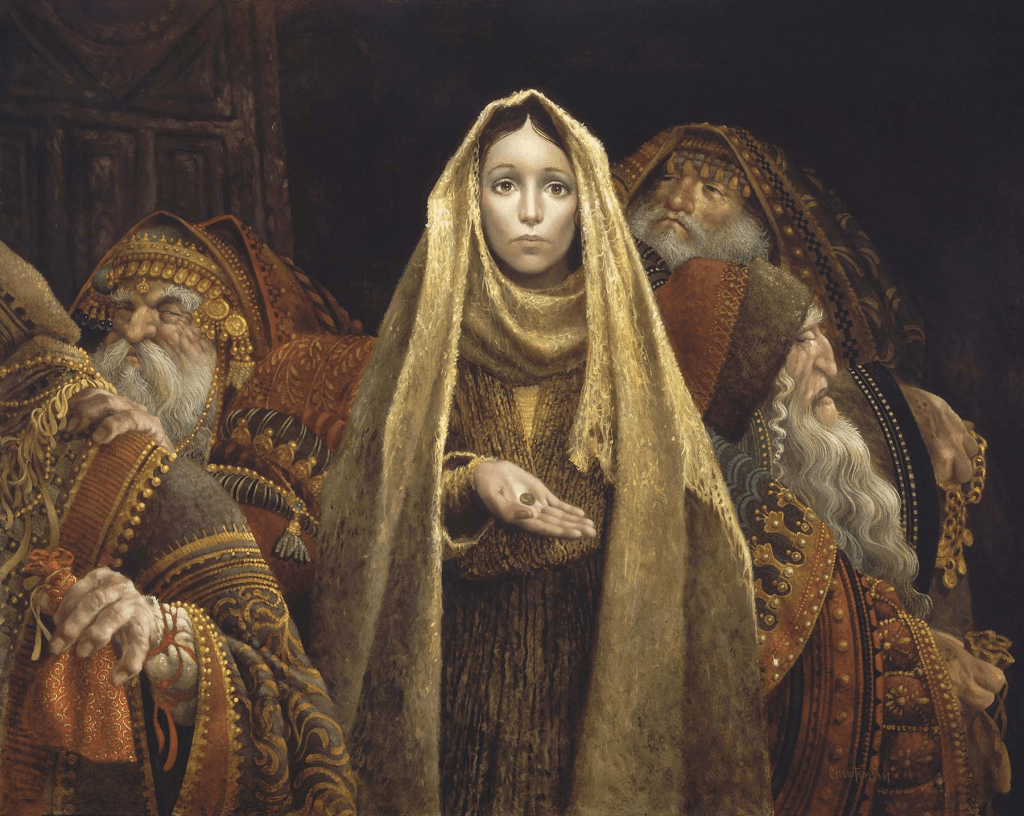
The Widow’s Mite by James Christensen

Jesus sat down opposite the place where the offerings were put and watched the crowd putting their money into the temple treasury. Many rich people threw in large amounts. But a poor widow came and put in two very small copper coins, worth only a few cents.

Calling his disciples to him, Jesus said, “Truly I tell you; this poor widow has put more into the treasury than all the others. They all gave out of their wealth; but she, out of her poverty, put in everything—all she had to live on.” (New International Version)

Money. Can’t live without it; can’t live with it. *Sigh*

If there’s a litmus test of one’s true benevolence and spirituality, it’s how money is handled and/or mishandled. And it isn’t as cut-and-dried as giving large sums of it away.

In today’s short Gospel lesson, the offerings of rich people were unimpressive to Jesus. To him, their big donations are insignificant.

On the other hand, a poor widow’s measly offering is validated as a rich contribution. In giving everything, Jesus holds up the widow as an example for us to follow.

This raises a natural and interesting question: Does this mean everyone should give everything they have? Maybe. Maybe not. Yet perhaps the very question betrays how we tend to think about money – that it’s ours, we earned it, and we can do whatever we want with it.

But the fact of the matter is that we really own nothing. We are merely stewards, entrusted with using that which has been graciously given to us by God. The Lord is the owner of it all. It was never really ours to begin with.

Taken from this perspective, anything we hold onto and refuse to let go, no matter how large or small, is a form of theft. We have taken something that doesn’t belong to us. We aren’t satisfied with being stewards; we want to be owners and masters.

What you do with your money shows your allegiance to the true Owner of it. If it belongs to Caesar, well then, go ahead and give it to him. And if it belongs to God, then there isn’t an issue in distributing money in ways which benefit humanity and uplift the poor.

The widow knew that her money, what little of it she had, belonged to God. She seemed to understand that God’s values are very different from earthly values. The kingdom of heaven expects us to hold all things, money included, with open hands. Whereas the kingdoms of this world fully expect that people will hold their money with tight fists – which is why we have so many layers of cybersecurity around our assets.

Money is a means to an end and not the end itself. It is the means to ensure the welfare of the common good of all persons. It’s a tool to shape a better society, built not on the backs of the poor, but for the benefit of the needy so that everyone can participate fully in the community.

To build a petty kingdom and become master of a small world is nothing more than stealing from God and withholding resources where they are needed.

And to make things more complicated and challenging, in today’s world, time is money. It’s easy to write a check, transfer some funds, or allocate some resources for others. However, it is never easy to grace people with the gift of time. Relational connection takes time and effort – the kind of time many people believe they do not have. Yet, time also belongs to God, and it is to be stewarded with care, just like our money.

The Poor Widow’s Offering by Unknown artist

Let’s come back to the poor widow. After all, she is our example of true generosity.

In ancient Israel, those in poverty were not required to give. So, whenever the poor did so, they simply gave because they believed in the need to maintain all it took for the worship of God to happen. The widow was under no compulsion to give anything, let alone everything she had. She seemed to understand what the Apostle Paul discovered later:

The person who sows sparingly will also reap sparingly, and the person who sows generously will also reap generously. Each one of you should give just as he has decided in his heart, not reluctantly or under compulsion, because God loves a cheerful giver. And God is able to make all grace overflow to you so that because you have enough of everything in every way at all times, you will overflow in every good work. (2 Corinthians 9:6-8, NET)

A spirit of generosity is to be ubiquitous throughout Christianity. It is a spirit that doesn’t let the left hand know what the right hand is giving (Matthew 6:3). A generous spirit rightly discerns that where your treasure is, there your heart will be also (Matthew 6:21).

And the guide of altruistic giving is savvy to the reality that the accumulation of money often leads to the love of money. So, the generous person keeps temptation at bay by withholding love toward things so that love can be lavishly given to people. For some people, eager for money, have wandered from the faith and pierced themselves with many griefs. (1 Timothy 6:10)

Like the poor widow, we are to put our hope in God, who richly provides everything for our enjoyment.

Eternal God, we pray that stewardship will be our way of life. We acknowledge You as the source of all we have and all we are.

Loving Creator, help us to place You first in our lives by being prayerful, loving, and caring for our families neighbors in need, and by becoming less preoccupied with material things.

Sovereign Lord, help us to hear your call to be good stewards, caretakers, and managers of all your gifts by sharing them for your purposes. May Your priorities be our priorities. May we have an active and generous faith.

Blessed God, help us to serve the Church, our communities, and our world with Your good and gracious gifts; and with joyful and grateful heart, through Jesus Christ our Lord. Amen.